Editor's note: Against the backdrop of persistently rising U.S. Treasury yields and markets重新pricing in more rate hikes, the discussion around interest rates is shifting from "will the Fed keep hiking" to "what exactly will be crushed first by high rates." As the 10-year Treasury yield has climbed above 5% and the short end of the market has rapidly switched from previous rate-cut expectations to pricing in multiple hikes, a more critical question is emerging: if the economy, stock market, and AI capital expenditure still show no clear signs of cooling, how high do rates actually need to go before they truly change capital behavior?
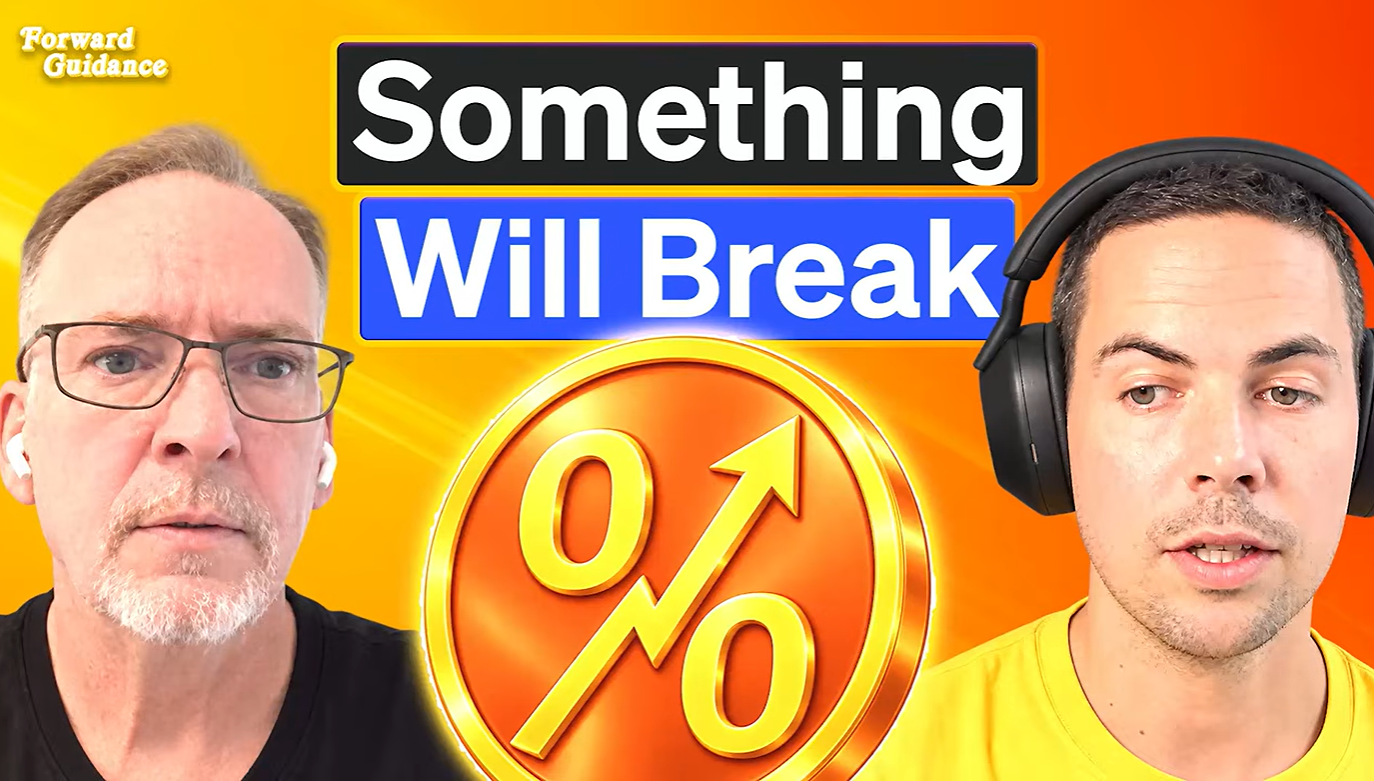
Forward Guidance invited DCP, a trader with roughly 40 years of experience in rates and fixed income trading, on its latest Weekly Roundup to discuss the increasingly complex relationship among this round of Treasury selling, AI capital expenditure, energy inflation, and the credit market. Rather than predicting whether the 10-year yield will ultimately stop at 5.5% or 6%, the real focus of the conversation is: what variable can reverse the current self-reinforcing high-rate trade.
In this conversation, DCP essentially broke down "when will the bond market bottom" into a set of more fundamental structural questions: can high rates truly suppress demand, will AI capital expenditure weaken the effects of monetary tightening, are supply shocks beyond what the Fed can handle, and which balance sheet in the financial system will be the first unable to withstand increasingly higher funding costs.
First, this round of rate increases is no longer merely a repricing of the Fed's policy path, but a search for a level of interest rates high enough to constrain capital expenditure. In recent years, the market has grown accustomed to understanding rate hikes as the prelude to slower demand, a cooling economy, and subsequent rate cuts. But now, large technology companies are still continuously investing in data centers, computing power, electricity, and other AI infrastructure. While high rates are trying to suppress demand, there is enormous capital expenditure on the other side. DCP therefore believes that as long as AI investment does not slow markedly, it will be difficult for rates to find a stable downward logic. This means what the bond market really needs to watch is no longer a single FOMC meeting, but whether financing costs can rise high enough to make marginal AI projects uneconomical.
Second, this round of inflation does not entirely stem from overheating demand in the traditional sense. Energy, diesel, transportation, and agricultural costs are still affected by supply-side factors, and monetary policy has inherently limited capacity to deal with such shocks. In the past, the Fed could cool aggregate demand by raising rates to suppress real estate, consumption, and corporate financing; but if price pressures come from energy supply, rate hikes can at most reduce second-round pass-through, while being unable to directly increase supply. DCP therefore raised an important distinction: what the market should truly worry about is not only the problems the Fed can solve through policy, but those that cannot be solved quickly even with continued rate hikes.
Third, the pressure of high interest rates is being transmitted in a highly uneven manner. For more than a decade, low interest rates benefited large corporations, small businesses, commercial real estate, and private credit almost simultaneously; now, that environment is reversing. Cash-rich large tech companies can still continue to invest, while small businesses that rely on loans, refinancing, and credit expansion are facing a completely different cost of capital. DCP therefore pays particular attention to small business bankruptcies, commercial real estate, regional banks, and private credit, because these areas may expose the real constraints of high interest rates earlier than large tech stocks. In other words, whether the market index continues to rise is no longer sufficient to judge whether financial conditions are truly easing.
Fourth, the real buying point for bonds may not come from a nice round yield number, but from some kind of "rupture." For more than a decade, investors have grown accustomed to a relatively stable policy reaction function: when financial stress in the market becomes large enough, the Federal Reserve will eventually stop tightening, or even shift back to easing. But the current problem is that this policy reversal can only re-enter pricing when AI capital expenditure slows, stress appears in credit markets, energy prices fall back, or the real economy clearly deteriorates. DCP's core judgment is therefore not that "6% U.S. Treasuries are definitely a buy," but that only when high interest rates begin to truly change economic behavior can rates themselves possibly peak.
If this conversation is compressed into one judgment, it is this: the endpoint of this bond market cycle does not depend on whether the 10-year U.S. Treasury yield rises to 5.5%, 6%, or higher, but on where high interest rates ultimately create a strong enough constraint.
In this sense, the subject discussed in this article is no longer just U.S. Treasuries, but a larger question: when AI capital expenditure, energy supply shocks, and fiscal financing simultaneously drive up demand for funds, how much longer can the asset pricing framework built over the past forty years on the premise that "interest rates will eventually fall" actually last?
The original text is as follows (for ease of reading and comprehension, the original content has been partially edited):
TL;DR
· The key to a bond market bottom is not whether "yields are high enough," but whether high interest rates have already truly suppressed capital expenditure, credit expansion, and real demand.
· AI is turning from "capital expenditure that supports growth" into "a variable that prolongs the high interest rate cycle." In essence, massive investment demand is weakening the traditional effect of monetary tightening in suppressing aggregate demand.
· This round of inflation is harder to deal with not because demand itself is overheating, but because energy and supply shocks cannot be directly solved by raising rates. Monetary policy can only restrain transmission, not repair supply.
· The real pressure of high interest rates is not evenly reflected at the index level. In essence, cash-rich large tech companies can still expand, while small businesses, commercial real estate, private credit, and regional banks are the first to bear rising financing costs.
· The real reversal signal for US Treasuries is more likely to come from a "problem first emerging" in some credit or capital expenditure link, rather than the 10-year yield hitting round-number thresholds like 5.5% or 6%.
· The market's rapid shift from "trading rate cuts" to "trading more rate hikes" essentially shows that the pricing framework has shifted from policy easing back to searching for the upper limit of interest rates the economy can withstand.
· The most important validation variables going forward are not a single FOMC meeting, but whether AI capital expenditure, energy prices, credit stress, and employment simultaneously show changes significant enough to alter the Fed's reaction function.
Video Highlights
The US 10-year Treasury yield has already reached above 5%, but in DCP's view, the bond market's "pain trade" may not be over yet.
Around the time this episode was recorded, the 10-year Treasury yield briefly touched about 5.23%, hitting a nearly 19-year high; the 30-year yield broke above 5.5%. At the same time, market expectations for further Fed rate hikes clearly intensified. Reuters reported at the time that the rates market had at one point priced in as much as about 90 basis points of additional tightening.
This is no longer an ordinary yield fluctuation.
Over the past two months, the long end of US Treasuries has experienced a rapid selloff, while the market had previously still been trading on rate-cut expectations. DCP described on the program that the short-end rates market has shifted rapidly from "pricing in rate cuts" to pricing in multiple rate hikes.
The question therefore becomes: how much further do bonds need to fall before the market is truly willing to step in? DCP's answer is that there is not yet enough reason to rush in and buy the dip.
A 5.2% 10-year yield may not be enough to mark a bond market bottom
DCP laid out a very clear "bond market turning bullish checklist."
In his view, at least one or more of the following variables needs to show a substantive change: the Fed signaling that the rate-hike cycle is nearing its end; AI capital expenditure clearly decelerating; refining margins, diesel, and energy price pressures easing; a substantive correction in the stock market; a clear deterioration in the job market, or another shock significant enough to force a repricing of the policy path.
Before these conditions appear, he still leans toward the view that continued upward pressure on yields is the market's pain trade.
The most important point here is not any specific yield target DCP gives, but his judgment on the nature of this round of rate increases. Normally, when rates rise high enough, financing costs rise, demand falls, the economy eventually cools, and the Fed no longer needs to keep tightening.
But the biggest variable in this cycle is AI. Large tech companies are still making massive infrastructure investments. Data centers, power, chips, and related construction are not only supporting corporate investment but also, to some extent, propping up U.S. economic activity.
This means that while high interest rates are trying to suppress demand, AI investment is continuing to create capital demand on the other end.
DCP even suggested that in this environment, the market may need higher real interest rates than previously imagined to truly create sufficiently strong restraint. This is his market judgment, not a validated equilibrium level. On the program, he envisioned that the 30-year U.S. Treasury yield may need to rise above 6%, with short-term policy rates climbing further, before it would be enough to truly change current capital allocation behavior.
The problem lies precisely here: by the time interest rates are high enough to suppress AI investment, they may have already damaged the more fragile parts of the economy first.
The Fed can suppress demand, but it cannot solve all inflation
This is also why DCP believes the current policy environment is particularly tricky.
On September 16, the Federal Reserve raised the federal funds target rate by 25 basis points to 3.75%–4.00%, the first rate hike in three years, and the FOMC approved the decision by a 12-0 vote.
But this round of inflationary pressure does not come entirely from overheating demand in the traditional sense. Energy prices are still affected by geopolitical and supply-side disruptions. By the end of September, the ongoing Middle East conflict was still pushing up energy costs and became one of the important backdrops for the renewed rise in global bond yields.
This creates a policy dilemma: rate hikes can suppress consumption, housing, and corporate financing demand, but they cannot produce more oil, nor can they directly remove an energy supply shock.
DCP summed this up into a question more worthy of attention: what should really be worried about is not the problems the Fed can solve, but the problems the Fed cannot solve. For example, if inflation comes from overly strong household demand, the Fed can reduce consumption and credit by raising interest rates. But if inflation mainly comes from an energy supply shock, the role of rate hikes is more to prevent energy costs from continuing to pass through to other goods and services, rather than to solve the shock itself.
This means that if oil prices and diesel prices remain high, the Fed may face an undesirable combination: more and more sectors of the economy are already feeling the weight of high interest rates, yet inflation is still not low enough for the central bank to feel at ease.
AI is both supporting the economy and may become the real turning point for the bond market
The most noteworthy judgment on the program is that DCP placed AI simultaneously in two positions in this economic expansion: a "supporting force" and a potential "breaking point."
Currently, the capital expenditures of large tech companies are creating enormous financing and investment demand.
This is causing the U.S. economy to show increasingly obvious divergence: investment related to AI, data centers, and large tech companies remains robust, while pressure is steadily building in housing, small businesses, and other sectors that are highly dependent on financing costs.
As of the end of September, even as long-term U.S. Treasury yields had risen to multi-year highs, global equity markets as a whole still showed considerable resilience, with enthusiasm for AI-related investment being one important supporting factor.
It is precisely for this reason that DCP believes that if one is looking for the variable that could truly reverse the direction of interest rates, AI may instead be the most critical link.
The logic is not complicated.
AI infrastructure investment requires large amounts of capital. If bond yields and corporate financing costs continue to rise, the internal rate of return threshold for new projects will also rise accordingly. When companies could originally build data centers with a cost of capital of 6% or 7%, versus having to pay 9% or even 10% in financing costs, the investment decision is already completely different.
In other words, the rates market may ultimately not "defeat AI" directly, but rather by continuously raising the capital cost of AI expansion, causing marginal projects to gradually lose their economic viability.
DCP therefore specifically mentions private credit and corporate credit markets. If a large AI-related company, private credit fund, or highly leveraged project is the first to encounter financing problems, this could become the trigger for the market to reassess the entire AI capital expenditure cycle.
This is still only his risk scenario, not a fact that has already occurred. But from the perspective of market mechanisms, this judgment is worth watching: over the past few years, U.S. government debt issuance has continued to increase the supply in fixed-income markets; if AI companies simultaneously enter bond and private credit markets to raise funds on a large scale, the public sector and private sector may begin competing for the same pool of capital.
The price of funds then rises further. This is a potential self-reinforcing mechanism: the greater the financing demand → the higher the yields → the higher the cost of capital → the weakest projects are the most likely to run into problems first. If this chain eventually breaks, it could instead become a true buying window for the bond market.
Those truly bearing the burden of high rates may not be the large tech companies first
Another issue in this market that is easily obscured by the indices is the high degree of divergence between the economy and stock performance.
On the program, DCP listed a series of companies that have already pulled back sharply from historical highs, including Nike, PayPal, Disney, Pfizer, Home Depot, and Lululemon.
His point was not to recommend these stocks, but to illustrate a phenomenon: an index still at highs does not mean the entire market is in a bull market.
The growing weight of large tech and AI companies in the index means that gains in a handful of companies can mask the weakness of a large number of ordinary companies.
Several guests on the program therefore raised an interesting question: if you take out the Mag 7 and the most prominent AI beneficiaries, where exactly is the "real market"?
DCP believes this divergence is similar to the "K-shaped structure" in the real economy.
Large, well-capitalized tech companies can withstand higher financing costs, or may not even need to rely on external financing at all; but small businesses, commercial real estate, and companies that need to constantly roll over debt face a completely different interest rate environment.
Using U.S. small business financing as an example, he pointed out that the financing costs of some loan products have already reached double digits. In this environment, what really needs to be watched may not be whether Apple or Microsoft can continue to invest, but when smaller companies with weaker cash flows and continuous refinancing needs begin to see more restructurings and bankruptcies.
This is also why he specifically recommends watching small business bankruptcies, private credit, commercial real estate, and regional banks. If long-term yields continue to rise, these areas are more likely to be where the pressure from high interest rates first emerges.
Will a 6% U.S. Treasury yield become the real "breaking point"?
The market is now paying increasing attention to one number: 6%. DCP believes the U.S. economy will not immediately fall into crisis just because the 10-year yield briefly breaks above 6%.
What really matters is the speed at which that level is reached, and whether the market can rediscover equilibrium in a high-yield environment. If yields rise slowly, investors may gradually accept the new prices. Pension funds, insurance capital, endowments, and individual investors will eventually all face an increasingly realistic question: when risk-free assets can provide sufficiently high returns, why take on so much equity and credit risk?
DCP himself also mentioned that once long-term Treasury yields become attractive enough, asset allocation funds will naturally begin to flow in. The question is only: when will yields be high enough to attract buyers, and when will they be high enough to first crush the economy?
Between those two points is the equilibrium the entire bond market is currently searching for. And recent price action shows that this equilibrium has not yet been found. On September 29, the U.S. 10-year Treasury yield briefly rose further to 5.293%, while the 30-year reached 5.6206%, respectively at highs since 2007 and 2002.
In other words, even though the 5.22% 10-year yield at the time of the Forward Guidance recording already seemed extreme, the market continued to push toward higher yields just days later.
What Does It Take for the Bond Market to Truly Bottom?
If the one-hour DCP discussion is compressed into a framework, what truly needs to be watched next is not whether "5.2% is high enough," but four sets of variables.
First, whether Fed rate hike expectations have truly peaked. After the September hike, policymakers still have not uniformly signaled that "tightening is over." New York Fed President Williams later said there was no need to rush another hike, but still considered one more increase this year reasonable. If future inflation data cools and the rates market begins to persistently reduce hike pricing, that will be the first important condition for a change in bond direction.
Second, whether energy pressure eases. If crude oil, diesel, and related costs continue to decline, the supply shock's push on inflation weakens, and the need for the Fed to keep tightening also diminishes.
Third, whether AI capital expenditure begins to decelerate. As long as large tech companies remain willing to invest at extremely rapid pace in data centers, power, and computing capacity, it will be hard for high rates to quickly suppress overall investment demand. Conversely, if financing costs for AI projects begin to noticeably affect investment decisions, or if credit markets show problems first, the bond market's logic could change rapidly.
Fourth, whether the financial system shows real stress points. Private credit, commercial real estate, regional banks, small business bankruptcies, and credit spreads may all reflect the real damage of high rates earlier than stock indices. This is also the core reason DCP is still unwilling to bottom-fish bonds too early. The market has quickly moved from "when will rates be cut" to "how many more hikes are coming," but what can truly reverse the trading direction is not some round number on the yield chart. It is when some real-world constraint finally begins to take effect.
In other words, the true end of this bond selloff may not be whether the 10-year Treasury hits 5.5% or 6%, but rather when high rates finally force AI investment, credit expansion, energy inflation, or some part of the real economy to retreat first.
Until then, how high yields actually go is still just the result. What is truly worth watching is what "breaks" first.
Welcome to join the official BlockBeats community:
Telegram Subscription Group: https://t.me/theblockbeats
Telegram Discussion Group: https://t.me/BlockBeats_App
Official Twitter Account: https://twitter.com/BlockBeatsAsia
