On October 6, the OKX NOW Global Product and Ecosystem Conference was held in Singapore. Star, Founder and CEO of OKX, delivered an opening speech, sharing OKX's development direction from a cryptocurrency exchange to a global fintech platform around the integration of the internet, crypto technology, and AI, and outlining a long-term vision for the next generation of users, covering fund custody, payments, investment, and wealth management.
The following is the full text of the speech (organized by ChatGPT):
We live in a real-time world, but financial infrastructure is still catching up
Good morning, everyone, and welcome to Singapore.
Today, I would like to use OKX NOW to talk with you about where we are today and a more important question: where do we believe financial services are heading?
Thirteen years ago, OKX started as a cryptocurrency exchange. But today, our vision goes far beyond that.
The internet has changed the way information flows, crypto technology is changing the way value flows, and AI is enabling intelligence to be applied at scale. We believe these three technologies are converging to jointly reshape financial services for the next generation.
Look at the lives around us. Today, we can send a message to someone on the other side of the world in one second; open Uber, and a car can arrive in minutes; through TikTok or YouTube, watch a live stream from another country in real time.
Almost all major consumer technology services have achieved global connectivity, instant response, and round-the-clock operation. However, a large part of today's financial system is still built on infrastructure and ideas from decades ago.
We live in a digital world that runs in real time, while financial infrastructure is still catching up. This gap imposes real costs on ordinary people.
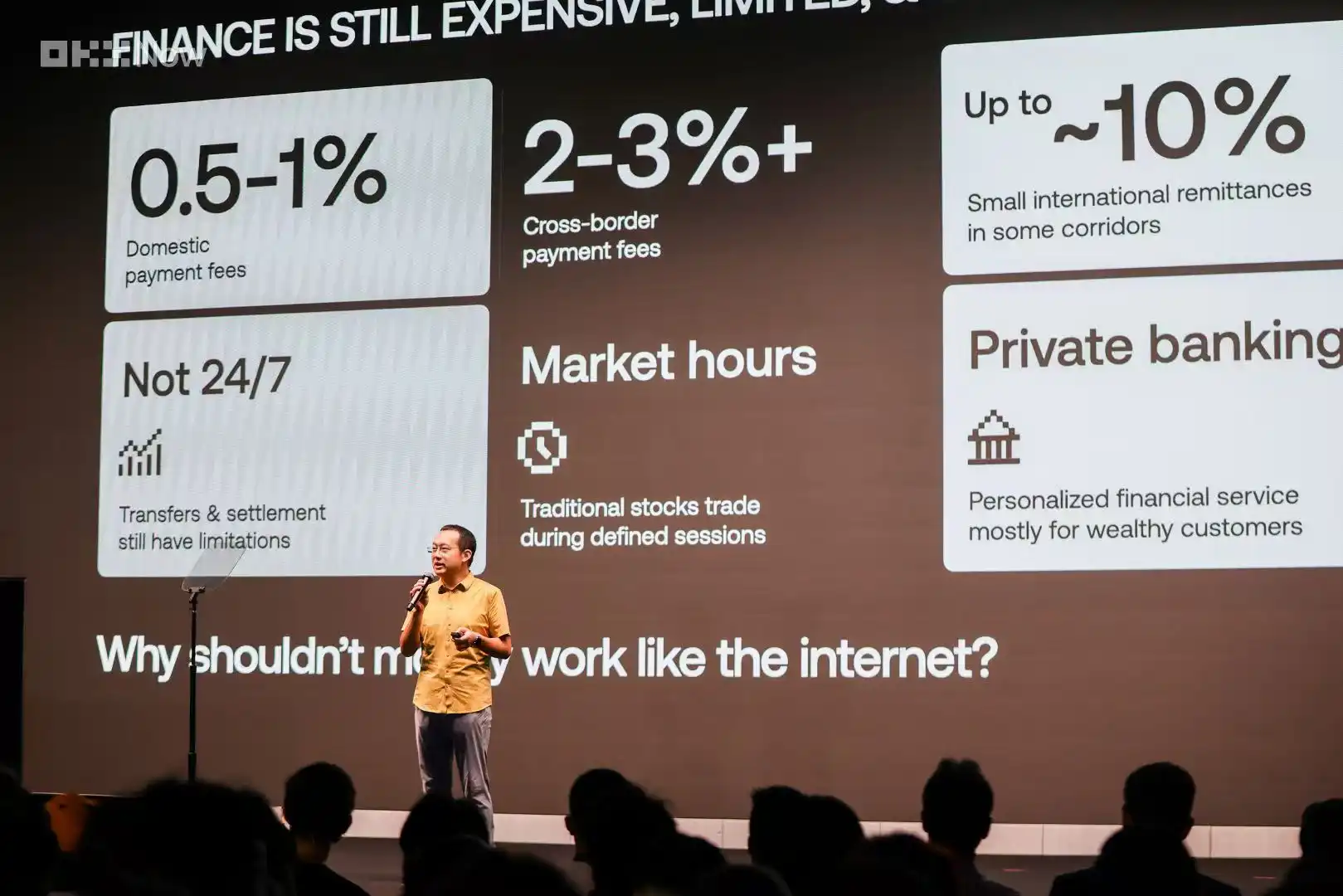
Domestic payments may still charge fees of 0.5% or 1%, and cross-border payment fees are often as high as several percentage points. And those most affected may be precisely the people least able to afford these costs.
Think about those workers overseas. They are far from home, working hard, sending a few hundred dollars home each month to support their parents, spouses, and children. For some small cross-border remittances, the total cost may be close to 10%. As members of the financial industry, facing such remittance costs, we should feel ashamed.
Meanwhile, traditional finance is still constrained by business hours. Many transfers cannot be processed normally at night or on weekends, and traditional stocks can only be traded during specific periods. Most people keep their money in ordinary bank accounts and earn very little returns; personalized private banking services are mainly aimed at wealthy individuals.
Technology has made communication and information within easy reach, but financial services have not yet achieved the same degree of accessibility.
From Industry Exploration to Mainstream Finance
The crypto industry is one of the most important social experiments of our generation.
From about 2008 to 2013, the industry was mainly driven by a group of geeks, cryptographers, and engineers. They tried to answer a very bold question: Can money exist natively on the internet?
From 2013 to 2017, the financial industry began to pay serious attention to crypto assets. With the development of exchanges and improved liquidity, crypto assets gradually formed a real financial market.
From about 2018 to 2022, the industry entered the exploration stage of ICOs and DeFi. Around smart contracts, stablecoins, and decentralized finance, a large number of attempts continued to emerge. Of course, this process was also accompanied by bubbles, failures, and bad actors.
Then, from about 2022 to 2024, the industry entered another important stage: building compliance capabilities. Licenses, governance, consumer protection, risk management, and institutional-grade infrastructure became key to the industry's development.
Starting in 2025, we are entering the mainstreaming stage. Crypto technology is increasingly integrating into the global financial system.
OKX has been involved almost since the early days of the industry, and it has now been 13 years. Today, on site, I saw many old friends and also met many new friends.
What we initially did was very simple: a crypto asset spot exchange. I think many people still remember the first version and first product we launched in 2013.
Since then, we have expanded into derivatives, built one of the industry's largest Web3 wallets, entered the payments sector, and gradually helped users connect to a broader range of markets. Within the scope permitted by regulation, these markets cover crypto assets, tokenized stocks, stock perpetual contracts, commodity perpetual contracts, and other financial products.
Therefore, simply defining OKX today as a cryptocurrency exchange is no longer enough to describe what we are doing.
The exchange is our starting point, but not our destination. We are evolving into a broader global fintech platform.
Building fintech services for the next generation
This leads to our long-term vision: building fintech services for the younger generation.
I often say that we cannot take it for granted that your children and mine will walk into a JPMorgan or HSBC branch in the future to open an account.
I think about the future of financial services mainly from four aspects.
First, how to hold funds.
Users should be able to choose how their funds are custodied: they can be placed in a regulated exchange account or in their own self-custodial wallet. In the future, some services may also take the form of a next-generation digital bank.
Second, payments.
Transferring money to a friend or paying a merchant should be as simple as sending a message, able to be completed instantly across regions, and at low cost.
Third, investing.
Why should investing in different asset classes require using many different apps? Crypto assets, stocks, commodities, and other markets will increasingly be integrated into a unified digital experience.
Fourth, wealth management. This is also an area where AI can play an important role.
In the past, private banking services were very costly. Banks could usually only afford to provide dedicated relationship managers and investment professionals to high-net-worth clients.
AI is changing this cost structure. In the future, every ordinary person may be able to have their own private banking advisor—an AI agent that can understand their asset situation, cash flow, risk preferences, and financial goals.
So, our vision is simple: to enable users to hold funds, make payments conveniently, invest, and grow their wealth.
Global financial services require trust and long-term building
But to build global financial services, technology alone is not enough.
Trust, regulation, governance, and the ability to take responsibility locally are all crucial.
Over the past few years, OKX has continued to invest in building regulatory-compliant infrastructure globally. Currently, we have obtained licenses or are subject to regulation in major markets such as the United States, Europe, the UAE, Singapore, Australia, Brazil, and Turkey, as well as in many other countries and regions.
We are also one of the earlier major global cryptocurrency exchanges to make proof of reserves a normalized transparency mechanism. I believe it has now become an industry standard.
In addition, we may also be one of the few international exchanges currently engaging a Big Four accounting firm as our global auditor. Deloitte has become OKX's global auditor.
Our goal is to combine crypto-native technology with the standards people expect from global financial institutions.
Crypto Finance and Traditional Finance Are Converging
At the same time, an important change is taking place around us.
For many years, when people talked about crypto finance and traditional finance, they always treated them as two opposing worlds. Now, this situation is changing rapidly.
Major global financial institutions are making equity investments in OKX. These institutions come from fields such as exchanges, banking, stablecoins, payments, and quantitative finance, including ICE and the New York Stock Exchange, Standard Chartered, Ripple, Circle, and others.
In my view, the significance of this goes far beyond capital itself. It shows that the boundary between crypto finance and traditional finance is gradually disappearing.
In the future, crypto finance and traditional finance will move toward integration. Every crypto company will expand into traditional finance, and every traditional financial company will invest in the crypto sector.
Crypto technology brings 24/7 infrastructure, programmable money, global settlement, and self-custody; traditional finance brings massive liquidity, regulatory experience, financial infrastructure, and institutional trust.
These two worlds are converging into a single financial system.
AI Has Become OKX's Core Infrastructure
Another transformation taking place inside OKX is AI. Perhaps I should call it SI, meaning superintelligence. Of course, we are not the U.S. government and do not have to follow their guidance.
I believe crypto technology has changed the field of money, while AI will change how the entire financial institution operates.
For OKX, AI has already become core infrastructure and is deeply integrated into daily business.
We have built our own internal AI platform. Currently, about 95% of engineering code merge requests, or PRs, have their main development work completed through AI workflows.
Engineers are still responsible for reviewing, testing, and approving the final output, but the actual development process has fundamentally changed.
The changes in customer service will be even more significant.
Today, when people mention "AI customer service," many still think of clumsy chatbots that cannot understand questions. The AI customer service of the future will be completely different.
It will be able to instantly understand a user's account, transactions, the problems they encounter, and relevant policies, providing responses around the clock. On many types of issues, it may ultimately perform better than human customer service.
AI can also be used for anti-fraud and user protection. In the past, we had to wait for humans to identify suspicious activity; AI can continuously analyze millions of signals, detect problems faster, and intervene.
I believe compliance is also one of the areas with the greatest potential for AI.
Global financial institutions operate in multiple countries, need to face different regulatory requirements, and rely on large numbers of people to carry out compliance work. In this process, different people may interpret the same policy differently.
AI can structure this information and, while maintaining a globally unified compliance baseline, combine it with local regulatory requirements to help compliance teams execute their work more consistently.
At present, our AI applications have already reached a considerable scale.
I have always encouraged the OKX team to use AI, but later discovered that last month our AI bill paid to large model companies reached 10 million USD. So we began pushing everyone to use AI more reasonably.
This shows that, for us, AI is already part of large-scale internal company operations, not just a concept in a presentation deck.
A globalized, real-time, AI-driven financial future
Looking ahead to the next decade, I see the internet, crypto technology, and AI converging.
The internet allows information to flow instantly around the world; crypto technology allows value to cross regions and be programmable; AI allows intelligence to be applied at scale and provides personalized services.
When these three technologies combine, financial services may undergo fundamental changes.
Funds can flow globally around the clock, more people can conveniently participate in markets, payment costs can be further reduced, and financial products can better fit individual needs. Services that in the past were mainly aimed at wealthy people have the opportunity to benefit every ordinary person.
13 years ago, OKX started as a cryptocurrency exchange. Today, we want to do more.
We want to build a global, real-time, AI-driven fintech platform for the next generation, enabling users to hold funds, make convenient payments, invest, and grow their wealth in a smarter way.
Welcome to join the official BlockBeats community:
Telegram Subscription Group: https://t.me/theblockbeats
Telegram Discussion Group: https://t.me/BlockBeats_App
Official Twitter Account: https://twitter.com/BlockBeatsAsia
