Editor's Note: In September, the U.S. bond market experienced a sharp selloff. The 10-year Treasury yield rose from 4.75% to 5.29%, climbing 54 basis points in a single month, with some fixed-income assets falling between 2.3% and 5%. But if you break down the yield change, a fact that is easily overlooked emerges: over the same period, the 10-year real rate rose by about 49 basis points, while market-implied inflation compensation rose by only about 5 basis points. In other words, this bond selloff was not primarily explained by rising inflation expectations — what truly changed dramatically was the real interest rate.
This raises a more complex question: why is the market willing to demand a higher real return? Typically, a rising real rate may be associated with stronger economic growth expectations, adjustments to the future monetary policy path, or higher compensation for the risk of holding long-term debt. What is more anomalous is that while Treasuries sold off sharply, AI-related tech stocks remained strong, with the semiconductor sector leading gains, while most other stocks came under clear pressure.
In his latest monthly investment letter, QuantStreet Capital founder Harry Mamaysky offers one explanation: the market may be repricing for stronger future economic growth and the capital demands generated by large tech companies' continued expansion of AI infrastructure. Under this framework, higher rates and strong AI stocks are not necessarily contradictory, because investors may believe that future earnings growth will be sufficient to offset the impact of rising financing costs and discount rates.
But this remains a market explanation yet to be validated. A rising real rate does not equal a certain improvement in growth prospects, and changes in the term premium also mean investors may be demanding higher risk compensation. For both stock and bond markets, the key is to distinguish: does this round of rate increases reflect higher future economic returns, or does it mean that holding long-term assets has become more expensive and more dangerous?
The following is the compiled original text:
In September 2026, U.S. financial markets exhibited a rather anomalous set of moves: Treasuries suffered a sharp selloff, while tech stocks, especially the semiconductor sector, continued to rise.
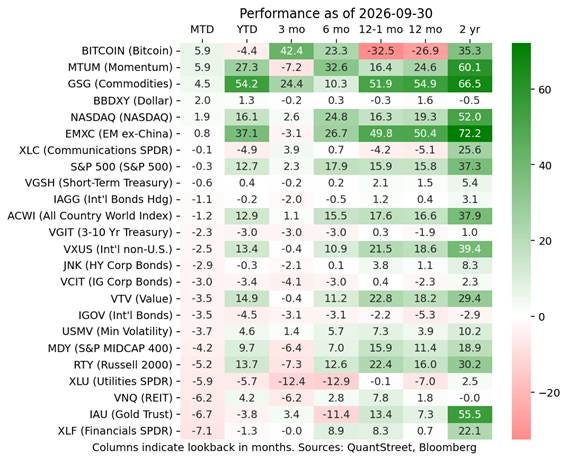
According to U.S. Treasury data, the 10-year U.S. Treasury yield rose from 4.75% at the end of August to 5.29% at the end of September, up 54 basis points in one month. QuantStreet Capital statistics show that some U.S. fixed-income assets fell by 2.3% to 5% during the month.
But the stock market did not experience a synchronized, broad-based decline. Bitcoin and momentum strategies with significant holdings in semiconductor and technology companies stood out, and the Nasdaq index kept rising. At the same time, U.S. small- and mid-cap stocks, the equal-weighted S&P 500 index, and rate-sensitive sectors such as real estate investment trusts, utilities, and financials were sold off.
Typically, a sharp rise in long-term interest rates raises corporate financing costs and lowers the discounted value of future profits, which is especially unfavorable for highly valued stocks. But the divergence in the market this time suggests that investors may be pricing the future returns of different assets very differently.
Harry Mamaysky, founder of QuantStreet, believes that to understand this market move, one must first answer a question: what exactly is the bond market trading?
1. U.S. Treasury yields surged in September, and what truly rose was the real interest rate
From the perspective of the yield structure, an important feature of the September Treasury selloff was that nominal rates rose mainly in line with higher real rates, rather than a simultaneous sharp increase in inflation compensation.
To understand this, one must first distinguish three concepts.
Nominal Yield is the Treasury yield investors usually see, which includes both compensation for future inflation and the required real return as well as other risk factors.
Real Yield can be understood as the yield after deducting inflation compensation. In the U.S. Treasury market, the yield on Treasury Inflation-Protected Securities (TIPS) is usually used to observe the market's pricing of real returns.
The difference between the two is the Breakeven Inflation Rate, often used as a reference indicator for the market's long-term inflation expectations. However, it also includes factors such as inflation risk and liquidity, and is not equivalent to a pure inflation forecast.
The changes in U.S. Treasury yields in September can be further broken down. The 10-year U.S. Treasury nominal yield rose from 4.75% on August 31 to 5.29% on September 30, up 54 basis points. Among this, the real yield rose from 2.44% to 2.93%, up 49 basis points; implied inflation compensation rose only from 2.31% to 2.36%, up 5 basis points.
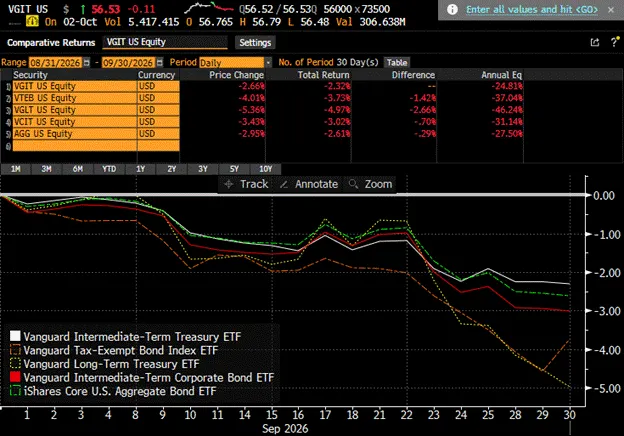
This means that of the rise in 10-year US Treasury yields in September, more than 90% corresponded to an increase in real rates, rather than an increase in inflation compensation. At least from the decomposition of this market indicator, the main change in the September bond selloff was not in inflation compensation, but in real rates.
This is especially important because rising real rates and rising inflation compensation often correspond to different economic explanations.
If the rise in yields mainly comes from inflation compensation, it may mean investors are worried about future price increases and a decline in the purchasing power of money, and therefore demand higher nominal returns. But if the rise mainly comes from real rates, then one must further consider economic growth expectations, the future real policy rate, and the risk compensation investors require for holding long-term bonds.
This does not mean inflation risk has disappeared. The inflation level itself remains elevated, and oil prices, fiscal policy, and the Federal Reserve's rate path will also affect market expectations. But judging from the yield changes in September, using "heightened inflation concerns" alone to explain this round of US Treasury selling is clearly insufficient.
II. It is not simply inflation worry; the market may be repricing economic growth and capital demand
Why did real rates rise notably? Mamaysky discussed several market explanations in his investment letter.
The first is that dollar credibility is being questioned. But the dollar actually appreciated in September, which does not fit the narrative of a broad crisis of confidence in dollar assets.
The second is that investors have begun to worry about the US government's debt-servicing capacity. The author believes that if the market's concerns about US fiscal credit were mainly reflected through future inflation risk, then long-term inflation compensation should have risen more noticeably, while the September data did not show this characteristic.
However, this does not rule out fiscal risk. Increased Treasury supply and higher risk compensation for holding bonds could also push up long-term yields while inflation compensation remains relatively stable.
By contrast, Mamaysky prefers to focus on another explanation: the market may be expecting stronger economic growth while repricing the increasingly massive capital needs of large technology companies.
The key variable here is AI. As investment in artificial intelligence infrastructure continues to expand, major cloud service providers (Hyperscalers) are pouring huge amounts of money into building data centers, purchasing GPUs, expanding computing power, and deploying power and network infrastructure.
These expenditures first and foremost imply a demand for capital.
From a macro perspective, if businesses wish to expand investment simultaneously while the long-term funds available for allocation do not increase in tandem, the price of capital could face upward pressure. At the same time, if investors believe AI will boost future economic productivity and generate more corporate profits, they may also raise their required long-term real rates of return accordingly.
Both forces could be associated with rising real interest rates, but the mechanisms are not entirely the same: the former emphasizes capital demand and financing conditions, while the latter emphasizes expectations for future economic returns.
Recent ING research also points in a similar direction, arguing that AI's impact on bond yields comes not only from tech companies' debt financing but may also be reflected in real interest rates through productivity and long-term economic growth expectations.
However, such judgments remain market analysis rather than confirmed causal relationships. Rising real interest rates alone cannot prove that AI is driving faster U.S. economic growth, nor can it prove that AI financing demand is the dominant factor behind the Treasury selloff.
For Mamaysky, the appeal of this explanation comes primarily from the stock market's reaction.
If the sharp rise in Treasury yields fully reflected deteriorating economic prospects, the stock market would typically come under broader pressure as well. But in September, AI-related stocks such as semiconductors remained strong, suggesting investors remain optimistic about the long-term growth of at least some tech companies.
This leads to a more interesting relationship between the bond and stock markets: higher real interest rates may be being priced in alongside higher future earnings expectations.
III. Why Can AI Stocks Still Rise When Real Interest Rates Are Higher?
From a traditional valuation perspective, rising long-term real interest rates are usually not good news for growth stocks.
Stock prices essentially depend on the discounted value of future cash flows. The higher the rate of return the market demands, the lower the value of a company's future profits when discounted to today. For growth-oriented companies whose profits are concentrated in the future, this effect is typically more pronounced.
But the performance of AI stocks in September suggests the market may be betting on another force.
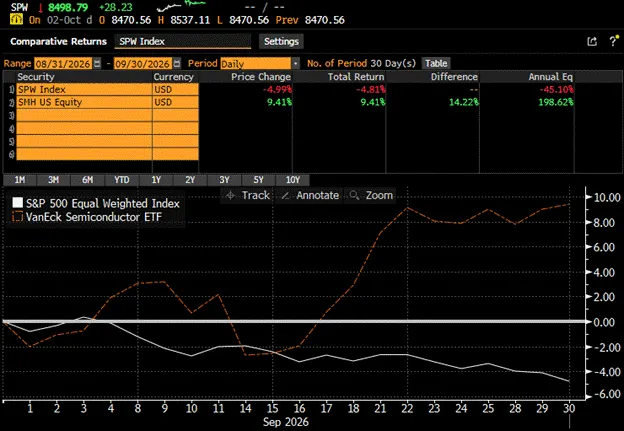
Mamaysky understands this as a "battle between numerator and denominator" in valuation: rising discount rates push up the denominator, pressuring valuations; but expected future profit growth pushes up the numerator, potentially offsetting some or even all of the negative impact. In other words, the market is not necessarily ignoring high interest rates, but may believe that future earnings growth driven by AI will be sufficient to cover higher capital costs.
In September, momentum ETFs with significant holdings in companies such as AMD, Micron, Intel, Cisco, and Applied Materials performed strongly, as semiconductors continued to be a major force driving the market higher.
This trend has some fundamental logic. AI infrastructure buildout first requires chips, servers, and related equipment, so upstream suppliers in the industrial chain can secure orders and revenue earlier.
But this also raises the author's biggest concern. Semiconductor stocks kept rising, while the equal-weighted S&P 500 index performed weakly. This indicates a clear divergence between capital's expectations for the earnings prospects of AI infrastructure suppliers and its expectations for the broader corporate sector.
Mamaysky refers to the vast number of companies outside semiconductors as ROCS (Rest of the Corporate Sector).
In his view, the companies buying AI chips are willing to invest large amounts of capital because they believe they can achieve economic returns in the future through productivity gains. The market is also willing to provide financing in advance for these profits that have yet to materialize.
Therefore, it is not surprising that synchronized growth across all industries is not yet visible at this stage. What is truly puzzling is that the stock market itself is forward-looking. If investors are already convinced that AI will significantly improve the future profitability of other companies, then these expectations should also gradually be reflected in the valuations of the relevant companies.
But the market in September did not show this kind of broad-based rally. Chip suppliers are already making money, while the companies buying chips have not yet broadly seen corresponding profit improvements. This means that the current AI trade has a commercial loop that needs to be validated: the revenue earned by upstream companies must ultimately be supported by economic value continuously created by downstream companies. If AI cannot generate sufficient profits for the broader corporate sector, then continuously increasing chip procurement, data center construction, and financing costs could gradually erode investment returns.
Mamaysky does not believe AI has already formed a bubble. He still believes in the long-term economic value of AI, but thinks the market needs to see more evidence that AI's benefits are spreading from the tech industry to other companies.
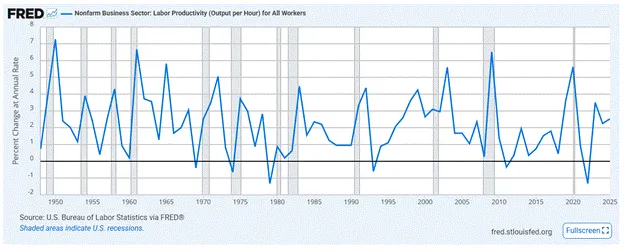
Labor productivity data released by the U.S. Bureau of Labor Statistics has already shown some positive signs, with productivity growth in recent years above the long-term average since 2010. But this improvement cannot be entirely attributed to AI, nor can it directly prove that companies have already obtained new profits sufficient to cover investment costs. From this perspective, the bond market and the stock market are actually waiting for the same answer: can future economic growth deliver the returns currently being priced in ahead of time?
IV. Rising real interest rates are not necessarily a positive; term premium is another risk
Interpreting the rise in U.S. Treasury yields as the market becoming more optimistic about economic growth can indeed explain some asset price performance. But this interpretation still has an important limitation: a rise in real interest rates does not fully equate to improved expectations for future economic growth.
Long-term Treasury yields not only reflect investors' expectations for future short-term interest rates, but also include the term premium — the extra compensation investors demand for bearing risks such as long-term bond price volatility.
The term premium can reflect interest rate uncertainty, fiscal supply, market supply and demand, and other risk factors. Even if inflation compensation has not risen significantly, long-term yields can still rise as long as investors are unwilling to lock up funds for the long term and demand higher risk compensation.
This distinction is especially important in the current market.
A Reuters market analysis on October 7 pointed out that the term premium on the U.S. 10-year Treasury has risen to about a 12-year high. This indicates that the rise in long-term yields may not only include economic growth expectations, but may also reflect investors' reassessment of fiscal policy, monetary policy, and the risks of holding bonds for the long term.
It should be emphasized that real interest rates and the term premium are not two independent indicators that can simply be added together. The TIPS real yield itself may also include a real term premium. Therefore, the roughly 49 basis point rise in real interest rates in September does not mean that all 49 basis points came from strengthened growth expectations.
Two different drivers may have different effects on asset markets. If the rise in real interest rates mainly reflects improved economic growth expectations, then corporate future profits may rise in tandem, and some stocks can withstand higher discount rates.
But if the rise in real interest rates and long-term yields comes more from the term premium, then companies may face persistently higher financing costs without a corresponding improvement in future earnings. In that case, higher interest rates would put more direct pressure on equity valuations, bond prices, and corporate investment.
This is also why the rise in AI stocks alone cannot be taken as proof that this round of U.S. Treasury selling is necessarily a positive signal for economic growth. For QuantStreet, the current market does not yet have enough evidence to support a full shift into any one asset class.
The institution remains relatively overweight value stocks and low-volatility stocks, hoping to retain exposure to the broader corporate sector, while continuing to hold some technology stocks in portfolios with higher risk tolerance.
Bond allocation is also beginning to see subtle adjustments. Mamaysky believes that when the 10-year U.S. Treasury yield reaches approximately 5.25%, the potential attractiveness of bonds has already improved somewhat. As a result, QuantStreet has begun to moderately extend duration in low-risk portfolios, i.e., increasing allocations to bonds that are more sensitive to interest rate changes.
However, this does not mean the firm has fully turned bullish on long-duration bonds. Its models still do not favor longer-duration assets, and overall bond duration remains below benchmark, though the underweight has narrowed somewhat.
The author also notes that for suitable investors, certain alternative assets such as evergreen private equity funds may provide some diversification benefit, but the liquidity and valuation risks of such products still need to be considered separately.
These adjustments reflect a cautious stance: long-term yields have begun to offer some appeal, but whether the forces driving yields higher have subsided remains an open question.
Next, the market needs to watch three types of signals: first, how long-term real rates and term premiums evolve, in order to distinguish between growth expectations and risk compensation; second, whether AI investment is beginning to genuinely improve productivity, profit margins, and cash flow at non-tech companies; and finally, whether Fed policy expectations, fiscal financing needs, and long-term Treasury supply continue to exert upward pressure on yields.
If economic growth and corporate earnings continue to improve, high real rates and strong equities could coexist for a period of time. But if term premiums keep rising while AI investment returns fail to materialize, the tech stocks that currently appear capable of withstanding high rates will also face a more severe valuation test.
The most important signal from the September U.S. Treasury selloff is not that inflation expectations have once again spiraled out of control, but that investors are demanding a notably higher long-term real return.
The truly unresolved question is: does this higher return requirement stem from confidence that the future economy can generate more profits, or from the increasing risk of holding long-term assets?
Both explanations could push U.S. Treasury yields higher, but they imply vastly different market outlooks for equities, bonds, and the AI investment cycle.
Welcome to join the official BlockBeats community:
Telegram Subscription Group: https://t.me/theblockbeats
Telegram Discussion Group: https://t.me/BlockBeats_App
Official Twitter Account: https://twitter.com/BlockBeatsAsia
