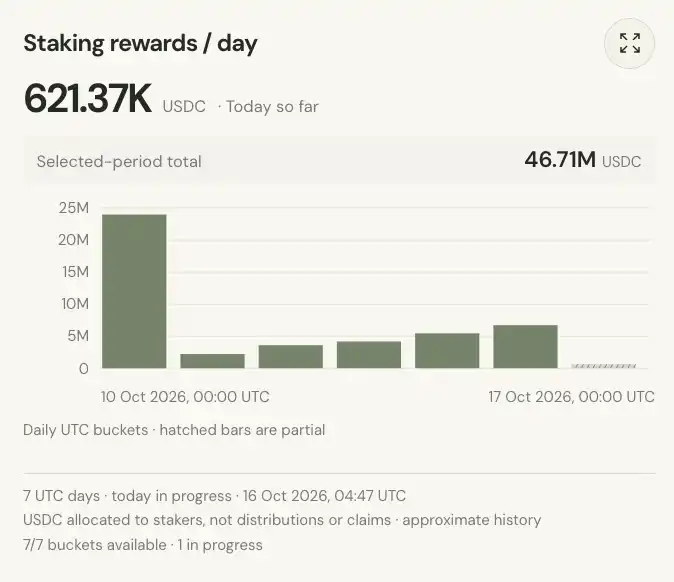
$1.15 trillion cumulative notional trading volume, $67.55 million TVL, $46.71 million in cumulative USDC staking rewards.
In less than a week since launch, PaperTrade has already delivered such results. "Cumulative staking rewards" represent the yield distributed to PAPER stakers.
The discussion around PAPER has thus shifted. Initially, traders cared about how many tokens they could get for how much loss; now, the more worthwhile question is how much revenue the PAPER they receive can actually capture, and what it should be worth.
Revenue Keeps Growing
Just how strong PaperTrade's start has been can be seen from a single comparison.
According to DefiLlama data, PaperTrade generated $23.97 million in Holder Revenue on October 10, with a cumulative total of $33.94 million from October 10 to 13. By contrast, Hyperliquid's single-day revenue peak was $8.81 million, and its four-day consecutive revenue peak was only $22.3 million — less than PaperTrade's single-day revenue.
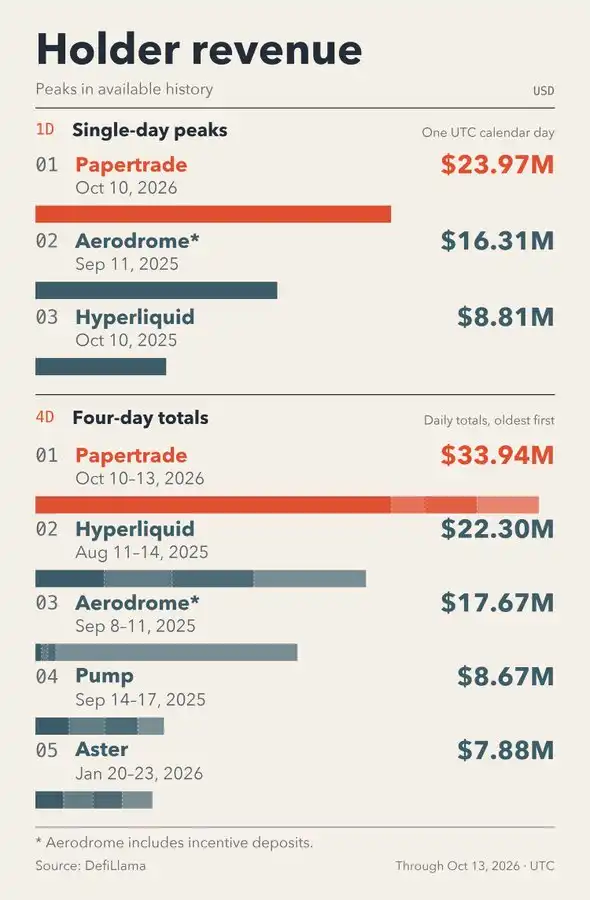
Single-day records are easily inflated by launch hype; subsequent performance is more telling. Daily staking rewards have been climbing steadily in the days since PaperTrade's launch.
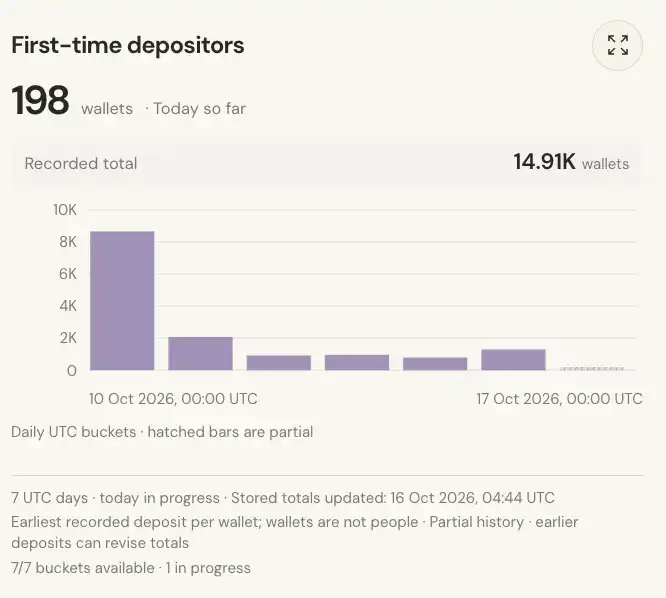
Protocol users are also growing steadily. PaperTrade's cumulative first-deposit addresses have reached approximately 14,900, with cumulative deposits of about $241 million USDC. These metrics, alongside growing daily rewards, are enough to show that PaperTrade has built up an active participant base.
Revenue Distribution
What makes PaperTrade attractive is that it connects the trading experience, token issuance, and revenue distribution into one.
Traders take the liquidity pool as their counterparty, with no need to wait for another user to fill their order; positions have no funding rate, no fees are charged on opening or losses, and leverage of up to 1000x is supported. After a trading loss, qualifying losses can generate PAPER. By holding and staking PAPER, users can participate in the protocol's USDC revenue distribution.
For high-frequency traders, this combination offers a different cost structure; for early participants willing to take on risk, losses come with the opportunity to acquire future revenue rights. Traders and participants in platform revenue can be the same group of people.
This is exactly what Ansem is bullish on. He believes that the revenue space created by trader losses is far greater than the small fees collected on a per-trade basis.
PAPER's issuance mechanism is also changing the cost for participants. Initially, every qualifying $1 of losses could mint up to 100 PAPER tokens; after the LP tracked by the protocol exceeded the $2 million threshold, the minting rate began to decline. The new supply of PAPER shrank significantly after the concentrated release on the first day.
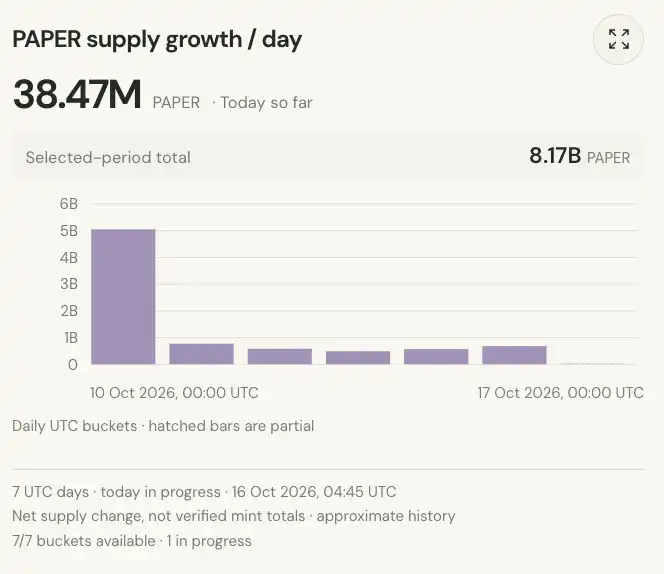
At the same time, PAPER's yield comes from LP revenue sharing, and when LP exceeds $5 million, excess funds are also used to distribute to PAPER stakers. With revenue continuously generated and early issuance slowing down, holders who have already accumulated PAPER have more reason to continue staking.
Currently, PAPER's total supply is approximately 8.16 billion tokens, with about 8.1 billion in staking, bringing the staking ratio to 99.23%. With nearly all tokens participating in staking, PAPER's value is therefore directly tied to revenue performance.
Pricing
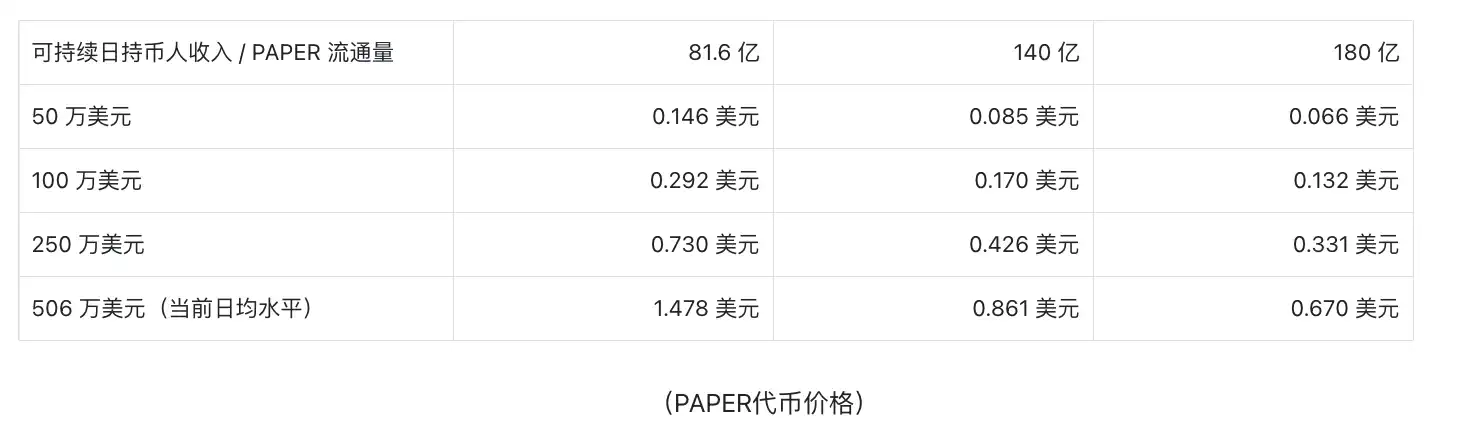
As of October 16, PaperTrade shows historical average daily staking revenue of approximately $5.06 million, corresponding to annualized revenue of about $1.85 billion.
But even with a significant discount to this figure, PAPER still has a valuation worth discussing.
Under the condition that nearly all tokens are staked, a simple model can be used to estimate the value of each PAPER:
PAPER reference price = holder daily revenue × 365 × holder revenue multiple (annualized) ÷ token supply.
This uses the revenue flowing to holders; the historically distributed $46.71 million USDC is no longer added again as an asset.
Currently, the ratios of circulating market cap to holder earnings for PUMP, HYPE, and LIT are 6.53x, 21.46x, and 27.33x, respectively. Here, the lower 6.53x is used first.
On the token supply side, 8.16 billion PAPER tokens have already been generated, and continued future issuance will dilute the revenue allocated to each token. Below, 14 billion and 18 billion tokens are used simultaneously as future supply scenarios.
Paper Strategy
The PAPER token is not yet open for trading. PaperStrategy is the "PAPER" treasury on HyperEVM and is currently one of the few ways to gain PAPER exposure outside of OTC.
Around PAPER's yield, PaperStrategy has built an accumulation mechanism. PaperStrategy's token, PSTR, charges a 10% tax on both buys and sells, with 90% of the tax going to the treasury and 10% to the team; the treasury accumulates PAPER through trading strategies and stakes it, then uses 90% of the staking yield to buy back and burn PSTR, with the remaining 10% going to the team.
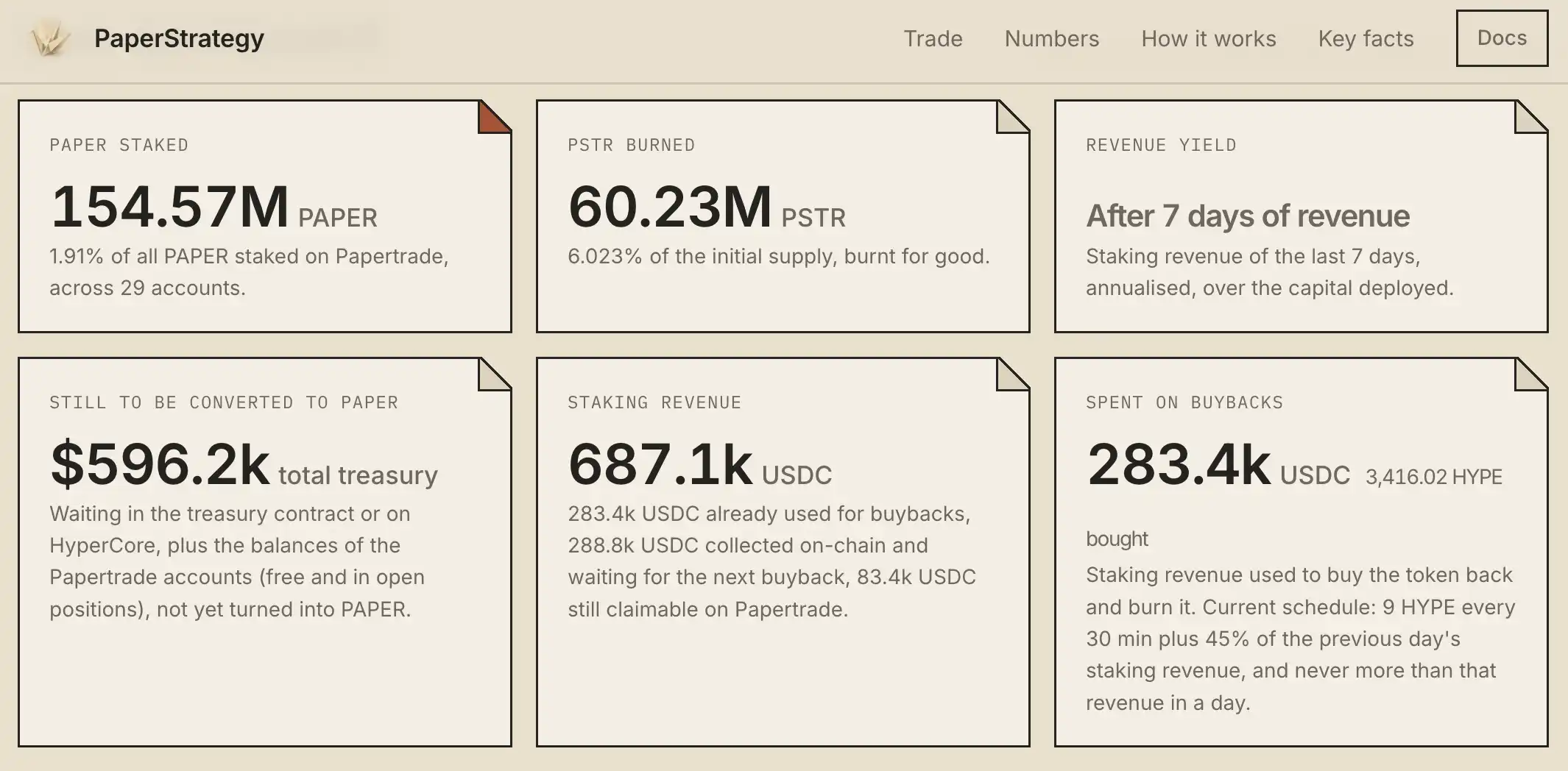
Currently, PaperStrategy has staked approximately 154 million PAPER. Over the same period, PSTR's market cap is approximately $8.5 million. After deducting approximately $600,000 in accounts and treasury balances not yet converted into PAPER, and adding the 10% tax on both buys and sells, the rough calculation implies an implied price of approximately $0.064 per PAPER. This provides a window into PAPER's market pricing.
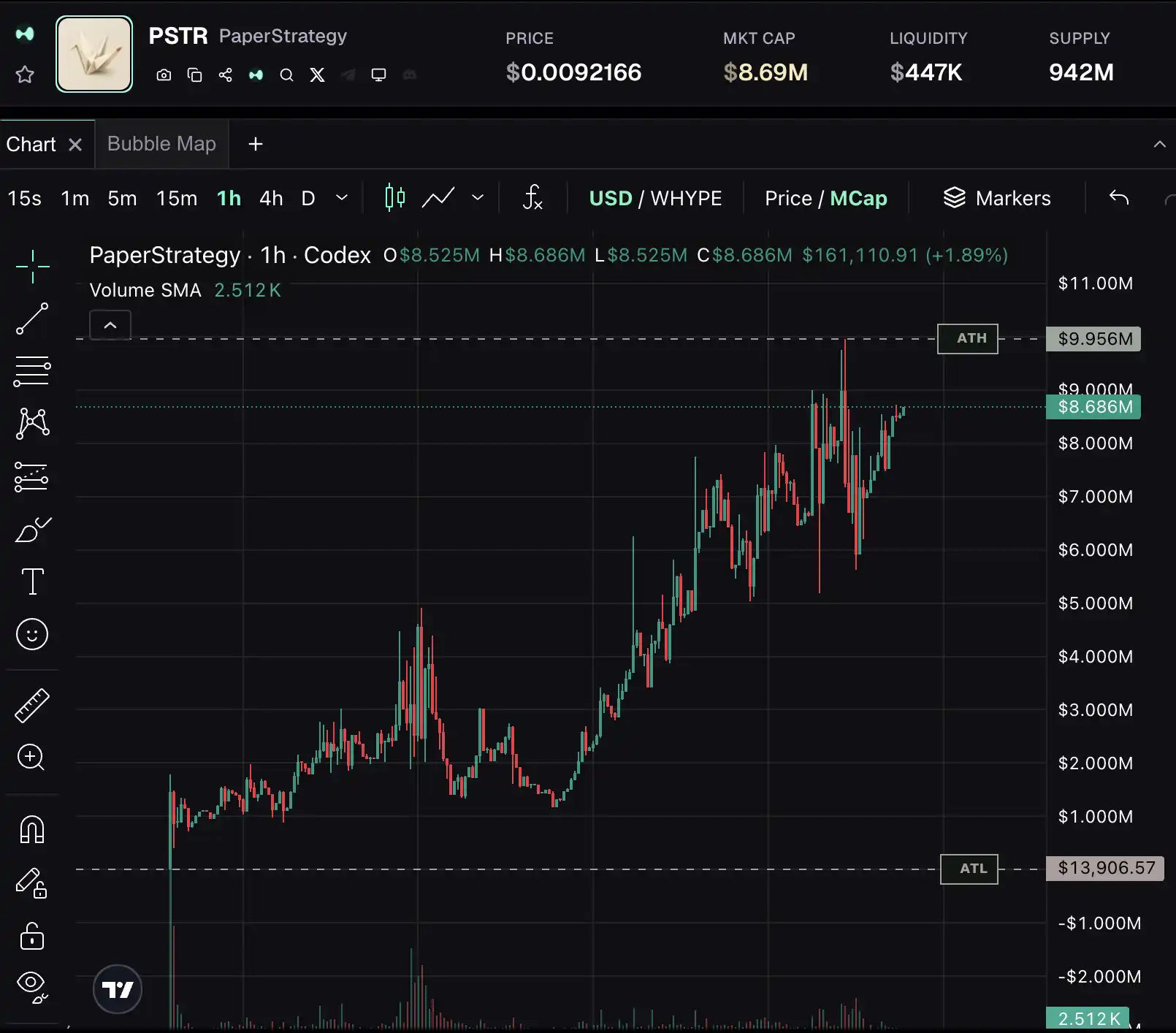
PaperTrade has already achieved a sufficiently strong start, and PAPER's value is beginning to be supported by revenue. Next, what is worth watching is whether the sustainability of revenue can provide a sufficiently strong valuation foundation for PAPER.
Welcome to join the official BlockBeats community:
Telegram Subscription Group: https://t.me/theblockbeats
Telegram Discussion Group: https://t.me/BlockBeats_App
Official Twitter Account: https://twitter.com/BlockBeatsAsia
