Pop Mart's performance adjustment is still ongoing.
In the third quarter of 2026, the company's overall revenue fell 45%–50% year-over-year, with China market revenue down 25%–30%, and declines in overseas markets such as Asia-Pacific, the Americas, and Europe even more pronounced.
This performance was weaker than JPMorgan's prior forecast of a 37% decline and close to the lower bound of the buy-side expectation range cited by the bank. In its October 28 research report, JPMorgan lowered Pop Mart's target price from HK$110 to HK$100, maintained its "Underweight" rating, and cut its 2026 adjusted net profit forecast from RMB 9.341 billion to RMB 7.871 billion, a reduction of about 16% and a decline of about 39% from 2025.
What the market needs to reassess is: in the absence of another Labubu-level blockbuster, how much normalized revenue and profit Pop Mart's existing IPs, store network, and membership system can support.
The key for the fourth quarter is whether sales can stop declining quarter-over-quarter
The third quarter faced a high year-over-year base, so whether the fourth quarter can achieve sequential stabilization better reflects short-term operating trends than the year-over-year decline itself.
JPMorgan expects Pop Mart's fourth-quarter revenue to be about RMB 6.56 billion, down about 41% year-over-year and up about 1% quarter-over-quarter. Among this, China market revenue is expected to be roughly flat quarter-over-quarter, while overseas revenue is expected to grow about 2% quarter-over-quarter. This means the bank has not yet incorporated a significant rebound from the peak season into its base-case forecast.
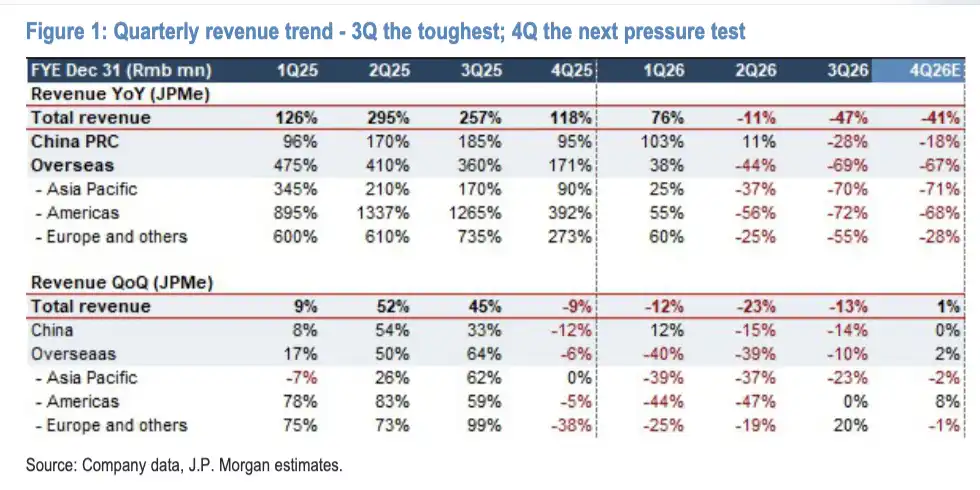
Management's judgment is relatively positive. According to the research report, the company expects China market revenue in the fourth quarter to be roughly flat and slightly up quarter-on-quarter, and still expects to maintain positive growth for the full year; after overseas markets enter the peak season in the fourth quarter, revenue is expected to grow quarter-on-quarter, but there remains some uncertainty in Europe.
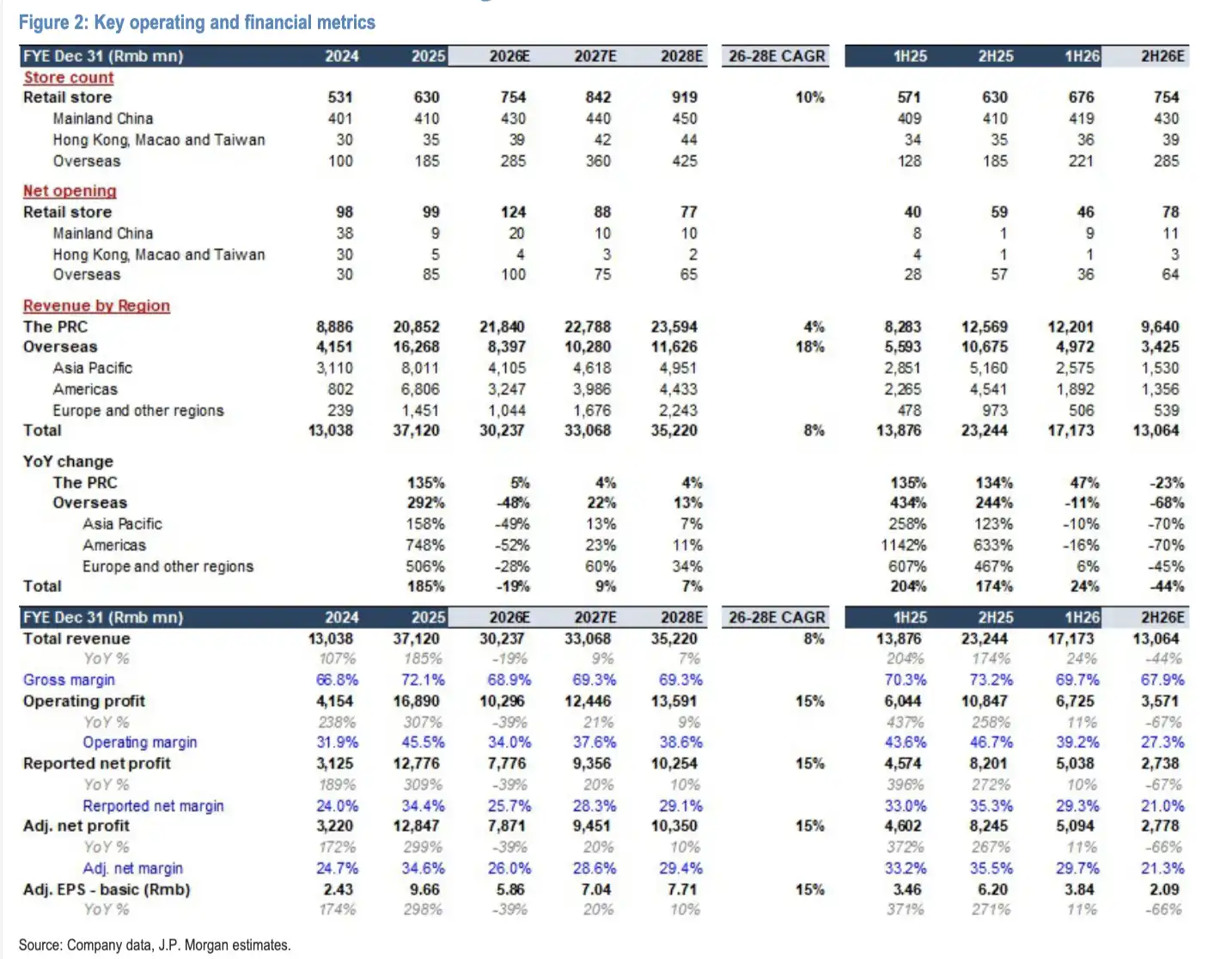
Regional divergence is also reflected in the full-year forecast. JPMorgan expects China market revenue of about RMB 21.84 billion in 2026, up about 5% year-on-year; overseas revenue of about RMB 8.4 billion, down about 48% year-on-year. Total full-year revenue is expected to be RMB 30.237 billion, down about 19% year-on-year.
The bank's forecast for 2027 still includes a moderate recovery: revenue is expected to grow about 9%, and adjusted net profit about 20%. But this judgment requires improved execution in the overseas business and a gradual stabilization of sales and profit margins as support.
Revenue decline, store-opening costs still accumulating
Slowing sales are amplifying expense pressure.
Management expects that in the second half of 2026, gross margin will decline by no more than 2 percentage points from the first half, while the expense ratio will rise and net margin will fall. Gross margin pressure mainly comes from two factors: first, the share of overseas revenue is declining, while the gross margin of the overseas business is higher than that of the domestic business; second, the company is proactively adjusting prices in some overseas markets to maintain competitiveness. According to management's explanation, these price adjustments are not driven by inventory clearance.
What is harder to shrink quickly is store cost. New overseas stores bring expenses such as labor, rent, and renovation. After revenue declines, these relatively fixed costs will account for a higher proportion of revenue, further depressing profit margins.
JPMorgan expects the company's adjusted net margin in the second half of the year to be about 21.3%, lower than 29.7% in the first half; the full-year adjusted net margin is expected to be about 26%, lower than 34.6% in 2025. The bank's adjusted net profit forecast for 2026 is also about 26% lower than the Bloomberg consensus listed in the research report. There is a clear gap between the two sides' judgments on whether profit margins can be maintained.
Against this backdrop, flagship store expansion is both a customer acquisition tool and an added requirement for operating efficiency.
Pop Mart is accelerating the layout of overseas flagship stores. The Paris flagship store opened in September, the London store has entered trial operation; as of the end of September, the number of stores in the United States exceeded 100. Subsequent pipeline projects also include New York, Milan, and additional flagship stores in the United States and Paris.
Some domestic flagship stores have already shown strong traffic-driving capability. According to management disclosure, flagship store sales in October still grew by double digits compared with August, average monthly foot traffic was more than twice the average of the top 50 stores, and new customer contribution and conversion rates were also higher. First-month sales at some flagship stores exceeded RMB 10 million.
However, the performance of individual flagship stores still needs to translate into returns across the overall store network. If the next strong IP cycle does not arrive soon, whether large stores can continue to generate sufficient sales to cover additional costs will become a core test of the expansion strategy.
Inventory Improves, but New IPs Still Need Time to Take Over
Inventory is a relatively positive signal in this update.
According to management disclosure, total company inventory peaked around May, began to decline in August, and by the end of September had shown a clear downward trend. The company reiterated strict inventory control and currently has no large-scale promotion plans.
The supply chain is also being adjusted. Pop Mart has established a global procurement team at its headquarters, shifting from the previous model of separate procurement by four major regions to a model in which each region submits demand and the headquarters coordinates procurement, in order to reduce duplicate stocking of popular products and supply-demand mismatches between regions.
Cross-regional transfers have increased, and Chinese warehouses are also supporting supply to overseas markets. U.S. e-commerce has achieved local fulfillment, while Europe aims to achieve local fulfillment by the end of the year. These measures are expected to improve inventory and logistics efficiency, but ultimately still require a recovery in end-market sales.
On the consumer operations side, some improvements have appeared in the Chinese market. In the third quarter, retail store foot traffic rose year on year, the number of new customers achieved double-digit growth with a faster pace than in the second quarter; the repurchase rate was roughly flat year on year, second-year retention improved, and the number of members consuming across IPs and categories also increased.
The overseas membership system is still being built. At present, except for two or three markets, the membership system has been launched in other markets, and member acquisition has also been included in store operations and assessment. However, the share of member sales in the Asia-Pacific region is still lower than in China, and the maturity of cross-channel consumption also lags behind.
On the product side, Pop Mart is broadening its IP portfolio. Twinkle Twinkle performed relatively well in the third quarter, Dimoo gained attention in Europe and the United States through cooperation with Pixar, Molly's 20th anniversary event drew attention in Bangkok, and Crybaby also plans to open its first themed store in Bangkok. In the third quarter, the top six IPs together contributed more than 60% of sales in the Asia-Pacific market.
These developments show that multi-IP operations are still advancing. But at this stage, they are not yet sufficient to confirm that any one of these IPs can replicate Labubu's sales scale.
The contribution of content and new category businesses also needs time. The Labubu film is still in the script stage, animation projects are being discussed with overseas partners, and management expects that content budgets will not increase significantly in the short term. Dessert stores, POPOP stores, and Hirono lifestyle stores are being advanced on a small scale, while progress in the building-block category is relatively slow.
JPMorgan's HK$100 target price corresponds to 12x its 2027 forecast P/E, calculated by multiplying its projected 2027 earnings per share by a 12x valuation multiple. The bank applied a valuation multiple similar to that of Chinese consumer discretionary stocks, reflecting its cautious assessment of slowing growth and margin pressure.
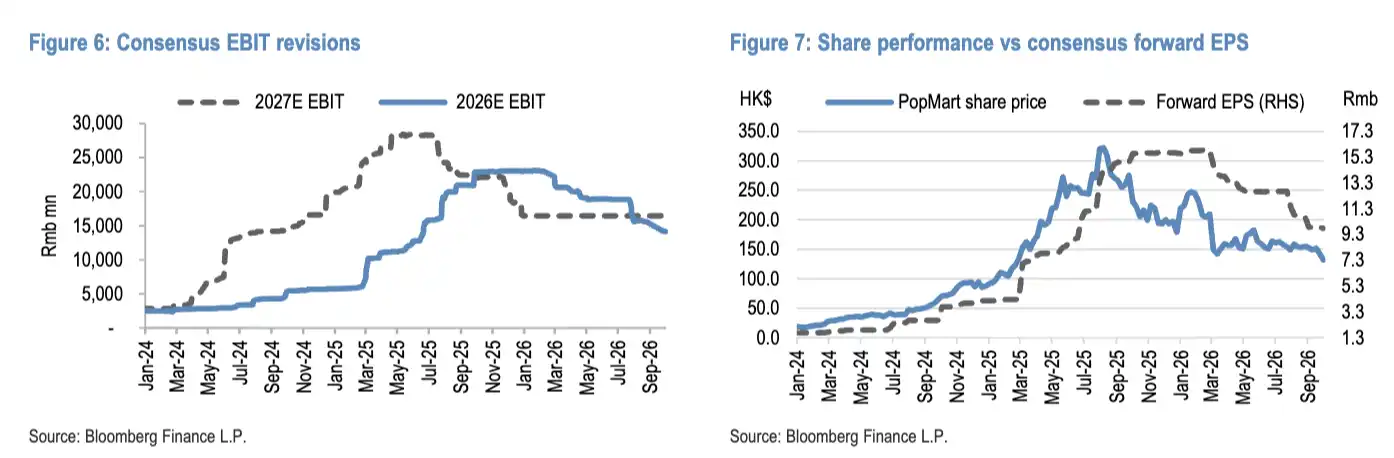
The variables that need to be verified going forward are now fairly clear: whether fourth-quarter sales can stop declining on a quarter-on-quarter basis, whether overseas stores can improve operating returns, and whether IPs beyond Labubu can continue to expand their revenue contribution. The inventory pullback has provided an improvement signal, while whether earnings expectations can stabilize still depends on the pace of sales recovery and cost absorption.
Welcome to join the official BlockBeats community:
Telegram Subscription Group: https://t.me/theblockbeats
Telegram Discussion Group: https://t.me/BlockBeats_App
Official Twitter Account: https://twitter.com/BlockBeatsAsia
