Apple's new CEO John Ternus delivered his first earnings report since taking office. The company set a new September quarter revenue record, with both iPhone and services businesses reaching new heights.
The market's initial reaction, however, did not dwell on this record. According to the Associated Press, Apple's stock fell during the earnings call. The company expects lower gross margins next quarter, with rising storage costs and Siri AI-related spending both weighing on profit margins.
Apple's earnings show that for the fourth fiscal quarter ended September 26, the company's revenue reached $114.477 billion, up about 12% year-over-year. This is the final quarter of Apple's full fiscal year, and a report card that reveals hardware growth, services revenue, and regional differences all at once.
Breaking down total revenue reveals that several stories are not entirely the same. iPhone growth overshadowed weakness in other hardware, the services business ranks higher on the gross margin table than on the revenue table, and Greater China's growth rate outpaced Apple's other major reporting regions.
How much of this growth came from iPhone?
Apple said in its earnings that iPhone set a September quarter revenue record. Subtracting each business segment from the year-ago period makes the phone business's weight in the growth ledger more intuitive.
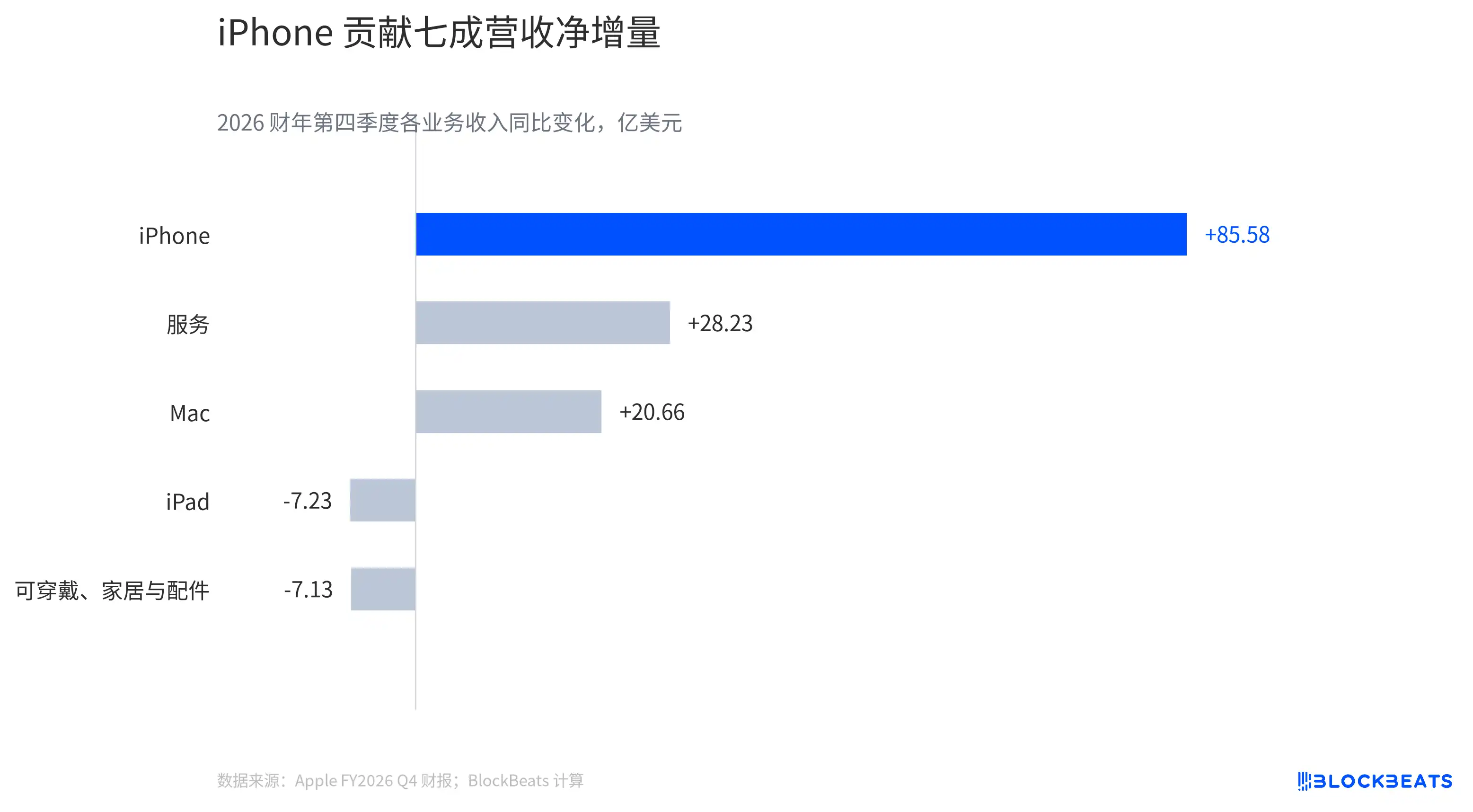
Based on calculations from Apple's consolidated financial statements, iPhone revenue increased by $8.558 billion year-over-year, equivalent to about 70% of the company's net revenue increase. In other words, for every additional $10 Apple brought in, about $7 came from iPhone's year-over-year growth.
The denominator here is the net increase after summing all business segments. Mac and services also contributed to growth, but iPad and Wearables, Home and Accessories revenue declined, offsetting part of the increase. This is why the positive figures in the chart add up to more than the company's final revenue increase.
Mac's revenue growth rate for the quarter was higher than iPhone's, but its scale is much smaller. A faster growth rate multiplied by a smaller base still yields limited absolute increment. For a company like Apple, a business "growing fast" and "bringing in the most new revenue" are two different questions.
Revenue records also cannot be directly translated into phone unit sales records. Apple discloses revenue by segment but did not provide iPhone unit sales for the quarter in this report. Pricing, product mix, and exchange rates can all affect revenue; the financial statements alone cannot determine how many phones were sold, nor can all growth be attributed to any single model.
Why does services account for less than 30% of revenue but nearly half of gross profit?
The iPhone is Apple's largest source of revenue, but transactions that occur after users buy the device also leave traces on another ledger. Businesses such as the App Store, cloud storage, and subscriptions are grouped under services. Together they make up services revenue in the financial statements, and Apple did not break out their individual contributions in this quarterly report.
Services revenue is still smaller than all hardware, but its share after deducting cost of sales has risen noticeably. Putting the two bars side by side makes the difference clear.
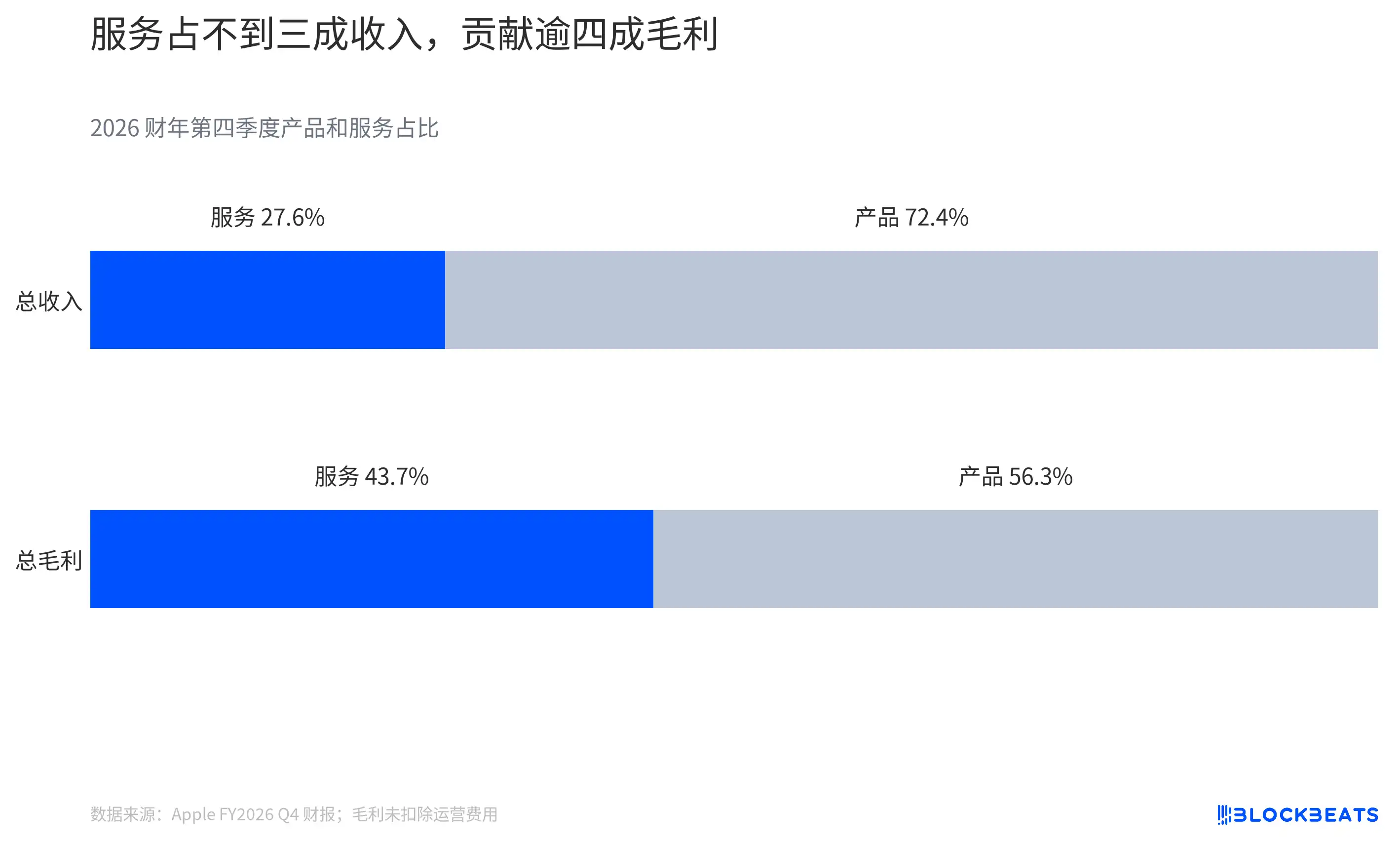
Based on revenue and cost of sales disclosed by Apple, services contributed about 27.6% of the company's revenue but about 43.7% of gross profit. In other words, out of every $100 of revenue, services bring in less than $30. Out of every $100 of gross profit, it leaves nearly $44.
The gap comes from the cost-of-sales structure of the two types of businesses. Product revenue must cover devices and related cost of sales, and the services business also has its own costs, but the financial statements show that its cost of sales accounts for a lower proportion of the corresponding revenue. Based on this quarter's data, services gross margin is about 76%, while products gross margin is about 37%.
Gross profit is not final profit. Apple also has to pay research and development, sales, and administrative expenses, which are not allocated between products and services in the chart above. Just because services contributed more than 40% of gross profit does not mean it contributed the same proportion of net profit.
This quarter's gross margin also had a special effect. Apple said in its announcement that tariff refunds benefited the company's overall gross margin by about 1 percentage point. This effect is already included in the published results, and the financial statement announcement did not separately break it out between products and services, so it should not be allocated on one's own.
According to the Associated Press, Apple expects next quarter's gross margin to be 45% to 46%, lower than this quarter's reported value. Actual results and guidance belong to different periods and are also affected by factors such as tariff refunds, so the difference cannot be attributed entirely to any single cost item.
How fast is Greater China growing?
After revenue is rearranged by region, Greater China tops the growth rankings. Apple's financial statements show that revenue in the region was $17.539 billion for the quarter, up about 21% from a year earlier.
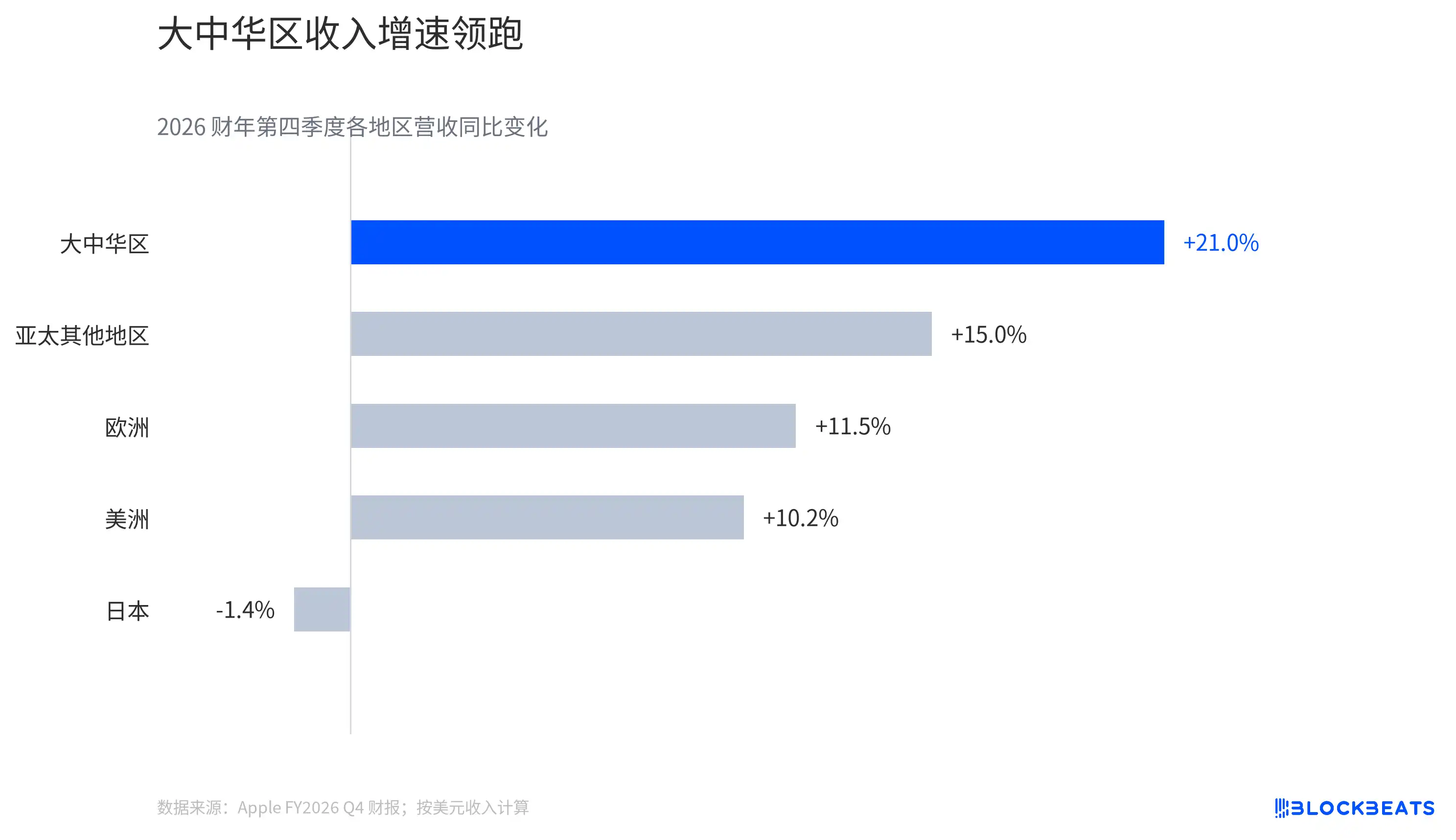
That is about 9 percentage points higher than Apple's overall revenue growth rate. The growth is reflected across all of the company's reported revenue by region, including products and services, and does not separately represent iPhone performance.
Absolute dollar amounts tell a different ranking. The Americas remain Apple's largest reported region, followed by Europe. Although Greater China had the fastest growth this quarter, its revenue scale is still smaller than those two regions. Growth rate shows how much something expanded relative to last year; it does not by itself show how large a market already is.
Japan was the only reported region with revenue declining year over year this quarter. This comparison uses Apple's revenue disclosed in U.S. dollars, and exchange-rate changes affect the result. It does not break out local-currency revenue, product prices, and device unit sales, so it cannot be used to conclude changes in consumer purchase volumes.
Greater China is also Apple's regional reporting basis, covering mainland China, Hong Kong, and Taiwan, and is not the single market of mainland China. Regional revenue and product revenue are two different ways of slicing the business, and the financial statements do not cross-disclose how many iPhones were sold in each region.
Behind the new record, Apple's revenue growth this quarter was driven mainly by the iPhone, while the gross margin statement shows another curve from the services business.
Welcome to join the official BlockBeats community:
Telegram Subscription Group: https://t.me/theblockbeats
Telegram Discussion Group: https://t.me/BlockBeats_App
Official Twitter Account: https://twitter.com/BlockBeatsAsia
