AMD delivered earnings that beat market expectations and raised its revenue target for the next quarter. On November 4 Beijing time, the news investors saw was that both revenue and adjusted earnings per share exceeded expectations, and management pointed to data centers as the source of growth.
According to AMD's official earnings report, the company's third-quarter revenue reached $13.377 billion, up 45% year-over-year. Revenue hit a record, and quarterly sales in the data center business nearly doubled from the same period last year.
Breaking down the earnings report reveals a result more concentrated than the growth rate. Calculated according to the official supplementary table, for every additional dollar of net revenue AMD generated this quarter, data centers contributed more than one dollar. Other businesses combined actually offset a small portion of the growth.
Where did the growth come from?
Why can a single business contribute more than the entire increment?
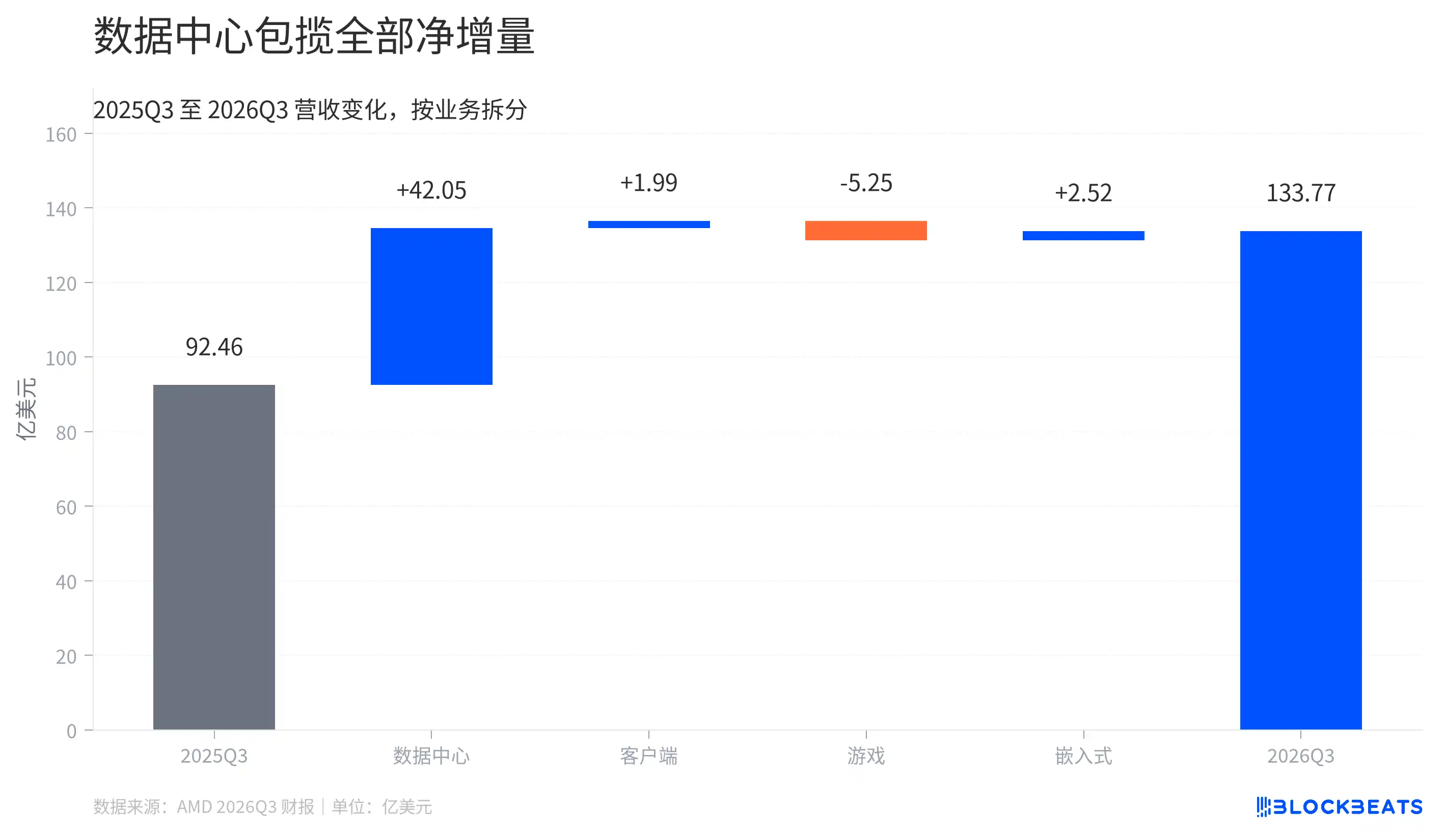
This chart connects the company's same-quarter revenue over two years. The blocks in between represent changes brought by different businesses, with increases and decreases offsetting each other, ultimately arriving at total revenue for the current quarter. Calculated using precise figures from the earnings report, data centers added $4.205 billion in revenue, exceeding the company's total net increase of $4.131 billion.
The difference comes from other businesses. Client and embedded businesses both increased revenue, but the shortfall in the gaming business was larger. Data centers not only propped up the company's growth but also filled the gap left by other segments combined.
The revenue structure changed accordingly. Calculated according to the same supplementary table, data centers' share of AMD's total revenue rose from about 47% in the same period last year to about 64% this quarter. That means for every ten dollars of revenue the company receives, the portion from data centers has increased from less than five dollars to more than six dollars.
However, not all of this revenue can be labeled as AI GPU. AMD's data center segment sells both Instinct accelerators and EPYC server processors and other products. The company attributed this quarter's growth to strong EPYC demand and the launch of the Instinct MI450 series GPUs, but did not separately disclose AI GPU revenue in the earnings supplementary table.
From chips to systems, the way customers use AMD products is also expanding. The company disclosed in its earnings report that customers including Meta, Microsoft, and OpenAI have already been running models and workloads on the first batch of Helios rack systems. Helios integrates Instinct GPUs and next-generation EPYC CPUs, putting components originally sold separately into a single system solution. It provides more opportunities for multiple products to enter customer data centers together, but the earnings report did not disclose how much revenue each product contributed.
Why Are Client and Gaming Businesses Diverging?
Now let's look at another common news statement: client and gaming business revenue declined. Does it mean AMD's consumer-facing products are all selling worse?
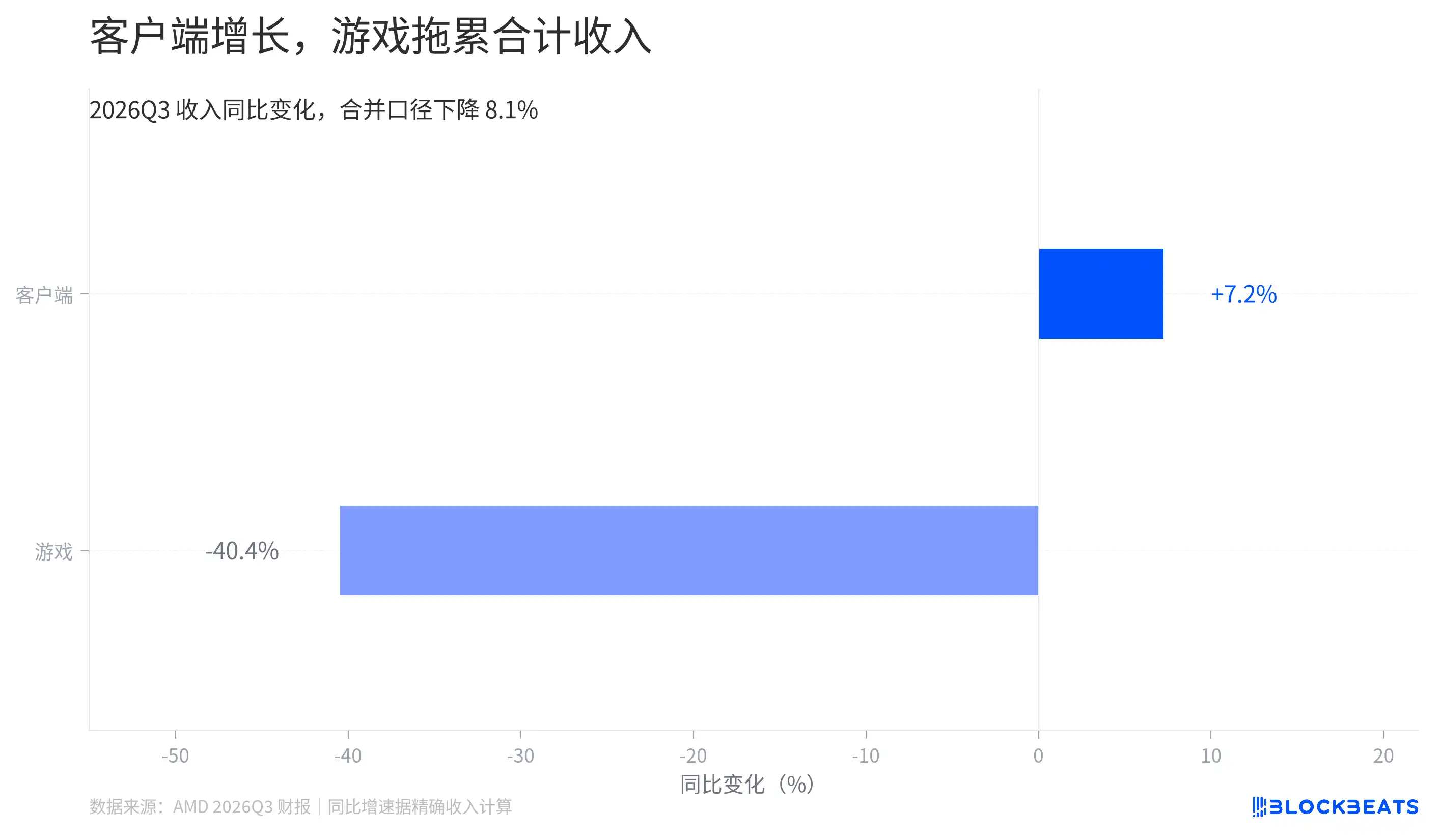
According to company financial reports, combined revenue from the two businesses declined approximately 8% year-over-year. Broken down, client is still growing, while gaming fell about 40% — the two are moving in opposite directions.
AMD attributed client growth to Ryzen mobile processor sales, and the gaming decline to lower semi-custom and graphics product revenue. The combined figure is suitable for observing the entire segment, but it compresses internal differences into a single downward arrow.
Based on financial report figures, gaming revenue decreased by $525 million compared to the same period last year. Although client sold more products, it was not enough to fill this gap. Growth in the embedded business offset part of the loss — only when these changes are added together does the company's total incremental revenue shown in the first chart emerge.
This also explains why AMD can simultaneously have record company revenue and declining consumer business segments. The company's revenue center of gravity has clearly shifted toward servers and data centers — changes in consumer business are overshadowed by the larger data center increment in terms of impact on total revenue.
How Much Profit Can Revenue Growth Retain?
Revenue is going up — can profit increase at the same rate? The current quarter's financials and next quarter's guidance provide information at different levels.
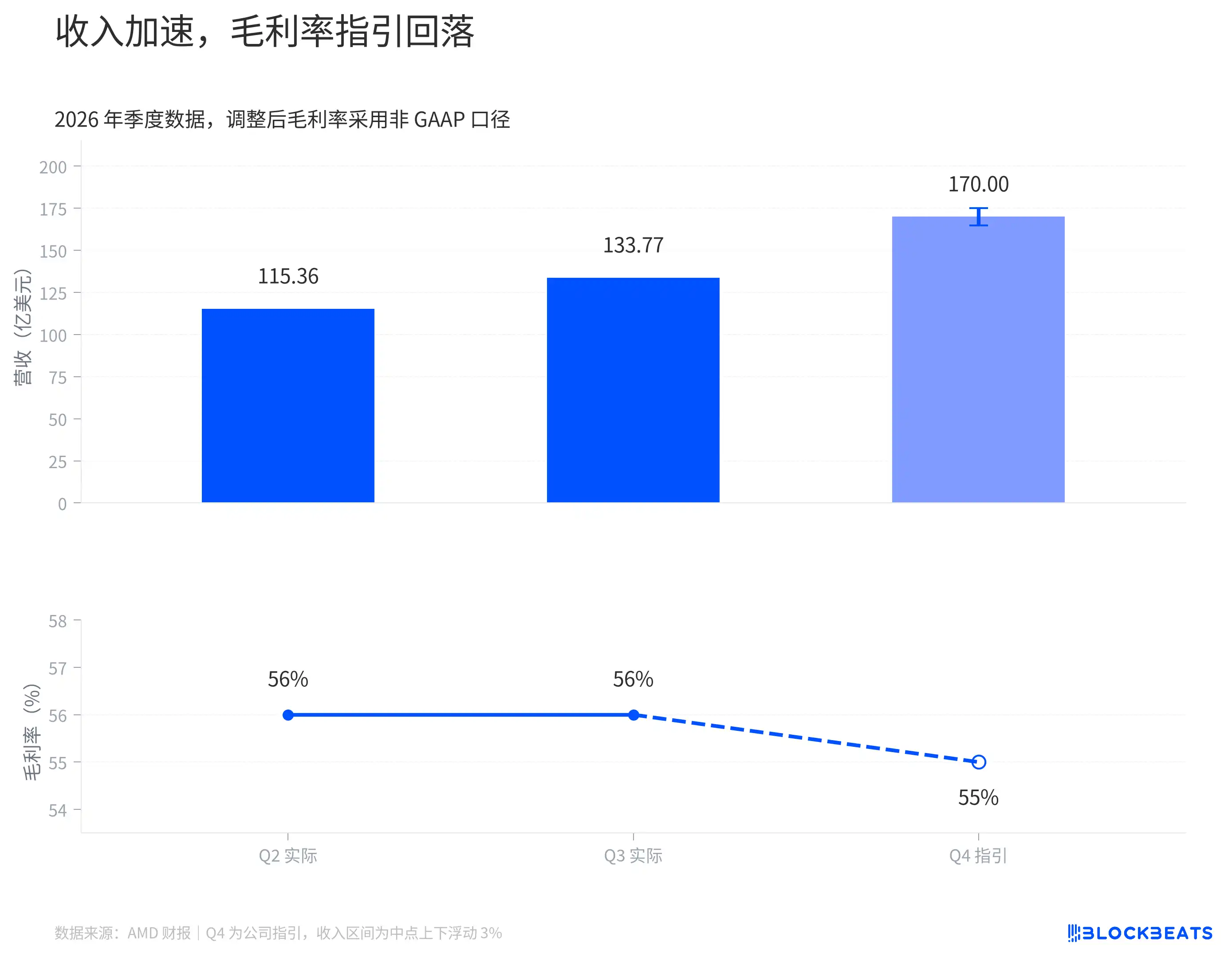
According to AMD's guidance, fourth-quarter revenue midpoint is $17 billion, up approximately 27% from the third quarter. If achieved, this means that in just one quarter, the company would add more than a quarter on top of its already record revenue base.
Alongside the higher revenue target, adjusted gross margin guidance is one percentage point lower than the current quarter. The upper part of the chart shows revenue scale, the lower part shows how much gross profit is retained per unit of revenue — the two changes can occur simultaneously.
Based on mechanical calculation using the guidance midpoint and gross margin, fourth-quarter adjusted gross profit would be approximately $9.35 billion. Even with a slight decline in gross margin, gross profit amount could still be higher than the third quarter. This is merely a calculation derived by multiplying two company guidance figures — it is not a separately issued gross profit forecast by the company, nor can it be directly treated as net income.
After gross profit, operating expenses must also be deducted. This quarter, operating expenses calculated under US GAAP increased by about 25% year-over-year, slower than revenue growth. Expenses such as R&D and sales did not increase proportionally with revenue, leaving room for operating profit growth.
The same financial report shows that the company's operating margin rose from 14% in the same period last year to 21% this quarter. Understood in terms of sales of the same scale, for every hundred dollars of revenue the company receives, the operating profit left after deducting operating costs and operating expenses is greater than in the same period last year.
However, the margin improvement this quarter cannot directly explain why the gross margin will decline slightly next quarter. AMD's brief guidance does not quantify the respective impacts of product mix, pricing, and costs, and these figures alone are not enough to conclude that the company is cutting prices to win orders, or that the new systems have already suppressed profitability.
In this financial report, the change in AMD's total revenue is already mainly determined by the data center business.
Welcome to join the official BlockBeats community:
Telegram Subscription Group: https://t.me/theblockbeats
Telegram Discussion Group: https://t.me/BlockBeats_App
Official Twitter Account: https://twitter.com/BlockBeatsAsia
