Data center construction is becoming a major policy issue in the U.S. midterm elections. As project approvals, electricity demand, and grid investment enter campaign discussions, the political pressure facing the industry is extending from local development disputes to the congressional level.
Data Center Watch's tracking of candidates in the 2026 congressional midterm elections shows that a significant share of candidates in both parties support stronger data center regulation, but Democratic candidates are more inclined to favor restrictive measures such as construction moratoriums. The organization judges that if Democrats gain control of Congress, it could create conditions for pushing stronger federal regulation.
However, there is still a gap between candidates' public positions and policies that ultimately take effect. Supporting a moratorium on a local project does not mean supporting a nationwide ban; requiring developers to bear grid costs is not the same as fully opposing data center construction.
Democratic candidates take stronger restrictive positions
Data Center Watch tracked 950 candidates from both parties across 470 House and Senate races, classifying their positions on data center development based on campaign statements, policy proposals, and legislative records. For candidates supporting multiple measures at once, the study categorized them according to the strictest position they publicly supported.
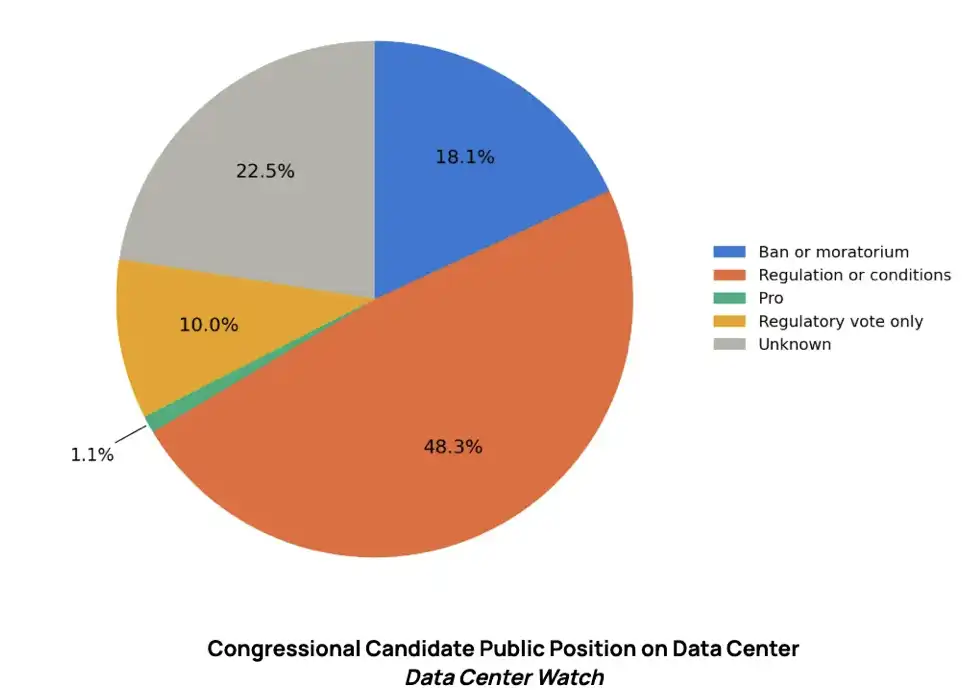
Overall, 18.1% of candidates support banning or pausing construction, 48.3% support regulation or conditional development, 1.1% support development without proposing restrictive policies, another 10% expressed support only through votes on relevant regulatory bills, and 22.5% had positions that could not be determined.
The most obvious difference between the two parties is reflected in whether they support a moratorium on construction.
Among the tracked Democratic candidates, 52.8% support regulation or conditional development, and 32.4% have supported a moratorium on construction at the federal, state, or local level. The corresponding proportions for Republican candidates are 43.7% and 3.4%, respectively.
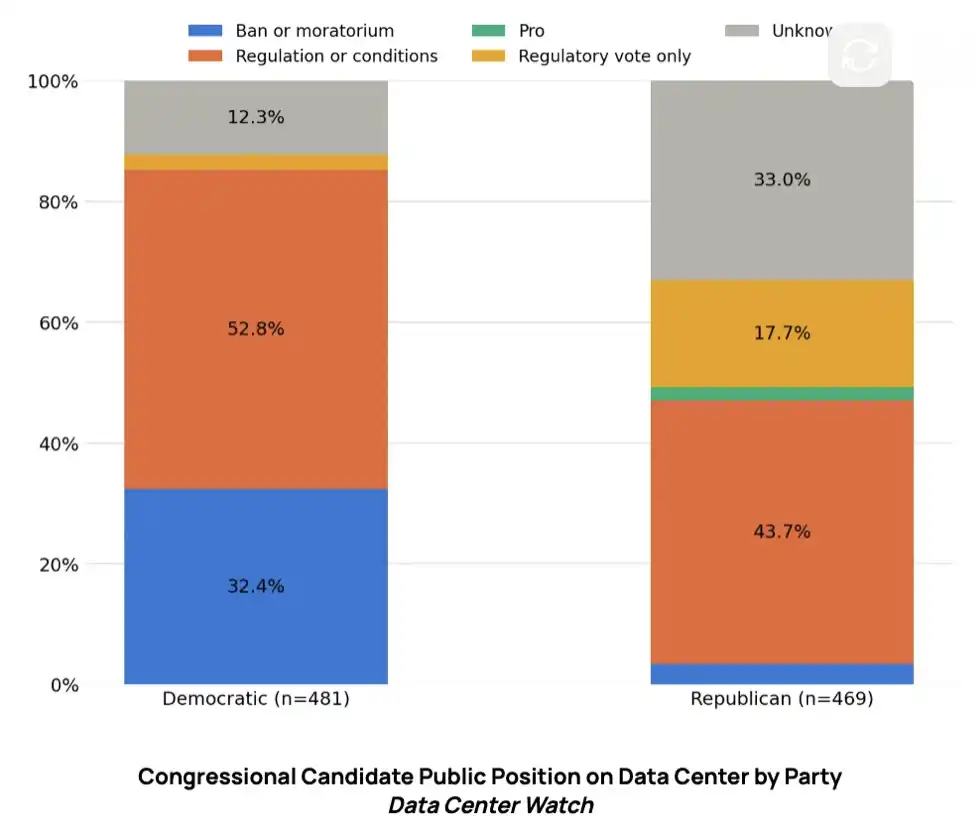
This difference means that if Democrats gain more congressional seats, political forces advocating restrictions on data center development may strengthen. However, these records involve policies at different levels, including both federal positions and state or local moratorium measures, and it cannot be directly inferred from them what the probability is of a nationwide ban being introduced.
There are also gaps in public information. The research could not determine the positions of 33% of Republican candidates and 12.3% of Democratic candidates, and these candidates cannot be directly classified as supporting or opposing development.
Grid cost sharing has a cross-party regulatory foundation
Compared with banning or pausing construction, regulation and conditional development have gained broader support across both parties. Related measures include raising permitting requirements and requiring data centers to bear the costs of power and grid infrastructure brought by their electricity demand.
H.R. 9340, the Ratepayer Protection Act, is one representative measure among them, involving the sharing of power infrastructure costs brought by large-load electricity users, including data centers.
The research shows that another 17.7% of Republican candidates and 2.5% of Democratic candidates have voted in support of the bill but have not expressed broader data center policy positions in campaign platforms or public speeches. Data Center Watch lists these candidates separately because support for a specific regulatory measure is not enough to prove that they hold a restrictive attitude toward development across the entire industry.
This distribution shows that even if Republicans perform better in elections, data centers may not necessarily face a looser regulatory environment. At least on the question of how grid costs are allocated, regulatory demands have already crossed party lines. The differences between the two parties are more reflected in the degree of restriction and whether they support pausing new projects.
Regulatory pressure is not limited to traditional data center markets
In absolute terms, California has the most congressional candidates who support banning or pausing construction, at 17; New York follows with 13, and Louisiana and Florida each have 10.
But the candidate base affects this ranking. The 17 in California represent about 16% of the state's tracked candidates. Among states with at least 10 tracked candidates, Indiana's share supporting a ban or pause is about 44%, Alabama about 37%, Kentucky about 36%, Tennessee about 30%, and Michigan and Louisiana each about 28%.
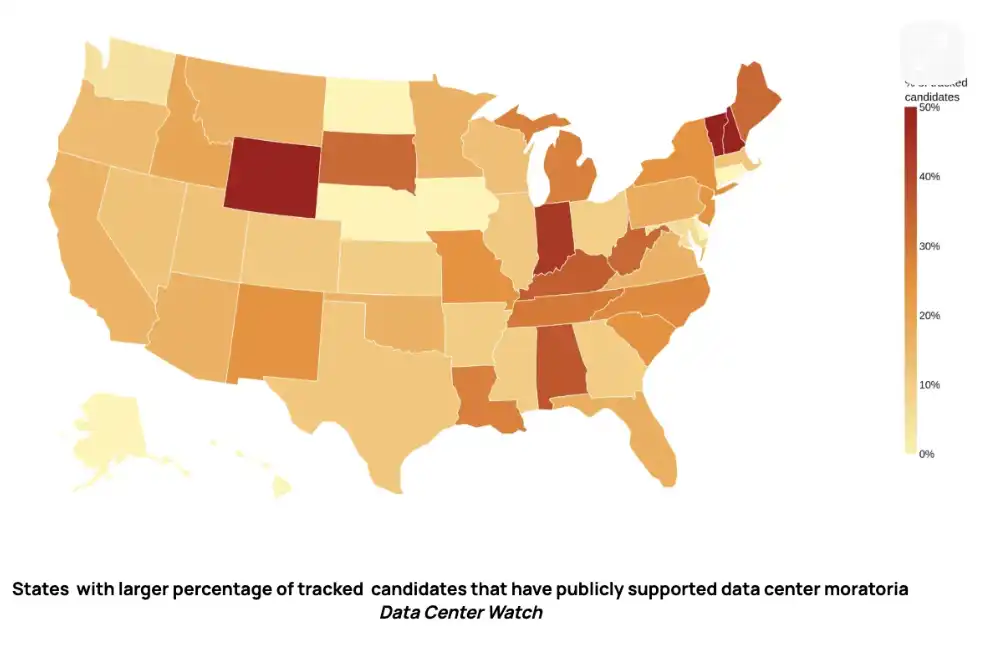
Other states are more inclined to manage development through regulation or conditional requirements. In Virginia, 79% of candidates support this position, followed by Pennsylvania at 76% and Oregon at 64%.
The policy pressure facing data centers is showing up in congressional races both in major markets such as Virginia, California and Pennsylvania and in emerging markets such as Michigan and Indiana. Data Center Watch notes that this broadly aligns with the distribution of local opposition activity it has tracked.
For the industry, the significance of the election results lies not only in which party wins control of Congress, but also in whether candidates supporting various restrictive measures can win, and in what form those proposals enter policy. A Democratic victory could strengthen the push for federal regulation, while electricity cost sharing, permitting conditions and local construction limits are variables that will need continued observation regardless of which party wins.
Welcome to join the official BlockBeats community:
Telegram Subscription Group: https://t.me/theblockbeats
Telegram Discussion Group: https://t.me/BlockBeats_App
Official Twitter Account: https://twitter.com/BlockBeatsAsia
