As we previously mentioned, in September, on-chain options notional volume reached $4.829 billion, up 121.7% month-over-month; monthly premium volume also grew from over $20 million at the start of the year to over $80 million. Hyperliquid founder Jeff publicly discussed the development opportunities for options.
However, many crypto-native traders have long been accustomed to the operation style of perpetual contracts. Bullish, go long; bearish, go short; deposit margin, open and close positions at any time. Switching to the options interface, facing rows of strike prices, expiration dates, and Greeks, half of the trading impulse is consumed by the complex operations.
HIP-3 trading platform Paragon's newly announced Power Perps offers another entry point. Starting with HYPE², it lets traders use the "open a contract" approach to obtain option-style payoff curves.
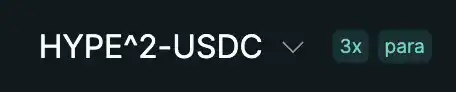
No strike price, no expiration date. You are still trading a perpetual contract, except the price it tracks has become the square of HYPE.
Convexity
The payoff of an ordinary perpetual contract is a straight line. Holding a fixed number of long positions, for every $1 the underlying rises, the profit is the same; for every $1 it falls, the loss is also the same. Adding leverage makes this straight line steeper, but the shape remains unchanged.
"N-th power contracts" change this.
For ease of calculation, assume an asset is priced at $100 when listed, and the price of the squared contract also starts at 100.
The underlying rises to 110, the index reaches 121, a gain of 21%; the underlying falls to 90, the index falls to 81, a decline of 19%. For the same 10% price change, longs earn a bit more on the way up and lose a bit less on the way down.
With larger moves, the difference becomes more obvious. The underlying rises 50%, the squared index rises 125%; the underlying falls 50%, the index falls 75%. If the underlying doubles, the index becomes four times the original. Cubic contracts go further: if the underlying doubles, the index becomes eight times the original.
Assume the underlying's percentage change is r:
The return of a quadratic contract = 2r + r²
The leading 2r provides the return magnitude of a 2x leveraged long; the trailing r² is no less than zero whether the price rises or falls, so relative to a 2x long, it increases gains when the price rises and reduces losses when the price falls, and the larger the price move, the greater this difference.
This is "convexity." Moving up along the quadratic curve, for every additional $1 rise, the long earns more than on the previous $1; moving down, for every additional $1 fall, the loss is less than on the previous $1. The sensitivity of a quadratic contract changes automatically with price, which ordinary contracts cannot do.
What options traders are willing to buy includes precisely this "convexity."
This concept already had a theoretical foundation as early as 2021. Paradigm's Everlasting Options discussed how to use continuous funding fees to maintain an options exposure that "never expires," and the subsequent Power Perpetuals article took powers of price as the tracking target. Opyn later put this into practice with Squeeth, which tracks ETH², and Paragon wants to bring this type of product to Hyperliquid's order book.
In addition, the trading demand for traditional options is dispersed across many contracts with different strike prices and expiration dates, making liquidity highly fragmented. "N-th power contracts" can allow traders of the same underlying and the same power to share a single order book.
Fees
At this point, it is easy to have a thought. Quadratic contracts rise faster and fall slower—what is the cost of this benefit?
Let us do an experiment with both long and short positions opened. Suppose a trader, when the price is 100, simultaneously opens one quadratic long and hedges it with a regular short position of two units of the underlying asset. The underlying asset rises from 100 to 110; the quadratic long earns 21, the linear short loses 20, for a total gain of 1. The underlying asset falls from 100 to 90; the quadratic long loses 19, the linear short earns 20, for a total gain of still 1. If it rises to 120 or falls to 80, both cases gain 4.
Written as a formula, the profit and loss of this long-short combination is:
Long-short combination price P&L = (square of the difference between the underlying asset price and 100) ÷ 100
If there were no funding rate, traders could arbitrage for free in the above manner.
However, the "no-arbitrage principle" requires that such a benefit must have a price, namely the funding rate.
It is easier to understand from the market maker's side. The market maker sells one quadratic contract while buying two units of the underlying asset to hedge. If the underlying rises by $10, the market maker's short position loses 21, while the hedged spot position gains only 20, for a net loss of 1; if the underlying falls by $10, the short position gains 19, while the hedged spot position loses 20, also a net loss of 1. This is exactly the "arbitrage" return on the other side.
The market maker also has to keep adjusting the hedge quantity as the price changes. After each adjustment, the next price move will again generate P&L related to the square of the price change. Accumulating these squares gives the "variance" here. The more violently the price moves back and forth, the higher the hedging cost the market maker bears for providing convexity.
Therefore, in addition to the holding cost of ordinary contracts, longs in Nth-power contracts also need to continuously pay for convexity. This portion of the cost is related to variance (the square of volatility) and is usually paid by longs to shorts. The premium or discount in the order book will also affect the final funding rate.
Liquidation
Still starting from $100, take $100 of principal and compare a 2x long position with a fully collateralized quadratic long position worth $100.
If the underlying falls from 100 to 50, the loss on the 2x long position is $100, the principal is already wiped out, and actual liquidation would be triggered even earlier. Without considering funding rates and losses from other cross-margin positions, the quadratic long position at this point falls from 100 to 25, still retaining $25 of equity, and will not be liquidated merely because of a price decline.
A fully collateralized quadratic long position gives traders about twice the initial price sensitivity while protecting them from liquidation caused by a simple price decline.
But once leverage is added on top of a quadratic contract, liquidation approaches quickly. According to the example in Paragon's risk documentation, ignoring cumulative funding fees and other account assets for now, a 2x HYPE² long position would be liquidated when HYPE falls by about 22.5%, while a 3x HYPE² long position would be liquidated after a decline of only about 10.6%.
The short side needs to be even more careful. The more the price rises, the faster a quadratic short loses, and even a 1x quadratic short will be liquidated.
Volatility Trading
The combination of a quadratic long paired with a linear short described earlier can also be turned into a trading strategy. You don't need to judge whether the price will go up or down next—you only need to judge whether the price will move far enough from its current position.
In traditional options, buying a call and a put with the same strike price and the same expiration date forms a "straddle." When the price surges, the call makes money; when the price plunges, the put makes money—there are profit opportunities in both directions. Power Perps, using a quadratic long paired with a linear short, can also assemble a payoff curve that slopes upward on both sides.
This is an intuitive entry point for going long volatility. Both big rallies and big drops can present opportunities, but the price needs sufficient volatility to offset funding fee costs.
Conversely, by going short a quadratic contract and buying a corresponding amount of the underlying asset or a linear long to hedge, one can go short volatility. If the price stays near the opening position, the funding fees collected by the quadratic short contract have a chance to become profit; once there is a big rally or a big drop, the hedged loss will increase with the square of the market move's magnitude.
However, the "no expiration date" feature of quadratic contracts also means that funding fees—this holding cost—can accumulate indefinitely.
Power Perps also cannot replicate all traditional options strategies exactly. A strangle requires two different strike prices, one above and one below; spread strategies can set profit caps and loss floors through different strike prices; covered calls and covered puts also require selling options at specified strike prices, giving up part of the profit potential in the corresponding direction in exchange for premium.
These strategies all have payoff inflection points delineated by strike prices, and usually also specify an expiration time. A quadratic contract paired with a linear position produces a smooth curve. By adjusting the position ratio, one can approximate some options strategies within a certain price range; but to precisely specify "cap the payoff once the price rises to a certain level" or "keep the payoff unchanged within a certain range," options remain indispensable.
The cost of simplified operation and concentrated liquidity is the loss of some freely selectable payoff structures.
Evolution of the "Listing" Strategy
Hyperliquid provides an order book, spot markets, and a margin system, while Paragon designs new yield curves on top of these foundations. Market makers can hedge more conveniently, and developers can continue to package combinations into strategies, reducing the operational burden on traders to build and adjust positions themselves.
Traditional options have already proven that the market has long-term demand for different yield structures. The value of Paragon's attempt this time lies in expressing part of that demand in a way familiar to crypto-native traders, and in allowing existing perpetual liquidity to provide hedging for new products.
The trend more worth watching is that "listing" on HIP-3 exchanges has evolved from selecting traditional financial assets with hype to creating new forms of derivatives. We look forward to seeing more such financial experiments on Hyperliquid.
Welcome to join the official BlockBeats community:
Telegram Subscription Group: https://t.me/theblockbeats
Telegram Discussion Group: https://t.me/BlockBeats_App
Official Twitter Account: https://twitter.com/BlockBeatsAsia
