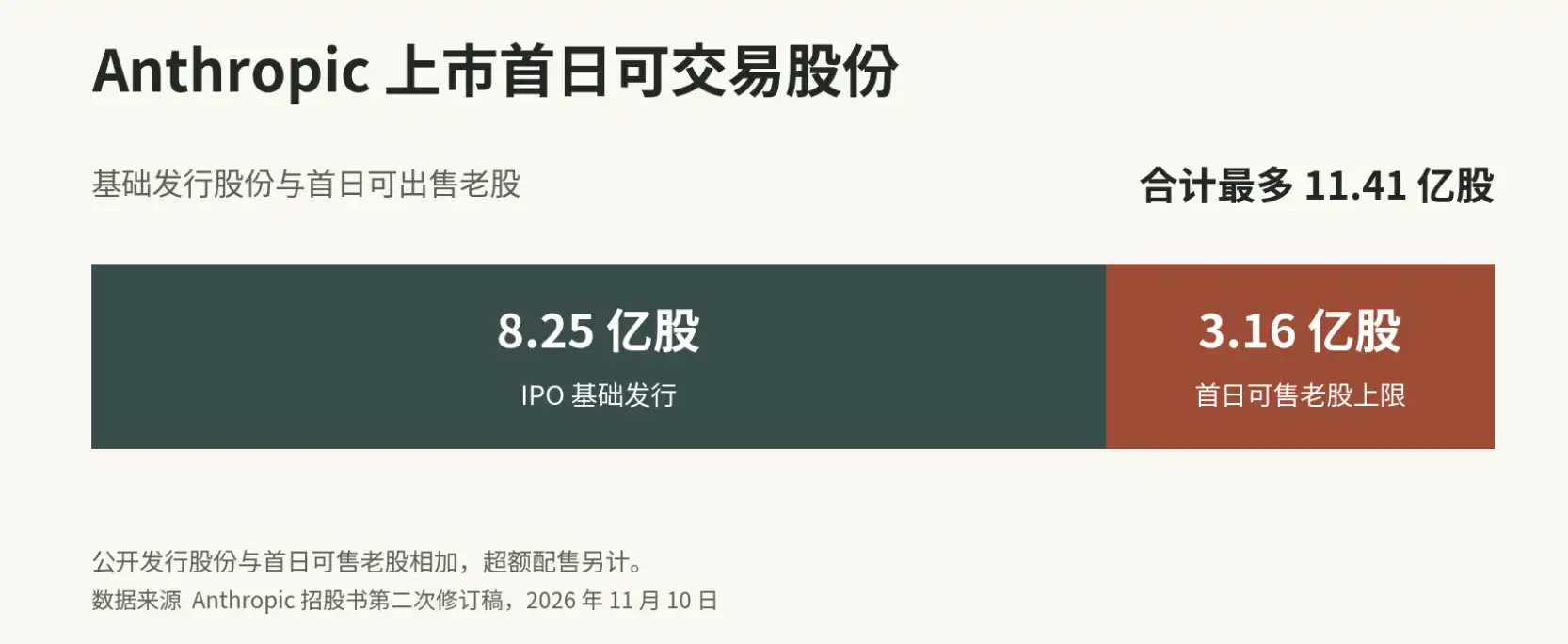
Anthropic plans to publicly offer 825 million shares at $70 to $78 per share. By the time the stock officially trades on Nasdaq, buyers may encounter another group of sellers. According to the prospectus, among shares held by certain directors, executives, current and former employees and consultants, up to 316 million shares will become eligible for sale from the first trading day. At $74 per share, this batch is worth about $23.4 billion, equivalent to nearly 40% additional potential supply on top of the base offering. To determine exactly how many shares may enter the market on the first day, one must calculate from the respective sale arrangements for the two batches of shares.
Up to about 1.141 billion shares on the first day, who can sell?
The first batch is the 825 million Class A shares in the public offering. Of these, about 801 million shares are newly issued by the company, and about 23.65 million shares are being sold by seven co-founders through the IPO. At $74, each of the seven founders is selling about $250 million worth of shares, with proceeds going to the selling shareholders. This transaction closes with the IPO, and the relevant shares are already included within the 825 million shares. Public offering shares can generally be traded after listing, while certain directors and their affiliated entities, if allocated according to disclosed subscription intentions, must still comply with applicable lock-up restrictions.
The second batch is up to 316 million existing shares eligible for sale on the first day. Under the prospectus arrangements, certain shares held by non-founder directors, executives, current and former employees and consultants may be sold from the first trading day. The prospectus footnotes specifically name the chief financial officer and chief accounting officer. Holders may choose when to sell, and actual transactions must also comply with applicable resale rules. The 316 million shares therefore represent the upper limit of this batch of existing shares eligible for sale on the first day.
Adding the two parts together, FourWeekMBA estimates that up to approximately 1.141 billion shares could enter the public market on the first day, about 1.38 times the base offering size. Subscribers can continue to hold, and existing shareholders can also wait to sell later. The same shares may change hands multiple times during the trading session, so even if first-day volume is high, volume alone cannot reveal how many employees or other existing shareholders sold shares.
How does the over-allotment option affect supply?
If the underwriters allocate more than 825 million shares to investors, they need to cover the shortfall. The prospectus grants the underwriters a 30-day over-allotment option allowing them to purchase up to an additional 123.75 million Class A shares from Anthropic. Within that limit, the underwriters may also buy back shares in the open market to cover the shortfall. The two approaches have different effects on supply. Exercising the option with the company brings new shares, while open-market purchases add buying demand. The final offering size depends on how much the underwriters actually exercise.
There is also a $26 billion strategic placement, with Google, Nvidia, AMD, Broadcom, Micron, Microsoft, and TSMC participating at the IPO price. At $74 per share, the seven companies will receive approximately 351 million Class N shares, with delivery planned after the public offering closes. These shares are subject to resale restrictions and must be registered or qualify for an applicable exemption before entering the public market, so they are listed separately outside the first-day supply estimate.
After the first day, how many lock-up release batches are there?
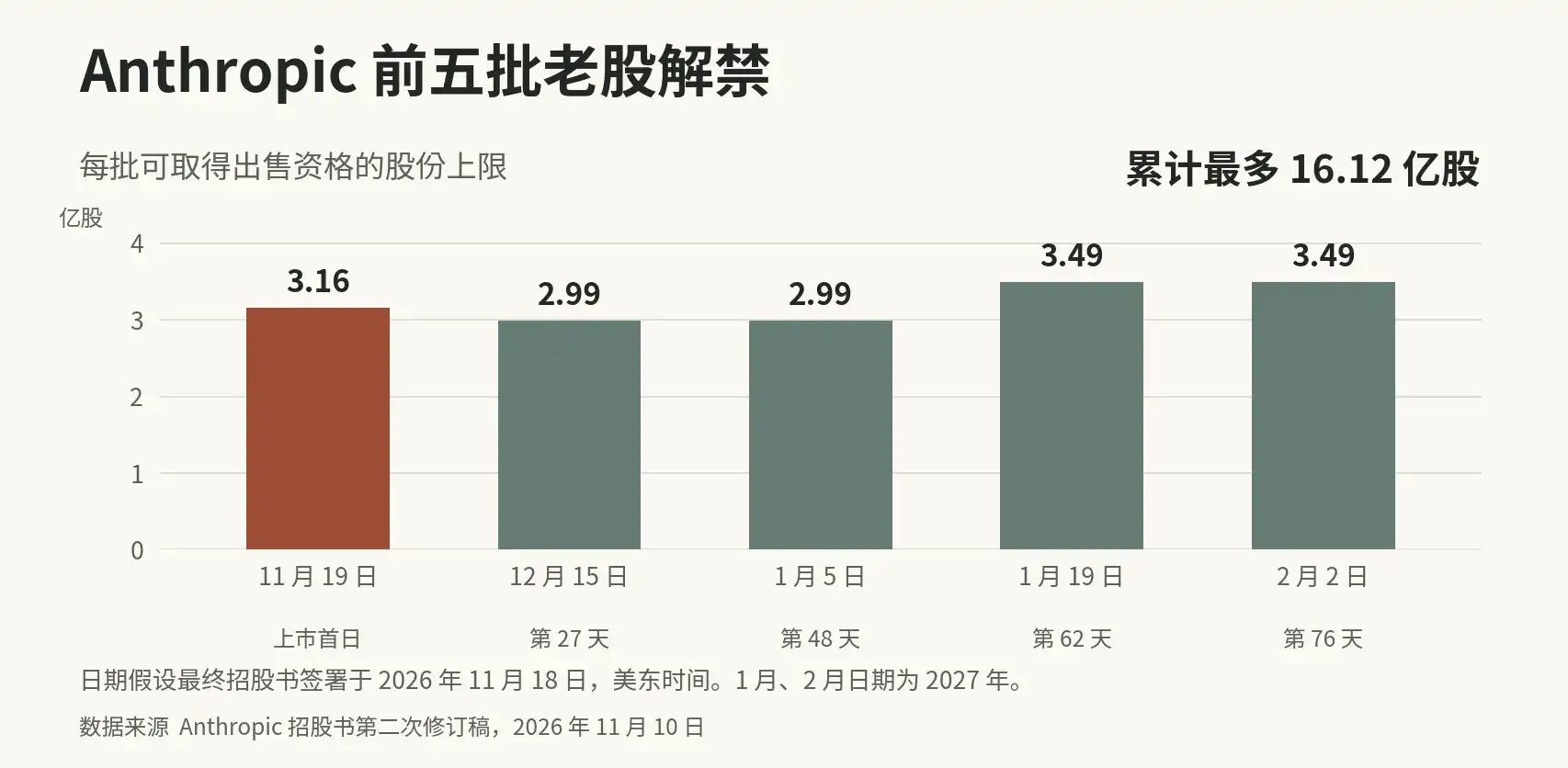
If the final prospectus date is November 18 Eastern Time, the four fixed-date lock-up releases after the first day fall on December 15, January 5, 2027, January 19, and February 2. The first two batches each cover up to 299 million shares, and the latter two batches each cover up to 349 million shares. Together with the 316 million shares on the first trading day, the first five batches total up to 1.612 billion shares, about 1.95 times the base offering size. They are distributed across five points in time, and shareholders can choose when to sell after each batch's lock-up expires.
Further out, two larger unlock tranches are tied to financial reports. On the second full trading day after the release of fiscal 2026 results, up to another 1.7 billion shares will become eligible for sale—a single tranche exceeding the combined cap of the first five tranches. Another tranche of up to 3 billion shares will unlock on whichever comes earlier: the second full trading day after the release of the first-quarter 2027 report, or the close of the 180th day after the prospectus date.
These arrangements mean that potential supply on the first day of trading will mainly come from IPO shares and old shares held by parties such as the first batch of employees that are eligible for sale. When annual and quarterly financial reports are released, the market will also face a new, larger round of unlocks. At that point, earnings will change what price investors are willing to pay, while unlocks will change how many holders are willing to accept that price and sell.
Welcome to join the official BlockBeats community:
Telegram Subscription Group: https://t.me/theblockbeats
Telegram Discussion Group: https://t.me/BlockBeats_App
Official Twitter Account: https://twitter.com/BlockBeatsAsia
