In the previous Bitcoin bull market, U.S. spot ETFs were an unavoidable driving force.
1.26 million coins—this is the total number of Bitcoins held by U.S. spot Bitcoin ETFs as of November 16, 2026, surpassing the largest single stock in the Bitcoin network, namely the approximately 1.1 million Bitcoins generally believed to have been mined by Satoshi Nakamoto in the early days and never moved since. From their listing in early 2024 to this point, these products took less than three years to become the largest holding group of Bitcoin.
Spot Bitcoin ETFs changed the way traditional capital participates in Bitcoin investment. Investors no longer need to manage wallets and private keys; through familiar bank or brokerage accounts, they can add Bitcoin to their portfolios. The success of U.S. products represented by IBIT has already demonstrated the potential of this channel, and now Switzerland has welcomed its own version.
On October 20, 2026, BIT's wholly-owned Swiss asset management subsidiary BIT Asset Management AG (BIT AM) received approval from FINMA (Swiss Financial Market Supervisory Authority) to launch the Bitcoin Fund ETF, ticker BBIT, expected to list on the SIX Swiss Exchange in November. This Singapore-headquartered group, formerly known as Matrixport, is backed by an asset management institution with even earlier roots in Switzerland: founded in 2017, obtained a FINMA asset management license in 2018, and joined the group in 2024.
BBIT is Switzerland's first ETF to directly invest in Bitcoin and is currently the only spot Bitcoin ETF in Europe. The U.S. has IBIT, and non-U.S. markets now have BBIT. Between the two, what is worth comparing goes far beyond a single letter.
What made BBIT's approval so difficult?
From submitting the application in April 2025 to approval this October, BBIT took about a year and a half.
Europe has long had Bitcoin ETPs, so why did BBIT's approval still take so long? This starts with the difference between debt-based ETPs and funds.
Common Bitcoin ETPs use a debt instrument structure. Investors buy a note that tracks the price of Bitcoin, and the issuer fulfills redemption obligations according to the terms. If the issuer collapses, how investors can pursue those assets depends on the product's collateral and legal arrangements.
BBIT, on the other hand, is a Swiss fund. Investors purchase fund shares, and the Bitcoin held by the fund is segregated from the management company's own assets. Even if the management company goes bankrupt, these Bitcoins cannot be used to repay the company's debts. BBIT also discloses its holdings daily, letting investors know how much Bitcoin the fund actually holds.
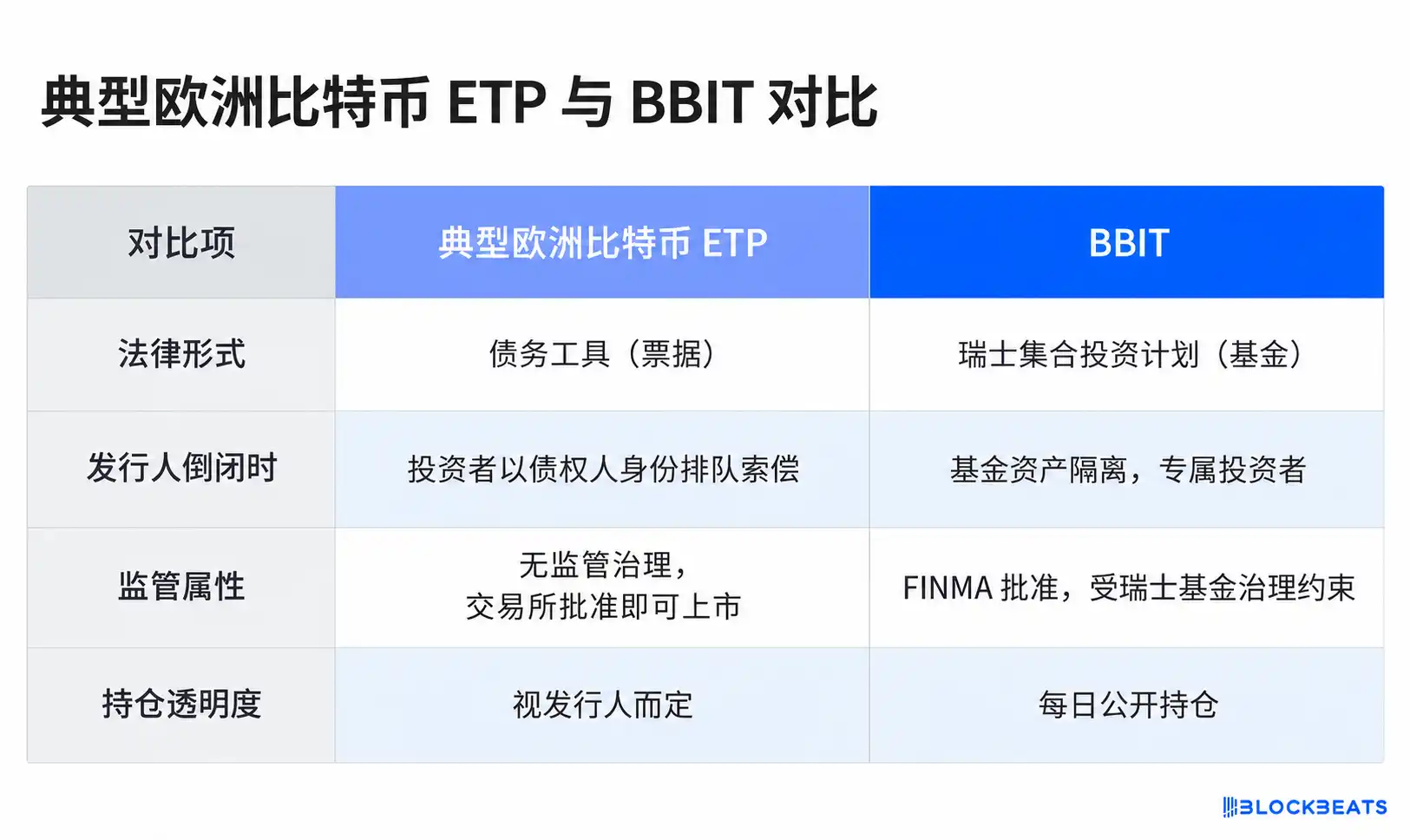
The FINMA announcement noted that other fund managers have also submitted or announced related applications, while BIT AM was the first to receive approval. During the application process, BIT AM needed to address three challenges: obtaining an exemption from risk diversification rules, meeting Bitcoin custody requirements, and meeting investor protection standards for retail sales.
The first is risk diversification. Swiss fund rules typically require diversified investment to avoid concentrating risk in a single asset, yet BBIT seeks to concentrate its holdings in Bitcoin, so it needed FINMA approval for an exemption to operate in this manner. FINMA's rationale was that Bitcoin already has a relatively long trading history and trading volume significantly higher than other cryptocurrencies. This exception applies only to Bitcoin; other cryptocurrency funds have not currently received the same treatment. Prior to this, single-asset physical ETFs in Switzerland were mainly gold and other precious metal products.
Next is custody. After the fund purchases Bitcoin, who holds it, who can transfer it, and what happens if the custodian goes bankrupt? These questions must all have clear answers before the product is launched.
In guidance published on January 12, 2026, FINMA set out requirements for the operational and custody risks of crypto assets. According to the arrangements disclosed by BBIT, Bitcoin is stored in segregated cold storage at a Swiss bank. Cold storage reduces the risk of private keys being exposed to networked environments, while asset segregation ensures that clients' Bitcoin is not included in the custodian's bankruptcy estate. Private keys must be managed properly on the technical side, and asset ownership must be clearly delineated on the legal side — both aspects must be addressed.
Finally, there are the requirements for retail sales. Opening up to retail investors adds another layer of sales requirements. Switzerland's first crypto fund, approved in 2021 — also a BIT AM product — was only available to qualified investors; BBIT, however, allows ordinary investors to participate. Therefore, sales institutions must also comply with the Swiss Financial Services Act, clearly explain product risks, and where applicable assess whether the product is suitable for the client. After the fund is approved, who it is sold to and how it is sold are likewise subject to regulatory constraints.
Switzerland's ability to review such products is also related to its independent fund regime. The UCITS fund framework commonly used in the EU imposes requirements on investable assets and diversification, making it difficult to directly hold a single Bitcoin asset in compliance with these rules. Switzerland is not an EU member, so FINMA can review applications under Swiss fund law and grant exemptions where conditions are met.
Therefore, what BBIT needs to address over this year and a half is a comprehensive set of issues, from fund design to custody arrangements, and to retail sales requirements, all of which require experience to support. BIT AM's ability to obtain approval first is backed by years of accumulated Swiss asset management business experience. This journey began before it joined the BIT Group.
Why BIT? The answer lies in the growth history of the Swiss team
In 2017, Crypto Fund AG was established in Switzerland, and the following year, it became the first asset management institution approved by FINMA to focus on crypto assets.
Since then, this institution has gradually accumulated management experience across different types of crypto investment products. In 2021, its Crypto Market Index Fund was approved for qualified investors, allocating to multiple crypto assets by tracking the SIX Crypto Market Index 10. In 2023, the business further extended to debt-type ETPs. Today, BBIT is advancing its product line to a single-asset spot fund for retail investors, which is also a concentrated reflection of this experience.

In September 2024, Matrixport, the predecessor of BIT Group, acquired this asset management institution from Crypto Finance, a subsidiary of Deutsche Börse, and subsequently renamed it Matrixport Asset Management, and then today's BIT AM. The acquisition took over a Swiss asset management business that had been operating for years, including the licensed entity, product experience, and institutional service capabilities.
The current management team also has backgrounds connecting both types of markets. CEO Dominik Oggenfuss has over 25 years of financial industry experience and was formerly a partner at Welsbach; COO Hui Wang previously worked in compliance at UBS, Credit Suisse, and Julius Baer; CIO Friedrich Herzog has experience at Goldman Sachs.

Today, BIT AM's product line includes funds, ETPs, actively managed certificates (AMC), and discretionary asset management, and it cooperates with independent Swiss securitization SPVs to customize products for banks, asset management institutions, and family offices. Its Digital Technologies Fund registered in Liechtenstein also invests in listed stocks in themes such as fintech, data infrastructure, and AI.
It is evident that BBIT only came into existence after a mature team, years of practice, and a well-established asset management system were in place. Before launching BBIT, the team had already provided valuation reports, asset custody arrangements, and compliance support to institutional clients, accumulating extensive experience in product operations and compliance management. Therefore, behind this regulatory application lies an asset management system that has been operating in practice for years.
From Asia to Switzerland, how is the compliance map connected?
First, the approval of BBIT means that BIT's Swiss asset management business has passed a review of a specific product on top of its licensed operations. An asset management license allows BIT AM to conduct the relevant business, but it does not mean that every product it launches is automatically approved. To launch BBIT, FINMA still needed to review how Bitcoin is custodied, how risks are managed, and how the fund operates and discloses information. This approval translates BIT AM's compliance capabilities into a Bitcoin fund offered to retail investors.
At the same time, different entities under the group also hold a Major Payment Institution license in Singapore, as well as a Trust or Company Service Provider license and a Money Lenders license in Hong Kong, which together with BIT AM's Swiss asset management business form the group's compliance footprint across Asia and Europe.
More directly, eligible investors now have another option for holding Bitcoin through traditional financial accounts.
The U.S. market already has IBIT, and BBIT offers a Swiss version with similar logic: direct Bitcoin holdings, custody by a Swiss bank, daily disclosure of holdings, and planned listing on SIX. Investors hold fund shares through bank or brokerage accounts that support the product, without needing to manage private keys themselves. European trading hours also provide Asian investors with an option outside U.S. market hours.
For clients who already hold large amounts of Bitcoin, in-kind subscription is particularly noteworthy. BBIT supports BTC in-kind subscription, allowing eligible coin holders to subscribe for fund shares with Bitcoin without first selling coins for cash. BTC already held can thus be converted into fund holdings in a securities account and incorporated into existing wealth management arrangements, and BBIT's management fee will also be lower than IBIT's.
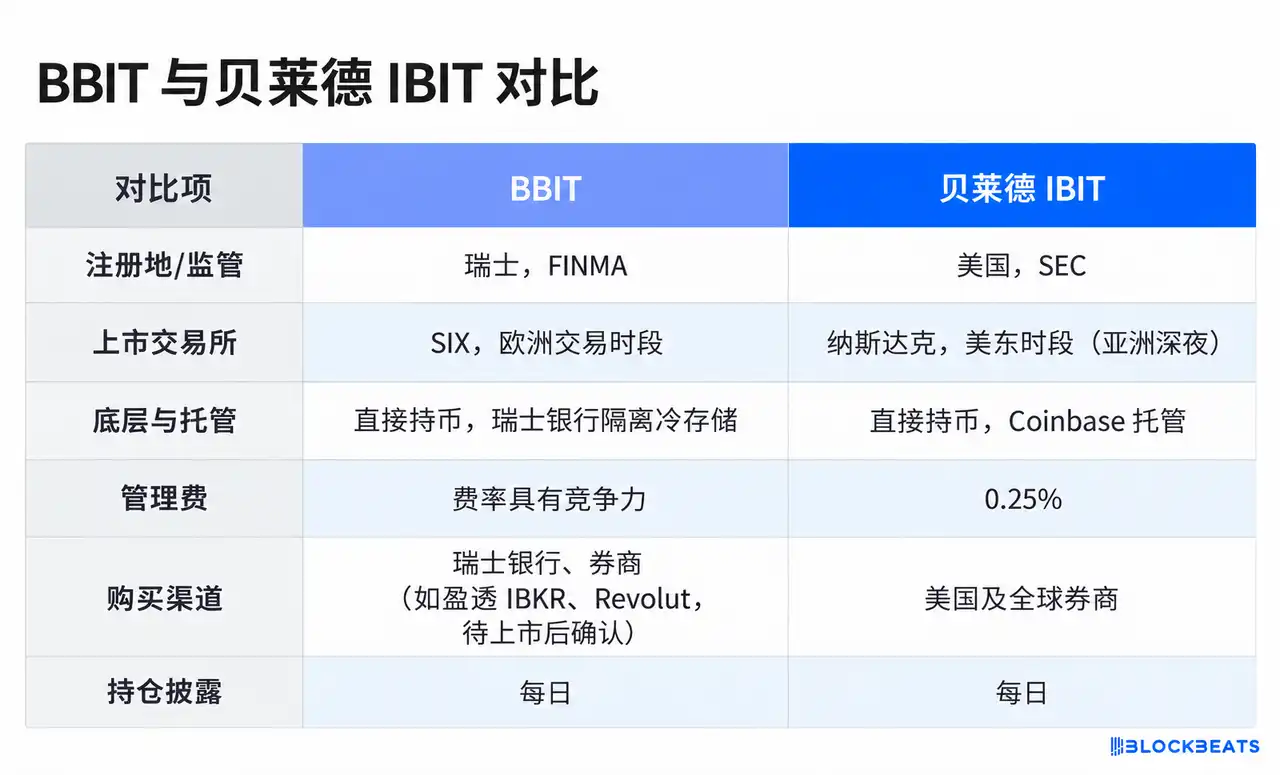
Against the backdrop of rising geopolitical uncertainty, more and more investors are beginning to value diversification of the jurisdictions where their assets are located. Switzerland has long pursued a policy of neutrality, with a stable legal system and financial regulation, and has always been an important center for international wealth management. For investors whose main assets are already concentrated in the U.S. market, BBIT provides an option for holding Bitcoin outside the United States.
For Asian clients, BBIT means an additional product option for holding Bitcoin under the Swiss regulatory framework. Investing in US ETFs not only falls during late night to early morning hours in Asia, but may also involve US legal jurisdiction and estate tax issues. BBIT is registered in Switzerland, custodied by a Swiss bank, and listed on SIX, with trading hours roughly corresponding to Asia's afternoon to around midnight. BBIT's features allow investors to make choices based on their own account arrangements and asset allocation needs (specific tax implications depend on individual circumstances; this article does not constitute tax advice).
Switzerland's wealth pool — how large a Bitcoin ETF can it support?
For high-net-worth families globally, Switzerland has long been one of the preferred destinations for cross-border wealth. This status comes from historical accumulation: long-term political stability, a tradition of neutrality, a sound rule of law, and a robust Swiss franc have made Switzerland a home for international wealth for generations. To this day, approximately CHF 2.9 trillion of global cross-border private wealth is custodied in Switzerland, accounting for over 23%, with clients from Western Europe, Asia, the Middle East, and Latin America. Total assets under management across the Swiss banking sector exceeded CHF 10 trillion for the first time in the first half of 2026, with nearly half coming from overseas clients. These assets cannot be directly equated with cash waiting to buy ETFs, but they sufficiently demonstrate the depth and internationalization of Switzerland's wealth management market.
The key to BBIT's scale potential lies in whether it can enter these clients' investment accounts through private banks and asset management institutions. Many high-net-worth clients are accustomed to having their wealth managed by private banks, asset managers, or family offices. Even if clients are willing to allocate to Bitcoin, the institutions serving them need to first resolve product access issues before it can be incorporated into investment portfolios.
Directly holding coins requires managing wallets, private keys, and asset custody; buying debt-based ETPs requires evaluating the issuer and collateral protection. BBIT adopts a Swiss fund structure, with corresponding arrangements for custody, valuation, and information disclosure, making it easier for local institutions to evaluate the product through familiar fund review processes. Once internal institutional approval is obtained, clients have the opportunity to allocate to Bitcoin within their existing accounts, without needing to establish a separate set of coin-holding and management processes.
This is also the market BIT AM aims to open up. CEO Dominik Oggenfuss, in an interview with Finews, a prominent Swiss financial news media outlet, listed private banks and pension institutions as target clients. For BBIT, establishing distribution and allocation relationships with these institutions is an important step in driving scale growth after approval.
The U.S. market has already demonstrated the absorption capacity of mainstream channels. As of October 23, 2026, IBIT's net assets stood at approximately $65.9 billion. ETFs have brought Bitcoin into securities accounts, enabling brokers and wealth management advisors to incorporate it into their existing service systems. Following this pattern, BBIT therefore has the opportunity to reach a far broader investor base than crypto trading platforms.
The Hong Kong market provides another scale reference. About two and a half years after spot Bitcoin ETFs were listed, the top products' scale remains at approximately $200 million. After a product is approved and listed, how many banks and brokers can be leveraged to reach customers, and whether it can enter wealth management institutions' allocation lists, remain important factors affecting scale growth.
Switzerland's concentrated high-net-worth clients and mature private banking channels provide BBIT with room for expansion. If it can successfully access these channels and attract traditional wealth management capital, BBIT's scale is expected to surpass the largest single Bitcoin ETF currently in the Hong Kong market.
Beyond ETFs, BIT is building a two-way bridge
From September to October, BIT's moves were not limited to BBIT. Securities, gold tokens, and Swiss custody have all been advanced in succession, pointing in the same direction: bringing traditional assets and digital assets into accounts and trading systems that more people are familiar with.
The securities business and BBIT happen to form two directions. BBIT brings Bitcoin into traditional investment accounts, while BIT Securities brings stock trading to crypto users. After offering U.S. stock services in February this year, BIT launched Hong Kong stock trading on October 12 and upgraded to the BIT Securities brand. Users can deposit with USDT or USDC to participate in Hong Kong Stock Exchange Main Board and GEM trading, as well as eligible IPO subscriptions and margin trading (the service is not available to Hong Kong residents).
This business is operated by Matrix Gelephu Pte. Ltd., which holds a Bhutan GFSO license. Hong Kong stock trading execution and custody are provided by Atomic Vaults Asia, a Hong Kong SFC Type 1 licensed broker.
The gold token XAUm connects physical assets with on-chain circulation. On September 23, BIT's Matrixdock brought XAUm to Circle's Arc, making it the first tokenized gold asset on that network, with same-day USDC settlement for eligible redemptions. Each XAUm corresponds to one troy ounce of physical gold, with gold bars stored in Brink's and Malca-Amit vaults in Hong Kong and Singapore, accompanied by independent audits and reserve disclosures.
On October 9, BIT invited clients to visit the Le Freeport vault near Singapore Changi Airport. This vault, known as Asia's Fort Knox, gives the gold tokens that usually appear in accounts a tangible physical form: gold bars are displayed in glass cases, and clients can learn about gold custody methods up close. As of the time of writing, BIT's official website discloses that XAUm reserves are approximately 540 gold bars, about 17,359 troy ounces, with a market value of approximately $70 million.

As the variety of investable assets increases, institutions also need corresponding custody services. On September 30, Cactus Custody launched Swiss custody, with private keys and client data kept in Switzerland, initially supporting 18 networks and 132 assets. For institutions hoping to store digital assets and related data in Switzerland, this provides a local service option and also extends BIT's Swiss business from asset management to institutional custody.
This service is provided by another BIT Group subsidiary in Switzerland, the Swiss entity ChainTech AG, which is a member of the Swiss self-regulatory organization VQF. Cactus's Swiss custody and BBIT are two independent businesses; BBIT's bitcoin is custodied by the Swiss bank AMINA. Together they expand the group's range of services in Switzerland, but each bears different responsibilities.
From these directions, BIT's Bridge Into Tomorrow has concrete content: stocks moving toward crypto users, gold entering on-chain, bitcoin entering traditional investment accounts, and custody providing institutions with an asset custody foundation. A crypto-native group is extending its business into a financial services network composed jointly of traditional assets and digital assets.
From product approval to actually entering investment accounts
The approval of BBIT extends BIT's bridge connecting traditional finance and digital assets one step further. With its Asian business as the foundation and Swiss licensed asset management and bank custody as support, bitcoin now has a new path into local wealth management accounts.
As securities, gold tokens, and institutional custody businesses gradually unfold, Bridge Into Tomorrow also has a concrete direction: enabling investors in both types of markets to access a broader range of assets through familiar methods.
Welcome to join the official BlockBeats community:
Telegram Subscription Group: https://t.me/theblockbeats
Telegram Discussion Group: https://t.me/BlockBeats_App
Official Twitter Account: https://twitter.com/BlockBeatsAsia
