Editor's note: A $11,000 buy order hadn't even filled yet, and two people watching it decided to immediately buy over $1 million of the same token.
Three days later, Robinhood announced the listing of cashcat. According to the author, he and his partner made over $4 million from this trade, and later made another $2 million on PONS with friends.
Why did that small pending order make them suddenly accelerate their buying?
On August 3, the author's tracker caught a signal he had been waiting weeks for: market maker Wintermute approved the cashcat/WETH trading pool. He and his partner had planned to buy in batches to avoid pushing up the token price all at once. Thirty-one minutes later, a wallet the author suspected belonged to a Robinhood insider placed a limit order. This address had appeared multiple times before listings in the past, and other traders were watching it too. Even though the order hadn't filled, everyone could already see what it wanted to buy. The two then abandoned their gradual accumulation plan and pushed their holdings to over 4% of cashcat's total supply in one go.
The starting point of this trade was a casual check. Before Robinhood Chain launched, the author saw a listing announcement and wondered whether anyone had transferred tokens into Robinhood's hot wallet in advance. He found that Wintermute had completed the transfer about an hour before the announcement, and looking back at earlier listing records, he repeatedly saw the same sequence. Once Robinhood had its own chain, the author began specifically tracking Wintermute's wallets and trading contracts on that chain, and also kept an eye on public code updates from custody partner BitGo.
On July 27, cashcat appeared in a public code update from BitGo. But many exchanges use BitGo, so based on that alone, the author couldn't determine who had made the request. Two days later, cashcat entered BitGo's release version alongside 99 stock tokens on Robinhood Chain, giving him more confidence to link it to Robinhood. By then, he and his partner already held 1.5% of the total supply and had set conditions for a major add-on: seeing Wintermute whitelist cashcat, or catching a cashcat transfer between it and Robinhood. On August 3, Wintermute's approval of the trading pool provided the market-making signal they had been waiting for.
They used public information to front-run orders, and their own moves were quickly spotted by the market. Concentrated buying pushed up the coin price, and soon accounts posted both wallet addresses, prompting more traders to speculate about a listing. By the time PONS appeared, the author concluded that others had already figured out Wintermute's contract patterns and could only follow the existing clues further upstream. As for PONS's later "listing," the author suspects it was a setup by Robinhood to identify insiders.
Looking at the two trades together, the most interesting part is how the author decided how much to buy at each step. When he saw the custodian update, he built part of a position first. When he saw the market maker select the trading pool, he prepared to add significantly. When that limit order put the buying intent on the table, he changed his execution pace again. From first discovering the transfer pattern to finally deciding to buy in one go, with every additional clue in between, the size of the bet he could place was different.
The original text follows:
First, thanks to @Cbb0fe for the inspiration. Reading about how he found asymmetric opportunities taught me a lot. Recently, people have often DM'd me asking how to find trading edges on-chain. My replies to everyone are pretty similar, so I wanted to write an article so that when people ask in the future, I can just send them this.
For most of you, 95% of your money will be made in the 5% of time you spend on-chain. Most of the time, you should try more things and let curiosity take you around. Many of the top bot players and traders I know share this trait. In the AI era, people's past advantages in low-level details like writing code will mostly fade away, while your ability to think abstractly at the system level will bring exponential returns. Once you spot a possible asymmetric opportunity, you have to keep finding ways to attack the problem in front of you from different angles.
This ability to find ways often shows up in tedious work. I keep adding new wallets and infrastructure to my tracking scope, improving tools, and polishing every part of my process. Over time, many small improvements stack up and produce emergent effects. You gain an information edge far beyond what any single improvement could bring, see more clearly what is happening, and ultimately execute trades based on signals more efficiently than other market participants.
In the cashcat trade, weeks of this kind of work gave us enough of an information edge to even buy ahead of Robinhood employees themselves.
About a month before Robinhood Chain launched, I saw a listing announcement and, purely out of curiosity, wanted to see whether anyone had transferred tokens into Robinhood's hot wallet before the announcement. Wintermute transferred the tokens about an hour before the announcement. I went back and checked earlier listing records and saw the same pattern again and again. At the time, I hadn't figured out how to use it for trading, but I kept it in mind.
After Vlad followed cashcat, I, like most of you, bought a lot. My position is sizable, and my unrealized gains are substantial, but still short of the standard I set for myself. I previously bought every Ansem concept coin up to a few percent of the supply, thinking he would pump one of them, but it fell through. cashcat looks like it could be one of those once-in-a-lifetime moonshots, and I want to make up for the opportunity I missed on those Ansem coins. The Robinhood listing is clearly the biggest turning point, so I spent weeks preparing to get ahead of the market.
I started with listing schedules and public interfaces, looking for any trading pairs that appeared before the official launch. Most of what I found only let me front-run by a tiny bit. The listing announcement accounts that most on-chain fighters follow already have this kind of alert, so naturally I had to break down their information-gathering process further upstream. The general idea was to figure out who Robinhood partners with for custody and infrastructure—all public information.
That led me back to Wintermute. On Ethereum, they market-make for all kinds of clients. Seeing them prepare to trade a coin could be for many reasons. But on Robinhood Chain, the signal from Wintermute building infrastructure is much clearer. So I built a dedicated tracker for Robinhood Chain that would show activity as soon as the set of Wintermute wallets I was watching started moving.
Later I found that BitGo is also an official partner of Robinhood Chain, handling custody, so I started tracking a batch of their infrastructure and GitHub activity. My partner also had a bot ready so we could buy the moment there was movement.
By July 16, cashcat was crashing. The lower it fell, the more we could make, because we estimated that once the listing news came out, cashcat would likely spike to 200–300 on that candle. At the time, Blockscout was basically the only usable block explorer for Robinhood Chain, and it was terrible to use. I re-checked Wintermute's wallets with a custom EVM block explorer. It could read data from Robinhood Chain and other EVM chains at the same time, making it much easier to track their cross-chain activity. I took this extra step to confirm whether I had missed any wallets, and I found a Wintermute wallet. This was the first time they had funded this wallet on the chain since Robinhood Chain launched. You have to know, the chain had already been live for two weeks at that point, so it became increasingly clear to me that I needed to put more effort into this. I now genuinely had a chance to buy before the listing.
I continued digging into Wintermute's cluster of wallets on Robinhood Chain and found that some of them had deployed contracts. There were four trading contracts, all owned by the same Wintermute multisig wallet. The multisig wallet's recent transaction history showed that it had authorized operators to trade through two of those contracts.
While reviewing the code, I found a function called getAllApprovedTokens() in three of the contracts. Realizing these were trading contracts, I started monitoring for changes, because at the time their whitelist was completely empty. A few days later, they added WETH and USDG to the whitelist, and the next day they began trading that pair.
On July 27, hoodeth:cashcat appeared in a public pull request, and five seconds later, our BitGo monitoring caught it. For the first time, we had a clear signal pointing to cashcat. The main problem was that many exchanges use BitGo, and based on that alone, I wasn't about to put millions of dollars in. Still, the overall picture was becoming clearer: both Wintermute and BitGo were preparing infrastructure for Robinhood Chain.
On July 28, a follow-up update to the BitGo pull request came, one day after we received the first alert.
On July 29, BitGo's release version included both cashcat and 99 stock tokens on Robinhood Chain. That was significant because it confirmed my guess that Robinhood was the one making the request. Otherwise, how would cashcat end up in there alongside their own stock tokens?
As the evidence emerged piece by piece, my partner and I kept adding to our position. By July 29, the two of us had collectively bought 1.5% of the supply. The next day, I told him what I needed to see before I would significantly increase our position. I wanted to see Wintermute add cashcat to the whitelist, or catch a cashcat transfer between Wintermute and Robinhood. The monitoring was on, and the money was ready.
At 17:48 UTC on August 3, the tracker caught Wintermute approving the cashcat/WETH pool. That was the alert we had been waiting for. Wintermute's trading desk had chosen where to trade, and what they were going to trade was exactly what we held.
We were prepared to deploy seven figures, but if we bought it all at once, the chart would spike immediately, and everyone would have a reason to dig into our wallets. I told my partner to slowly DCA in half of the planned buy amount first, to see if anyone noticed.

Half an hour later, at 18:19, a wallet we suspected belonged to a Robinhood insider placed a $11,000 limit buy order for cashcat. We'd been tracking it because it always appeared before listings, and I knew other traders had this address too. The order hadn't filled yet, but anyone watching that wallet could see which coin it wanted to buy. I figured others would start buying before we'd accumulated enough of a position.
We abandoned the slow DCA plan, and the two of us bought over $1 million worth of cashcat, printing a massive green candle on the chart. By the time we'd accumulated enough, we held a bit over 4% of the supply.
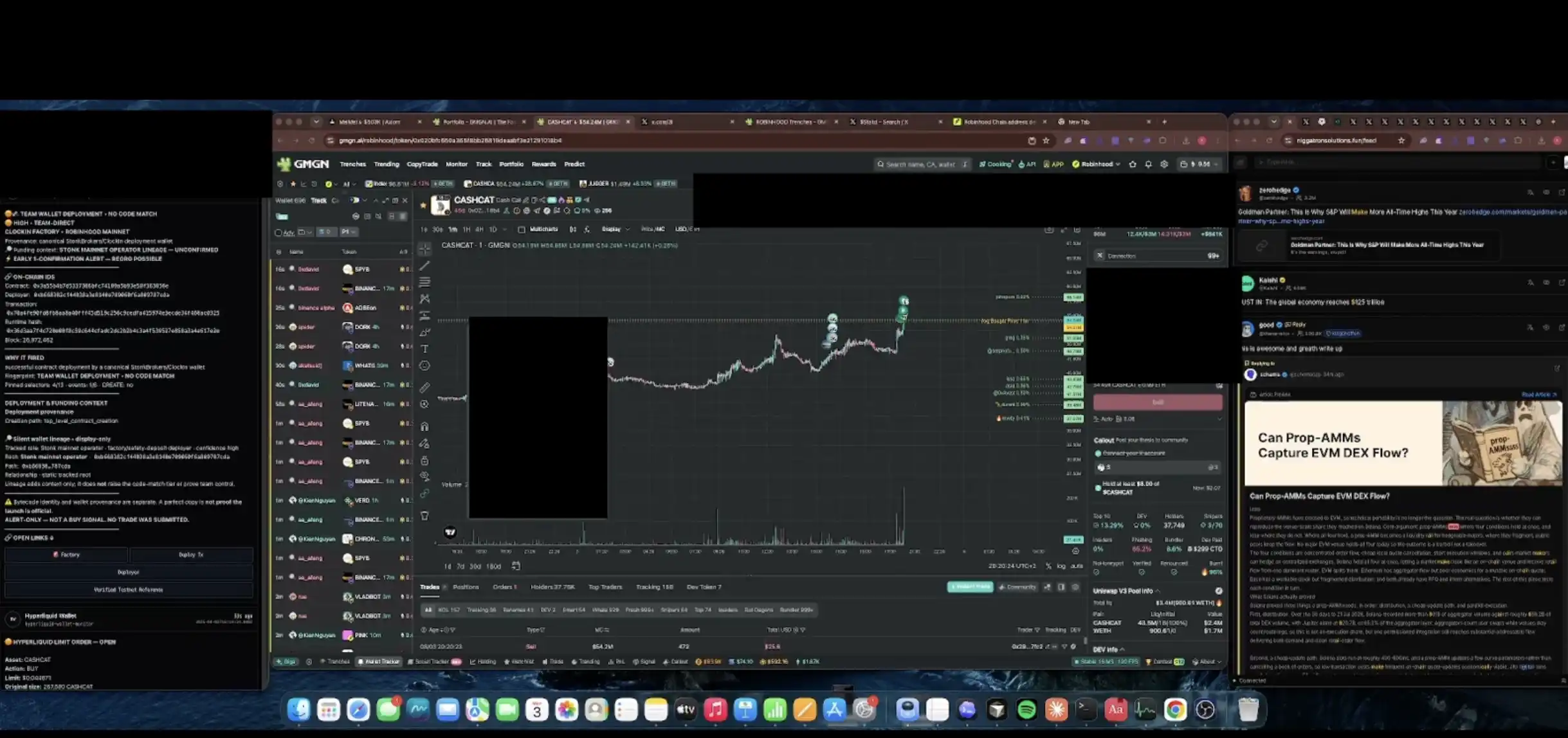
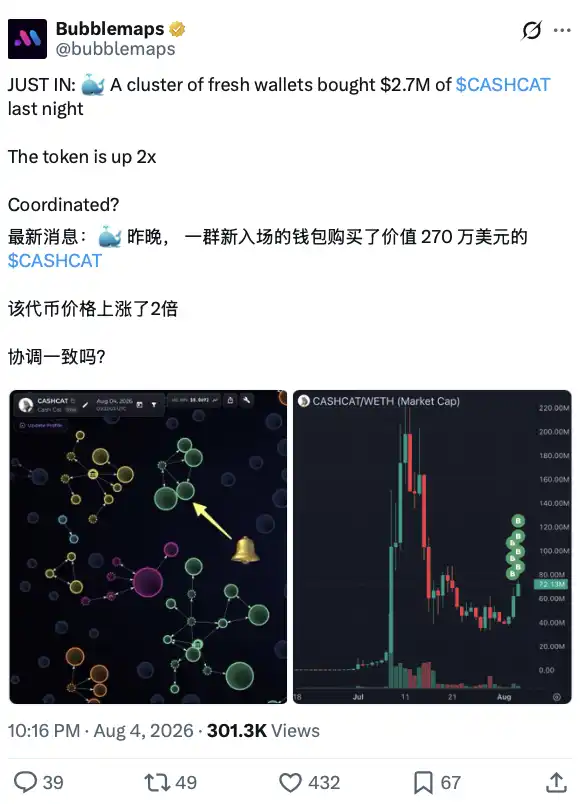
Some accounts immediately started posting our wallet addresses, which was exactly what we wanted to avoid. Once a wallet is exposed, it stirs up market speculation and gets a crowd buying before the official listing, which erodes a big chunk of our edge. This insider's lack of on-chain trading experience probably cost us millions.
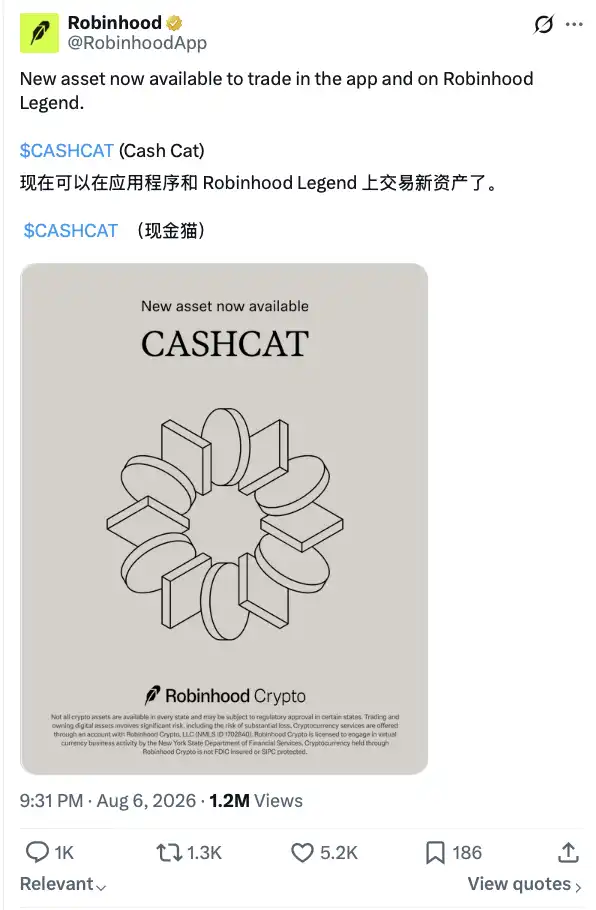
Three days later, Robinhood listed cashcat. I was dozing off at the time and missed the opening candle. I could have sold better, but my partner and I still made over $4 million combined.
By the time PONS came around, I figured most sharp traders had probably figured out the pattern in Wintermute's contracts, and waiting for the same tell wouldn't work anymore. To front-run it again, we'd have to dig further upstream in the process.
We followed the leads from the cashcat investigation and eventually found enough signals to start buying PONS on August 28. I can't go into detail about this part of the process.
Three days later, BitGo joined PONS, and not long after, Wintermute started market-making for it. Then on September 2, PONS "listed." In the end, it seems this was some kind of honeypot Robinhood set up to catch insiders. After that, most of the edge I've detailed here was eroded.
My friends and I made a total of $2 million on PONS.
Most of the details discussed here are more relevant to those who trade using bots, but you may find that many of the principles also apply to other trading styles. Overall, I have always wanted to combine pure narrative-based trading with maximizing technical advantages and executing trades well. In the future, I may write more about narrative trades I have done.
Thanks for reading.
Welcome to join the official BlockBeats community:
Telegram Subscription Group: https://t.me/theblockbeats
Telegram Discussion Group: https://t.me/BlockBeats_App
Official Twitter Account: https://twitter.com/BlockBeatsAsia
