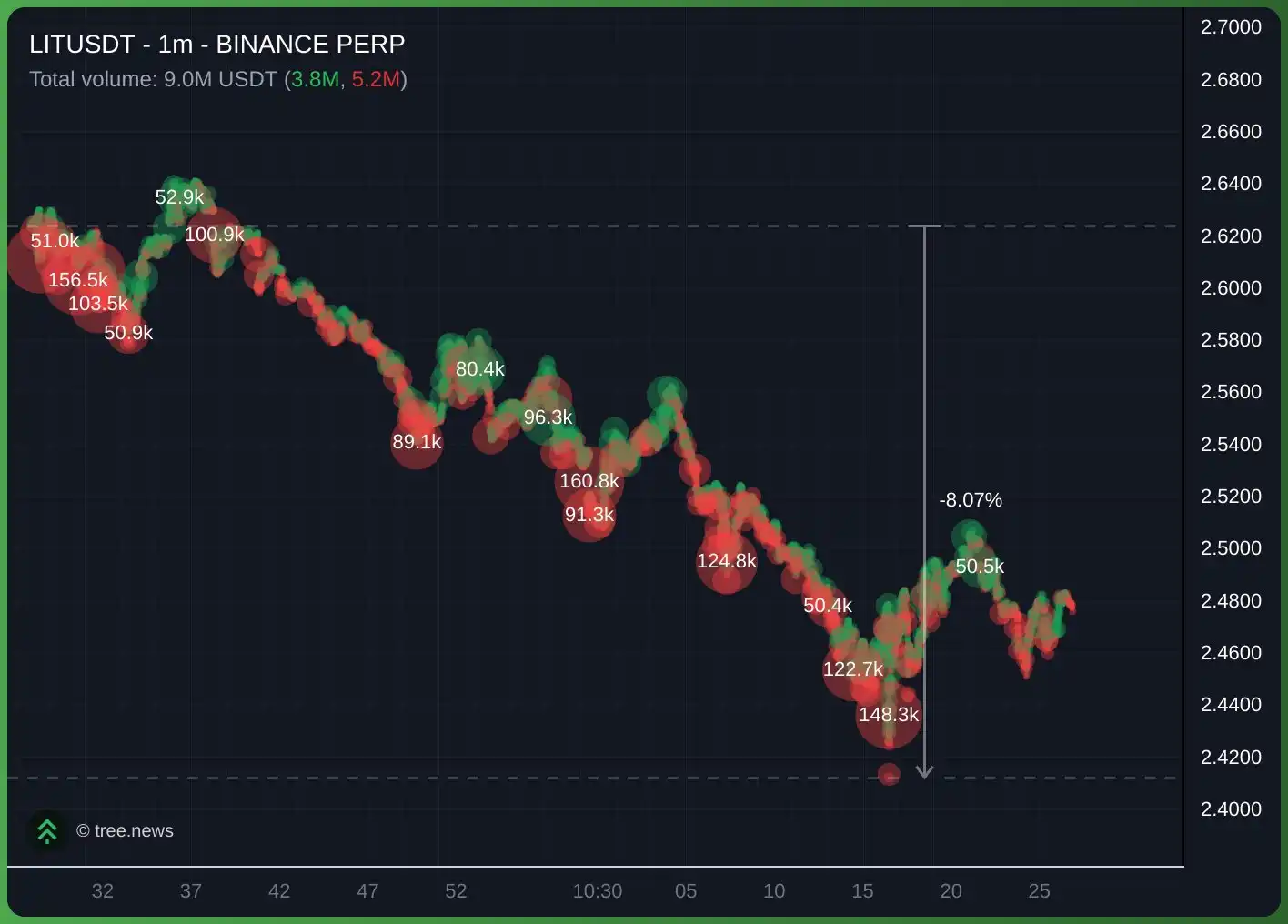
On the evening of November 16, on-chain detective MLM detected an abnormal withdrawal of 10.39 million USDC on Lighter, pushing Lighter into the spotlight of a security incident. A wallet started with only about $10,000 withdrew a large sum from the platform, quickly swapped it into ETH, and then split it across different addresses. Meanwhile, the price of LIT briefly dropped by about 8%.
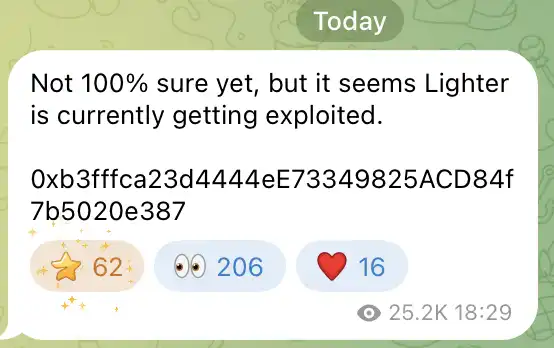
News that "Lighter was hacked" quickly spread. But as the fund path became clearer, subsequent analysis pointed the attack target at an institutional account, with clues leading to Abraxas Capital. The attacker is suspected of obtaining its trading API key and then exploiting the permission design of a public pool to transfer the funds in the account into their own hands. The Lighter protocol itself was not hacked.
The attack began with a small test
The attack address is a wallet ending in 0xb3ff, corresponding to Lighter account #769455. Its preparations began several hours earlier than the community warning.
At 14:47:23, this address swapped a small amount of ETH into 29.959999 USDC via the Relay router and deposited it directly into Lighter.
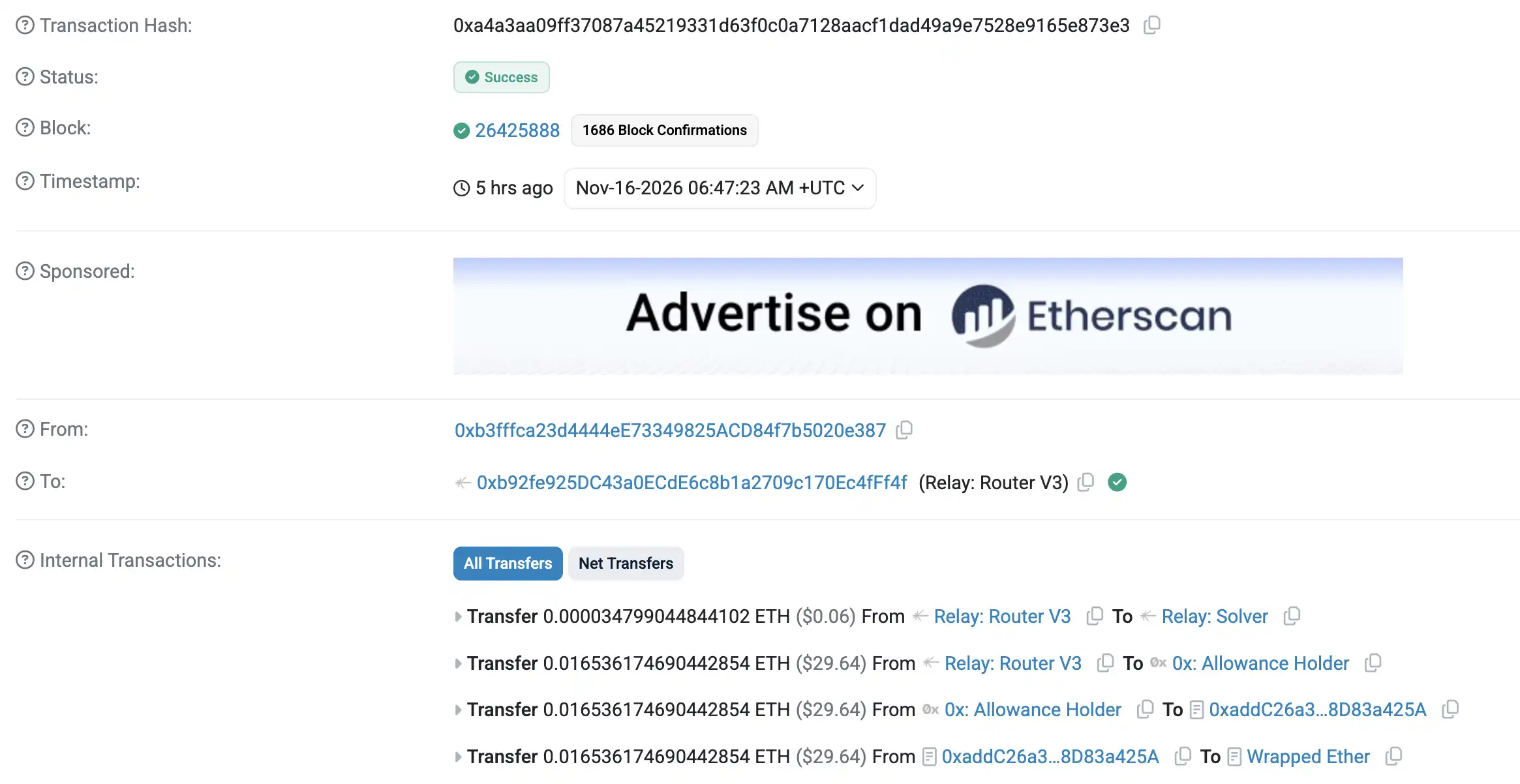
At 16:45, about 10,500 USDC arrived at the address via cross-chain transfer. At 17:35, the hacker deposited 10,200 USDC into Lighter and began preparing for the first round of operations.
At 17:40:10, Lighter account 714710 (the compromised account) created a public pool with a 0 fee. Initially, the compromised account used 1 USDC to buy pool shares, while the hacker put 9,999 USDC into the pool and obtained a 99.99% share.
This arrangement exploited the two identities of the public pool.
For the pool creator (the compromised account), the public pool is an account under its own Ethereum address, allowing internal fund transfers via API without additional signatures. For external participants, the public pool also allows the purchase of shares and redemption of assets in proportion to holdings.
Normal subscriptions would exchange for corresponding shares. This time, the compromised account used an "internal transfer," and when the funds entered the pool, no corresponding shares were added for it. As a result, the more money transferred into the pool, the more assets the attacker, who already held a 99.99% share, could redeem. This can perhaps be understood as a bug in Lighter.
The attacker first validated the path with 1 USDC.
At 17:44:13, the victim account transferred 1 USDC into the public pool. In less than 3 seconds, the attacker redeemed 9999.9999 USDC. The attacker then re-injected the funds into the pool and began scaling up the same operation.
At 17:45, the victim account made ten consecutive transfers of $1 million USDC each, followed by an additional balance of approximately $384,000 USDC. At 17:45:38, the attacker redeemed approximately $10.393 million USDC and immediately initiated a mainnet withdrawal.
Timeline
At 18:11:47, the first withdrawal was completed. The Ethereum transaction receipt shows that the Lighter mainnet contract paid 10,393,056.789298 USDC to the attacker's address.

After receiving the funds, the attacker deposited another 10,200 USDC into Lighter and applied the same method to a second victim account, 714723.
At 18:25, a second public pool was created. The victim account deposited 1 USDC, the attacker deposited 9999 USDC, and then another 1 USDC internal transfer and redemption test was performed. At 18:27, five transfers of $1 million USDC each and one residual balance entered the pool, and the attacker redeemed again. At 18:28:45, a second withdrawal request of approximately $5.097 million USDC was submitted.
At 18:29, MLM detected the fund outflow in the TG channel.
Binance's minute-by-minute market data recorded the ensuing sell-off. The LITUSDT perpetual contract opened at $2.725 at 18:29 and touched a low of $2.3218 by 18:34, a drawdown of approximately 14.8% within minutes.
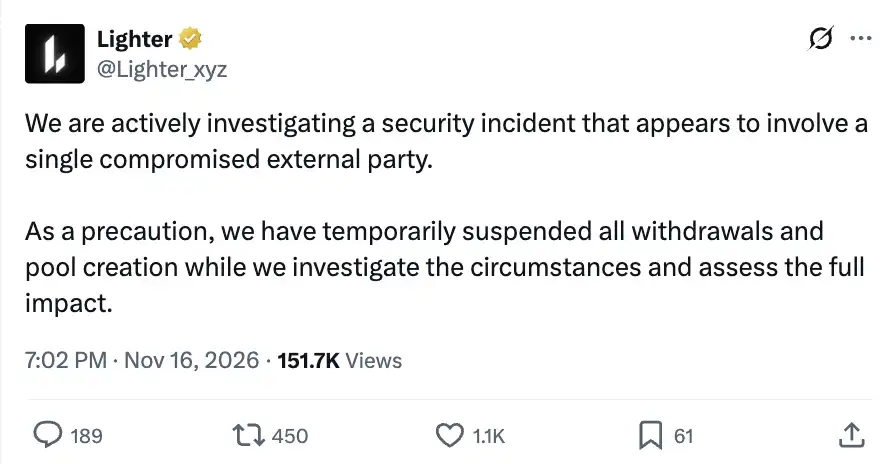
At 19:02, Lighter announced an investigation into the security incident, stating that it appeared to involve a single external entity, and precautionarily suspended all withdrawals and public pool creation.
Funds Enter Hyperliquid via Arbitrum
After the first withdrawal arrived, the attacker sold approximately $10.383 million USDC through six transactions, obtaining a total of 5,764.47 ETH-equivalent assets.
Next, the funds began to be split into tranches of 160 ETH each.
Take the sub-address starting with 0x63d09 as an example. At 18:19:59, it received 160 ETH from the main address. In less than two minutes, this sub-address called LiFi and executed a cross-chain transaction via LayerSwap.
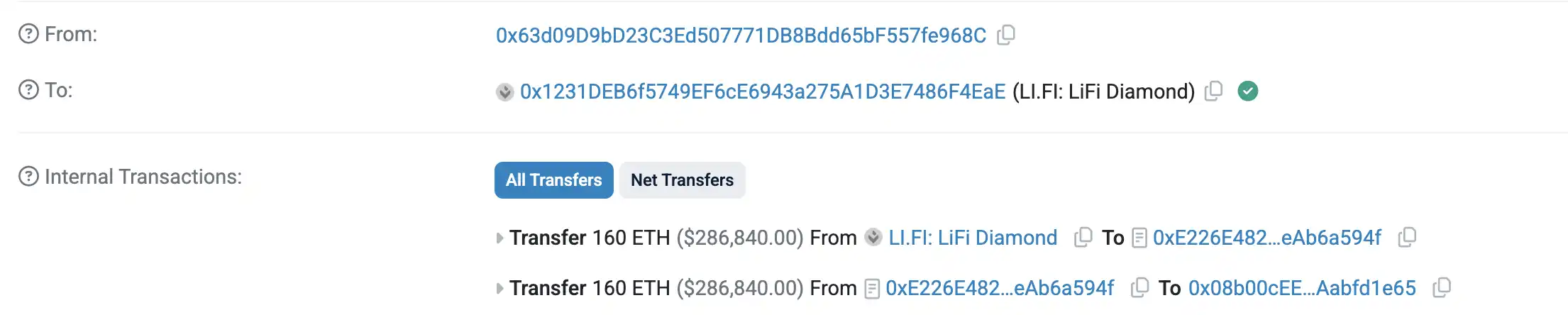
At 18:37, the same address on Arbitrum received 287,557.5548 USDC; at 18:39, it transferred the exact same amount into the Hyperliquid deposit bridge.

After the funds entered the Hyperliquid spot account, the hacker continuously bought 552 XMR1 (Monero).
The hacker's other sub-addresses are repeating this route as well. ETH is bridged from Ethereum, USDC is received on Arbitrum, and then it enters Hyperliquid to purchase the spot token XMR1.
Victim Account
Now let's look at the victim.
The Ethereum address corresponding to Lighter account 714710 is a wallet starting with 0x0d1D. On February 16, a Hyperliquid wallet 0xb83de, previously labeled as Abraxas, had transferred 0.1 ETH to it on Arbitrum to top up gas fees for this address.
This record supports the judgment that the compromised Lighter account is related to Abraxas Capital.
According to our previous institutional introduction, Abraxas Capital was founded in London in 2002 by Fabio Frontini and Luca Celati, both from traditional banking backgrounds. It initially engaged in global macro trading and pivoted to digital assets in 2017. The Elysium Global Arbitrage Fund, launched in 2018, started with Bitcoin cross-market arbitrage and later expanded into stablecoin arbitrage. On-chain data shows that the institution's assets under management have consistently exceeded $1 billion.
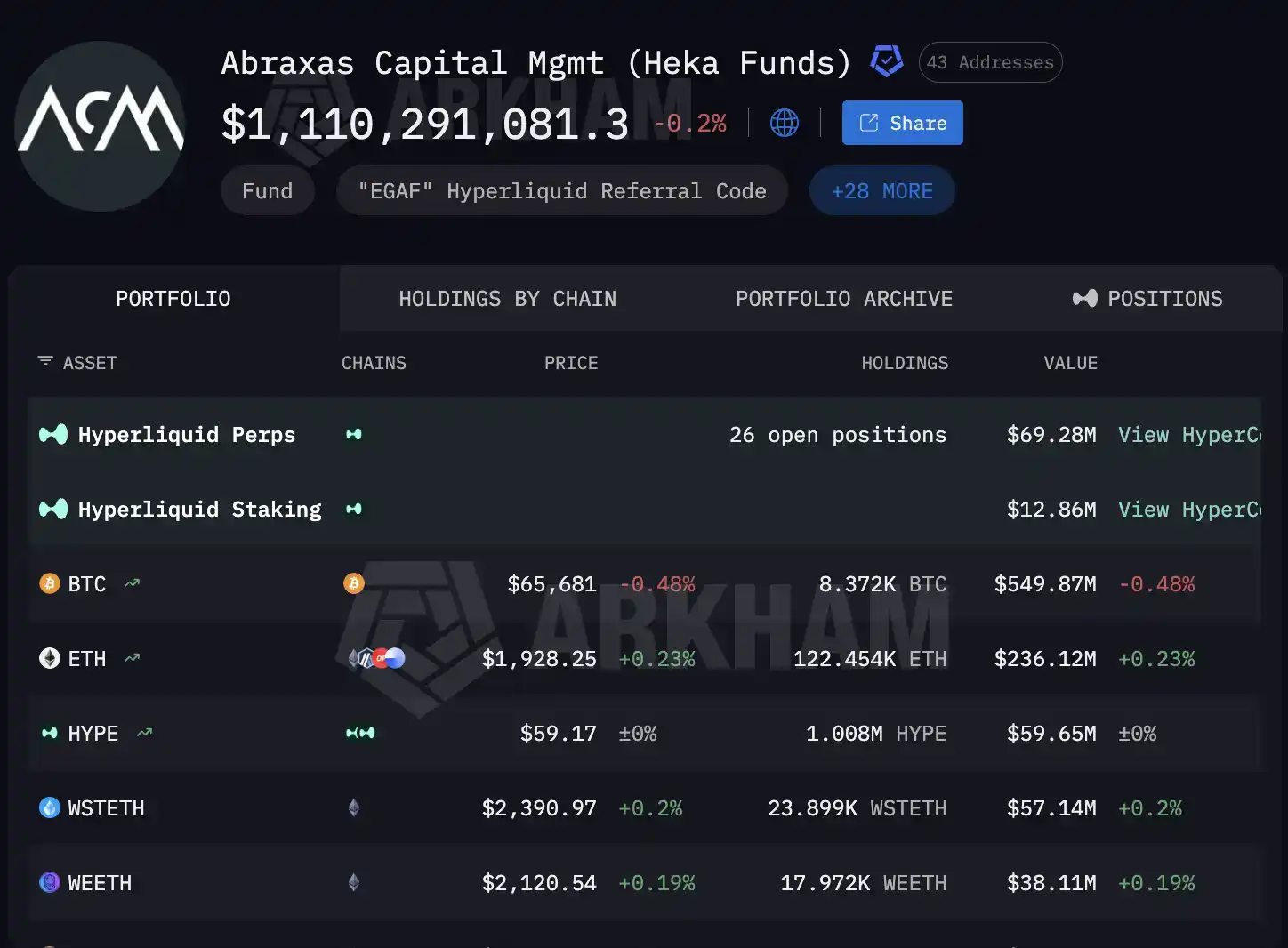
For institutions that rely on program trading, cross-platform position adjustment, and capital turnover, safeguarding API keys is part of daily operations. However, even the most meticulous precautions can miss a thing, and leaked APIs are exploited by hackers.
The shock of the Binance hack at the end of October has not yet subsided, and Lighter has now suspended withdrawals due to this security incident.
It is foreseeable that with the further development of AI, more funds will be deterred by frequent security incidents or even directly withdrawn and exit the market. The threat of hackers will remain a long-term dark cloud hanging over the crypto industry.
Welcome to join the official BlockBeats community:
Telegram Subscription Group: https://t.me/theblockbeats
Telegram Discussion Group: https://t.me/BlockBeats_App
Official Twitter Account: https://twitter.com/BlockBeatsAsia
