On November 23, 2026, before the U.S. stock market opened, Nvidia's board of directors issued an announcement: reinstating Jensen Huang as CEO.
Eleven days earlier, Jensen Huang resigned due to a personal life scandal, and Nvidia's market value evaporated by more than $1 trillion; eleven days later, with White House intervention and a unanimous board vote to bring him back, Nvidia's stock price surged 31.48% in a single day, reaching an intraday high of 36.6%, and its market value rebounded by $952 billion in one day, marking the largest single-day gain since May 2003. Short sellers across Wall Street betting on Nvidia's continued decline had $12.2 billion in paper profits wiped out within hours.
On the other side of the screen, trader Ao Ying pressed the buy button a step earlier.
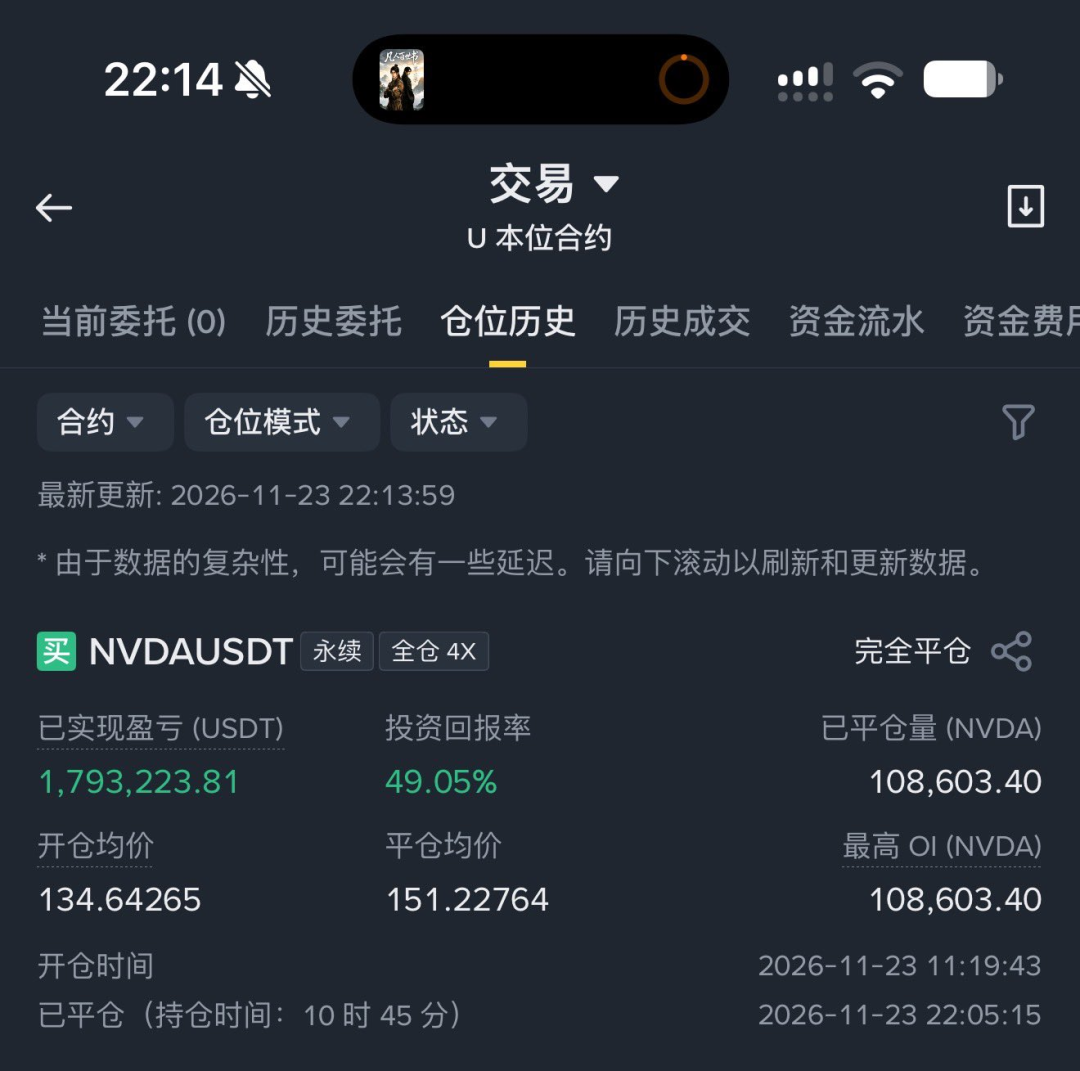
Within a dozen or so minutes after the news landed, Nvidia's stock chart shot up almost vertically, and his unrealized gains on paper jumped by more than 10 million RMB. Settlement slips later leaked from the trading community showed that he made about $1.8 million (approximately 12.6 million RMB) on this Nvidia call option, and combined with other trades in U.S. and A-share markets that day, his single-day earnings exceeded 15 million RMB. Two days later, he tallied up his assets on social platform X: 48 million in a single trading account, 14 million in stocks, 12 million in cash, and about 20 million in real estate, totaling 94 million RMB—just one final step away from "a small target."
The financial market is a very cruel place. So cruel that a person can earn in a dozen minutes what ordinary people couldn't make in several lifetimes, and so cruel that before this, the same person spent a full five years climbing out of the mud of a 600-yuan lower bunk in a Beijing basement, 400,000 yuan in online loans, repeated account blowups, and several falls back to rock bottom.
Behind the dozen-minute battle that made him famous were five years of bloodshot eyes.
The 600-yuan lower bunk and the 200,000 curse
The starting point of the story has nothing to do with finance.
On the day college entrance exam scores came out, he got 118 in Chinese, 81 in English, 31 in math, and around 40 in physics. His father rushed back from out of town, looked at the score that was only enough for a junior college, and blew up at him. He left home with 200 yuan in his pocket and walked upward along the road by Southwest Petroleum University for two hours. His father cooled down, worried he might do something rash, called him home, and said sorry to him.
"This was the first time he ever apologized to me."
In his sophomore year, his father was diagnosed with esophageal cancer and passed away not long after. From that day on, no one in the family could backstop him anymore. He started working — customer service, part-time jobs — and later pivoted into internet product management, grinding nonstop until 2023. In Beijing, he lived in basements, in eight-person bunk rooms — 600 yuan for a lower bunk, 550 for an upper.
At the end of 2020, through work, he first came into contact with the cryptocurrency industry. In 2021, he started trading "contracts" in it. At the time his monthly salary was over 10,000 yuan, and he could squeeze out three to five thousand a month to deposit into trading platforms.
Contract trading, simply put, is leverage — you take 10,000 yuan of principal and borrow five or ten times that from the platform to bet on direction. Call it right, and your gains multiply accordingly; call it wrong, and the moment your losses eat through your principal, the platform force-liquidates your position, leaving nothing. The jargon for it is "blowing up your position."
He had no finance background, and his way of learning to trade had a wildcat flavor: no courses, no poring over dense technical charts — instead he dug through public live-trading software for real traders' fill records, schemed his way into their chat groups, and chased them down asking why they bought this order, why they sold.
It was a product manager's instinct: first find the people who've already made it work, then reverse-engineer the tricks behind it. He later summed it up: "What I learned from them wasn't a systematic methodology — it was the kind of thing that helps you avoid a lot of detours and lose a lot less money."
But reading someone else's orders and putting your own real money on the line are two completely different things.
2022 was the hardest year. Mortgage and debt pressed down on his head, and a fixed salary simply couldn't cover it. Carrying nearly 400,000 yuan in online loans, he spent his days at the company writing requirement docs and his nights back in his rented room staring at the charts. He recalled those nights online: "The losses tore me apart. Close my eyes and even in dreams I'm terrified of the people around me finding out I borrowed money to gamble, crying in grief."
Two identities — he forced his way through four years of it. That same year, he developed a habit that would run through his entire trading career: once he opened a position, he didn't sleep. "When a big move comes, I'll stay up — 40, 50-plus hours at most. Once it's over, I can sleep for a whole day and it's fine."
Soon he ran his account up to 200,000 yuan. Then he spent a full three years unable to get past the 200,000 mark.
200,000 is an awkward number. Enough to buy a car, enough to pay off half the online loans, enough to make the family feel "the kid's doing okay out there." But he hit 200,000 again and again, and gave it all back to the market again and again. He did the math himself: "I gambled from 24 all the way to 28. I've lost count of how many times I deposited $1,000 — at least 15? 20?" The ending was always the same: make a few tens of thousands of dollars, then blow up, back to zero.
What held him back wasn't technology—it was debt. When you're carrying 400K in liabilities, the little money in your account is no longer cold, hard chips—it's your lifeline. When you're losing, you simply can't bring yourself to accept the loss and walk away; you keep thinking, "Just hold on a little longer and I'll break even." The result is you pull your stop-loss, grit your teeth, and ride it all the way down to a zeroed-out account.
His later post-mortem was brutal: "The vast majority of large losses, at the end of the day, come down to your unwillingness to stop out... I just hadn't lost enough to feel the pain." On "pain," he set a cruel scale: "Make ten thousand mistakes in year one, two hundred in year three, and once in the final half-month—that's what it means to have forged discipline."
In February 2024, after yet another wipeout, he had only 13,000 RMB left. That was one month's salary—just enough for rent and food.
The days of being underwater on debt had finally hit bottom.
13,000 RMB: Bringing Leverage Down
The turning point came without warning.
In February 2024, Bitcoin spot ETFs had just been approved in the U.S. a month earlier—meaning Wall Street's regular army could, for the first time, buy Bitcoin just like buying stocks, and a flood of traditional capital poured in. Market sentiment ignited, hot money spilled over from Bitcoin, and a batch of established peer coins began surging in rotation. One old coin, sharing the same origins as Bitcoin, rallied 30% first, then shot up to 50%.
Ao Ying stared at the screen and did the math: this was like a leading stock going crazy in the equity market—capital naturally goes looking for cheaper alternatives in the same sector that haven't taken off yet. Another brother coin with a larger market cap, belonging to the same camp, hadn't moved yet. "The big brother has already run that far—it's bound to catch up sooner or later." He took his entire remaining stash and opened a 5x leveraged long on it.
In two days, that coin skyrocketed 80%. He didn't get greedy for the last leg—he took profit at 2.7x and walked away, turning his account from just over $3,000 into more than $10,000.
"That was the first really big trade of my life." Looking back on it later, what he emphasized wasn't how much he made, but that he "held it"—a man who had been struggling underwater for three years, for the first time, didn't panic and run the moment he made a little profit, nor did he stubbornly hold on to the bitter end when losing. He carried a single trade all the way to its preset target.
Once the paper window was punched through, the road ahead smoothed out.
In the first half of 2024, the crypto market's three fattest waves rolled through in succession, each backed by a completely different "narrative" and sentiment. The first wave was the AI concept—for example, the "scan your iris for free money" project launched by OpenAI founder Sam Altman. Whenever there was a new release in Silicon Valley's AI circle, the market would trade this project as the crypto world's AI bellwether, and Ao Ying rode the wave of narrative heat for swing trades. The second wave was the "Pepe the Frog" meme coin that flooded social media—it had no real business, its price moves driven entirely by emotional relay on social media. He cut in decisively as the hype fermented and pulled out before the tide receded. The third wave was the habitual small-step rally that the world's largest exchange's native token would always stage before each announcement of a new project listing—anyone wanting to grab the new coin had to buy it first as an "entry ticket," and once buy orders flooded in, the price would be marked up in advance. He specifically feasted on this most certain slice of expectation gap. As for when Bitcoin and Ethereum (the second-largest cryptocurrency after Bitcoin) oscillated back and forth in a range, he played "whack-a-mole"—shorting at highs, tolerating at most 10% volatility, and bailing if it didn't go his way.
What truly propelled his scale to tens of millions was another sudden trade that year.
At that time, the founder of a veteran financial project in the crypto circle was exposed for privately cashing out, and the market buzzed with rumors of an impending capital chain collapse. Aoying Ren was in Thailand, standing on a yacht deck preparing to dive, when he glanced down at Twitter and saw the leak. Before mainstream media could publish, he directly opened a 2x leverage "short" position—betting in reverse on a crash, where the harder it fell, the more he earned. No sooner said than done, that coin plunged 20% in a single bearish candle, breaking to a historic low. He watched the chart and saw it couldn't drop further, so he immediately closed the short and reversed to buy long, capturing another 20% rebound. Back and forth, he pocketed over 3 million RMB.
In his later review, he didn't hype this trade as a godlike move, admitting that if that project had truly gone to zero like those completely collapsed coins in history, his reverse long could very well have cut him instead. There was indeed luck involved. But luck only deals the cards; the one who decided to bet and reverse within seconds on the deck was himself.
22 days, from 20,000 to 1 million. On the day he hit his first 1 million, he paid off the 400,000 RMB in online loans he'd been carrying for four years in one go. "400,000 in debt underwater, using 13,000 to climb to 1 million above water—back then, I could really stay awake for 30 hours straight." Four months later, his account had rolled from $20,000 to 10 million RMB.
In this turnaround battle lies the first cornerstone of his methodology: low leverage, compound rolling.
Throughout all of 2024, except for that initial trade which used 5x, the actual leverage on all his subsequent trades was kept under 5x, and for highly volatile small coins (collectively called altcoins in the circle), he even used only 0.8x, 1x, or 2x. "The lower the leverage, the bolder I dare to hold, the more stable I can stay. When losing, dare to stop loss; when winning, dare to hold." What truly rolled the snowball big was never an all-in gamble with 100x leverage, but pocketing all profits after each trade and rolling the next with the enlarged capital.
But the market never lets you graduate smoothly.
Don't look at charts, think events first
In June 2025, Aoying posted two screenshots over 11 days.
At 8:43 PM on June 5, the first: "Finally captured it, keeping it as a memento—my first ever single trade earning $1 million."
Eleven days later, at 5:28 AM, the second: "A single trade of $1 million! Loss achieved!"
One trade made a million dollars, another lost a million dollars, with 11 days in between. This is the price of scaling up capital—when your single position reaches $5 million, the fees for just one buy and one sell amount to $4,500, and both wins and losses are magnified exponentially.
The million-dollar winning trade came from the public feud between Trump and Musk. That day, Tesla's US stock fell 5% intraday, then plunged to 8% and 10%, but the cryptocurrency market hadn't reacted yet. Aoying immediately recognized this "time lag": Dogecoin is a cryptocurrency highly tied to Musk, and the panic in US stocks would inevitably spill over. He decisively shorted at the low, and after Dogecoin broke support, it dropped another 10 points, pocketing over $1 million.
He has perfected this approach, and there's almost no mystery to it. While others fill their screens with indicators and trend lines for trading, he lays it out directly: "I don't look at charts. I think about events first. Can the event sustain? If it can, trade with it; if not, trade against it at key levels."
He doesn't have Wall Street's expensive intelligence terminals—just an economic data website, Twitter open, and message alerts set for key figures. "The real key is on-the-spot reaction ability—can you spot the event in the first instance and quickly judge whether it can affect prices in the coming days?"
In May 2025, Ethereum rose for four consecutive days, gaining nearly 80%. Those who missed the ride were holding piles of cash ready to buy the dip, afraid to chase Ethereum that was already high up, their emotions running hot, and they would inevitably rush into smaller coins that hadn't risen yet to find alternatives. Normally, if a small coin doubled one day, no one would dare chase it the next; but in the extremely euphoric mood at the time, Aoying specifically targeted the sentiment-driven small coin that had gone viral thanks to a Thai internet-famous baby hippo, with built-in全网传播力, and opened 9 consecutive trades in the direction where hot money was piling in, without a single loss, growing from over $1 million to over $5 million. On October 11 of the same year, Trump posted a long article about tariffs, and he was one of the first in the Chinese-speaking community to finish reading it and react, shorting Bitcoin in response and precisely catching the market's turning point downward.
He categorizes himself as a trader with "no fixed system." Many have pored over his trade records, trying to distill a universal formula, but he says there isn't one: "My trading is completely improvised. I can trade breakouts, I can trade ranges—the key is what I think about the market at that moment."
He sums up this adaptability as driving an F1 race car: foot on the gas on straights, brake on curves. Bull markets and one-sided trends are straights—strike decisively to amplify returns; bear markets and choppy markets are curves—you must slow down. And the only iron rule that cannot be broken is to admit mistakes faster than anyone: "One second I feel a breakout is coming, and I can immediately say Bitcoin is heading to $100,000; the next second it drops 1%, and I immediately stop out and call for zero."
But a methodology that only works in a tailwind isn't truly proven. At the end of 2025, he faced the final major test before his methodology reached full closure.
By October 2025, he had already acquired his car, house, and watch, yet he posted a rare moment of self-reflection—three times he had grown small capital into over ten million, thirty million, even seventy million, but what truly remained in his hands was far less impressive than the paper numbers. Money in a trading account is just chips; only when withdrawn to a bank card is it real money. A month later, the straightaway ended.
At the end of 2025, liquidity in the cryptocurrency market suddenly dried up. MicroStrategy, the U.S.-listed company famous for borrowing money to hoard Bitcoin, was questioned about needing to sell coins, Wall Street capital kept flowing out, and the market had no new story to tell. When the curve truly arrived, he still instinctively hit the gas—he stubbornly stayed in the quiet crypto market, chasing pumps and dumping dumps, getting stopped out repeatedly by high leverage. In 40 days he lost $1.12 million, and his account at one point fell from a peak of six times gains back down to just $350,000. All told, this round saw a drawdown of 16 million RMB from the peak.
Earlier property purchases plus consecutive drawdowns drained all the liquid capital he could deploy. In April 2026, he sold the AITO M9 he had bought a year earlier to "reward himself," getting back 490,000 RMB in cash. "By April this year, I had lost every bit of cash on hand, so I just sold it." Five months earlier, the car and watch were medals of victory; five months later, they were emergency winter rations.
The pain of selling the car actually forced out the last two pieces of his methodology puzzle: strictly adhering to low leverage, and no longer stubbornly sticking to a single market.
On April 22, 2026, he didn't hide—instead he took $10,000 and started over, publicly live-streaming the entire process, posting settlement statements daily, and never adding a cent of principal along the way. This time, he locked leverage firmly within 4x and never again gambled his life in the curves. In half a day, $10,000 became $100,000; in 8 days he reached $200,000; in two months he clawed back to $1 million; and by July 30, $10,000 had compounded into 10 million RMB.
Immediately after, he filled in the most critical step: stepping out of his comfort zone and moving the battlefield out of cryptocurrency.
When crypto trading was quiet and prices thrashed back and forth in place, he took that "event + supply chain transmission" playbook straight to U.S. stocks. Nvidia announced a 15% chip price increase, and he traced up the supply chain, judged that memory raw material costs would come under pressure, and shorted several of the world's top memory chip companies—Micron, SanDisk, SK Hynix; when Apple raised prices in response to memory cost increases, he continued following the logic to short the memory sector. After several rounds, he pocketed millions of dollars in profit from U.S. stocks alone. "Basically, the big profits have nothing to do with cryptocurrency anymore."
On September 15, he withdrew $20 million from his account to completely exit the risks of the crypto world, declaring, "Even if Bitcoin drops 99% in a day, I won't pull it out to buy the dip." At 2:20 AM on November 13, he posted a screenshot with no price chart, no emojis—just a single line of numbers on the screen: 10M—$10 million. The caption read six words: "Returning to the realm of terrestrial immortals."
Just the day before, across the ocean in Silicon Valley, an earthquake had been triggered that was足以 to rewrite the history of US stocks.
Jensen Huang's Comeback Battle
On November 12, 2026, Nvidia announced that CEO Jensen Huang was resigning from his roles as president, CEO, and director due to a personal life scandal.
The news hit Wall Street like a depth charge. As the absolute heart of global AI computing power, Nvidia's stock price instantly bled out, and over the following ten-plus days, its market value evaporated by more than $1 trillion cumulatively, setting the longest losing streak since the 2008 financial crisis. Panic spread, and investors during Asian trading hours simply ignored the positive earnings and guidance, leaving the entire chip sector on edge.
Ao Ying was not on the sidelines; he focused all his attention on Nvidia's trading action.
This was the hunting ground he knew best and excelled in: major sudden events, extreme market panic, and severe mismatches between information and sentiment.
But his breakthrough battle was not a myth of a one-shot hit. On November 16, as Nvidia fell to around $160.5, Ao Ying tentatively bought a call option. The logic was straightforward—the company's profitability and guidance were intact, and the market had overreacted emotionally. He publicly retorted: "Aside from Old Huang's return, all the positive earnings and guidance are out... Does Nvidia collapse just because Jensen Huang doesn't come back?"
However, the market paid no heed to reason in the short term. The stock continued to face pressure, and Ao Ying did not stubbornly hold on like he did back when he was burdened with online loans. Instead, he strictly adhered to his iron rule of "admitting mistakes quickly" and decisively stopped out. Dramatically, on November 17, just as he stopped out, news came that Jensen Huang was willing to return to Nvidia, and onlookers even joked about it in the community all day.
If it were his younger self from three years ago, the feeling of missing out—"cutting losses just before good news"—would have been enough to break his mindset. But this time, he didn't panic. He kept a close eye on the winds from Washington and Silicon Valley.
On the weekend before November 23, the undercurrents suddenly accelerated. US Treasury Secretary Bessent's tone softened, and Trump and Vice President Vance directly intervened and pressured Nvidia's board, stating that a national security briefing found no illegal conduct by Jensen Huang.
Aoying caught this decisive turning point. In the early hours of November 23, he had originally planned to wait until December 1 to enter and bottom-fish Nvidia. But seeing the drop far exceed expectations and signals of White House pressure being released intensively, he immediately tore up the original plan—the situation had changed, he could not wait—and went heavily into Nvidia call positions ahead of schedule.
"In the early hours, the U.S. Treasury Secretary softened, and Trump added more pressure. Nvidia's board would most likely go for a compromise, but I didn't expect a return this fast."
Before the U.S. stock market opened on Monday, November 23, Nvidia's board suddenly announced: a unanimous vote to restore all of Jensen Huang's duties.
The $1 trillion of pent-up sentiment from eleven days burst through in an instant.
Nvidia's stock price shot straight up, surging unstoppably after the open, jumping 31.48% in a single day, with market value recovering $952 billion in one day. The Nasdaq index rose 6.51%, the Philadelphia Semiconductor Index soared 14%, and SK Hynix, Micron, and Intel all took off together.
And in the dozen or so minutes when the market exploded, the numbers in Aoying's account skyrocketed, with a single Nvidia call trade netting about $1.8 million (equivalent to about RMB 12.6 million), and total gains across multiple markets that day exceeding RMB 15 million.
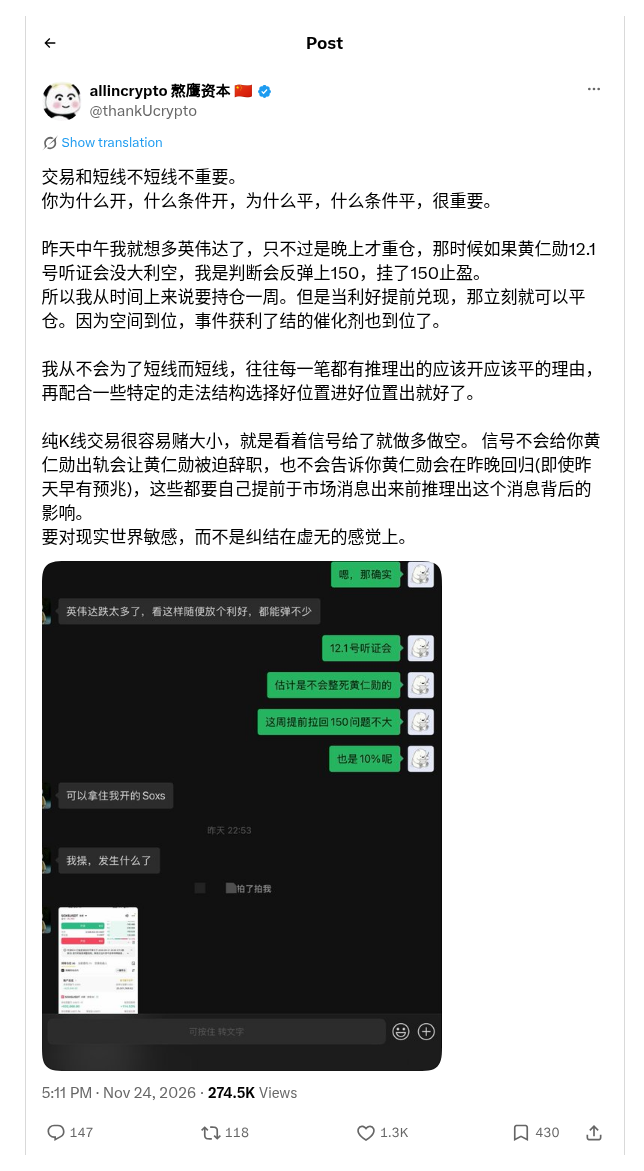
In absolute terms, more than RMB 10 million was not the largest number he had ever seen on his account; ten days earlier he had just posted a screenshot of a $10 million account. But this battle still became his true breakthrough battle: first, because of the extreme speed of pulling out tens of millions in profit in just over ten minutes; second, because he no longer relied on the explosive luck of small coins in the crypto circle, but instead used a complete playbook honed over five years on the world's largest and most fiercely contested chip giant—small test positions at lows, decisive stop-losses, close attention to events, and heavy positions on attack—completing a textbook counterkill and, in the process, pushing himself to the threshold of RMB 100 million in net worth.
Two days later, on November 25, he rarely disclosed on Platform X the composition of his total assets: trading account RMB 48 million, stocks RMB 14 million, cash RMB 12 million, real estate about RMB 20 million, totaling about RMB 94 million. It had been only seven months since he restarted in April this year with $10,000.
He wrote plainly in the post: it is extremely difficult to go from small capital to nearly RMB 100 million in the public markets, and during the period he faced the risk of potential liquidation many times, surviving entirely by timely stop-losses.
Epilogue
During the days when the 2025 college entrance exam results were released, Aoying wrote about a dream online. In the dream, it was his wedding day, and his father, who had passed away early, came over and said to him: "I'm sorry, Dad shouldn't have scolded you. Dad apologizes." He woke up from the dream and cried for a while.
At the end of that post, there were only three words:
So bitter.
Over five years, Aoying posted thousands of screenshots of settlement statements. The numbers kept jumping violently.
Now he is just a few steps away from "a small goal," and the chips in his account have been converted into real estate, stocks, and cash locked in his bank card. Nvidia's狂欢 only lasted one day; by pre-market on Tuesday, the stock had given back nearly 6%, and new volatility was already on the way. The market never issues anyone a graduation certificate, and he doesn't know when the next bend will come. He only knows that as long as the screen is still on, the lamp must keep burning.
Welcome to join the official BlockBeats community:
Telegram Subscription Group: https://t.me/theblockbeats
Telegram Discussion Group: https://t.me/BlockBeats_App
Official Twitter Account: https://twitter.com/BlockBeatsAsia
