Editor's Note:
Recently, a video of a lecture on international affairs given two years ago in a Beijing high school classroom has been circulating widely. The lecturer was Jiang Xueqin, who, based on history and geopolitical logic, predicted that Trump might be re-elected and the U.S. might take action against Iran. As some of his predictions have been confirmed by reality, his YouTube subscribers have skyrocketed, and many netizens have referred to him as the "Chinese Nostradamus."
On March 21, 2026, he appeared on Tucker Carlson's show, shifting his focus from "predicting events" to "explaining structure": why does the Middle East war never seem to end once it starts? Why is the U.S. in a dilemma? And how will this conflict ultimately reshape the global economic and power structure.
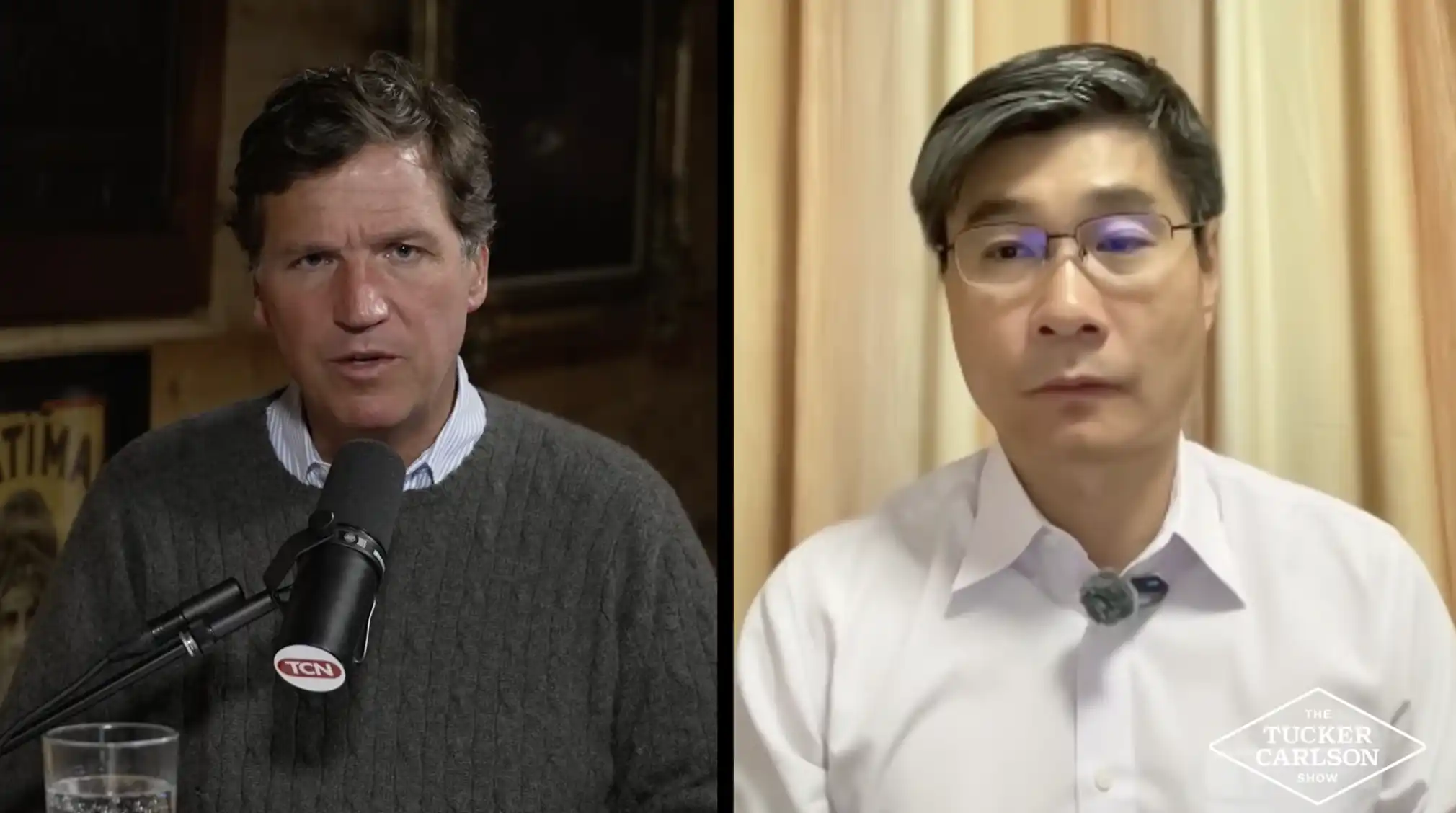
The most noteworthy aspect of this conversation is not the conclusion itself, but the way it offers a perspective on the world—viewing war as a system that will continue to reinforce itself, rather than a conflict that can be quickly resolved.
This conversation can be understood from five main aspects.
War as a "System," Not an Event
One core assessment of the conversation is that the Middle East conflict is no longer a war that can be easily ended through diplomatic means but is a system that self-reinforces once initiated. In this system, the actions of all parties gradually become locked into a structure, and the war itself will continuously generate new momentum, making "exit" increasingly difficult.
America's Dilemma: High Costs of Both Continued Engagement and Withdrawal
For the U.S., the issue lies not in its military capability but in the inescapability of strategic choices: continued involvement entails a higher financial burden and domestic division, while choosing to withdraw could potentially undermine the dollar system and the existing global order. The war is thus having a reverse effect on the U.S. mainland, amplifying internal contradictions through conscription pressure, financial costs, and policy disagreements.
The Arrival of a New Era: Energy and Economic Structural Reordering
As the era of cheap energy gradually comes to an end, the global economy is being forced into a new stage: deindustrialization, remilitarization, and a simultaneous return to trade protectionism. The logic of differentiation between nations is also changing, shifting from "development level differences" to "resource acquisition capability and security assurance capacity."
Structural Divergence in Asia and the Middle East
In this transformation, regional disparities have rapidly widened. Asia is no longer seen as a monolithic entity: China faces pressure to adjust its exports and energy structure, Japan and South Korea are reassessing the balance between security and resources, Southeast Asia is at the forefront of energy and supply chain shocks; while the Middle East presents a different path of division — the Gulf countries' security and financial hub status is under pressure, Iran is accumulating new leverage amid disruption, and the regional power dynamics are being reshaped.
The Overlooked Variable: Ideological and Religious Narratives
The dialogue also emphasizes that geopolitics is not entirely driven by rational calculations. Religious beliefs, apocalyptic narratives, and historical memories still influence decision-making in critical moments. This means that conflicts involve not only competition for resources and power but also tensions between different worldviews.
If this dialogue offers a clear entry point, it is because it transforms "war" from an isolated event into a systemic trigger: once activated, it will simultaneously affect energy, finance, and national structures, driving the global order into a slow yet profound reorganization. From this perspective, the issue is no longer about the outcome of local conflicts but about how the entire world will be restructured.
The following is the original content (rearranged for better readability):
TL;DR
The Middle East War is a long-term attrition war that cannot be easily resolved through diplomacy. Once initiated, it forms a self-reinforcing system that traps all participants.
The real dilemma for the United States is not whether to engage or withdraw, but "both engaging and withdrawing will undermine the foundation of the dollar and the global order."
The world is entering a new era. The era of cheap energy is ending, and deindustrialization, remilitarization, and neo-mercantilism will return simultaneously.
The core divergence of the future world is no longer between developed and developing countries, but "the structural difference in whether self-sufficient resources can be obtained."
Asia is moving towards differentiation. China is constrained by its export and energy structure, Japan and South Korea are forced to rethink the trade-off between security and resources, and Southeast Asia is already facing energy shortages and supply chain shocks.
The security and financial hub status of Gulf countries will be shaken. The global appeal of cities like Dubai is declining, Iran seeks to rebuild amid destruction and relies on the Hormuz to reaccumulate resources, while the entire Middle East is heading towards long-term turbulence and power redistribution.
The War is Boomeranging on American Soil. Through conscription pressure, financial burden, and escalating controversies over overseas intervention, the polarization has been magnified, triggering protests and social conflicts, further undermining the stability of the political system.
Interview Transcript
The Middle East War: An Unexitable Long-term War of Attrition
Tucker Carlson:
Professor, thank you very much for participating in this interview.
We have never met, and I don't know much about you, but I have watched many of your videos, and the predictions you have made in those videos have been exceptionally accurate. I really admire you, especially your ability to anticipate events before they happen.
So, where do you think this Iran war is heading? How will it end? And what are the potential consequences?
Jiang Xueqin:
Thank you very much for the invitation, Tucker. I am a loyal viewer of yours. Over the years, I have always followed your show.
Regarding this Iran war, I believe it will be very similar to the Ukraine war, that is, it will be prolonged and evolve into a war of attrition. Neither side will admit defeat, although a ceasefire would actually be more in their interest. This will have a very serious impact on the global economy, and this war may last for many years. We are already beginning to see the effects, such as flight cancellations, fuel shortages in some parts of Southeast Asia, and people being asked to stay at home. In a few months, experts even predict food shortages, and countries may have to resort to rationing.
At the same time, the situation is still escalating: Israel has attacked Iran's largest natural gas field, and Iran has retaliated against the energy infrastructure of the Gulf Cooperation Council states. Iran has clearly stated that its strategic goal is to push oil prices to $200 per barrel, which will have a huge impact on the global economy, as the entire global economy is built on cheap energy.
Therefore, I believe this war will last a long time, and eventually, the United States will send ground troops, with the Strait of Hormuz becoming a flashpoint, and the conflict spilling over globally, dragging other countries into it. For example, Saudi Arabia may declare war on Iran, and Saudi Arabia has a defense pact with Pakistan, which would also drag Pakistan into the war.
The situation is spiraling out of control, and just recently, the actual leader of the Iran war, Ali Larijani, was assassinated, who was originally capable of pushing for a ceasefire. With his death, there is almost no longer any "exit ramp," and both sides will be locked in a long-term war of attrition, with a very severe impact on the global economy.
Tucker Carlson:
I'm not going to say that this is already the worst-case scenario. After all, the worst-case scenario may involve one or more actors launching a nuclear strike, the destruction of the Al-Aqsa Mosque in Jerusalem triggering a religious war, which would be the real worst outcome. But what you just described is actually only one step away from that, a protracted, extremely destructive, almost unstoppable war.
So my question is, since there are so many global participants, major players like the United States and China will both be harmed in this conflict, then why is there not enough impetus to end it quickly? Why is it not possible?
Jiang Xueqin:
Right. Once the war starts, it generates its own momentum and logic. The U.S. actually doesn't have a real "exit path." That is to say, if the U.S. tries to negotiate a ceasefire with Iran, Iran is likely to demand around one trillion dollars in compensation and require the U.S. to withdraw permanently from the Middle East to ensure its own long-term security.
If the U.S. really does this, then the Gulf Cooperation Council (GCC) countries will collectively become subservient to Iran because only Iran can provide security for them and maintain the operation of this common system. The GCC is the foundation of the petrodollar system; they sell oil in dollars and then recycle the funds back into the U.S. economy. Once this system is abandoned, it will have a severe impact on the U.S. economy and will also trigger a chain reaction: Japan and South Korea will draw conclusions from the Middle East situation that the U.S. can no longer guarantee their security, thus being forced to remilitarize, and resources originally intended to address potential threats will be reassigned.
Europe will also be affected; watching what is happening in the GCC and Southeast Asia, they will start to question, "Why are we still fighting with Russia?" "Wouldn't it be more in our interest to reach a peace agreement with Russia as soon as possible?" This will further undermine the U.S. dollar's status as the global reserve currency. It is important to note that the U.S. currently has $39 trillion in debt, and its economy relies heavily on foreign countries continuously buying dollars.
The U.S. economy is essentially a Ponzi scheme, relying on foreign countries continuously buying dollars. Therefore, the U.S. cannot afford the cost of withdrawing from the Middle East. In other words, the U.S. is trapped in its current situation.
Tucker Carlson:
So how does China view this? I mean, China obviously wants the Gulf to remain stable, especially those seven oil-producing countries. So why doesn't China intervene and push for a quick de-escalation of the situation?
Jiang Xueqin:
In a sense, both the U.S. and China benefit from the current situation, but China does have a vested interest and hopes that this Middle East war will end soon. China depends on the GCC for about 40% of its energy, including not only Iran's oil but also Qatar's gas.
As you said, China certainly hopes to achieve a ceasefire as soon as possible. However, the issue lies in the fact that the Chinese government has always adhered to the principle of non-interference in the internal affairs of other countries. Therefore, although they have publicly stated their desire for the killing and violence in the Middle East to end quickly and for the Strait of Hormuz to reopen, as I mentioned earlier, once a war starts, it will continue to advance according to its own logic, and stopping it will be very difficult.
Three Major Trends: Deindustrialization, Remilitarization, and the Return of Mercantilism
Tucker Carlson:
So, if your assessment is correct, which I certainly pray it is not, and I believe you also hope so. However, if this war continues to "steamroll" as it is now, continuing to destroy energy infrastructure, effectively destroying the civilization of the entire region, whether Iran or the GCC countries. Then, two years later, from a global perspective, what will the world look like? What impact will it have on the global economy?
Jiang Xueqin:
This war will accelerate three major trends, and all countries will have to adapt to a new reality: energy will no longer be cheap or easily accessible.
Firstly, deindustrialization. The current scale of urban populations is based on the premise of being able to import cheap energy and cheap food. Once these two conditions disappear, more people will have to return to the land to produce food, forcing a societal shift towards "deindustrialization" and reducing reliance on energy. This will be the first change we will see soon.
Secondly, remilitarization. In the past, we were in the so-called "Pax Americana", where the United States largely maintained global order and prevented wars between nations. For example, Trump once mediated a ceasefire between India and Pakistan. However, the United States no longer has the invincible deterrent power it once did, and its military power is no longer seen as omnipotent. Therefore, the United States can no longer "maintain world peace" as before, and countries can only rearm, especially countries like Japan that were once heavily reliant on U.S. security protection.
Thirdly, the return of mercantilism. With global trade under strain, countries, especially industrialized countries like Japan and Germany, must establish independent, self-sufficient supply chain systems. Fortunately, the United States is relatively exceptional because of its abundant resources and strong self-sufficiency. However, for Japan and Germany, if they want to maintain their industrial strength, they must expand outward and even extend their sphere of influence.
So, these are the three major trends we will soon see.
Structural Differentiation Between Asia and the Middle East
Tucker Carlson:
What I mean is, this kind of dynamic actually occurred in the last century and is very typical. I also indeed think that Japan is a major variable.
Jiang Xueqin:
Superficially, Japan does indeed have many structural weaknesses. For example, population aging, having the world's most aged population, poses a significant constraint on its long-term growth potential. Another example is its resource dependency; Japan highly relies on imported resources, with its energy transportation route depending on the Strait of Malacca.
In addition, the Japanese economy has been in a long-term deflationary state for the past three decades, burdened by heavy debt, which are fundamental issues. However, from a historical perspective, Japanese society has shown tremendous resilience. In the 13th century, facing two Mongol invasions, Japan was still a feudal society, yet it managed to unite and repel the world's most powerful empire at that time. In the mid-19th century, amid China's colonization by Western powers, Japan underwent the Meiji Restoration, completing its industrial transformation within two to three decades and defeating Russia in 1905. After World War II, Japan suffered a thorough devastating blow, but within a generation, it emerged again as a global manufacturing powerhouse.
Therefore, I would not underestimate Japan. There is something in their culture that is extremely resilient and entrepreneurial. I believe that when faced with a crisis, they will unite as a nation and adapt to these challenges.
Tucker Carlson:
This is a very interesting assessment. I intuitively agree as well. But considering the historical relationship between China and Japan, China's development trajectory, and its strategic focus, will China really tolerate such a strong competitor emerging in the core region of East Asia?
Jiang Xueqin:
China has crafted itself as the "Middle Kingdom." You know, "China," the Middle Kingdom. This means that the Chinese believe they are self-sufficient in the universe. What happens outside of China does not really affect China. Therefore, it is important to uphold China's national sovereignty because it is a self-sufficient country uninterested in the external world. Japan, on the other hand, is completely different. It is an island nation that must obtain resources from other countries to survive as a nation.
So, these are two completely different mindsets. China is largely an agrarian, self-sufficient, inward-looking, and conservative country. Japan, on the other hand, is outward-looking and maritime in nature.
Tucker Carlson:
Interesting. It sounds like they can coexist to some extent. At least you just made it clear that you would not bet on Japan's failure. What about South Korea? South Korea has one of the lowest birth rates globally, possibly the lowest, and at the same time, it is highly 'Americanized' in its institutions and social structure. If the U.S. withdraws from East Asia, this would undoubtedly be a major turning point for South Korea. What would happen?
Jiang Xueqin:
Yes, South Korea's situation is very dangerous, mainly because of North Korea. Once the United States is forced to withdraw from Southeast Asia, North Korea will be able to take the initiative. The problem with this conflict is that Seoul, South Korea's largest city, is only 30 minutes away from North Korea's artillery positions. Therefore, within a day, North Korea could level Seoul to the ground.
Therefore, South Korea's situation is very dangerous. Moreover, if you look at South Korea's economy, it is a highly monopolistic and very corrupt system, with the entire economy controlled by just a few companies. This has also led to extremely intense competition in South Korea, which in turn has resulted in a very low birth rate.
But on the other hand, the people of South Korea are very hardworking, have a strong historical memory, and national consciousness. Therefore, I would not rule out the possibility of some compromise between North and South Korea in the future. Against the backdrop of the intensifying rivalry between China and Japan, South Korea may even use this situation to carve out its own space.
Tucker Carlson:
That's very interesting. I think you make a lot of sense. But I would like to ask you about a point you mentioned earlier. You said that South Korea's economy is highly monopolistic and centralized, essentially a monopolistic economy, hence its low birth rate. So, specifically, what is the relationship between economic monopoly and low birth rate?
Jiang Xueqin:
That's a great question. When an economic system is highly monopolistic, it is actually building a hierarchical structure, right? Because everyone is desperately trying to get into those companies, which are the most prestigious companies in Korea. At the same time, Korea is a Confucian culture society that values "face" very much. So the question becomes: How do you get into these companies? It's a highly scarce and prestigious position that everyone is competing for. Typically, you have to pass the university entrance exam, get into a prestigious university to have a chance to enter these companies.
So, if you are a Korean family, your strategy usually only has two options: either choose not to have children because you can't afford the cost of this competition. You need to send your child to cram schools, hire the best tutors, consolidate almost all resources to ensure that they excel in the entrance exam to have a chance to enter a company like Samsung; or choose to have children but only one. Because concentrating all resources on one child obviously is more "cost-effective" than distributing them equally among three or four children.
Therefore, based on this logic, a monopolistic economy naturally suppresses the birth rate.
Tucker Carlson:
So, intense competition for scarce resources forms an incentive mechanism that ultimately lowers the birth rate.
Jiang Xueqin:
Exactly. Because when everyone sees others as competitors, a sense of community in society disappears. People are willing to have more children because they want to contribute to the community, to see their country become stronger. But when you view your neighbor as an enemy, that motivation naturally diminishes.
Tucker Carlson:
Interesting. So, if the energy crisis in the Middle East continues, what kind of economic impact will it have on China, as well as other regions in Asia, especially Southeast Asia, such as the Philippines, Vietnam?
Jiang Xueqin:
The reality is that this Middle East war has already had a severe impact on the entire Southeast Asian economy. India gets about 60% of its oil from the GCC, Pakistan is also highly dependent on imported oil, Japan gets about 75% of its oil from the GCC, and China about 40%. That means all these countries are being affected.
And now, Thailand and Vietnam are already experiencing fuel shortages. You go to the gas station, you can't get any gas, even motorcycles can't run. People are forced to work from home, fuel rationing has begun, and aviation fuel is also in short supply. So, the entire Southeast Asia is under pressure.
Therefore, the question is not "who will be affected," because everyone will be affected; the real question is, who is more resilient, who is more willing to innovate and adapt to this new reality. Because we are facing not a short-term conflict, but an economic landscape undergoing long-term reshaping.
Tucker Carlson:
So, those locked into this current "Western consumption, Eastern production" pattern are not just in the West; the East is also locked into a position of "only producing." Are you saying that this will be a massive readjustment for everyone?
Jiang Xueqin:
Yes. And I want to say, the impact on the East will be greater. Because ultimately, the Western Hemisphere, especially the United States, is extremely rich in resources and wealth, with the ability to be self-sufficient; but Southeast Asia does not have such conditions, it is highly dependent on overseas energy.
Tucker Carlson:
How will this affect Africa then?
Jiang Xueqin:
If the Ukraine war and the conflict in the GCC region overlap, experts believe that in the worst-case scenario, the entire African continent may experience a large-scale famine. Because the African economy relies heavily on external food and energy supplies.
Tucker Carlson:
Okay, let's look further west. What will happen to the GCC? What will the situation be like in five years?
Jiang Xueqin:
Unfortunately, no matter how this war ends, the biggest loser will be the GCC. Even if the U.S. wins, the GCC will still be the biggest loser.
Because for the past three to four decades, the GCC has been built on a kind of "illusion": it is essentially a desert with a lack of freshwater resources, limited agricultural capabilities, and was originally unable to support such a large population. However, with the help of the petrodollar system and U.S. military protection, these countries were able to invest massively in technology, such as desalination and modern infrastructure, to support population growth, leading to the rise of cities like Dubai, Qatar, and Riyadh.
And this war is shattering this illusion, exposing its structural limitations. Taking Dubai as an example, it has long attracted global elites with its image as a safe, open, and international tax haven. However, even just a few drone attacks on hotels have already dealt a severe blow to this image. Once this "security myth" is shattered, it is difficult to rebuild. Therefore, Dubai's vision as "the New York or London of the Middle East," a future financial center, has basically dissipated.
Tucker Carlson:
What about Iran five years from now?
Jiang Xueqin:
Iran is currently suffering severe damage. Israel and the U.S. are attacking key infrastructure, such as Iran's largest gas field being targeted, and desalination facilities being destroyed.
But more importantly, there are some situations that have not been made public: the U.S. and Israel are actually weakening Iran's governance capacity, essentially dismantling its monopoly on violence. What we are seeing is continuous attacks on police and military facilities, and there are rumors that special forces are entering Iran, supporting opposition forces such as the Kurds and armed groups in the southeast of Iran.
Therefore, no matter how the war ends, the Iranian government will struggle to maintain effective control over the country, even if the regime itself survives.
Meanwhile, Iran has been facing severe drought in recent years, with significant damage to agriculture. There have even been discussions about relocating several million people from Tehran as the capital is no longer sustainable. The war will only exacerbate these issues, especially with civilian infrastructure such as dams, reservoirs, and desalination facilities being damaged. Iran will need many years to recover, its national service capacity will be weakened, and its social structure will be impacted.
But a key "silver lining" for Iran is that it seems to still be able to control the Strait of Hormuz. This is crucial because it can levy tolls on passing ships, reportedly around 10%, which could generate approximately $800 billion in revenue annually. So, Iran will suffer significant damage in this war, but if it can rally national identity and effectively utilize this resource, it still has the potential to rise again in 10 to 20 years.
Tucker Carlson:
So where will Israel be in a few years?
Jiang Xueqin:
If we look at it from the perspective of the beneficiary, the biggest beneficiary of this war is Israel. This is because it has long pursued a so-called "Greater Israel Plan," based on a religious narrative that God had granted them the land from the Nile River in Egypt to the Euphrates River in Iraq, even extending to southern Turkey and parts of Saudi Arabia.
From this perspective, the current situation is favorable to Israel: the GCC is being weakened, Saudi Arabia and Turkey could also be dragged into the conflict, providing Israel with space to reshape the Middle East according to its own intentions. From a game theory perspective, the biggest obstacle for Israel to achieve this goal is not Iran but the United States, as the U.S. has been providing security protection for the GCC.
If Israel wants to become the dominant regional power, it must find a way to get the U.S. out of this system. This war has already to some extent exposed the limits of U.S. power and has generated anti-war sentiment domestically. Many Americans do not understand why the U.S. should continue to be involved in the Middle East. Therefore, it is very likely that regardless of how the war unfolds, the U.S. will eventually be forced to withdraw. Once this happens, Israel will have the opportunity to advance its regional strategic goals.
America's Dilemma: Dragged Into War, Forced Contraction, and Internal Division
Tucker Carlson:
In my view, this is obviously also part of the motive. That is, Israel understands this point, so it has dragged the U.S. into this war with the aim of pushing the U.S. out, weakening the U.S., and ultimately getting the U.S. out of the Middle East. Do you think this will eventually succeed?
Jiang Xueqin:
I think, based on the current trend of this war, this plan is likely to succeed. The reason is that the U.S. military has not fought a truly meaningful war for decades.
The 2003 Iraq War was not really a war because Saddam Hussein had basically given up resistance. He had no air defense capability because years of economic sanctions had destroyed his economy. His logic was, "Let the Americans invade; they cannot really break through because if they destroy us, it will only make Iran (an enemy of the U.S.) the regional power, so why would the U.S. do that? This is logically unsound, it is self-defeating." So he was not worried that the U.S. would act.
But when the U.S. did launch the attack, he was very shocked because to him, this was irrational. But the U.S. did act, and it was a very easy victory that took only about two weeks. The U.S. quickly gained air superiority, rapidly advanced to Baghdad, and toppled the regime. So it was a very fast and easy war, completely in line with the U.S. military's expertise in "deterrence and strike" mode.
But Iran is completely different. The US military actually didn't want to fight this war because they had conducted countless war simulations, and almost every time the conclusion was that they would lose. The reason is that the US military is too cumbersome, unlike Iran, which is agile and resilient. And now we are starting to see this situation manifest in reality.
The US sent the USS Abraham Lincoln and USS Gerald Ford aircraft carriers to deter Iran, but they didn't take action because they didn't dare to get too close to the Iranian coast. If they did, they would be exposed to drone and hypersonic weapon strikes. Iran has been preparing for this moment for over 20 years, understanding the full US combat logic and designing a comprehensive counterplan against this system.
So, it would be very difficult for the US to win this war. The real key issue is whether the US will deploy ground troops because once ground troops are sent, they will be thoroughly drawn in, leading to a typical case of "mission creep" and "sunk cost trap," just like the Vietnam War escalating step by step.
There are rumors now that about 200 US Marines deployed from Okinawa are rushing to the Middle East and will arrive in approximately 7 days. There is another theory, whose authenticity I'm unsure of, that their target is to capture Kharg Island, Iran's main oil export island, where 90% of Iran's oil is exported.
If the US military really seizes this place, it would have a great propaganda effect. Trump would appear very tough on TV, boosting morale domestically in the US.
But the problem is, you can take it, but you can't hold it because it's too close to Iran's mainland, and Iran can continue to attack with artillery and drones. This means you must control the coastline next, establish a forward base, but then you are exposed to the Zagros Mountains, so you would have to keep advancing inward, occupying the mountainous regions, leading to the typical "mission expansion."
This is almost identical to Vietnam. In 1965, 3,000 Marines entered Danang, occupied an airbase, and four to five years later, the force expanded to 500,000 people. It started as a very limited, clearly defined operation but quickly spiraled out of control, so the US is likely to fall into a similar situation again.
Tucker Carlson:
If you are the US Commander-in-Chief Trump now and have to make a decision, what should be the next step for the US? If he is acting in his own interests, trying to preserve his power and wealth at this stage, what should he do?
Jiang Xueqin:
First, I must admit that these events are actually interrelated. The trade war with China, the war in Ukraine, and the war in the Middle East are fundamentally different parts of the same structure. Because the US's global layout has been overly expanded, its reach is too long, wanting to control everything, so its opponents can continually create conflicts, dragging it into one protracted war after another.
So what I will do is bring all the key countries to the negotiating table, including Russia, China, Iran, and then say directly, "Now is the time to establish a new world order." In this order, all parties are in a cooperative relationship, not a unipolar hegemony.
In the past, the United States was a hegemonic power, with the dollar as the global reserve currency, but next, we need to start a real dialogue where all participants are respected. The United States is no longer in a commanding role, but is a partner in cooperation, benefiting from it, to jointly build a new economic order, where interests are no longer concentrated in the hands of a few, but more widely distributed.
Tucker Carlson:
I think this is probably the most rational suggestion, and perhaps the only path that can still preserve civilization. But the problem blocking this path is Israel. As you just said, it is the biggest beneficiary of this war.
I think this point is valid. Besides Israel, can you think of any other beneficiaries?
Jiang Xueqin:
Russia is also a beneficiary. Because Russia is advancing on the Ukrainian battlefield.
Tucker Carlson:
Exactly.
Jiang Xueqin:
At the same time, the United States has been forced to relax energy sanctions, allowing Russia to gain more war dividends, and then convert these resources into support for Iran, helping Iran resist the United States and Israel. So Russia has also gained significant benefits from this war.
Tucker Carlson:
This point is valid. But back to your previous suggestion, if the United States really wants to do this, it must restrain Israel. Is this realistic? Does the U.S. president really have the ability to control such an ally?
Jiang Xueqin:
If you look at the situation within Israel, they are no longer acting entirely rationally, to some extent they have been engulfed by an eschatological fanaticism.
If you look at some of the videos coming out of Israel now, you will see rabbis (Rabbi, a religious teacher or spiritual leader in Judaism) everywhere saying that although the Middle East war is destroying Tel Aviv, it is actually a good thing for them because it will bring about the coming of the Messiah.
They believe that when Israel is under the greatest pressure, when the very survival of the nation is threatened, God will intervene. Because at that moment, the Jewish people will once again unite as a whole, recommit to God, reaffirm their faith. And once God sees this kind of blind, absolute faith, He will send the Messiah to save His people, redeeming the Jewish nation.
So in other words, mundane, real-world matters are not important, the Middle East war itself is not the issue, what truly matters is divinity, the relationship between humanity and God. Therefore, ultimately, faith is what's important, and whether nuclear weapons are flying around is actually irrelevant in this logic.
Tucker Carlson:
Interestingly, 25 years ago, around 9/11, no matter how you look at that event, how you understand why it happened, but I witnessed with my own eyes, there was indeed a "politicized Islam" at that time, with Wahhabism, there were many Islamic extremists around the world.
However, for various reasons, 25 years have passed, Islamic extremism has not disappeared, it still exists, but it is no longer a significant political force. At the same time, Islam as a whole has become much milder, with the GCC being the most obvious example.
Yet, during the same period, there emerged something that can be called "Jewish Wahhabism" and "Evangelical Christian Wahhabism." By that, I mean you can indeed see a kind of apocalyptic extremism among some American Protestant believers, as well as among some Israeli and American Jews. How did this happen? What are the reasons behind it?
Jiang Xueqin:
First of all, I believe we cannot underestimate the influence of apocalypticism in American politics.
For example, about a quarter of Americans are Evangelical Christians, and many of them fall into the category of the so-called "Christian Zionists." They believe that Israel is a crucial fulcrum for God's plan and the return of Jesus. You are probably very familiar with a representative figure, John, who runs an organization called "Christians United for Israel," which has about 7 million members. And it is these people who are funding a lot of conflicts in the Middle East, especially in Israel, because they are funding settlements in the West Bank.
So, Christian Zionism is an extremely powerful political force in the United States. As for how this happened, the issue is that this is actually a plan that has been operating for centuries, its history is very complex, involving different religious groups within the Jewish community, including Frankists, Shabbateans, Lubavitchers as you have mentioned, and also involving Freemasonry, Knights Templar, Rosicrucians, and the Jesuits.
So what you see is that different secret societies, different religious organizations, have been collaborating over centuries to advance a plan about the "end of the world," which will usher in the Messianic Age.
This plan has many different components, but the basic structure includes: first, the establishment of the Israeli nation, which was accomplished in 1948; next is the construction of the Third Temple, which requires the destruction of the Al-Aqsa Mosque. Based on what we are currently witnessing, this could potentially happen in this war.
In recent days, Israel has already closed off the Al-Aqsa Mosque, along with some religious sites including the Church of the Holy Sepulchre, to visitors. There are also rumors that for the past two years, Israel has been conducting archaeological excavations beneath the Al-Aqsa Mosque, with the aim of undermining the mosque's foundation to carry out a controlled explosion, then blaming it on an Iranian missile attack. Furthermore, there are discussions within Israel on how to use this plan to ignite a war between Arabs and Persians.
So, in this logic, the Al-Aqsa Mosque must be destroyed for the Third Temple to be built. They are also talking about the so-called "Gog and Magog Battle," which is a war between Israel and the whole world, followed by the coming of the Jewish Messiah, the realization of the "Greater Israel Plan," and the return of all dispersed Jews.
So, this plan is multi-layered, multi-part. But if you just observe from a geopolitical perspective, you will find these events converging gradually to today, meaning these things seem to be happening simultaneously. Therefore, it looks like there is some kind of very powerful "shadow force" working behind the scenes. We don't know who they are, but it appears they are influencing or even shaping policies in some way to drive the landing of this entire apocalyptic script.
Tucker Carlson:
What role do you think Donald Trump plays in this?
Jiang Xueqin:
This question is actually very difficult to answer, so we can only analyze it from a few possibilities.
The first possibility is that he is simply being set up to play a "role," acting like an actor following a predetermined script, but he does not know where the entire plot will ultimately lead. He is just fulfilling his part, and behind the scenes, the people around him are the ones truly influencing him.
Because when asked by reporters "why the Iran War broke out," he did say that his advisers, including Jared Kushner, Pete Hegseth, Marco Rubio, told him that Iran was very close to possessing nuclear weapons and that Iran was the one being attacked first. So, he was actually misled.
I think this statement is likely valid because there is indeed a group of people around Trump with a certain apocalyptic political agenda. So, this is a possibility: he is just an actor.
The second possibility is that he himself has some kind of "messianic" sense of mission.
If you go back to January 2021, his political life was almost over. The "January 6th incident" happened, he was impeached twice, faced a series of lawsuits after leaving office, and even went bankrupt at one point.
At that time, it seemed as if the whole world was against him, but now he is once again the President of the United States. So, how would he understand all this? Most likely, he would think, "This is God's call to me, and I must fulfill a mission." As for what this mission is, whether it is to save Israel, save America, or part of a larger plan, perhaps only he knows in his heart, and outsiders cannot know. This is the second possibility.
The third possibility is that all of this is actually driven by Israel, and it is Benjamin Netanyahu (Prime Minister of Israel) who has gradually pushed him into the current situation because Israel was the first to launch the attack. Marco Rubio has also stated that the U.S. originally hoped to continue negotiations, but Israel was planning a military operation; once they acted, Iran would inevitably attack both the U.S. and Israel, and the U.S. did not want its soldiers exposed to such risks, so they chose to act in concert with Israel. So, it is also possible that this is the result of Netanyahu and his series of political maneuvers.
The fourth possibility is that he is actually being "controlled," for example, holding some leverage over him, causing him to have no real choice but to act according to the other party's will, and even the safety of his family may be constrained. These four possibilities all exist, and frankly, I don't know which one is closest to the truth.
Tucker Carlson:
Yes, I also don't think anyone really knows the answer. I have always tried to avoid making too many guesses. People always tend to believe that the motives of politicians are transparent, that they will directly explain what they are doing and why. But the reality is, you can never truly know what is in someone's heart, right? And many times, you may not even be completely clear about your own motives. So I think your view is actually very cautious and very rational.
So, what if we shift our focus to North America? The United States, of course, also includes Mexico and Canada. We rarely think of these two countries together, but they are both vast countries with sizable populations and are neighbors of the United States. If the world is indeed undergoing a structural rearrangement, perhaps we need to understand the landscape using the term "continent" rather than "country." What will it look like in three to four years?
Jiang Xueqin:
From a geopolitical perspective, if the United States is forced to retract to the Western Hemisphere, the first issue it will face is a resource problem. Therefore, based on its own interests, the United States is likely to move towards control of and even "reintegration" with Canada and Mexico.
Mexico provides labor, Canada provides resources, and Canada itself is likely one of the most resource-rich countries in the world. From this perspective, if the world moves towards self-sufficiency, if there is a resurgence of mercantilism and an increase in trade barriers, the United States has almost no choice but to ensure the integrity of its own supply chains. This means that it will eventually look to Greenland, Canada, Mexico, and the broader Latin America, including Cuba and Venezuela. In other words, the United States does not have much room to maneuver on this issue.
At the same time, we have also seen that this war and a series of external shocks are exacerbating political divisions within the United States, especially the confrontation between the left and right camps.
Events like what happened in Minneapolis in January of this year are a sign. It can be expected that if the war continues and if Trump does push for a nationwide conscription to supplement troops, then street riots, large-scale violent conflicts, and even the deployment of the National Guard could become the norm. It has even been proposed to deploy the National Guard to major cities by April.
In this sense, the United States may experience a prolonged "low-intensity civil war" for several years in the future, not necessarily a full-scale civil war, but more like the "Troubles" period in Northern Ireland, that is, sporadic but continuous violent conflicts.
I don't know if you have seen the movie One Battle After Another. Although it was not well-made, it at least offered a glimpse of what a prolonged confrontation between a country and internal rebellious forces might look like.
Tucker Carlson:
Even so, do you still believe that America will continue to exist as a unified country?
Jiang Xueqin:
I believe so. Frankly, the United States remains one of the most powerful countries in the world. The American people are open, generous, entrepreneurial, and vibrant; the resources in the U.S. are extremely abundant, almost approaching "infinite"; it is itself a fortress protected by two great oceans, with no true equivalent competitor in North and South America.
Therefore, no matter what happens, the United States will ultimately be fine, if only because its people possess tremendous vitality and creativity.
Tucker Carlson:
You just mentioned Canada. Most Americans don't even know where the capital of Canada is, Canada is hardly on their radar, and rarely enters their thoughts.
But you describe it as "possibly the richest country in the world." I think this is an objective judgment, but the reality is that Canada is not wealthy now and is actually getting poorer. Its life expectancy is declining, and GDP is falling.
And you believe that this change is not natural but man-made. You feel that Canada is being deliberately suppressed: on the one hand, reducing the population through a state-driven euthanasia system; on the other hand, changing the population structure through large-scale immigration, a change that does not align with the will of the native population. So the question is: Who is doing this? Why?
Jiang Xueqin:
This is a very good question, one that I have been thinking about because I am a Canadian citizen myself and have studied there.
So, my answer is, Canada has never been a typical nation-state; it is more like a sanitized "resource colony," just packaged more decently. It has long been under the British system and has deep ties to the City of London. And now, the UK itself is under a lot of pressure, the London financial system is also facing challenges, so it will reassess resource-rich regions like Australia, New Zealand, and Canada.
Imagine this, if you were under financial pressure, what would you do? Usually, you would carry out a "corporate restructuring," adjust the structure, change middle management, right? Historically, this is what the British did in India, restructuring through collaboration with local elites to extract resources. They went into India and looted trillions of dollars from the Indians, and the Indian elites were very happy to help them.
So, some may wonder, why not apply the same pattern to Australia and Canada?
Over the past five years, millions of Indian immigrants have entered Canada, which has indeed put some pressure on the local economy, such as skyrocketing housing prices, making it unaffordable for the average Canadian to buy a house, and also straining the welfare system and the overall economy.
Logically, you might think that immigration should be put on hold, digest the existing population first, let them have stable housing and jobs. But the actual policy direction is not like this, as people like Mark Carney are still pushing for further openness, including attracting more international students, "We want more Indian people, and we will even give you scholarships to come to Canada for free education." Meanwhile, there are many Canadians who are homeless, unemployed, or even can't afford to eat, but they say, "It's okay, we still want more Indian people."
Some people find this policy combination hard to understand, so if this is not in the context of Canada's "structural reshaping" or even "asset stripping," then I really can't understand the motivation behind it.
Tucker Carlson:
It sounds like some would interpret this kind of change as a "systemic reshaping" of the existing social structure, even to some extent, a "racial extinction" (targeting those who have lived in Canada for generations).
But the issue is, this phenomenon doesn't seem to be happening in isolation, but rather a similar trend can be seen throughout the West, throughout the English-speaking world. From Australia to Canada, it seems that some kind of structural change is taking place. What is the logic behind this? What do you think?
Jiang Xueqin:
If we shift our focus to Europe, it will be easier to understand. 2014 was a major turning point for Europe when tens of millions of refugees tried to enter Europe from the Middle East, and these refugees are themselves a result of the US-led wars in the Middle East.
At that moment, Europe faced a choice: either close the borders to maintain its cultural identity or open up and welcome.
German Chancellor Merkel said a very famous quote, "We can do it. We are Europeans. We can definitely accept these millions of refugees, welcome them into our society, and prosper together as a nation," believing that Europe could absorb these populations and thrive. However, the actual development proved to be more complicated than expected. After a large number of people entered, it brought about cultural, economic, and social pressures, and these groups themselves may not necessarily want to assimilate completely. This has led to tensions in some regions.
Millions of refugees entered Europe. By the way, this was not their choice but because their countries had already been destroyed, Libya, Syria, Afghanistan, Iraq, all destroyed in the "war on terror." So, they came to Europe. And these people are very proud Islamists. They love their religion, love their families, love their communities. So, they will not absorb themselves into European society, nor will they assimilate.
And today, you can see a kind of population replacement in many cities. You go to certain places in the UK, and you might think you are in Cairo or Baghdad. And this has already caused significant conflicts throughout Europe. If in the next two to four years, the UK and France erupt into civil war, into rebellion, I would not be surprised at all.
So the question is, why is this happening simultaneously worldwide? Why are these different countries, whether European countries, Canada, or Australia, adopting the same policies, not only at a cultural level but also at an immigration policy level? This is one of the significant issues of the contemporary world that we must think about.
It seems like a kind of "controlled demolition" of Western civilization is taking place, right? The English-speaking world, Western Europe, these countries seem to be intentionally destroyed. For what purpose? I don't know. But I will say that a certain pattern has emerged. And this pattern can only lead to the controlled dismantling of these societies.
Tucker Carlson:
Frankly, I feel like this is no longer even up for debate. Just look at some of the most basic data, and you can sense a significant demographic shift, with the white population significantly decreasing. The real question is, why is this happening? I have absolutely no idea.
I know there are many speculations from the outside about "who is doing this." But let me be clear, I don't know. Of course, I know who the people at the executive level are, but Kier Starmer does not truly control the UK, Macron does not truly control France. I'm not even sure how many leaders of countries today can truly steer their own countries, or how many countries still have sovereignty in the full sense. I really don't know the answer.
But what is certain is that some kind of change is happening. So, historically speaking, are there any similar precedents? As a historian, have you seen similar situations?
Jiang Xueqin:
Well. Look at the situation happening in Ukraine now; this war has actually been lost, it was lost two years ago. Ukraine has lost over a million combatants, with a large population fleeing overseas. Regardless of how the conflict unfolds next, Ukraine, as a nation-state, has in fact become unsustainable; it is no longer a viable functioning nation-state.
But Europe has not acknowledged this, nor has it chosen to ceasefire with Putin. Instead, they are discussing conscripting their own male citizens to send them to the Ukrainian trenches. This is almost equivalent to sending them to their deaths in reality because Russia has a clear advantage on the battlefield through drones, artillery, and trench systems, so this is nearly a suicide mission.
Furthermore, Germany has proposed, "We can conscript German men, but we cannot conscript Islamic men because we are concerned about their loyalty." So, a very contradictory situation has emerged: the local men of the UK, France, and Germany are being sent to die in Ukrainian trenches, and at the same time, in their own countries, those immigrant populations have not integrated into their culture.
This policy logic itself seems very absurd, and I find it hard to understand who would design such a path. As for historical precedents, frankly, there are none. Indeed, there are none.
Historically, of course, there have been large-scale migrations, such as during the collapse of the Roman Empire, where masses of migrants poured into Rome. However, when the scale reaches a certain point, assimilation is almost impossible, often leading to a change in cultural structure. If so many people insist on maintaining their cultural identity, and their fertility rate is higher than yours, they will eventually overwhelm your cultural identity.
Tucker Carlson:
Yes, I also feel that this is almost a repetitive logic in history, one population structure replacing another. The so-called "multiculturalism" is often difficult to sustain in reality and eventually a dominant culture will emerge and take the lead.
But what puzzles me is that no one ever thought before that this kind of change would happen in such a global way, or even as a systematic, global "cleansing" of a certain race. I mean, not long ago, this didn't even seem achievable. But now, it seems that there is some kind of overarching logic behind it all, a plan behind everything. I am curious, how many Americans do you think truly understand what is happening in the world right now?
Jiang Xueqin:
Frankly, unfortunately, if you have been educated and grown up in the American system, you probably won't see it that way. I myself studied at Yale and know many Ivy League background individuals. The problem is that we have been instilled with a whole set of values since childhood, and these values are hard to question.
For example, there was a case about the University of Michigan affirmative action that went to the Supreme Court.
From the perspective of traditional American values, there is obviously tension between affirmative action and the American "meritocracy," but the final ruling emphasized that affirmative action is good because "diversity itself is a good thing."
But what is interesting is that if you really walk into Yale, Harvard, or any Ivy League school, you will find that there is no real diversity in the true sense, I mean in terms of diversity of thought. Superficially, there is diversity of skin color, but if you look at the viewpoints actually being discussed in the classroom, it is actually a highly uniform environment.
So, this is a great irony: an affirmative action that was supposed to bring diversity to the classroom ultimately brings an extremely homogeneous classroom. In such an elite environment, you can't even raise issues of demographic replacement or immigration, because once you do, you will be called a racist. And that is the most dreaded label. I mean, you're better off being called a pedophile. Right now, pedophiles have more rights than racists.
So, unfortunately, the problem is not only at the current affairs level. It's also in the classroom, it's in the broader culture. People aren't even allowed to ask questions that are obvious if you just walk down any street in a big Western city.
Tucker Carlson:
Interestingly, I'm not here to defend white people. I am white, of course. White people have done a lot of bad things, just like any ethnic group does a lot of bad things. But overall, people still like to vacation in white countries, as you just mentioned, because those places are actually quite nice.
So, if you take the emotion out of it and just look at the outcomes, some developed countries have indeed made significant contribut
