On April 9, 2025, the S&P 500 experienced a single-day surge of 9.52%, marking the largest gain since 2008. The reason was not the introduction of any bullish policy, but rather President Trump's announcement in the morning of the effective implementation of reciprocal tariffs, followed by a sudden declaration of a 90-day suspension at noon.
This was not an isolated incident. Starting from that day, Wall Street coined a term for this pattern using an acronym, called TACO, which stands for Trump Always Chickens Out. Over the past 14 months, this pattern has repeated at least 12 times. Every threat, every retreat, every market rebound. However, the Iran incident on March 23 showed that this once most profitable trading strategy is now failing.
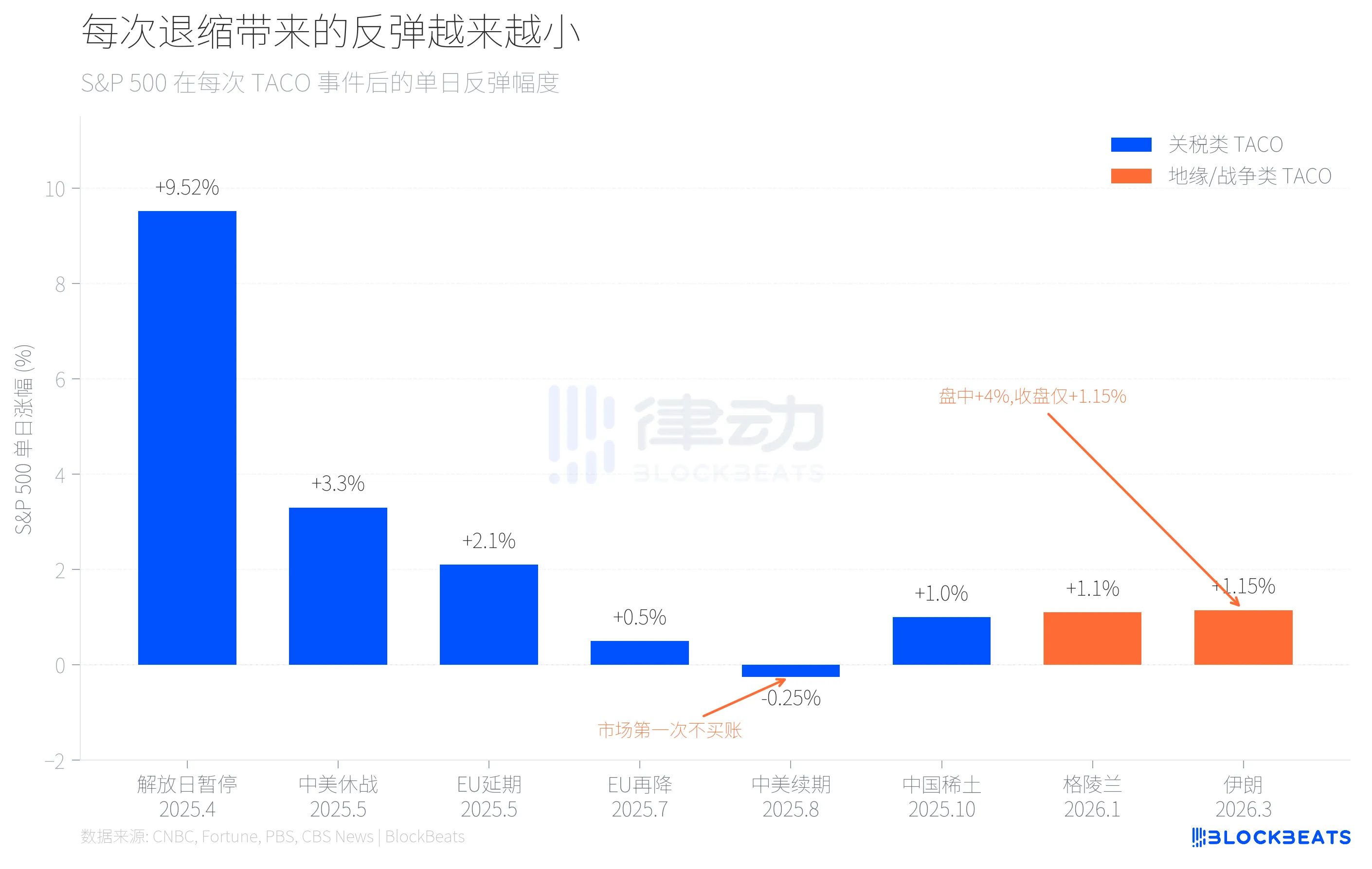
According to CNBC, the surge on April 9 was the third-largest post-war single-day surge, with the Nasdaq soaring by 12.16%, setting a record since 2001. The Dow rose by 2,962 points in a single day. FT columnist Robert Armstrong first used the TACO acronym on May 2, a month later. He wrote that the U.S. government "has a low tolerance for market and economic pressure and quickly retreats from tariffs that cause pain."
That was the golden age of TACO trades. The operating logic was extremely simple: every time Trump toughened his stance on Truth Social, the market plunged, smart money bought. Once the retreat news came out, they sold for a profit. The strategy was effective because the time gap between the plunge and the rebound was extremely short, usually not exceeding a week, sometimes only a few hours.
On May 12, the U.S.-China truce reduced both sides' tariffs from 125%/145% to 10%/30%, causing the S&P 500 to turn positive the next day. On May 25, Trump threatened a 50% tariff on the EU, causing the market to drop. Two days later, he announced an extension until July 9, and the S&P 500 rebounded by 2.1%. When asked about the term TACO, Trump referred to it as a "malicious question" and countered by saying, "This is called negotiation, didn't they come to negotiate because I imposed a 50% tariff?" Vital Knowledge analyst Adam Crisafulli summarized, "Investors are becoming increasingly confident in the severity of tariff threats."
But the returns were diminishing.
On July 11, 2025, the same EU tariffs dropped from 50% to 30%, with little market reaction. On August 12, as the U.S.-China truce expired, Trump renewed it as scheduled for another 90 days. UBS economist Paul Donovan's comment was brief, "The market anticipated this." The S&P 500 closed down by 0.25% that day. According to Fortune, this was the first complete failure of the TACO trade. On October 10, Trump threatened a 100% (totaling 130%) tariff on rare earths from China, leading to a 2.7% drop in the S&P 500 that day. Two days later, he posted "Don't worry about China" on Truth Social, causing futures markets to rebound by around 1%. Then in November, the U.S. and China quietly extended the ceasefire agreement by one year. The market had almost no reaction.
JPMorgan CEO Damon expressed a deeper concern during the same period, saying, "I think his retreat was right, but unfortunately, the market has a sense of complacency." He pointed out the core paradox of TACO trading. When the market treats every dip as a buying opportunity, the threat itself loses its effectiveness as a negotiating chip.
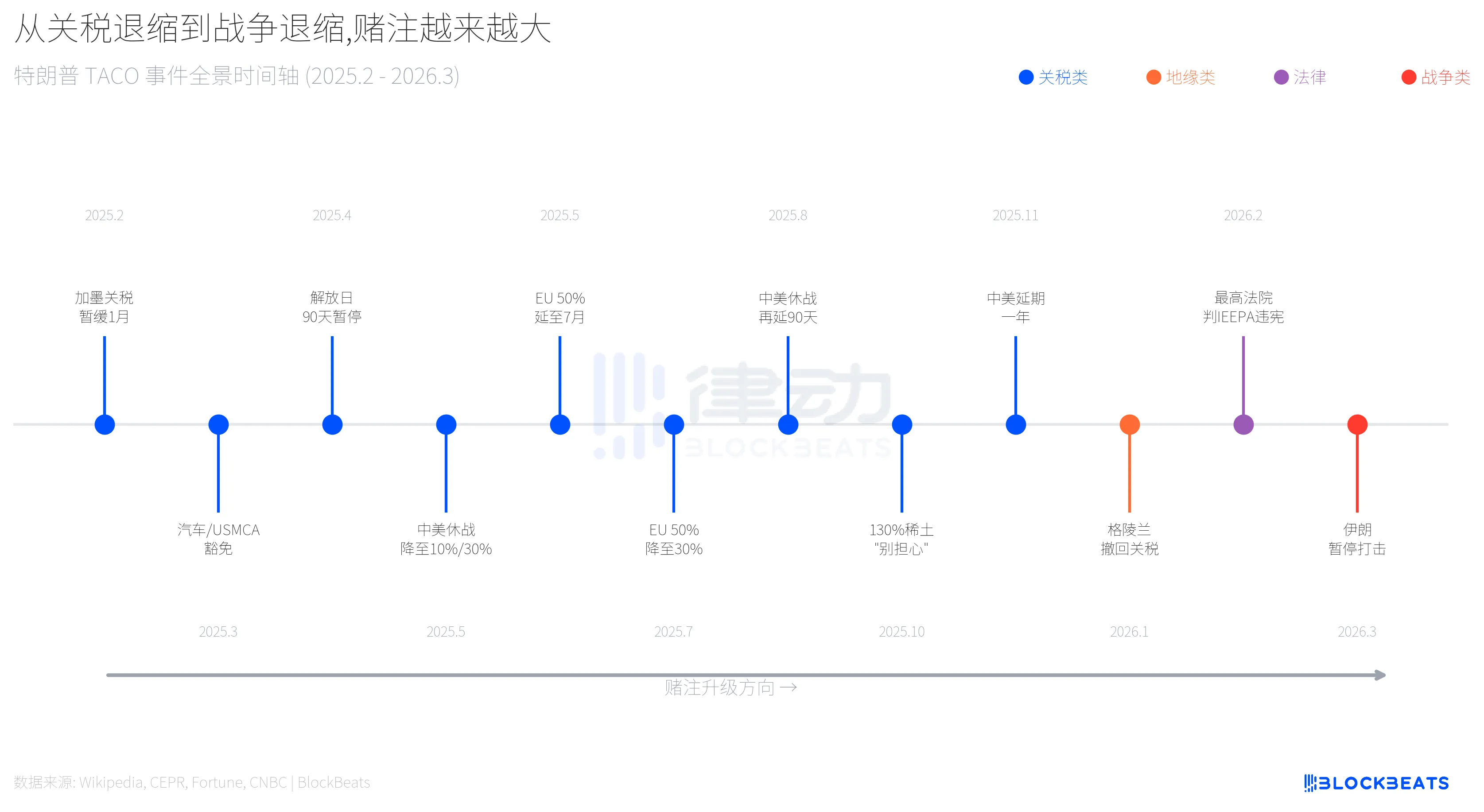
Over 14 months, the TACO bet escalated from tariff escalation to geopolitical issues, and then escalated to war.
In 2025, TACO was all about tariffs. The deferral of tariffs on Mexland, auto exemptions, Liberation Day pause, US-China truce, EU extension, and rare earths "don't worry." These retreats have one thing in common — Trump can decide alone. A Truth Social post, tariff suspension, market rebound.
In January 2026, the bet changed. According to CNBC, Trump threatened to impose a 10% tariff on 8 NATO countries before the Davos Forum, forcing Denmark to compromise on the Greenland issue. The S&P 500 fell by 2.1% that day. The next day, he announced a "framework agreement" with the NATO Secretary-General, withdrew the tariffs, and the Dow Jones rebounded by 580 points. However, the so-called "framework agreement," according to CNN analysis, was essentially a replica of the 1951 US military presence agreement in Greenland.
On February 20, the Supreme Court ruled 6-3 that the IEEPA tariffs were unconstitutional, affecting an estimated $175 billion in tariff revenue according to Penn-Wharton. Trump quickly switched to using Section 122 to sign a new 10% global tariff within hours. The legal basis of TACO was undermined, but he did not stop.
On March 23, the bet was escalated to the highest level.
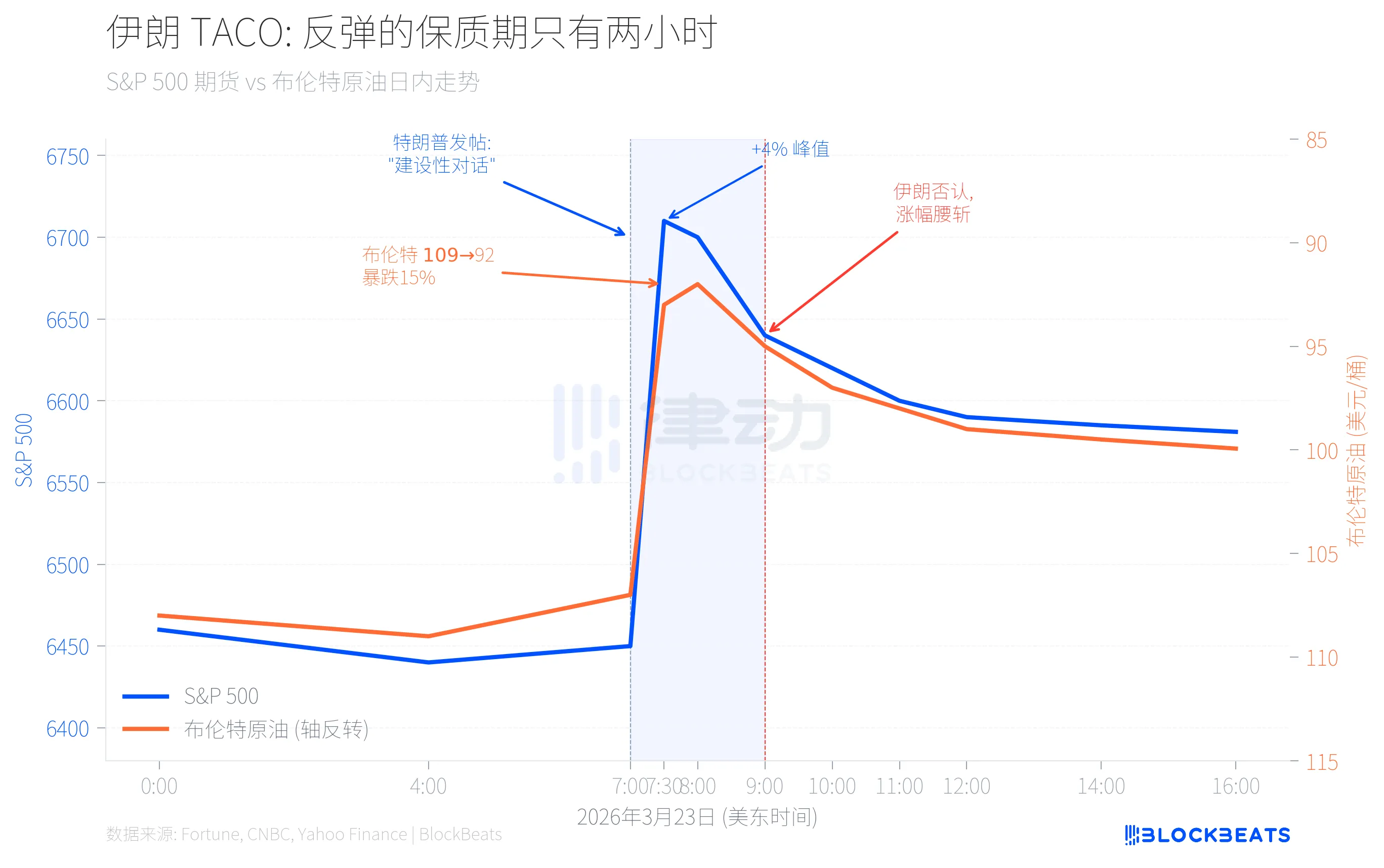
According to Fortune, Trump posted on Truth Social around 7 a.m. ET, claiming that the US had engaged in a "very productive dialogue" with Iran and ordered the Pentagon to pause strikes on Iran's power grid and energy facilities for 5 days. S&P 500 futures soared by nearly 4% from the low point within minutes, instantly adding $1.7 trillion in market value. Brent crude oil dropped from $109 to $92, a decrease of about 15%.
Then Iran denied the existence of negotiations.
As reported by BNN Bloomberg, Iranian state media quoted a "senior security official" saying that the dialogue never took place, calling it a market manipulation tactic. The gains were halved within two hours. The S&P 500 ultimately closed up 1.15%, and Brent crude oil rebounded to $99.94. Oil analyst Rory Johnston pointed out, "The baseline expectation was that Trump would try to back down and declare victory, but actually pushing oil prices down is not that simple."
This is a paradigm shift in TACO mode. The retreat in the era of tariffs is unilateral, with a president's single post enough to fulfill it. The retreat in the era of wars requires cooperation from the opponent. When the opponent denies, the retreat becomes a lie. Despite Brent crude oil dropping from $109 to a intraday low of $92 on that day, it closed at $99.94. The actual supply risk in the Hormuz Strait does not disappear because of a single post.
From +9.52% on April 9 to an intraday +4% on March 23 but closing at only +1.15%. The TACO trade completed a full cycle from windfall to default in 14 months. It's not that Trump didn't retreat; it's that the retreat itself has already been priced in by the market. When "retreat" becomes a consensus expectation, it is no longer a retreat but noise.
