I recently noticed a phenomenon that I think is worth discussing.
It seems that various Agents are now very popular, such as OpenClaw, Claude Code, Codex, and so on, as well as AI creative tools like Seedance 2.0, Little Skylark, and others, which are also gaining popularity.
All these things are coming out, one after another, each one a creativity tool that has never existed in human history.
Many people have put in a lot of effort to install them, opened them up, and then, nothing happened.
They started to feel lost, staring at the blinking cursor, their minds blank.
I know, it's definitely not just you in front of the screen, many people are like this, and sometimes I am too when I see a new AI tool.
OpenClaw, in particular, has pushed this phenomenon to its climax.
Then I saw a comment online, saying:
If you've installed OpenClaw and don't know what to do with it, then you don't need it.
The term OpenClaw can actually refer to all AI tools.
But, honestly, I don't think that statement is correct.
How could someone not need AI tools or Agents? Many people actually do need them but have forgotten what they need in the midst of busyness and growing up.
Or, to put it more vividly, they have forgotten their own creativity.
Actually, we can think back to our childhood. Give you a pile of building blocks, and you could play for a whole afternoon; give you a pen, and you could draw all over the wall.
Back then, you never asked the silly question, "Do I have creativity?" because back then, you were full of creativity.
Everyone was.
Then what happened? We went to school, and the teacher told you there was only one correct answer to the problem.
Your drawing is not good because the sun should be red, not green, and your essay is off-topic because you didn't follow the template.
Later on, when you started working, your boss told you to follow the process, avoid innovation, finish your current tasks first. Your ideas don't matter, only KPIs matter. Weekly reports must be submitted on time, presentations must follow the template, and reports must use the STAR method.
You lived like this for twenty or thirty years until the skyscraper collapsed.
Under layers of training, your creativity disappeared. Now, facing AI tools, you don't know what to do, not because you don't need to.
It's because your creativity has been buried for too long, so long that you've forgotten it ever existed.
It's quite poignant to me.
As someone who has been a designer for nearly ten years and is also a hardcore gaming nerd, I've always believed that creativity is a fundamental human trait, something inherent in everyone from birth. I have some immature experiences myself, having previously encouraged creativity within design teams I led.
So in this article today, I also want to share some of my experiences, hoping that, perhaps, through this article, I can help you rediscover your creativity.
I'm not sure if it will work, but I hope you'll give me 10 minutes of your time.
And I hope it can be useful to all of you.
1. Find That One Thing That Makes You Uncomfortable
Many people think creativity is an ability, just like programming or English proficiency, something some are born with and others without.
But as I mentioned earlier, creativity is something we are born with.
Creativity is desire.
Coming from a UI design background myself, why can a designer come up with a great interface solution? Often, it's not because they are smarter than others, but simply because they feel incredibly uncomfortable when they see a lousy interface.
It's that kind of "This is so awful, I can't stand it" feeling that, in my opinion, serves as the starting point for creativity.
There's a psychological concept called cognitive dissonance, which is essentially when there is a gap between your expectation and reality, causing a strong feeling of discomfort in your brain, then driving you to eliminate this gap.
I believe this discomfort is the engine of creativity.
When I used to lead a team, I encountered a particularly troublesome situation. When you ask a newcomer to create a page, they would ask you, "What color should go here? What icon should be placed there?" You ask them, "What do you think?" And they say they have no idea.
Do they really have no idea? No.
They lack desire. They don't have the obsession of "I must make this thing look stunning today" or the empathy of "Users will definitely be confused at this step."
They are just completing a task, not creating a masterpiece.
But the same person, if you ask them to work on something they truly care about, like creating a poster for their own band or drawing fan art for their favorite game, they may stay up until 3 a.m. without feeling tired. Truly, once desire is ignited, capability naturally follows.
So I think the first step to reclaiming creativity does not require learning any skills; it's about finding that thing that makes you utterly uncomfortable.
This is how I do it.
Every day, when you're scrolling on your phone or looking around, you will surely encounter two types of moments that make you pause.
One type is so amazing and awesome that you skip over it because it only makes you anxious.
The other type is "OMG, this is so bad," or "Why has no one done this???"
The latter is the seed of your creative desire.
Write it down. Just use your phone notes and write a sentence like, "The xx feature of xx product is so counterintuitive," "Why isn't there a tool that can xxx," or "If this thing could xxx, it would be great."
No need to think about how to solve it; just jot it down.
When you have around ten of them, look back, and you will notice a pattern. These things you've written down mostly revolve around one or two specific areas.
That is what you truly care about.
Your creativity will sprout from there.
This step may seem simple, but I've seen too many people get stuck here.
They are not lacking creativity; they just have never seriously asked themselves, "What am I really dissatisfied with?"
2. Narrow It Down to an Afternoon
After having an idea, most people get stuck at the second step.
Because the idea is too big.
Many people's ideas are like, "I want to create a groundbreaking AI product," "I want to shoot an amazing short film," "I want to write an unbeatable book."
To be honest, this scale of thing, besides giving you a mental orgasm, often isn't very useful.
In psychology, this is called choice overload.
Barry Schwartz wrote in "The Paradox of Choice" that when there are too many options, people don't become more free, instead, they get paralyzed, just like when there are 6 types of jam in the supermarket, 30% of people buy, but when there are 24 types of jam, only 3% buy.
The more choices, the lower the action.
When we do interaction design, we also have a principle called the 7±2 information chunk rule, can't have more, if there are more, users will experience cognitive overload, and then the brain will crash.
In the AI era, it's like you are given this state of having 24 types of jam, you have too many things you can do, so many that you become completely lost, and end up doing nothing.
The solution is very simple, it's to proactively impose constraints on yourself.
Unlimited freedom is the enemy of creativity; the human brain has never been good at making choices in unlimited possibilities. What it's best at is finding the optimal solution under limited conditions.
Just like my favorite game, "The Legend of Zelda: Breath of the Wild," the game gives you only four abilities: magnetism, cryonis, stasis, and bombs, just these four, and then weapons break, arrows run out, stamina depletes, you see, the screen is actually full of limitations.
But it's these limitations that have forced out countless epic maneuvers.
For example, if you want to climb a cliff but don’t have enough stamina, you can ignite a patch of grass at the foot of the mountain, an updraft forms, you open your paraglider and let the updraft carry you up. The game never taught you this move, but the physics engine tells you, fire generates hot air, hot air rises, paraglider can catch the updraft. You figured this out on your own.
There's even the Windbomb technique, which all the pros should know, jump forward with the shield and press L to drop a round bomb at that instant, then enter bullet time to place a square bomb, switch back to the round bomb to detonate, and you'll go straight into a bullet time bow state.
These were all dug out by the players themselves under constraints.
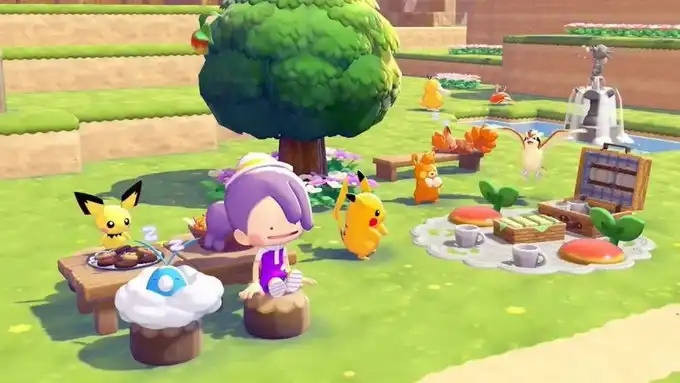
Recently, I have been playing Pokémon Pokopia in my spare time, which has even more constraints. Many things I wanted to build are impossible, many Pokémon I wanted are missing. However, this has actually sparked even more creativity and a desire for exploration in me.
Creativity often stems from constraints.
How can you impose constraints on yourself? I think it's quite simple, just three constraints.
First, Tool Constraint. For example, only use one tool this time. Whether it's Claude Code, Midjourney, or Seedance 2.0, pick just one, don't be greedy.
Second, Time Constraint. Just an afternoon or an evening. Absolutely not a week, not a month, just this afternoon, for example, you must have something runnable by dinnertime.
Third, Scope Constraint. Only build one feature, solve one problem.
Stacking these three constraints is like having only three moves in Zelda.
Believe me, at this point, your brain may no longer panic, but instead start to get excited.
Let me give you a few real examples.
"This afternoon, using Claude Code, create a small tool for yourself to record daily inspirations, with just one input box and a list."
"This afternoon, using Midjourney, design a visual style for your public account, just create 5 images."
"This afternoon, using Seedance 2.0, turn a dream scene into a 15-second short video."
That's how small, small to the point where you might think, "Isn't this too simple?"
Then just do it.
Shigeru Miyamoto has been making games all his life, always using this trick.
He once said, roughly, that good game design is finding fun in a small room, not getting lost in a vast continent.
So Nintendo has contributed almost all of the world's most awesome sandbox games.
Creation is the same way.
III. Build Something Crap
Next is the most crucial step, and also the step where most people get stuck.
Just do it.
Many people get stuck in the mindset of "Let me think about it some more," "I'm not ready yet," "Let me finish learning xxx before I start."
This kind of thinking may have been correct in the traditional era, after all, the cost of creating something was very high back then — changing a line of code would take several days, getting a prototype done would cost thousands.
But in the AI era, this logic is completely reversed.
AI has brought the cost of creation down to almost zero. You tell Claude Code a sentence, and a small tool will be up and running in 5 minutes. You describe the image in your mind to Midjourney, and you get results in 10 seconds. With PixVerse v6, Seedance 2.0, a video can be generated with just a piece of text.
The cost of creation has reached a historic low.
You don't need to have a perfect idea before you start; just jump in and create something rough. Finish it, take a look, if you're not satisfied, change it. After the changes, take another look; if you're still not satisfied, change it again.
This process is known as "prototype thinking" in the design industry.
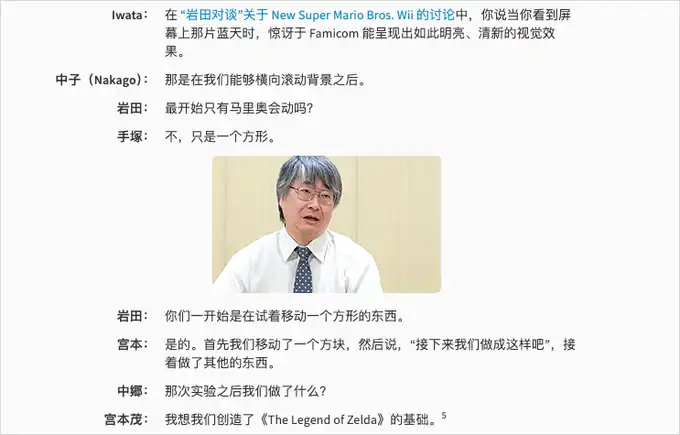
The game designer who has had the biggest influence on me and is also my idol, Shigeru Miyamoto, has followed this path his whole life in game development.
He hates writing lengthy game design documents. Instead, he always starts by creating an extremely rough prototype for people to play — if it's fun, he polishes it; if not, he scraps it.
At the very beginning, Mario was just a block jumping around on the screen.
And this approach isn't limited to the game industry.
Friends who are often involved in startups or product development are familiar with a core concept known as MVP, Minimum Viable Product. Instead of creating a perfect product to validate the market, start with the smallest, runnable thing, put it out there to see users' reactions, and then iterate quickly.
The principle is exactly the same, launch first, then iterate.
Ten years ago when I was still doing UX design, my leader said to me, "Stop thinking, start drawing. Draw first. Even if it looks like crap, it doesn't matter — you can still find gold in crap."
Vulgar, but true.
Because when the idea is in your head, it's fuzzy, uncertain, something you can't articulate.
But once you bring it out, even in the most basic form, you instantly see what's wrong, what could be better, what is truly your vision.
The act of creating is the act of thinking, trust me, hands are faster than the brain.
So, here's a very specific piece of advice.
Today, open Claude Code or any AI tool at your disposal, take out those few annoying items from your notes, choose the simplest one, spend an afternoon creating the most basic version of it.
Don't aim for perfection, just aim to have something.
You'll find that the moment you create the first crappy thing, everything else will automatically start falling into place. As you look at it, you'll naturally think, "It would be great if I could add xx here" or "The interaction there should be tweaked."
These ideas are creativity.
It doesn't come from the sky; it grows from your first crappy creation.
IV. Steal from Other Fields
After creating the first crappy thing, the next question naturally arises.
How can you make it better?
For this step, I'd like to focus on a particular individual.
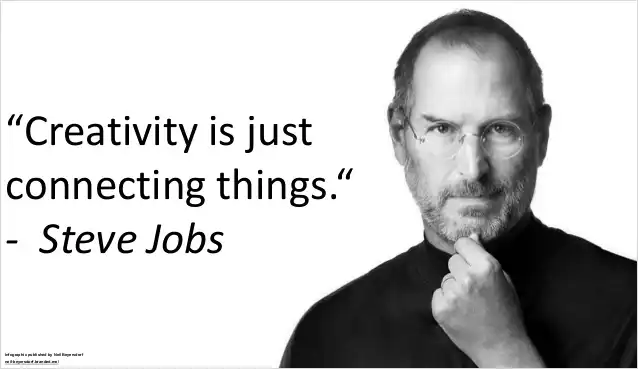
In a 1996 interview with Wired, Steve Jobs said a statement that is probably the most widely quoted insight on creativity in the world.
He said, creativity is just connecting things.
Creativity is connecting things.
Then he said something even more important.
“When you ask creative people how they did something, they feel a little guilty because they didn’t really do it, they just saw
You see, he didn't say creativity comes from being smart, nor did he say it comes from talent; he said it comes from a richness of experiences.
The more dots you have, the more lines you can draw to connect them, and the more lines you have, the stronger your creativity.
This quote has been referenced countless times, but few people actually tell you how to do it.
From my own past experience, the method consists of three steps.
Step One, gather dots from unrelated fields.
I myself am a living example.
I started with a background in UX design, then switched to AI content, which is what this public account is about.
On the surface, these two fields seem worlds apart, but when I write articles, I often unknowingly use a designer's mindset to deconstruct AI products.
For example, when I wrote the article about AI not recognizing love, while others saw a fun phenomenon, I saw the Freudian theory of the uncanny, the cornerstone of interaction design, and the underlying differences between the human perceptual system and the AI perceptual system. That perspective wasn’t forced; it was from my years of design experience, intuitively feeling a connection.
Furthermore, after playing simulation games for years, when I look at a business model, my mind automatically runs a resource loop model.
What are the inputs to this company, what is the processing process, what is the output, how to create a positive feedback loop—doesn't that resemble the core gameplay of "Cities: Skylines" and "Dyson Sphere Program"?
So you're a programmer? Go learn photography.
You're a designer? Go study history.
You work in finance? Go raise a fish tank.
Don’t take it too seriously, no need for rigorous analysis—just go interact, play, and feel.
Step Two, dissect other people's works and connect the dots.
Find a work you like and dissect its framework.
I personally learned how to dissect things from games; many times, playing a game isn’t just about beating it but about thinking, why did this level make me die ten times but still want to try again? Why can't I stop playing this economic system? This kind of contemplation is actually very interesting.
When dissecting, just answer three questions, and that's enough.
How did it hook you? How did it progress step by step? At what moment did you go, "Wow"?
Deconstruction is actually like that too.
After deconstructing a few works, you will start to see the world with the eyes of a creator; you must have this mindset.
Step three, apply the stolen structure to your own thing.
This step is the key of keys. Deconstruction without application is equivalent to not deconstructing at all.
Many of the techniques I use in my own writing and case studies come from two completely unrelated fields, which I think I can share.
The first one is from screenwriting.
For example, the Hero's Journey is the underlying narrative structure of many Hollywood movies: an ordinary person is called to adventure, faces trials, gets the treasure, and returns with a change to the ordinary world. Sometimes when I write stories, the structure is almost the same.
I first talk about the problem I encountered, then I explain how to solve it step by step using AI tools, and finally, I present the "Wow" result.
Many of He Tong's videos also follow the rhythm of the Hero's Journey.
Another example is Chekhov's Gun. Also a screenwriting theory, it says that if you hang a gun on the wall in the first act, it must be fired by the third act.
Translated into content creation, every detail you set up at the beginning must pay off later. Sometimes when I write articles, I would leave a small hook at the beginning or in the middle, and then callback to it at the end. Readers will feel that it is a complete work, not just a stack of information.
And so on, many things in screenwriting techniques are actually useful for the rhythm of content creation.
The second one is from comedy.
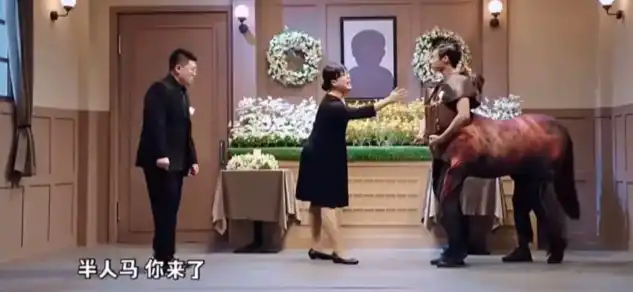
I was introduced to sketch comedy from the Happy Comedy Night and learned a technique called "Heightening."
It's about finding a fun game point, and then escalating round by round, each round more exaggerated and unexpected than the previous.
For example, in the classic "Father's Funeral," each round is more outrageous than the last.
I've used this escalation logic a lot in my AI case studies.
A tool will not showcase its full power right from the start.
It will first demonstrate the basic functions to give everyone a sense of its capability, then reveal an advanced usage to spark interest, and finally unveil an unexpected trick to make everyone say, "Wow, I didn't know it could do that!"
It's a gradual escalation, guiding the audience's emotions along the way.
See, I've applied the principles of storytelling and comedy, two seemingly unrelated fields, to AI content creation.
This is what we call connecting the dots.
Dots don't just magically appear; they are added to your mental canvas every time you explore a new field.
The more dots you have, the more likely it is that one day a line will connect between two dots, and that's when creativity shines.
Steve Jobs also said another thing:
"You can't connect the dots looking forward; you can only connect them looking backward."
So you have to trust that those dots will somehow connect in the future.
Every unrelated thing you learn now is an investment in your future creativity, the most precious asset you can cultivate.
Five. Give Your Brain Some Do-Nothing Time
The first four steps involve doing.
This step is the opposite—it's about not doing.
I genuinely believe that besides attention fatigue, there's something else that poses the biggest threat to creativity.
Comfort.
The stand-up comedy industry used to have an interesting concept called the "poverty gate."
During the peak of He Guangzhi's career, he told stories about his poverty, earning only 1400 RMB a month, living in the outskirts of Shanghai. He shared those details of his difficult life, making the audience laugh with tears, and causing an uproar.
But as he gained fame and wealth in the following seasons, moving to a more affluent area, the jokes about poverty became fewer, the content declined, and the creative and philosophical aspects of life diminished. The things that sprouted from the soil of life withered once they were removed from that soil.
However, He Guangzhi is a very talented comedian. He eventually found a way to readjust, went back to his roots, and finally won the championship.
Then there's the great Liu Cixin. Liu worked at the Niangziguan Power Plant in Shanxi for over twenty years, a place surrounded by mountains on all sides. However, it was in that seemingly remote and boring place, under the pressure of layoffs in a northeastern state-owned enterprise, that he wrote The Wandering Earth and The Village Teacher.
Even under the mental depression of the era's background, Liu experienced some adverse symptoms in his body. A quack doctor then told him, "You have liver cancer. You don't have long to live."
So, faced with the ultimate anxiety of death, Liu completely unleashed his creativity.
And thus, Ball Lightning was born.
Later on, because the Niangziguan Power Plant was going to shut down, out of 2000 employees only 400 could stay, leaving 1600 people not knowing where to go. The anxiety of death and survival competition directly gave birth to the Dark Forest theory.
So, one of the greatest masterpieces of science fiction, The Three-Body Problem, came into being.
Afterward, it was discovered that it was a misdiagnosis. Along with the success of The Three-Body Problem and newfound wealth, as everyone now knows, his output plummeted sharply. People often mock online, saying he can't produce good works anymore, mainly because he lacks that feeling of stealing time from his original workplace...
So, now the real fuel for creativity is friction.
It's the gap between you and reality, the feeling of "I'm not satisfied with this thing," the necessity for "my situation to change."
But why do I say you shouldn't do anything?
Because anxiety is the fuel, but the fuel needs a fire to ignite.
That engine is blank time.
In neuroscience, there's a theory that when a person is in a state of idleness, the brain enters the default mode network, starting free associations, randomly connecting scattered memories and thoughts.
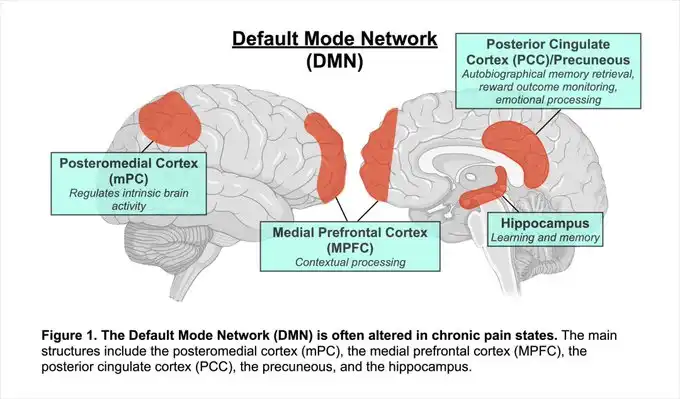
To be honest, in this day and age, anxiety is something we never lack.
Work anxiety, comparison anxiety, backwardness anxiety – we have so much fuel that it's almost overflowing.
What we truly lack is that fire, that blank time that allows the brain to quiet down and ignite the fuel.
In our current lives, every second of leisure time is filled by our phones.
Waiting for the elevator, pay with your phone; taking the subway, pay with your phone; going to the bathroom, pay with your phone; before going to bed, pay with your phone. From morning to night, your brain is constantly processing external input, and the default mode network never gets a chance to start.
That's why I always advocate for reducing noise and selecting information carefully, and I do the same.
You can also think back to those best ideas in your life and consider when they came up. I think, probably like me, the highest probability is when you were taking a shower, walking, daydreaming, or just about to fall asleep.
During those moments, your brain finally has the opportunity to process all the built-up anxiety and thoughts.
So, here's a very specific suggestion for you.
Set aside 30 minutes of blank time every day. It doesn't need to be much, just 30 minutes.
You don't need to do deliberate meditation-like emptiness; just take a walk without headphones, spend extra time in the shower, or simply lie down doing nothing.
This 30 minutes is not for you to relax but to give your brain the opportunity to connect all those pent-up anxieties, dissatisfactions, and thoughts into creativity.
Many times, what you can't figure out through contemplation, believe me.
It will come to you during these 30 minutes.
Six. Just for Your Own Pleasure
Finally, this last point may also be the most important.
After you see too many things done by others, a very dangerous mechanism starts in your brain.
That is, comparison.
"This person made a website with Cursor, much better than I could ever do." "That person's AI video quality is too high; I'm sure mine won't be good." "This idea has already been done by someone, and they did it better than what I had in mind."
Every time you compare, your desire to create decreases a little.
By the end of all the comparisons, you come to a conclusion: Forget it, I won't do it, anyway, I can't do better than others.
In psychology, this is called learned helplessness.
Martin Seligman conducted a classic experiment in 1967, which is basically when an organism repeatedly experiences defeat that it cannot control, even if the conditions change later, and it can escape, it won't even try.
Because it has learned helplessness.
You are not inherently helpless, you have learned helplessness through repeated comparison.
Honestly, I have experienced this kind of moment myself.
I ran a public account for three years. Sometimes when I saw other people's articles written better than mine, with more impressive data, and gaining more fans, I would feel a sense of emptiness like "What am I even doing."
But later on, I understood.
When you create something, the primary purpose should be to make yourself happy.
I started this public account, and the driving force was never to become a big account. It was simply because I found so many interesting things in the AI era that I couldn't keep to myself, I wanted to share, that's all.
I created tutorials for Claude Code not because it would generate traffic; it really doesn't have much traffic. It's simply because I enjoy using it so much, and I feel uneasy if I don't share it.
Edward Deci and Richard Ryan's Self-Determination Theory states that humans have three basic psychological needs: autonomy, competence, and relatedness.
When you do something out of internal interest rather than external reward or punishment, your creativity, persistence, and sense of fulfillment all significantly increase.
Just like when I play Pokémon Pokopia, my island definitely doesn't look as good as those designed by top players, but it's my island. Every tree is planted by me, and every corner holds my memories.
If you ask me to trade with others? No way.
You do these things first and foremost to make yourself happy.
Not to gain followers, not for KPIs, not to please your boss, not to show off on social media.
It's just because the feeling of creating is so exhilarating.
I truly believe that's more important than anything.
Final Thoughts
As I conclude, I suddenly remembered a book I read before.
Entitled "Homo Ludens," written by Dutch historian Johan Huizinga in 1938.
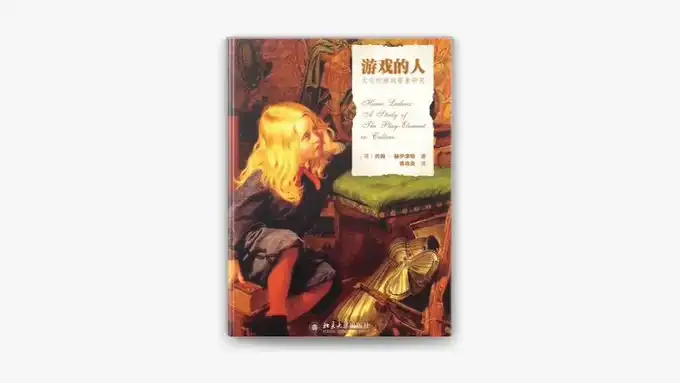
He argued that human civilization emerged not from labor but from play.
Language is play, poetry is play, law is play, art is play.
All the great achievements of human civilization can be traced back to the impulse of play.
Everything in our society is essentially a set of rules in a game.
Look at children, what is their primary way of learning? It is through play.
They don't start with any supposed theory; they just dive in and play, gaining an understanding of the world's rules through the process of play.
They are not afraid of failure because in games, you can always start over.
They do not need to consider costs because the game is the purpose.
They also do not require external motivation because playing itself is joyful.
Not afraid of failure, unconcerned with costs, intrinsic joy.
Isn't this the purest state of creativity?
As we grow up, it seems we lose these three things.
We fear failure because it comes with a cost. We calculate costs because time and energy are limited. We need external motivation because there are no KPIs, no one's recognition, and we don't know the meaning of doing something.
But I want to say.
The AI era has given us a huge opportunity.
It is helping us get these three things back.
The cost of failure? Virtually zero. Code written by Claude Code doesn’t work? Delete it and start over. The cost of doing? Extremely low. AI helps you skip the most tedious startup phase, allowing you to dive straight into the "playing" phase.
As for intrinsic joy...
You have to find that on your own; AI can't help with that.
But my own methods are all laid out in this article.
I don't know if it will be helpful to everyone, but I have shared everything without reservation. If it can help one or even a few friends, I will already be very happy.
Haejin Ha said, in a game, we are closest to ourselves.
I couldn't agree more.
Go play, go create.
Even if it's just starting from a very, very small thing.
