In early March 2026, Qian Xiaolei, the founder of Banana Climbing, gathered his dispersed core team from around the country in Shanghai to learn about AI. He didn't want to wait any longer.
Qian Xiaolei has opened 21 climbing gyms in 7 cities nationwide, with a staff of over 200 people. By national standards, this is a small and micro enterprise. However, in the Chinese climbing industry, this is the chain brand with the most stores and the largest scale.
Over the past decade, he has transformed from the founder of an internet media and PR company into an offline industry boss who spends a lot of time every day dealing with site selection, construction, and performance evaluations. Qian Xiaolei said that these are things he doesn't really want to deal with but has to.
Calling people to Shanghai was because during this year's Spring Festival, he "felt something was not right." His circle of friends was divided into two groups: one group consisted of peers, coaches, and members of the climbing industry; the other group was people he knew from his previous work at internet companies and tech media. Around the Spring Festival, the two groups showed extreme differentiation, with peers having almost no awareness of AI, while the internet group's discussion had escalated to FOMO.
What excited him even more was Tencent Research Institute's annual conference. Qian Xiaolei attends every year, and the topics of the past few years have been about technology for good, internet ethics, and environmental protection. This year, every topic from morning to night was related to AI.
This spring, anxiety about AI technology became the main theme for this climbing gym owner.
An Emergency Offline AI Training
Qian Xiaolei stands at the intersection of two worlds. He has written about the mobile phone market on Zhongguancun Online, worked in public relations at Smartisan Technology, and witnessed Nokia's fall from grace and the iPhone's journey from being mocked to world domination. These experiences have made him reflexively vigilant about technological change, but many people in the team he now manages have never even encountered the concept of efficient work.
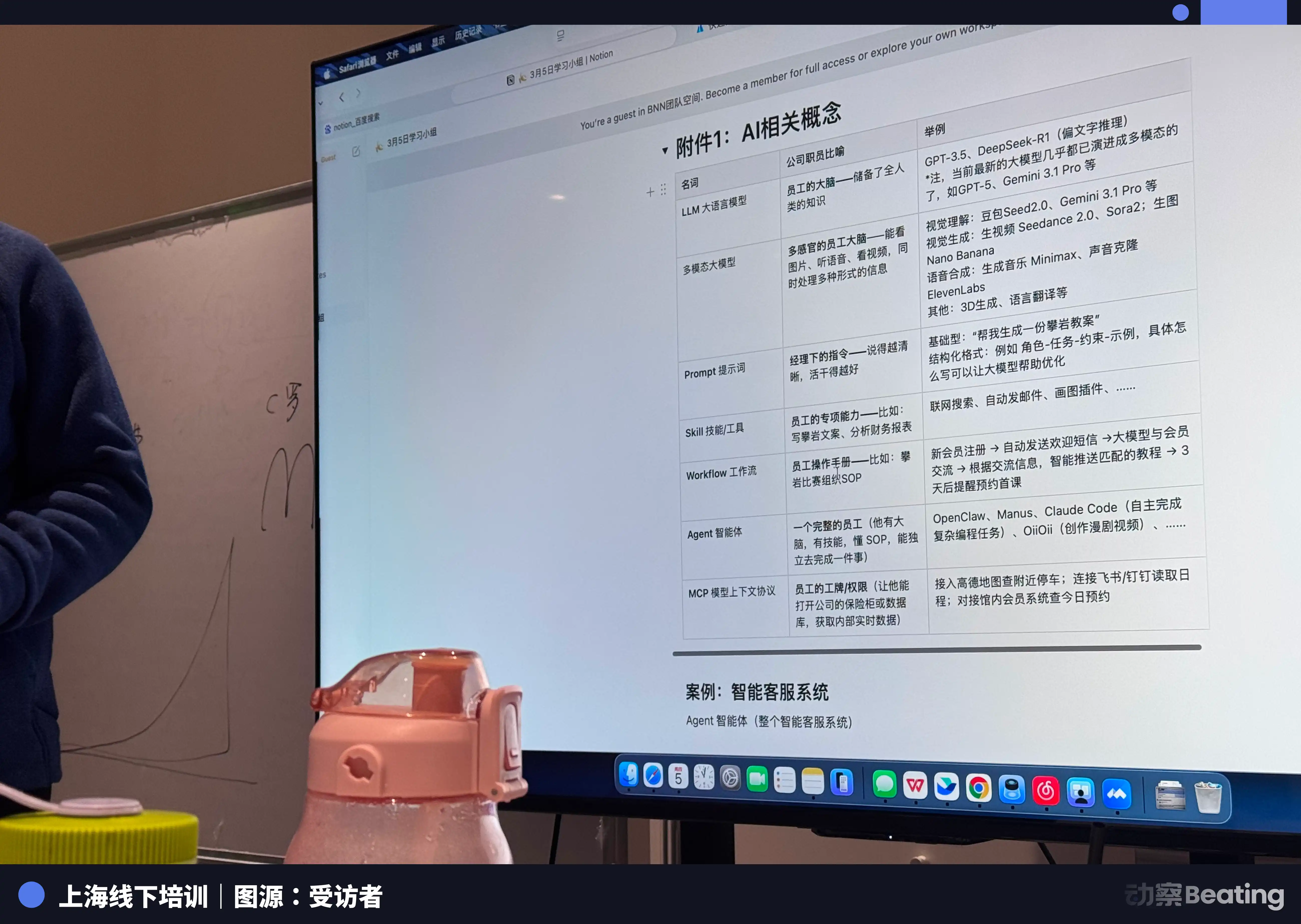
The conference in Shanghai lasted two days. Qian Xiaolei, his partners, and a former digital team product manager who was about to join them conducted on-site AI technical training, requiring everyone to create something using Manus based on their respective business responsibilities.
There were no tools for on-site configuration, no hand-holding for vibe coding beginners, and the issue of a blocked Google email was resolved on the spot. In the end, the conversion rate of all employees getting started with AI was 50%.
What surprised Qian Xiaolei the most was a route setter named Yang Kai.
A route setter's daily routine involves designing climbing routes on rock walls, selecting holds, color-coding, and testing difficulty. It requires spatial imagination and physical experience, making it a craft. No one expects them to write code.
Yang Kai spent about two hours on-site and created two things.
One of them is a rock point inventory management system. Each store has three to five thousand rock points, but if order data is lost, no one knows which holds are installed in the gym. Yang Kai created a tool to label, archive, and track each rock point.
Peers may handle one or two stores, stay up late to set routes a couple of times, endure for two to three days, and it's over. But with Banana having twenty stores, Yang Kai fights with Excel every month. Scale created pain, and AI happened to appear where the pain was most intense.
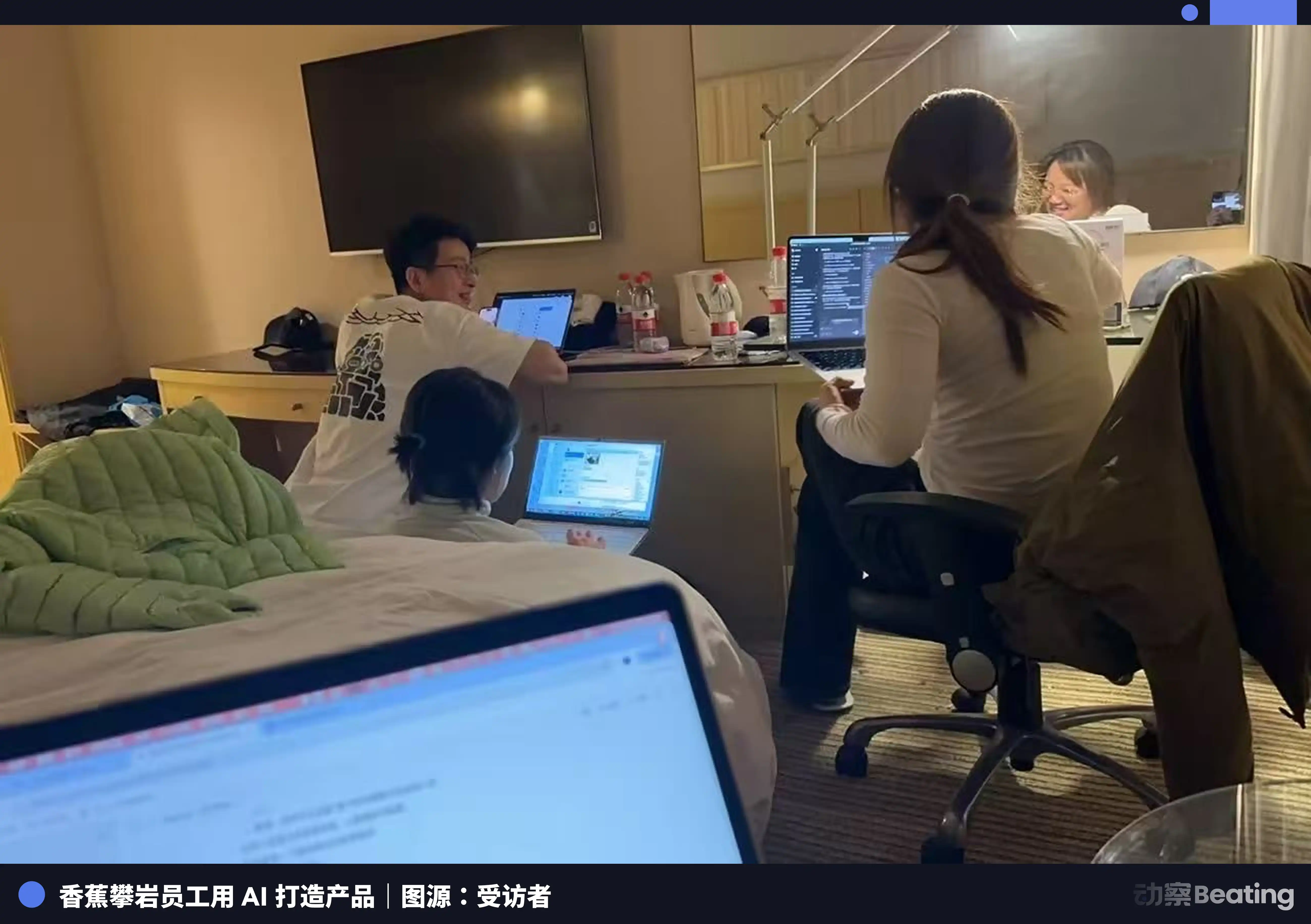
KK is the head of Banana Climbing Gyms in Shanghai and Zhuhai. Before joining, he worked at a property company in Macau's casino, managing one of the most complex indoor spaces in Asia.
He implemented a store monitoring and inspection system using AI.
All Banana Climbing Gym stores have full coverage surveillance, with no blind spots except in the changing rooms, as climbing involves a risk of injury, requiring video retrieval at any time. Since surveillance cameras were already in place, KK's idea was to have them also perform store inspections, such as checking for litter on the floor, timely return of rental shoes, coaches wearing uniforms, and front desk staff playing with their phones.
The system can launch inspections for 21 stores in 7 cities nationwide with a single click. Surveillance screenshots, AI analyzing the footage, and generating reports.
This system resolved the contradiction between store scale and distance. Banana Climbing Gym stores are spread across seven cities, with an average of three stores per city. Traditional supervisor travel inspections incurred high travel costs. In contrast, the operating cost of this AI system per day, including API and Token fees, is just over one hundred yuan.

But Qian Xiaolei also knows that this system cannot see everything. It can detect paper on the floor but can't smell if shoes are smelly. It can check if coaches are wearing uniforms but can't sense whether the venue is well-ventilated or if customers are feeling hot or cold. "Sitting at the front desk, you may feel cold, but actually, the customers inside might feel hot. You have to go to the customer's position, do the same things as them, to feel their discomfort."
For this reason, Qian Xiaolei established a special AI efficiency award and rewarded KK.
What AI can do is free people from repetitive supervision tasks to do things that only humans can do.
「I'm So Happy」
After the Shanghai training camp, Qian Xiaolei found that the employee adoption rate of AI was only 50%. His initial distance anxiety turned into tech anxiety.
Those who were already using AI produced results beyond expectations; but for those employees who hadn't started using it yet, transitioning from zero knowledge to becoming proficient in AI technology was not a lack of willingness, but a lack of a tech-savvy person to help them overcome the initial hurdles.
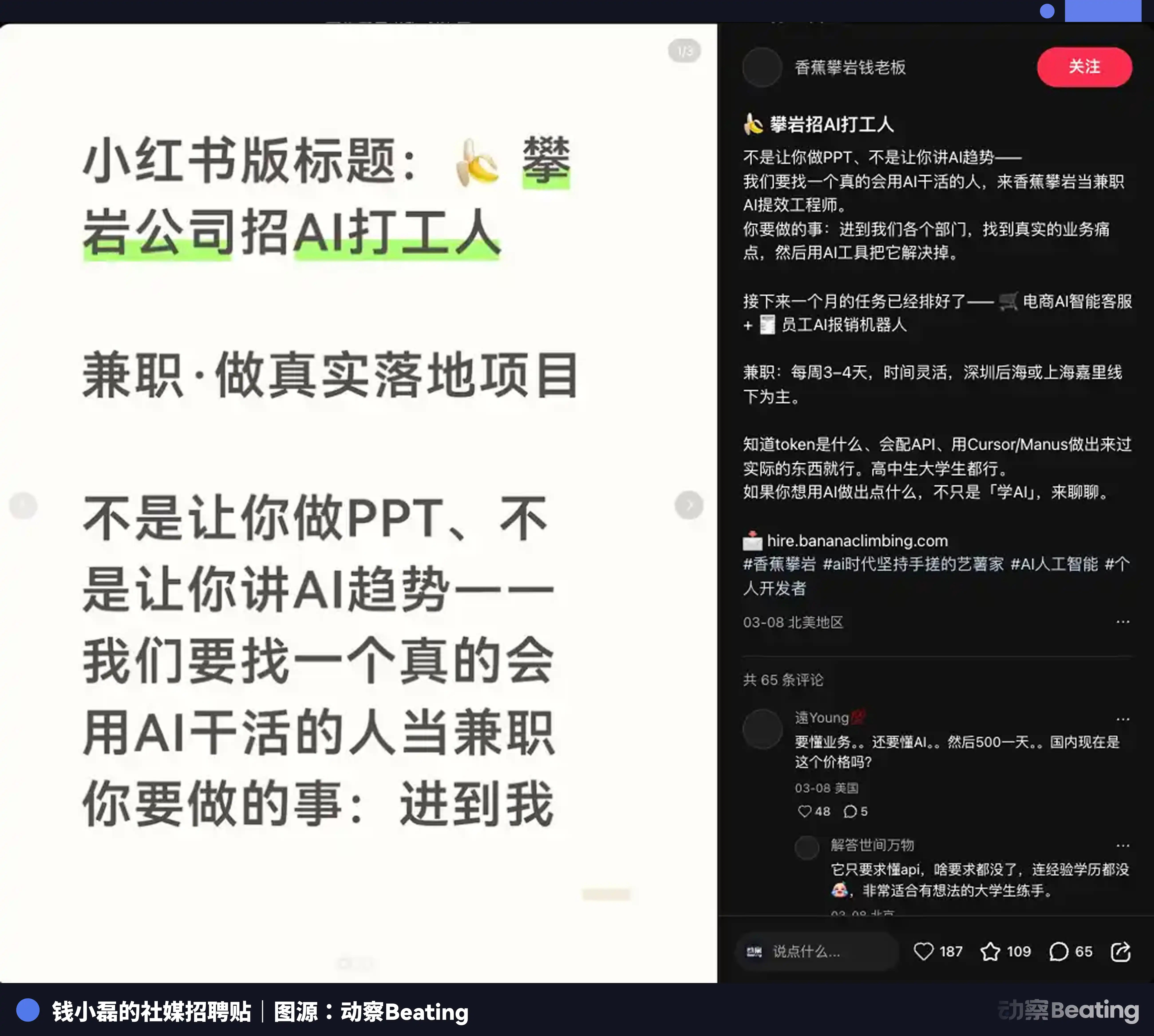
So Qian Xiaolei posted a job posting on Xiaohongshu (Little Red Book).
This job posting wasn't aimed at a coach, but at someone who understands AI, is willing to delve into specific business scenarios. People from various backgrounds showed up, with the majority being rock climbing enthusiasts. After meeting several people in Shenzhen and Shanghai, he recruited two individuals.
One of them helped his e-commerce team solve a long-standing problem.
Under the Banana Rock Climbing brand's outdoor equipment branch Tmall store, there were a large number of SKUs, including various equipment, quickdraws, camming devices, harnesses, each requiring a Tmall product details page.
The previous process involved operations first translating English product information into Chinese, pasting it into the approximate location on the layout file, indicating font size, and then handing it over to the designer for rendering. The design cost of a product details page was usually between 300 and 500 RMB, but more costly was the time: operations spent a lot of effort providing requirements, designers spent a lot of effort understanding the requirements, going back and forth several times in communication, and a single page could take several days to finalize.
The newly hired AI engineer provided an e-commerce operation with a toolchain, connected to several APIs, created a custom skill, input the product name, and automatically generated the product details page image, with the designer having no involvement throughout the entire process.
In the end, the API consumed approximately $60 and outputted dozens of product details pages. When Qian Xiaolei got to this point, he used four words: 「I'm so happy.」
Goat in the New York Valley
The same thing is happening on the other side of the Pacific.
Scott is the founder of Hudson Valley Forestry, a company in the Hudson River Valley in New York state. The main business is land clearing, using large-scale grinding equipment to deal with shrubs and weeds, making space for solar projects, pipeline corridors, or private estates. Everything from half-acre backyards to 50-acre industrial projects, you name it.
Scott used to be a film and television photographer, working for 15 years, with no software engineering background.
In some places where machines can't go, or where there are underground high-pressure pipelines, he releases a herd of goats for targeted grazing, using animals instead of machinery for clearance. He needs to track the goats' location, with smart collars on the market costing $300 each, plus a monthly fee. Scott built his own tracking system with a device costing $30.
This is not the only system he has built. He also set up the company's website, CRM, ERP, all self-hosted on his own server. Another project he is working on is setting up a mesh communication network for remote valleys where there is no cell phone signal, enabling workers to exchange messages, share photos, GPS locations, and engineering data.
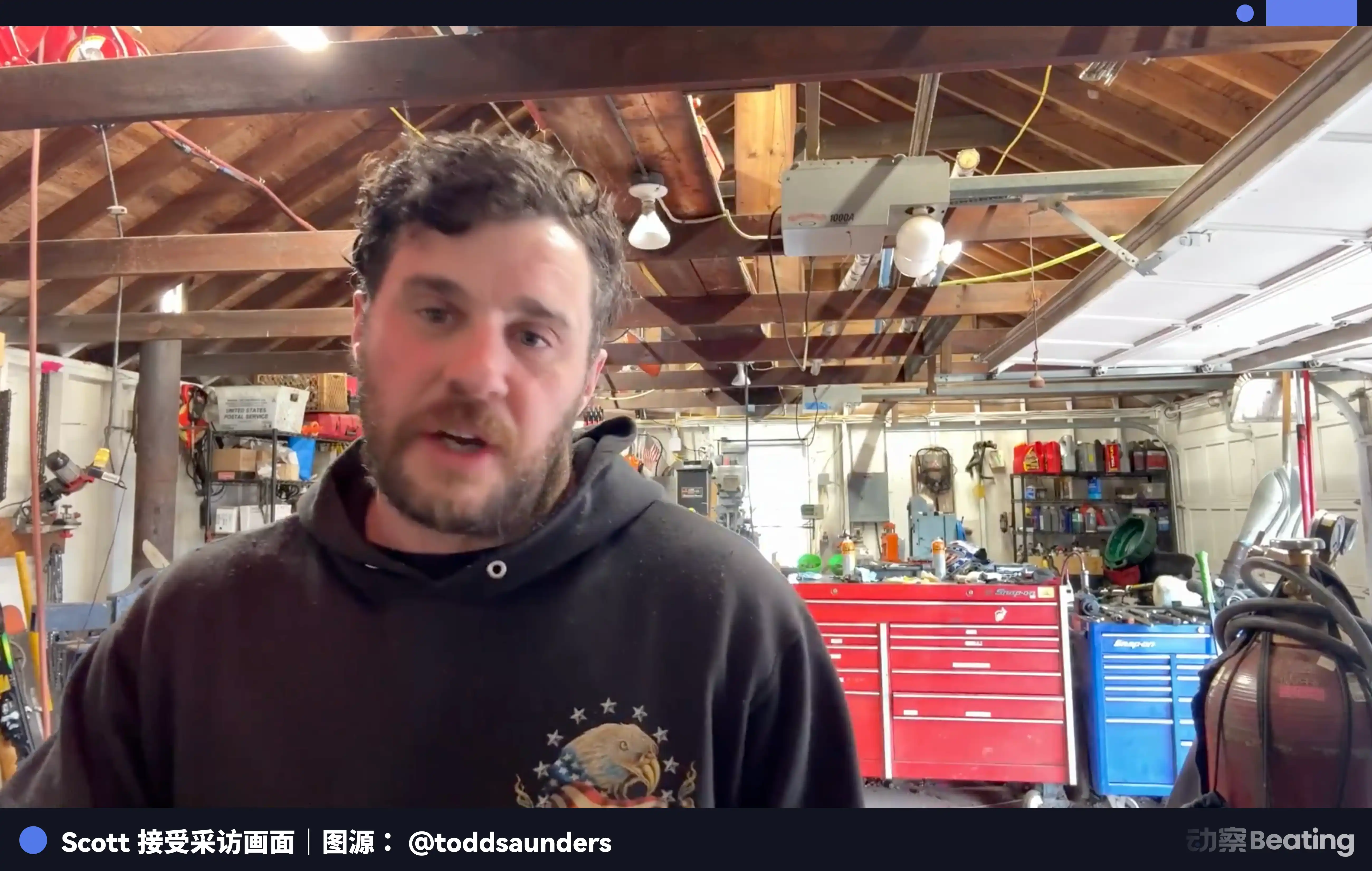
When investor Todd Saunders shared Scott's case, he used a term—Blue-Collar Developer.
There is a distance of 12,000 kilometers between Qian Xiaolei and Scott. One manages twenty-one climbing gyms and two hundred employees, while the other releases goats in a New York valley and operates a crusher. But they are both moving in the same direction: in their respective industries, they use AI to solve problems that used to be tolerated, outsourced at great cost, or simply not considered worth solving.
But AI has arrived. Qian Xiaolei's CRM system was developed by a climbing enthusiast who is also a member of a bouldering gym.
This person started a small company, using AI to assist in coding, and in four to five months, developed and launched a membership management system specifically for climbing gyms. Facial recognition for entry, gate machine interlocking, insurance integration—all features cater to the unique needs of the climbing industry. The bouldering gym he frequented was his seed customer, and now he is selling this system to more climbing gyms.
Qian Xiaolei feels that although this system occasionally has small bugs, its cost and efficiency improvement were unimaginable in the past. "When the threshold and cost of coding are low enough, I can customize it, so why buy a standardized product?"
This statement is a reality in the 2026 SaaS industry. In 2024, the global SaaS industry experienced the most severe valuation contraction in a decade.
Salesforce's stock price plummeted over 30% from its 2021 peak, and its P/E ratio compressed from over 60 times to less than 30 times. Twilio, once seen as a SaaS benchmark, laid off over 1500 people in 2023. The number of funding rounds for vertical SaaS companies plummeted by over 40% in 2024. Almost every star company from the previous cycle is experiencing the same story: slowing growth, increasing customer churn, and eroding pricing power.
The reason is not just the economic cycle. In the AI frenzy, those companies that once relied on a general solution to collect subscription fees saw their moat transition from product to inertia.
Ultimately, this inertia will be broken.
Qian Xiaolei himself is also a practitioner of this migration. He even tried to abolish the internal work order system. The operations team previously used a work order system to manage design requirements, "I was particularly against it at the time, thinking it was a bad habit that only big companies had."
Later, he found that if one could describe the design requirements clearly, they could directly provide them to AI to get results, eliminating the need for work order scheduling. "Of course, the poster delivered by AI may score 70 points, while the designer's work would score at least eighty to ninety points." The gap still exists, but for many simple requirements, waiting three days for that 30-point difference is no longer worthwhile.
Using AI to Control Organizational Size
In Qian Xiaolei's climbing gym, many members are programmers. Some have already been laid off.
"When they were just laid off, their frequency of coming to the climbing gym would increase. They would show up during weekdays in the daytime, and when asked, it was to receive a welcome package, looking very happy. After a few months, they might come and ask us, 'Are you hiring coaches?'"
There is a climbing buddy of Qian Xiaolei's age who used to work in the Internet industry. After being laid off, he went to work as a coach at a climbing gym. Looking at it from a different perspective, Qian Xiaolei thought: he climbs well, can be a good coach, which is better than being unemployed at home.
In the past few decades, the personal computer revolution, the Internet revolution, and the mobile Internet revolution have not been able to digitize half of the world's work. And what AI is impacting is precisely those who "won" in the previous waves of change.
A financial analyst analyzing data in a cubicle is more at risk than a construction worker laying bricks on a construction site. A designer Photoshopping in front of a computer is more at risk than a kitchen assistant chopping ingredients in the back kitchen. A programmer typing on a keyboard is more at risk than an office cleaner tidying up. This is because the cost of AI replacing digital work is rapidly decreasing, while the cost of replacing physical work remains high.
Qian Xiaolei's climbing gym happens to be at the intersection of these two groups. His members include both white-collar and blue-collar workers. In his observation, climbing has never been an exclusive sport for white-collar workers.
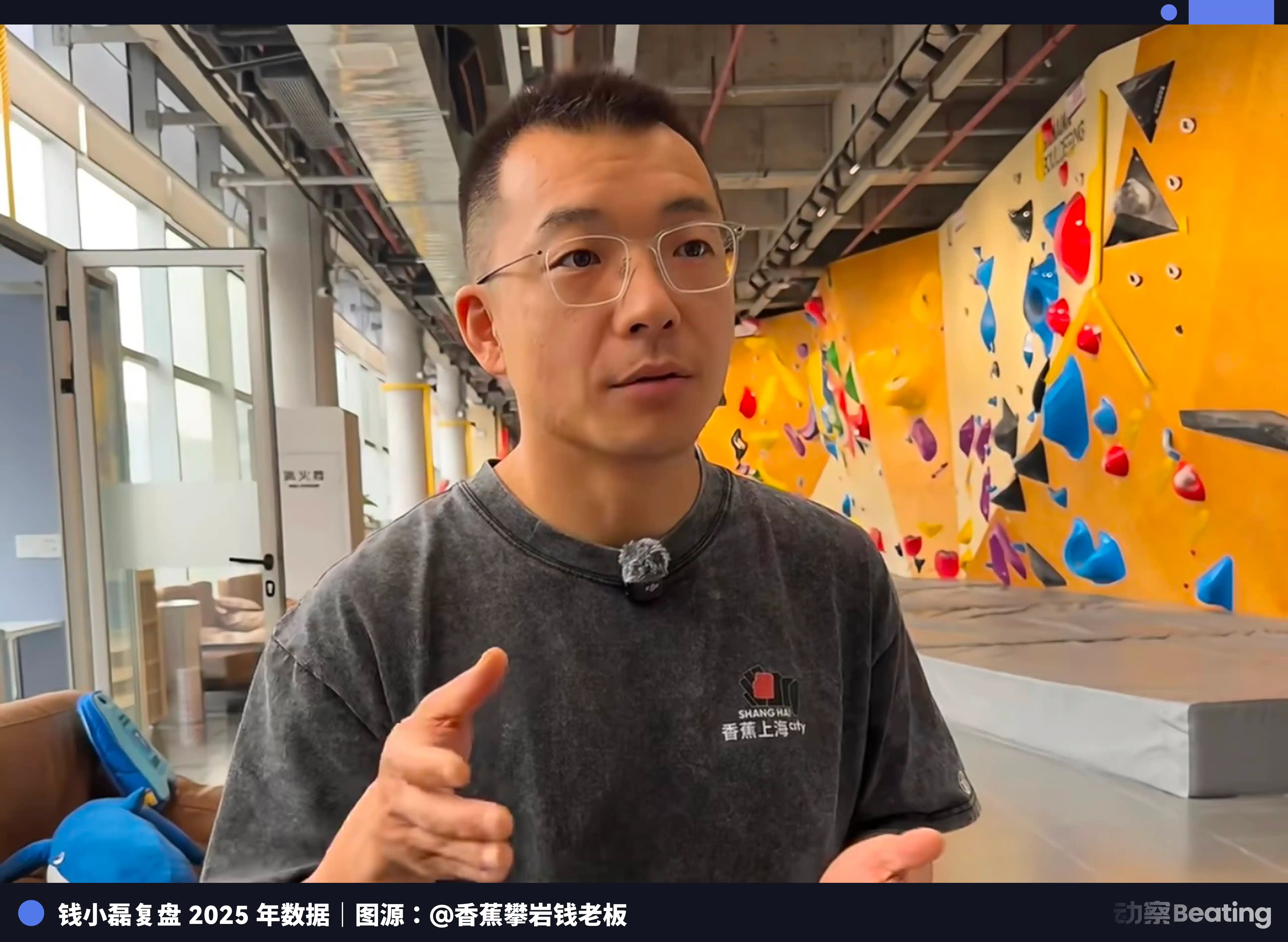
Qian Xiaolei is a very optimistic person. He says, "All sad things will not last beyond two o'clock in the evening; just sleep, and it will be fine." But his anxiety has worsened in the past two months. "As I delve deeper, I find this thing is still quite scary."
The fear is not that AI poses any fatal threat to the climbing industry; climbing itself is very distant from AI. The fear lies in his inability to imagine what the large model and Agent will look like three years from now.
“People tend to find the unknown more frightening.”
But for Qian Xiaolei, the other side of this fear is an opportunity: “This is a very good opportunity for us to widen the gap.”
He does not want the company to expand to 500 or 1000 people, only to be dragged down by numerous unnecessary processes and regulations. He wants to use AI to control the organization's scale, not through layoffs, but by enabling 200 people to do what used to require more.
Qian Xiaolei's way of easing anxiety is to go rock climbing, find a less crowded gym to climb for a while. If he doesn't feel like exercising, he goes to a store, walks around, stays at the front desk for a while, and chats with members.
“Once you start climbing, or you have contact with someone, that feeling is different from chatting with GPT in front of a computer.”
Rock climbing penetration in China is far from its peak. The members of several large chain climbing gyms in Paris combined account for 5% of the city's permanent population, meaning one out of 20 people goes rock climbing. China is still far from this number. Moreover, the spread rate of this sport has exceeded 1, meaning on average, one enthusiast can bring in more than one newbie.
Qian Xiaolei used a very optimistic assumption to describe the future, where if everyone works only three days a week, they would have four days off to rest, be with family, and go rock climbing. Of course, he also knows the other side of this assumption – if most people lose their jobs, have no income, they won't be able to go rock climbing. “The uncertainty is behind, what the world will look like in five years, who knows?”
But he is quite certain of one thing, no matter what the world looks like, people still need to experience the world with their bodies. AI can help him patrol stores, create business pages, manage inventory, generate financial reports, but it cannot replace a person spending three hours on a rock wall, the friction when fingers grasp a handhold, the split-second buffer decision the brain makes when slipping, the exact sense of achievement after completing a route.
Wang Shi is 75 years old and still rock climbing. He once said, “The first thing climbing taught me is how to fall safely.”
In a world where more and more work is taken over by algorithms, perhaps the scarcest ability is knowing how to fall, how to get up after a fall, and keep climbing.
