Perpetual futures are a type of futures contract with no expiration date. It was originally an innovative design native to the crypto space and saw a full-scale breakout on-chain in 2025. Today, perpetual contracts have become one of the largest categories in the crypto market, covering assets beyond crypto and achieving trading volumes in the trillions of dollars.
Last year, centralized exchange (CEX) top perpetual contract trading volume reached $86.2 trillion, a 47% year-on-year increase; while on-chain decentralized perpetual contracts saw even more rapid growth: mainstream decentralized exchange (DEX) trading volume reached $6.7 trillion, a 346% year-on-year increase. Currently, DEX trading volume accounts for about 7.8% of CEX trading volume, compared to just 2.5% a year ago.
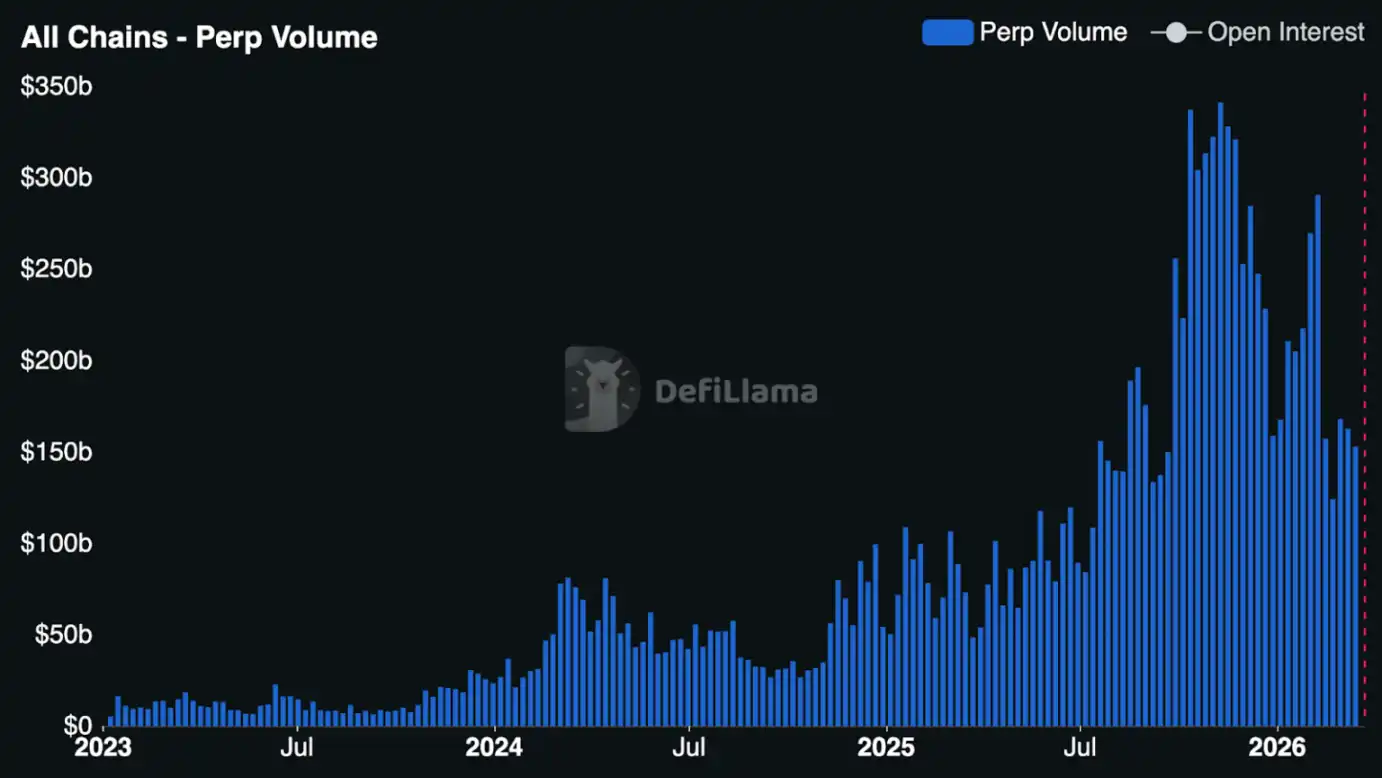
But more importantly: Perpetual contracts are gradually shedding the label of a "niche crypto-native tool" and are transforming into a fundamental force driving trading behavior and market structure.
What exactly is driving the popularity of perpetual contracts? Why now? This article will analyze the reasons for the widespread adoption of perpetual contracts by traders globally, the market's scale potential, and the business opportunities seen by developers.
History and Evolution of Perpetual Contracts
The concept of perpetual contracts is actually older than the crypto industry itself. As early as 1993, Nobel laureate Robert Shiller proposed perpetual futures contracts, initially envisioned as a tool to hedge real estate price risk. However, it wasn't until 2016, with BitMEX and the emergence of the longest-running Bitcoin perpetual swap contract XBTUSD, that perpetual contracts truly became popular in the crypto space.
Today, a decade later, various trading platforms have introduced perpetual contracts covering stocks, stock indices, commodities, interest rates, startup valuations, and even the price of an NVIDIA H100 GPU.
Over the years, perpetual contracts have been a billion-dollar revenue engine for CEXs. With the rising demand for leverage among retail traders, perpetual contracts have become key venues for short-term price discovery, liquidity, and trading activity. At several mainstream Asian CEXs, perpetual contract trading volume surpasses that of spot markets.
Over the past year and a half, the market share of DEXes has undergone a significant change, with them starting to eat into CEX market share. Leveraging the structural advantage of self-custodial wallets, perpetual contract DEXes are rapidly narrowing the gap with CEXes in terms of liquidity, performance, and functionality.
With the explosive success of perpetual contract DEXes like Hyperliquid, mainstream crypto wallets and applications are increasingly integrating perpetual contracts and creating a high-quality trading experience, enabling millions of users to easily participate. In the second half of 2025, the frontend of perpetual contract DEXes saw explosive growth, with everything from simple mobile apps to professional multi-platform trading terminals available.
In particular, Hyperliquid, through the HIP-3 mechanism, has pushed the boundaries of DEX capabilities, allowing anyone to launch perpetual markets on the platform permissionlessly. With HIP-3, developers can list almost any asset, receive a 50% revenue share, and autonomously manage oracles and risk parameters.
At the same time, new players such as Avantis, Lighter, Ostium, Variational, and others have emerged or accelerated their product development. Intense competition has forced perpetual contract DEXes to differentiate in terms of trading platform design, market structure, asset support, and permissionlessness, leading some platforms to find strong product-market fit in new areas like Real World Asset (RWA) perpetual contracts.
For a long time, perpetual contract traders only speculated on crypto assets like BTC, ETH, SOL, and various altcoins. However, starting from the second half of last year, despite an overall crypto market downturn leading to a decline in perpetual trading volume from its peak, RWA perpetual contracts have risen against the trend.
Several DEXes have launched commodity, stock, and stock index contracts, expanding the range of tradable assets to listed companies like NVIDIA, Samsung, private firms like SpaceX, and commodities like silver and palladium.
This year, the growth of RWA perpetual contracts has further accelerated. In recent weeks, RWAs briefly accounted for 44% of Hyperliquid's total trading volume and have consistently been the highest-earning trading pairs on the platform.
DEXes have also provided efficient price discovery channels for RWA assets like oil during weekends when traditional markets are closed.
With the explosion of RWA perpetual contracts, a large number of related startup projects and products have quickly emerged. In just the past six months, a wave of new trading platforms, trading interfaces, market deployment tools, and liquidity providers have appeared.
The participants entering this field include brand-new startups, projects transitioning into the sustainable track, and global fintech giants, all of which are integrating perpetual trading into their existing products.
All participants are targeting the same opportunity: perpetual contracts are poised to become a mainstream trading tool in the global financial market.
Market Opportunity for Perpetual Contracts
Looking at the traditional financial markets, options are one of the largest and most actively traded markets globally, covering various assets such as currencies, stocks, indices, commodities, ETFs, and more. Options are powerful, supporting trading strategies based on time, volatility, price ranges, and other logics.
However, focusing on retail behavior reveals that a large volume of trades is concentrated in a specific type of option: short-term, leveraged, directional exposure. The most typical example is 0DTE options (zero-day-to-expiration options), where traders speculate on intraday price fluctuations at a low cost.
This type of trading is the fastest-growing segment in the options market. In 2025, the average daily trading volume of SPX 0DTE options reached 2.3 million contracts, a 51% year-on-year increase, representing 59% of the total SPX options trading volume.
To meet this demand, the market has introduced various daily-expiring index products, including CBTX, MBTX Bitcoin ETF Index Options, and Cboe Magnificent 10 Weighted Index Options.
In other words, although options are used for structured hedging, volatility trading, convexity trading, and other complex purposes, the significant and growing retail funds actually seek short-term, leveraged directional exposure. This is precisely the demand that perpetual contracts excel at meeting.
The trade-offs between the two are very clear: options excel at fixed risk, convex returns, remain the default tool for volatility trading, with traders' maximum loss limited to the premium paid; whereas perpetual contracts can lead to the entire margin being liquidated.
But for the vast majority of retail traders desiring directional leverage, perpetual contracts have several structural advantages:
Trade Around the Clock: The next-generation perpetual market operates 24/7, non-stop, catering to the basic expectation of uninterrupted trading for global crypto-native users.
No Strike Price, No Expiry Date, No Rollover Needed: A single continuous position where traders don't need to choose parameters, manage expiry dates, or rebuild positions daily/weekly. Positions can be held for as short as a few seconds, as long as several months, and theoretically indefinitely.
Simplified Risk Structure: Perpetual contracts only need to focus on price, margin, and liquidation. Whereas options, even if the directional bet is correct, may incur losses due to time decay, implied volatility changes, or path dependency. Perpetual contracts eliminate this complexity, purely expressing directional views.
Efficient Capital Deployment for Continuous Exposure: Short-term options require full premium payment and constant rolling. Perpetual contracts only require posting margin, making them more capital-efficient for directional positions held for intraday to multiday durations.
Options will not disappear. As a long-standing part of the financial market, options will continue to play a dominant role in scenarios involving fixed risk and complex payoff structures. However, for large and growing funds seeking short-term, directional leveraged exposure, perpetual contracts have already captured trillions of dollars in trading volume and billions of dollars in revenue.
This raises a key question: As perpetual contracts transition from a niche tool to a mainstream foundational financial product, where will the value accrue in the industry stack?
In traditional markets, the most valuable companies are often built on top of trading platform infrastructure, rather than the trading platforms themselves. For example, the market cap of retail broker Robinhood is higher than that of its underlying exchange, Nasdaq.
Whether this model holds in the crypto space, and whether platforms like Hyperliquid, Lighter, Ostium can accumulate strong network effects at the exchange platform level, remains one of the most open questions for the industry to watch.
Nevertheless, the developer ecosystem is rapidly expanding, focusing on several directions:
· Vertical distribution layer: Front-end interfaces tailored to specific user groups, showcasing not only market data but also integrating narratives, strategies, gamification, and social elements.
· Market creators and operators (such as HIP-3 deployers): Operating popular markets on Hyperliquid, akin to owning a mini trading venue without the need to build complex infrastructure.
· Specialized market-making: Focus on long-tail markets, event-driven order books, and cross-platform position management.
· Perpetual-specific data infrastructure: Around dimensions like open interest, funding rates, liquidations, trader signals, leverage exposure, user retention, community-driven dashboards, block explorers, heatmaps, and analytics tools are taking shape. More mature, high-quality real-time data will enhance the transparency and efficiency of the entire ecosystem.
These are all the growing pains that perpetual futures contracts have to go through as they move from the crypto-native realm to the global financial stage. As the ecosystem matures, the question is no longer "Can perpetual contracts scale?" but rather who can build the most valuable applications and infrastructure around it.
