Many people dive into on-chain data to figure out "whether a coin has a rug pull" and then try to avoid, embrace, or follow it in various ways. But the truth is — a coin without a rug pull simply won't pump. So the truly useful question is not "whether there is a rug pull," but "at which stage is the rug pull" — pre-sale, pump, dump, or has it already run?
Let's start with the conclusion: You can definitely find a rug pull because rug pulls are everywhere.
This article provides you with a set of on-chain + off-chain signal frameworks. It's not about turning you into a detective to catch the rug puller but rather to help you quickly assess: Is the current state of this project retail-friendly?
I. On-chain Signals: What Chip Distribution and Funding are Saying
Remember: This version is not lacking funds or data; what's lacking is funds willing to take the plunge. Like all games, everything revolves around how to get you to "recharge your payment." As long as you keep an eye out, with a thousand memes, there's always one that suits you.
1: Chip Concentration — Wallet Interconnection Calculation, concentration is not important, the degree of concentration is
Don't just look at the "Top 10 Holders' Share," anyone can see that number, and it's easy to disguise — a rug puller splits the tokens into 50 wallets, each holding only 1%, making the Top 10 look "healthy." The right approach is to open a professional tracking tool and look at the bubble chart, merging addresses with direct transfer relationships. If three wallets each holding 2% have transferred among each other, then one person holds 6%. Look at the purchase times of these related addresses — if they are concentrated on the same day or even the same hour, ask yourself, do you believe in coincidences?
Funding Wallet Analysis — Where did the initial ETH/BNB of these wallets come from? If the gas fees of 50 wallets all come from the same CEX withdrawal address or the same funding wallet, even if there are no direct transfers among them, it's likely the same person.
If someone is spending to receive, what do you think they intend to do?
2: Volume Authenticity - Vol / Holder (OI) Ratio
24-hour Volume ÷ Total Holders = Average transaction amount per holder. If a coin has only 800 holders, a 24-hour volume of $2 million, and an average of $2500 per person — it is highly likely that only a few addresses are wash trading the volume or bots are at play. Why would someone spend money to inflate trading volume?
Next, you can calculate the network's vol/holder ratio and the vol/holder ratio for the top 3 trending tokens.
3: DEX Liquidity Pool Monitoring
Observe changes in LP (Liquidity Pool) — a decrease or increase in LP size can signal rug pulls or manipulation. If LP is unlocked or about to expire, the risk is very high. Also, monitor changes in LP depth. If the price is rising but the LP depth is shrinking, it indicates that whales may be quietly draining liquidity in preparation for a rug pull, and vice versa.
Compare the LP status and depth of the top 5 trending tokens.
4: Turnover Rationality - 24h Vol / Market Cap
Measure "what percentage of the market cap is traded in a day." Break it down by the hour — if the volume suddenly spikes in a few hours far beyond other time periods, someone is likely wash trading. Normal retail trading hours have relatively smooth distribution, so a sudden peak is likely a prelude to manipulation. Additionally, it's more valuable to look at net buy volume rather than total volume.
Next, you can calculate the network's vol/holder ratio and the vol/holder ratio for the top 3 trending tokens.
5: Transaction Count vs Volume - Large Transaction Ratio
Look at the average transaction amount per trade in 24 hours. If the top 10% of large transactions account for over 60% of the total volume, the market is being primarily driven by a few addresses, and the price trend depends entirely on these addresses. (A better method is to use the Gini coefficient to quantify the concentration of transaction value, between 0 and 1, closer to 1 indicating more concentration). When these addresses are inactive is more important than when they are active.
Next, you calculate the vol/holder ratio for the entire network, as well as the vol/holder ratio for the top 3 trending tokens.
6: Address/Account/OI Growth Rate vs. Price Change Rate—Determining the Stage of Whales
Combining the calculation of the previous 5 indicators (be sure to process, filter, and calculate), you then use data analysis to determine which stage the asset is currently in?
· Accumulation Stage: The price remains low or even slightly decreases, large on-chain addresses slowly accumulate, and the number of wallets/accounts shows little change. Whales are quietly accumulating chips. (Addresses associated with each other do not count.)
· Pump Stage: For example: if the price rises by 30%, but the wallet/account count only increases by 5% → the chips have not been distributed, and a few people are orchestrating the rise.
· Distribution Stage (Most Dangerous): The price stagnates or even slightly decreases, but the wallet/account count increases (sometimes also reflected in the long/short ratio) by 20% → whales slowly distribute to retail investors at a high point, giving the appearance of "community growth" when, in fact, the whales are exiting.
· Dump Stage: The price drops, but the wallet/account count does not decrease → retail investors are trapped, and the whales have already exited.
II. What's Next After Analyzing?
Alright, you've spent time confirming the presence of whales and determining the asset's stage. So, what's next? Switch to another one? Switch again and find there are still whales? Because—
III. Whales Aren't a Bug; Whales Are the Underlying Structure of This Game
Why would a token rise? Pumping requires two things: chips + capital. When these two things come together, it's called pricing power. Without concentrated chips and insufficient ownership, no one has the motivation to pump.
Chip concentration is not a conspiracy; it's a prerequisite for pumping. No whales, no market movement.
IV. What Whales Use to Win Against You
Pricing power is just the entry ticket. What truly makes whales win consistently is how they trade, completely different from you. You rely on intuition, while whales operate on a system.
· Market Maker's Cost Awareness: Calculate the profit of pulling up the price, and if the EV is positive, execute. Retail traders FOMO based on screenshots.
· Market Maker's Probability Thinking: Continuously adjust probabilities and position size. Retail traders keep making repetitive bets.
· Market Maker's Psychological Exploitation: Create FOMO, utilize sunk cost to make you hodl to the death.
· Market Maker's Tooling Advantage: Ability to hedge, with cost/information advantage, operational dimensions, and error margin overwhelm retail traders.
5. So How Can Retail Traders Win?
In the Market Maker's domain, following the Market Maker's rules, retail traders cannot win. Information, tools, and psychology are completely asymmetric. But there is one asymmetry that can be broken.
6. Retail Traders' Biggest Structural Flaw: Can Only Long
Without perpetual swaps, Market Makers indeed can only go long, but they don't need to go short. The reason is the cost.
The Market Maker's chip cost is close to zero (gas fees or very low early prices). Even if it drops by 90%, they are still profitable, just "less profitable." The ultra-low cost gives them a huge margin of error.
But retail traders buy in at the FOMO stage, their cost may be 50 times that of the Market Maker. Your cost structure determines that you cannot withstand a drawdown. Retail traders have neither shorting tools nor a low-cost safety net. The only way to make money is: buy, see the price go up, and sell before it drops.
One direction, one opportunity, with an almost zero margin of error. This is a structural unfairness.
7. What if Retail Traders Could Short Too?
When the signals point to the distribution phase, to a false prosperity — not only can you "exit quickly," you can short, turning the Market Makers' distribution into your profit. When the truth returns, you can be on the winning side. Your analytical ability is finally not wasted.
8. Mechanism Perspective: With the Ability to Short, Can Retail Traders Control Pricing?
To put it bluntly: No.
The formula for pricing power will always be: chips + funds. Retail traders are fundamentally a group with dispersed funds fighting individually. No matter how sophisticated the mechanism is, it cannot turn a pile of sand into a cannon. However, by introducing some decentralized spot leverage and lending protocols, it's not to let retail traders "act as Market Makers" but to break the Market Makers' "absolute monopoly" on pricing power.
From a Mechanism Perspective, This Reshapes the Structure Along Three Dimensions:
Creating "Sell Pressure" out of Thin Air, Stripping Away Unilateral Control
In a pure spot market, if a market maker does not sell, there is no selling pressure, and they can easily drive up the price by trading with themselves. However, with the introduction of shorting mechanisms, retail investors can borrow tokens in excess, dump them on the market, turning previously "locked" dead chips into active sell orders. This effectively increases the real cost of the market maker's price manipulation. To continue driving up the price, the market maker must buy up the orders dumped through shorting.
2. Symmetry in Price Discovery: Piercing Through the "False Narrative"
Previously, when detecting a market maker's sell-off or a narrative debunking, retail investors could only "not buy," and bad news could not be reflected in a price drop. The shorting mechanism allows retail investors to transform "bearish information" into substantial sell orders, making price movements not just a game of the market maker drawing lines but a real outcome of longs versus shorts.
3. Transition from "Cannon Fodder" to "Hunter"
In reality, the shorting platform accelerates the lifecycle of meme coins. This mechanism doesn't turn you into a rule-making market maker, but it transforms retail investors from mere "cannon fodder" into "hunters armed with guns."
Nine, But Shorting Is Not a Panacea—Risks You Must Know
Shorting meme coins carries extremely high risk, with theoretically no limit to potential losses. Market makers excel at short squeezes, intentionally driving up the price to trigger short sellers' liquidation, using the liquidation funds to further boost the price. Even if your timing is right, a correct bet can still lead to losses. Moreover, low liquidity, significant slippage, and high shorting costs are also challenges.
Shorting is not a path to guaranteed profits just because you understand it; it simply gives you an additional directional choice. You still need to manage your position and set stop-loss orders. Shorting transforms you from a "chip" into a "player," and players also lose—it's just a more dignified loss.
Finally
This article doesn't teach you "how to avoid whales" but rather helps you understand:
Whales are everywhere, so don't seek "whale-less coins"; the key is to identify the stage at which whales operate.
Retail investors' biggest disadvantage is their one-dimensional perspective. Whales can afford to create a safety net at a low cost, something you lack. Understanding a bullish trend allows you to profit, but understanding a bearish trend forces you to retreat—this is unreasonable.
Shorting power is the final puzzle piece that changes retail investors from being "harvested" to "sitting at the table."
It's a weapon, not a talisman. Even if this gun has a risk of backfiring, having a gun and not having a gun are two completely different levels of the game. What we need to do is "equivalent armament," allowing retail investors to short as well.
One more thing
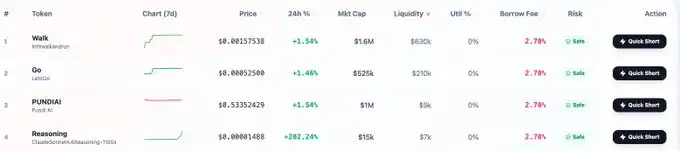
For example: (on Bnbchain Pancake swap)
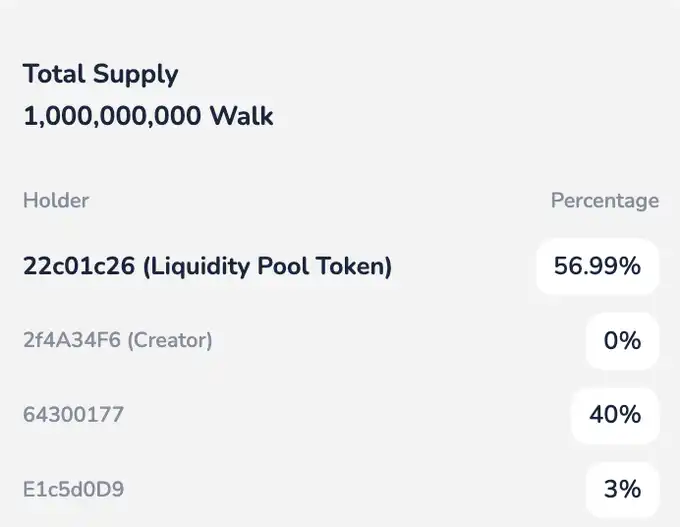
WALK (ca:0x9234e981e395dA3BE7b00B035163571698f8f756)
The current market cap is 1.6m
Chip structure:
57% Pancake liquidity pool (v3)
0% Creator (Dev)
40% in the vault on youcanshortit.com (for everyone to short)
3% Pancake liquidity pool (v2)
Notice: Trading has risks, and trading requires caution. DYOR.
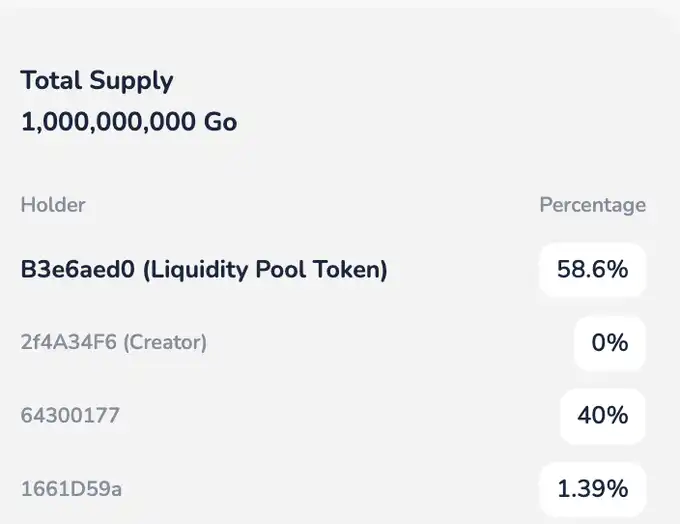
Go (ca:0x0a5D8c6D776A5903Bc568f41aADEeb4c71D2FFba)
The current market cap is 550k
Chip structure:
58.6% Pancake liquidity pool (v3)
0% Creator (Dev)
40% in the vault on youcanshortit.com (for everyone to short)
1.4% Pancake liquidity pool (v2)
Whether you want to seize pricing power, experience harvesting whales, play the role of a whale, or participate in a unique community experiment, this time, let's experience the rotation of offense and defense from "minnow" to "hunter" together~
Get ready in 72 hours~
Notice: Trading carries risk, so trade cautiously. Do Your Own Research.
