Editor's Note: In the past few days, RAVE experienced an extreme price surge, skyrocketing by 4500% in a matter of hours. Subsequently, on-chain investigator ZachXBT pointed out that around 90% of the token was held in team-related wallets, and the price pump was triggered by chip inflows to the trading platform. As the investigation unfolded, the price rapidly dropped from $26 to $1, causing a one-day evaporation of approximately $5.7 billion in market value. This event, following the familiar path of "pump-expose-dump," once again brought the structural contradictions of the crypto market to the forefront.
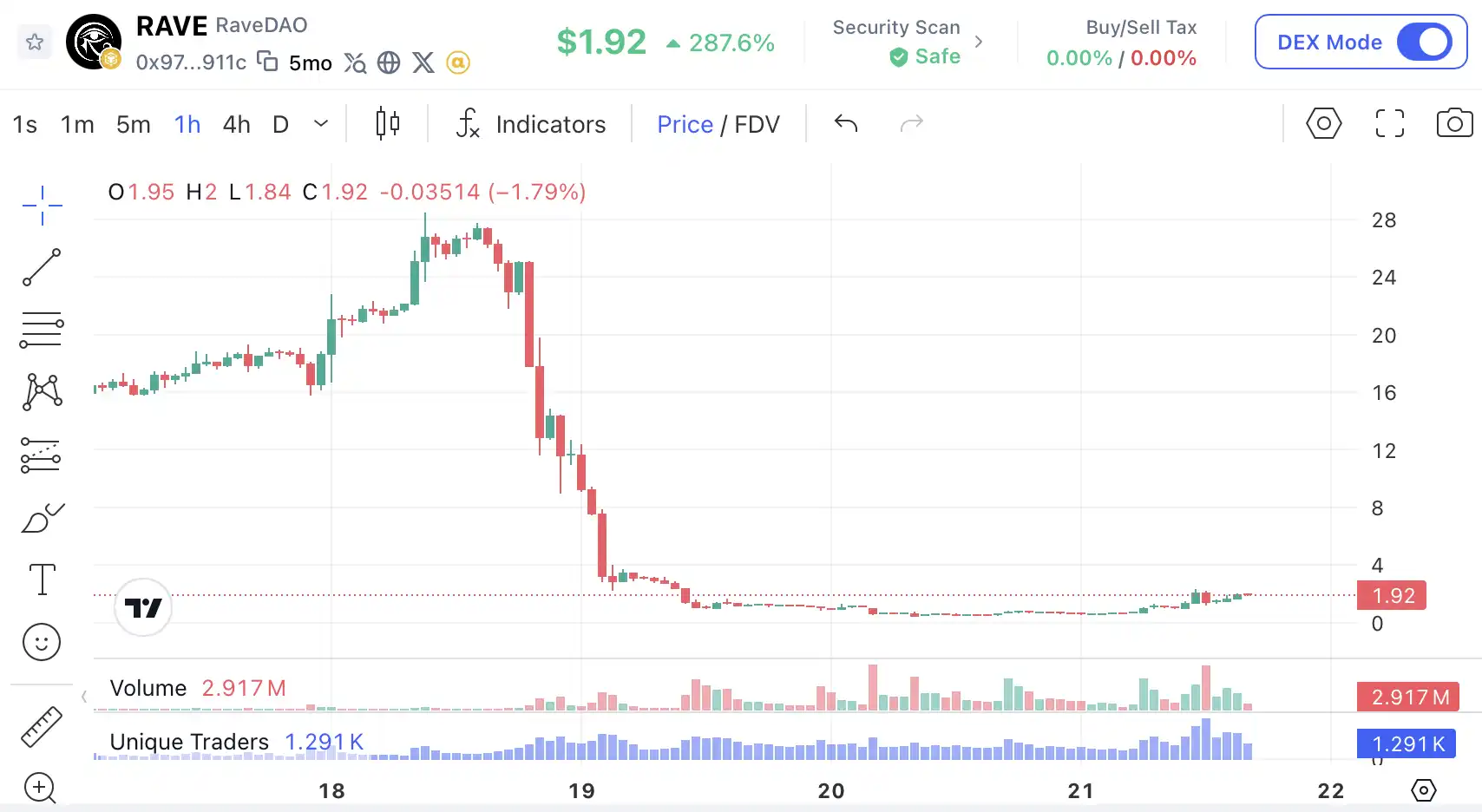
Of note, this correction did not come from a regulatory agency but was driven by an anonymous on-chain investigator. Individual action leveraged a response from exchanges within a day, leading to a value reassessment in the tens of billions of dollars range. This incident showcased both the power of on-chain transparency and the absence of institutional constraints.
However, the issue is not only about "whether manipulation exists." More crucially, it raises the question: What is left in this market if structures like RAVE are systematically cleansed?
Against the backdrop of institutional funds entering rapidly and regulatory frameworks taking shape, the crypto market is evolving towards a "stock-like market": with more thorough disclosure of information, traceable transactions, and converging price volatility. Nevertheless, this process is also undermining its original appeal of extreme fluctuations and asymmetric returns.
Hence, a more challenging question arises: when the "45x in one hour" opportunities vanish, will liquidity exit as well? As the market becomes safer, will it also become more mundane? And will the remaining participants still be willing to engage in a system that is becoming closer to traditional finance?
RAVE does not merely offer a sample of a manipulation event but more resembles a mirror—a reflection of the trade-offs the crypto market must face in its path to maturity: transparency vs. efficiency, regulation vs. vibrancy, order vs. speculation, all of which have always been challenging to reconcile simultaneously.
Perhaps this is the real question at hand.
Below is the original article:
Key Takeaways
Shortly after RAVE's 4500% surge, on-chain investigator ZachXBT revealed that around 90% of the token's supply was concentrated in team wallets, with evidence of organized behavior transferring tokens to exchanges. Subsequently, Binance and Bitget launched investigations, leading to a more than 90% crash in the token within a day.
However, a more concerning issue arises: if the market is "cleaned out" overnight, those extreme fluctuations that attract retail investors will also disappear.
Many investors are not here for the S&P 500's annual 10% return but for the opportunity of "4500% overnight." ZachXBT's work is certainly commendable, but the question is—do those "degens" (high-risk speculators) really want a clean, rational market? This question deserves an honest answer.
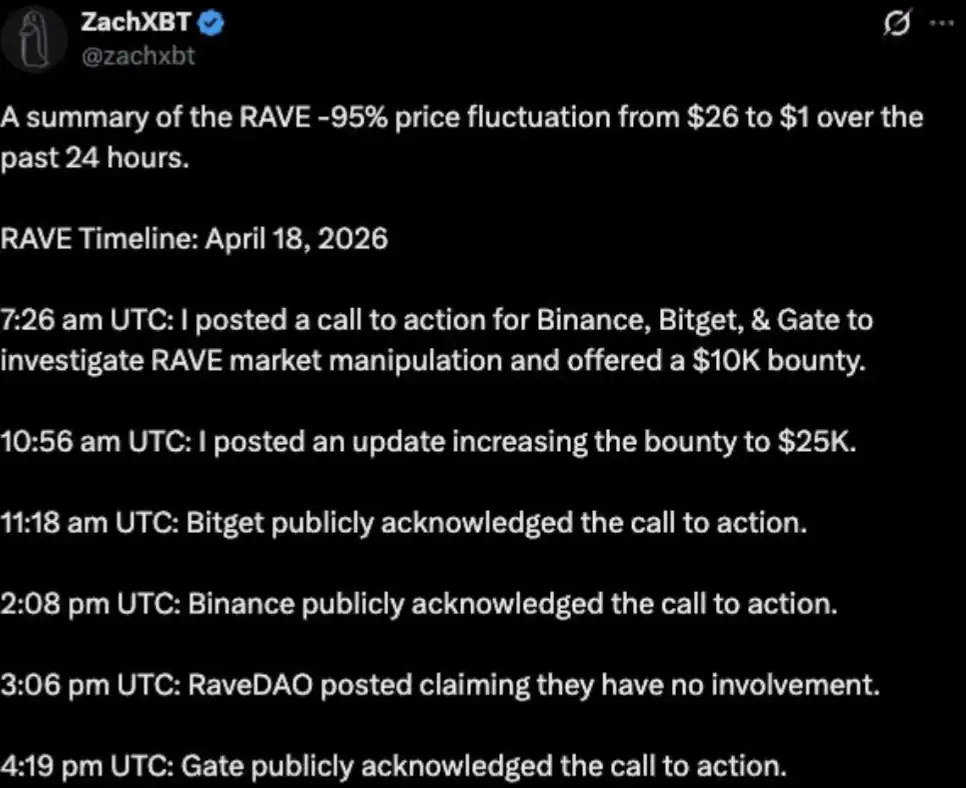
In April 2026, shortly after the RAVE token surged 4500%, on-chain investigator ZachXBT publicly accused the project of manipulation.
He pointed out that three wallets associated with the project team controlled around 90% of the total 1 billion tokens' supply, and the price surge occurred rapidly after these wallets moved their holdings to mainstream exchanges. Meanwhile, the market saw liquidations amounting to $44 million. ZachXBT then called out Binance, Bitget, and Gate.io to investigate and offered a $25,000 reward for any relevant leads.
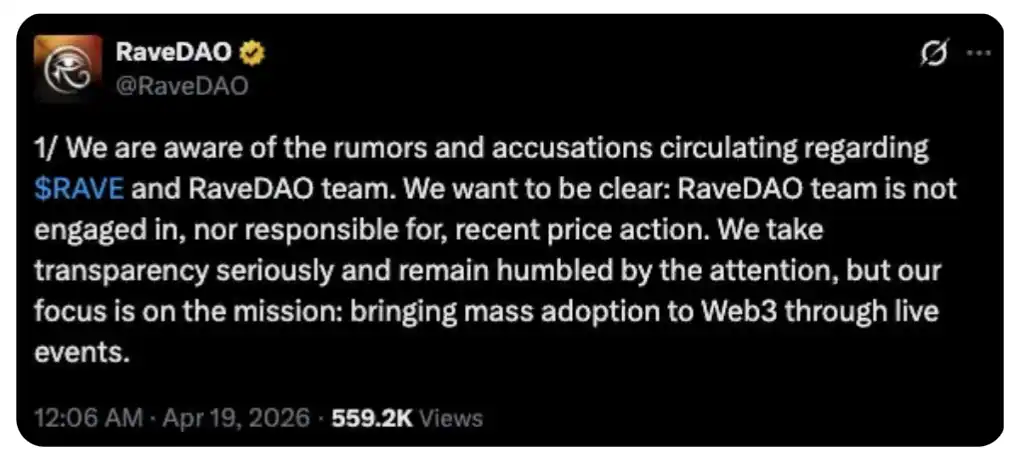
Subsequently, Binance and Bitget initiated investigations, causing the price of $RAVE to plummet from $26 to $1, a 90% drop, erasing approximately $5.7 billion in market value in a single day. RaveDAO later responded, denying the team's involvement.
Why Now
Institutional funds are beginning to flow into the crypto market on a large scale, but hack events have not decreased, and price manipulation is recurring. The question of "Is this market trustworthy" is once again brought to the forefront.
More notably, the "correction" in this event did not come from the U.S. Securities and Exchange Commission or any financial regulatory body but was driven by an anonymous on-chain investigator—he prompted two exchanges to take action in a single day and indirectly wiped out around $6 billion in market value. The speed of individual action even surpassed that of regulation.
However, this structure itself is difficult to sustain. The integrity of the market cannot be built on individual goodwill. And the more disturbing question is: Is the so-called "self-correction" really what these high-risk speculators (degens) want?
A Simple Analogy
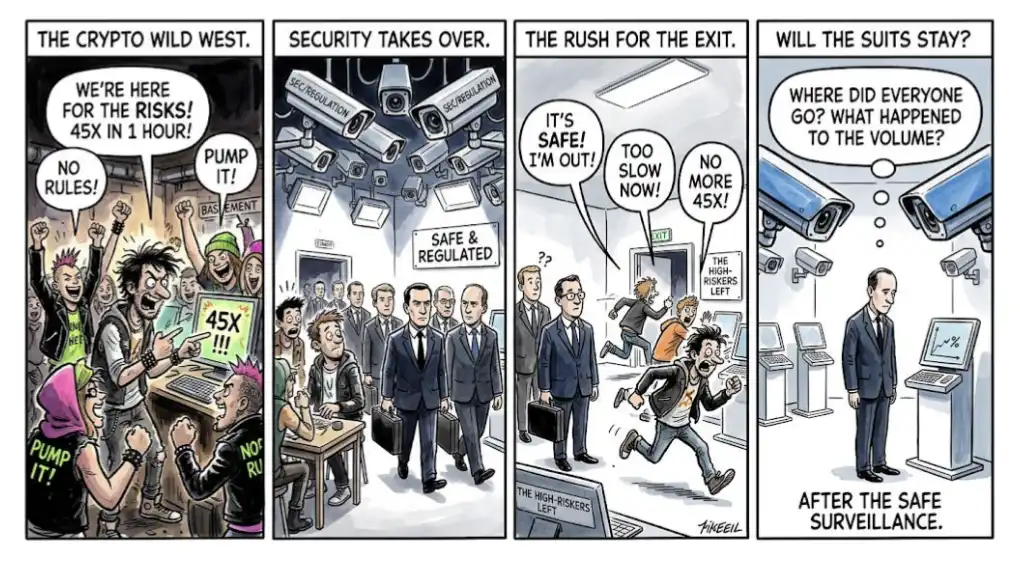
The crypto market is beginning to look more and more like a heavily regulated stock trading platform.
Surveillance "cameras" are being set up, and suited institutional clients are gradually entering. However, the initial occupants of these seats did not come for "safety," but because there used to be the possibility of "45x in one hour" here.
When every table is under surveillance coverage, that 45x opportunity also disappears, and the initial batch of people leaves as well.
So, the question arises—will these institutional clients stay once everything becomes safe?
The Uncomfortable Truth
Identifying and curbing manipulative behavior like $RAVE is necessary. When a team wallet controls 90% of the supply, and the price skyrockets at the moment these chips flow into the trading platform, this is very close to manipulation. Illegal manipulation should be removed from the market.
However, the question remains: why do most retail investors choose the crypto market over the stock market? It's not for the ~10% annual return of the S&P 500, but for the possibility of "a 4500% day." While the market does have many high-quality projects, extreme volatility often stems from information asymmetry, liquidity manipulation, and supply concentration.
Imagine such a crypto market: akin to comprehensive regulation by the U.S. Securities and Exchange Commission — team wallets fully disclosed, projects with highly concentrated supply screened out before listing, and real-time monitoring of liquidity manipulation. In such a market, which project could still trigger retail investors' "adrenaline"? It would no longer be a crypto market but more like a slowly operating stock market.
ZachXBT's work is commendable, and we agree. A safer market is necessary.
However, the current reality remains uncomfortable: many people claim to want a "clean" crypto market, yet in practice, many high-risk speculators (degens) are precisely drawn to this volatility. When regulation truly tightens, the crypto market is more likely to become "boring" than "pure." Projects that survive will also be validated to standards approaching those of public companies.
We recognize ZachXBT's efforts. But at the same time, there are still plenty of speculators seeking the next "RAVE-like" trend.
Today, there is still a clear gap between the ideal future and the current market reality. If more projects could rely on their fundamentals to prove value, this market mechanism reliant on extreme volatility should not exist in the first place.
This is the uncomfortable truth.
