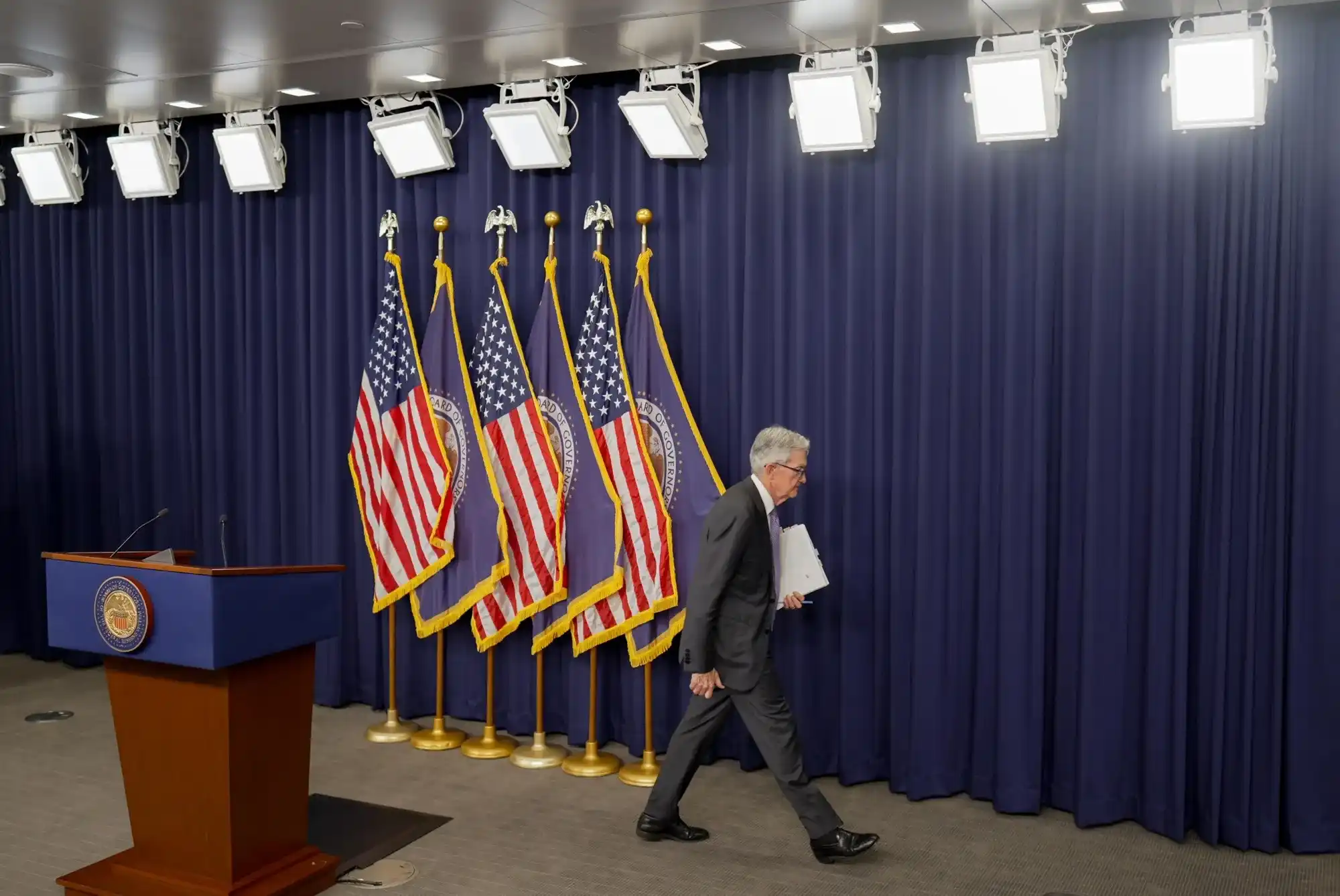
This morning, Powell took to the lectern in the Eccles Building press room for the last time. Like every FOMC press conference over the past eight years, he walked up to the stage, adjusted the microphone, and began his remarks.
This was Powell's final public speech as Fed Chair. The agenda was a routine review of the FOMC interest rate decision and a Q&A session with reporters. Just two weeks before his formal departure, everyone knew this would be a somewhat different press conference, but Powell still had some surprises up his sleeve.
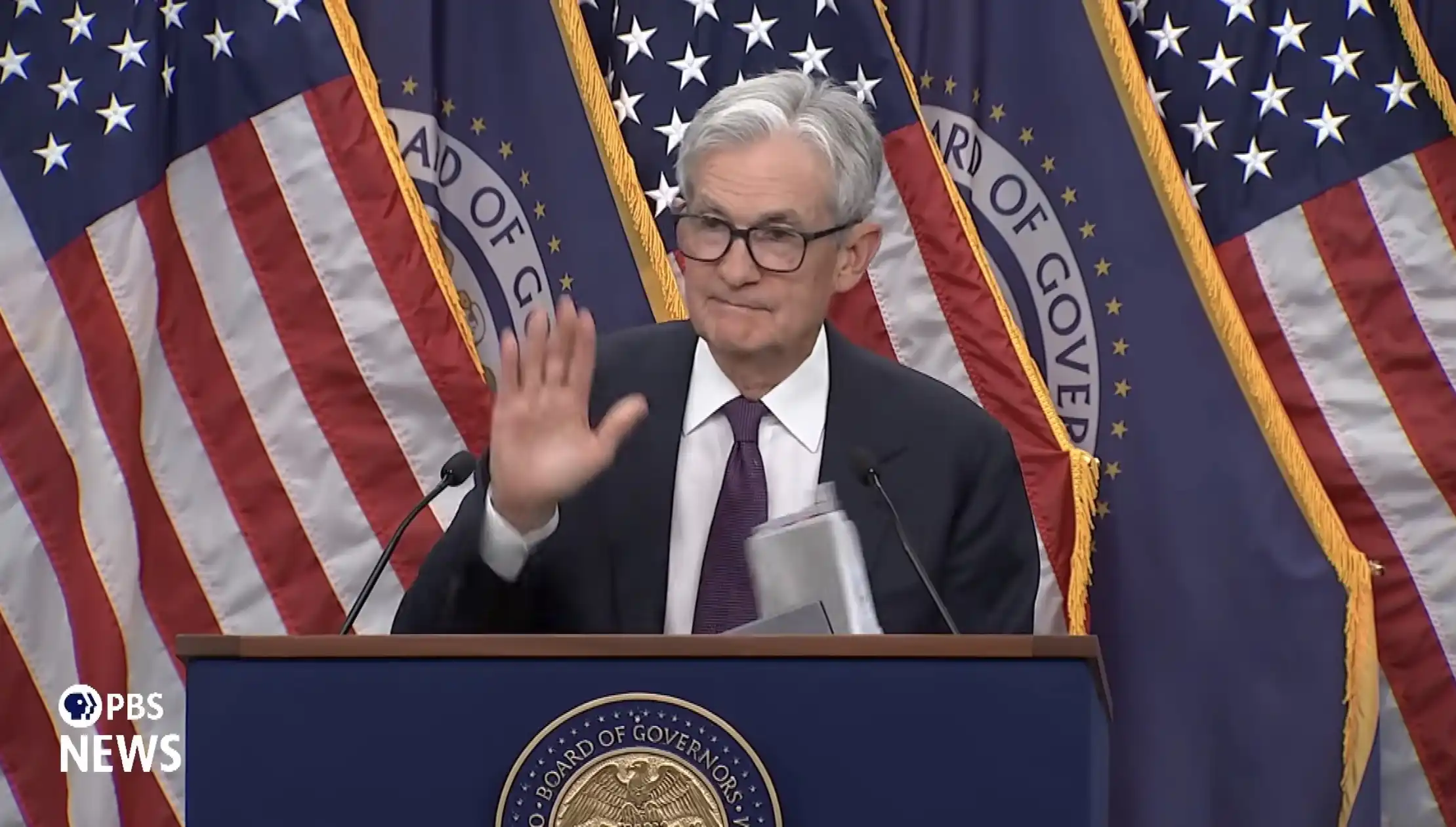
The interest rate decision remained unchanged in the 3.5%-3.75% range, which was not surprising. However, there were four dissents within the committee, making it the most divided monetary policy meeting since 1992. At the same time, he formally addressed earlier market speculations by confirming that he would stay on at the Fed.
The last person to stay on as a governor after stepping down as Chair was Marriner Eccles in 1948, the namesake of the Fed's building. Between him and Powell, 78 years have passed.
Why did Powell choose to stay? The story of these eight years always started with "Good afternoon." It was the opening line he had said countless times at the lectern in the press room, becoming the most widespread and familiar memory of him on social media. But to understand the significance of his decision today, we need to go back eight years in time.
‘Ineligible’ Chair
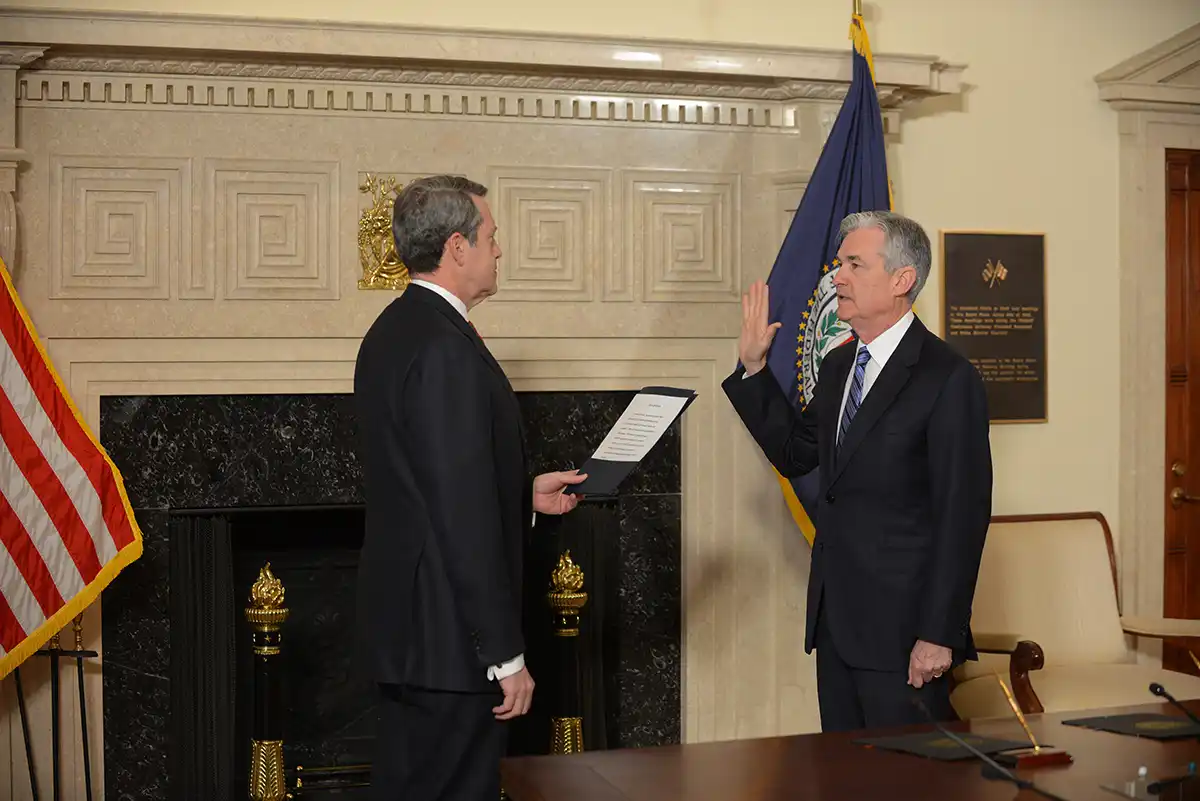
On the morning of February 5, 2018, Jerome Powell raised his right hand in a second-floor conference room at the Eccles Building to take the oath. The ceremony was brief, lasting less than three minutes, with no president in attendance. The oath was administered by Fed Governor Randall, a colleague younger than him. Two journalists captured the scene: a dark blue suit, a steady gaze, and no words spoken.
On that day, at the age of 65, he officially became the 16th Chair of the Fed, with a salary of just over two hundred thousand dollars. By the standards of his four predecessors in that position, he seemed inadequate.
Greenspan earned his Ph.D. in Economics from New York University and had spent thirty years in private economic consulting before his appointment. He was already a well-recognized "market interpreter" in Washington and New York before Reagan took office. Bernanke, the former Chair of the Princeton University Economics Department, based his 1980s thesis on the Great Depression, which later became the theoretical foundation for central bank policy in the early 21st century. Yellen received her Ph.D. from Yale and spent most of her career as a scholar in the UC Berkeley Economics Department, becoming the first female Chair among her predecessors.
Powell does not have an economics background; he studied Political Science at Princeton for his undergraduate degree and then went to Georgetown for a law degree. Strictly speaking, he is a lawyer. Powell served in the Treasury Department during the elder Bush administration, rising to the position of Under Secretary. He then spent nearly a decade as a partner at Carlyle Group. In 2012, Obama nominated him, along with a Democratic economist, to the Federal Reserve Board of Governors for political balance. He spent five years on the Board, during which no one paid particular attention to him.
Looking back further, to find a case of a "non-economist" holding the Chair position, one must go back to 1978.
In March 1978, U.S. President Jimmy Carter brought in a man named G. William Miller to the Eccles Building. Miller had previously been the CEO of Textron, a defense contractor. The Carter administration chose him, in part, due to his good relationship with the labor movement, believing he could "control inflation without being too harsh."
However, Miller only sat in that chair for 17 months. During his tenure, the CPI rose from 6% to 12%, and the U.S. dollar experienced its most severe post-World War II crisis in the foreign exchange market. In August 1979, Carter kicked him out to become Secretary of the Treasury, letting Paul Volcker take over the Fed. The rest is history: Volcker raised interest rates to 20%, a double-dip recession occurred, inflation was crushed, and the U.S. economy entered the 1980s.
For almost forty years after Miller, no non-economist sat in that chair. Until Powell.
During his five years as a Governor, Powell was virtually invisible. From his swearing-in in May 2012 to assuming the Chairmanship in February 2018, he voted with the majority on all FOMC decisions, never dissenting. His daily work involved technical issues such as financial regulation and payment systems, far from the spotlight. Colleagues later recalled the most remarkable aspect of his time then was not papers or speeches but his phone calls. He wanted to bypass academic papers and official data, listening to what frontline market participants had to say, calling bankers, bond traders, and corporate treasurers. A Governor voluntarily making dozens of such calls every week was something his colleagues from academic backgrounds would not do.
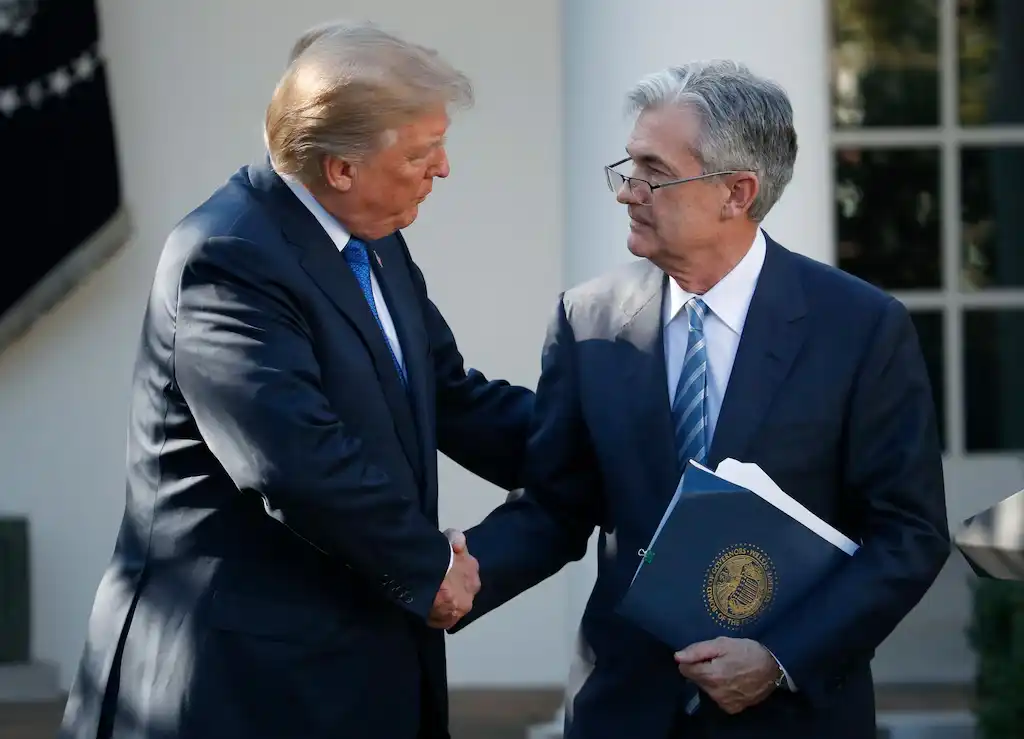
On the afternoon of November 2, 2017, President Trump announced in the White House Rose Garden the nomination of Powell to be the Chair of the Federal Reserve. Trump delivered a forceful speech, while Powell's remarks were more restrained, focusing on the "dual mandate of achieving employment and price stability."
That evening, the major Wall Street traders' memos to clients were mostly in agreement, expecting a continuation of the moderate approach, signaling no need for market jitters. However, there were some dissenting voices in academia. Several economists interviewed by The New York Times expressed concerns about whether a lawyer could lead the FOMC at a crucial moment. Nevertheless, these concerns were quickly overshadowed by the overall positive financial news.
In less than a year after taking office, Powell made a structural change. He transformed the Fed's post-meeting press conferences from being held quarterly to after every meeting, using plain language with minimal academic jargon. The once proud "constructive ambiguity" of Greenspan was no longer the Fed's communication style. However, this new style had not yet become a habit before March 2020 arrived.
Every Choice, Unprecedented
March 15, 2020, was a Sunday. Later that afternoon, Powell held an emergency FOMC meeting in the Eccles Building, which was originally scheduled for three days later. The announcements made after the meeting included: a 100 basis points reduction in the federal funds rate to 0-0.25%, the initiation of $700 billion in asset purchases, and the establishment of dollar swap lines with the five major central banks. This was the Fed's most aggressive move in history.
At that moment, the novel coronavirus was spreading across the U.S., ICU beds were running out, the U.S. stock market had triggered circuit breakers twice in the past week, and the Treasury market experienced a chilling liquidity crisis. The deepest market in the world saw several trading days where no one was willing to bid on U.S. Treasuries.
Over the next three weeks, Powell introduced a new tool almost every few days. On March 17, the Commercial Paper Funding Facility; on March 19, the Money Market Mutual Fund Liquidity Facility; on March 23, an announcement of unlimited QE, the restart of TALF, and the unveiling of the Main Street Lending Program; and on April 9, an expansion of the corporate bond purchase program to $2.3 trillion. These tools broke through the Fed's boundaries that had been in place for many years.
Buying corporate bonds is something Bernanke definitively ruled out in 2008, bypassing banks to lend directly to small and medium-sized enterprises, a move not even dared during the 2008 financial crisis. On the autumn day when Lehman collapsed in 2008, Bernanke took nearly three months to launch the first round of QE, while Powell went from an emergency rate cut on March 3 to unlimited QE in just 20 days.
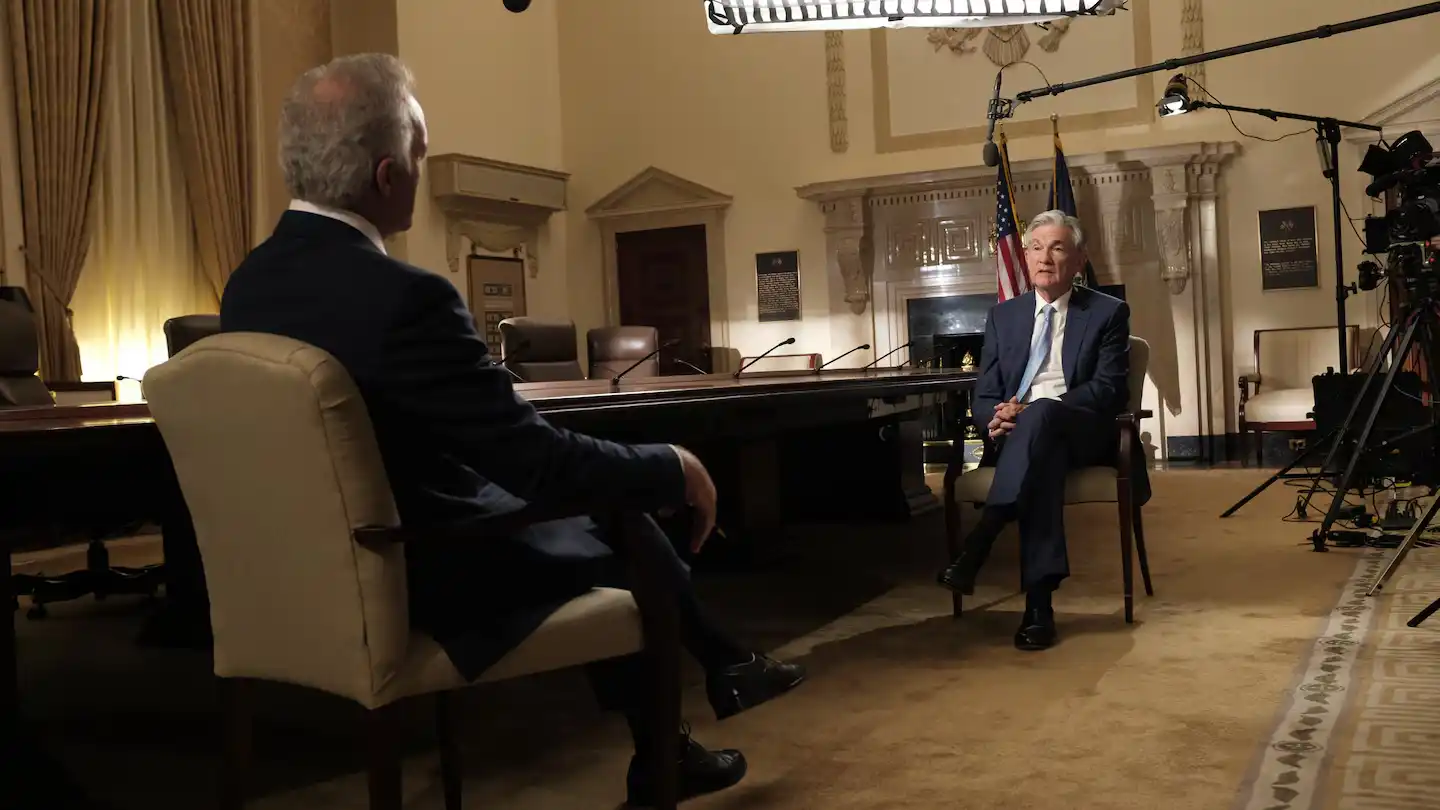
On May 17, Powell sat in front of the camera for a CBS "60 Minutes" interview and said a sentence that would later be repeatedly quoted: "Our ammo is not going to run out." He was not chanting a slogan but making a specific commitment to the market. In the following months, the voices claiming he "doesn't seem like a Fed chairman" collectively quieted down for the first time.
But his biggest mistake was precisely the quiet beginning.
In the spring of 2021, the CPI year-over-year reading began to rise. April 4.2%, May 5.0%, June 5.4%. Powell and his team of economists judged it to be "transitory." They believed it was a disruption caused by the pandemic in the supply chain, which would fade away over several quarters. This judgment was not indifference but a genuine belief. Powell repeatedly said in internal meetings that he was unwilling to stomp on a labor market that was still recovering due to a wave of cyclical disruption. Among the millions who lost their jobs during the pandemic, a considerable portion were low-income earners who were now being rehired.
So throughout 2021, the Fed maintained a zero interest rate, continuing to buy $120 billion in assets each month. At every press conference, Powell used everyday language to explain why raising rates should wait.
Inflation did not wait. September 5.4%, October 6.2%, November 6.8%. Questions resurfaced in academia, Wall Street, and Republican Senate seats in a new form: a lawyer unable to understand what economists were saying, accusing him of plunging the U.S. into an inflation crisis. Former Treasury Secretary Larry Summers wrote in a Washington Post column that he had never seen fiscal and monetary policy so detached from reality.
On the morning of November 30, Powell testified before the Senate Banking Committee. When asked about the inflation situation, he said, "I think, now might be a good time to retire that phrase ('transitory inflation') and try to explain ourselves more clearly."
This was not an admission forced upon him. There were no reporters pressing him, no senators demanding he abandon "transitory." He chose to say it himself.
After acknowledging the mistake, Powell acted swiftly.
In March 2022, there was a 25 basis point rate hike, followed by a 50 basis point hike in May, and a 75 basis point hike in June. This was the largest single-rate hike since the 1994 Greenspan tightening cycle. In July, another 75 basis points were added. Initially, the market interpreted this pace as a "catch-up" move, believing that the Fed would soon return to a more moderate path. On August 26, the global central bank governors' closed-door meeting at Jackson Hole proceeded as scheduled, with the market's expectation that Powell would soothe sentiments there and leave room for the possibility of a "policy pivot."
At ten o'clock in the morning, Powell took the stage to deliver his speech. As is customary, such chairpersons' speeches at such events usually last half an hour. However, that morning, Powell did not look at the teleprompter in the audience section, and the speech lasted only 8 minutes. He did not discuss any academic frameworks, did not delve into complex transmission mechanisms, did not give any dovish hints, but only conveyed three points: price stability is the Fed's responsibility, rate hikes will bring pain, and we will see it through to the end.
The last sentence of the speech was, "We will keep at it until the job is done." Those who understood immediately recognized that he was borrowing language from a former chair. "Keeping at it," this was the title of Paul Volcker's 2018 memoir. In summarizing the anti-inflation action he took in 1979, during which interest rates surged to 20% and the economy entered a double-dip recession, Volcker later used these three words. In his 8-minute speech, Powell mentioned Volcker three times. He did not compare himself to Volcker, but he chose to conclude using Volcker's words.
On the day the speech ended, the S&P 500 fell by 3.4%, and the Nasdaq fell by 3.9%. This marked the market's final disappointment with a commitment to "mildness continuation."
He knew the market would drop after delivering that paragraph, but he still said it. Four years into sitting in the Fed Chair's office, this was the first time he made it clear to everyone that he did not intend to be defined by his past.
Following Jackson Hole, Powell's rate hike pace did not slow down. In September, there was a 75 basis point hike, followed by another 75 basis points in November, and a 50 basis point hike in December. In March 2023, Silicon Valley Bank (SVB) collapsed within 48 hours, marking the second-largest bank failure in U.S. history. Powell did something beyond market expectations again: he established the Bank Term Funding Program (BTFP) to rescue the bank while continuing with a 25 basis point rate hike.
This "dual-track operation" is not easily understood within the traditional central bank framework since liquidity rescue and tightening policies should point in opposite directions. But Powell is not one to follow the textbook. He viewed "system stability" and "inflation targeting" as separate issues: using one set of tools to rescue the bank and another set of tools to combat inflation. This was a lawyerly tool-based thinking, using the right tool to address the right problem, without letting the logic of one issue squeeze out the other.
By the time of the last interest rate hike in July 2023, the federal funds rate had reached the 5.25%-5.50% range, the highest level in 22 years. The entire rate hike cycle totaled 525 basis points.
Inflation finally began to retreat. By June 2024, the CPI had returned to 3.0% on a year-over-year basis, dropping to 2.9% by the end of the year. The unemployment rate remained near historic lows throughout the rate hike cycle, without the sharp increase typical of past recessions. This marked the first time since the 1980s that the Fed managed to bring down high inflation without plunging the economy into a broad recession.
Economists later debated whether he was "lucky," as the unique nature of the pandemic shock made his tools more effective than theoretically predicted, and the decline in energy prices also played in his favor. This debate will continue.
In his final press conference, Powell summarized these eight years as follows: "In fact, we've experienced four supply shocks: the pandemic, the Russia-Ukraine conflict, tariffs, and now Iran and the surge in oil prices. Each supply shock had the potential to drive up inflation and unemployment, making it challenging for central banks to know what to do." It was this unprecedented macroeconomic environment lasting decades, coupled with every unprecedented move the Fed was forced to make, that made the morning's committee the most divided since 1992.
But in those 8 minutes on the morning of August 26, 2022, the judgments he made were real judgments, the risks he took were real risks, and his choice not to be defined by his mistake in 2021 was a real choice.
The Watchman at the Gate
On the afternoon of January 11, 2026, Powell recorded a video in a conference room at the Eccles Building. The backdrop was the Fed's seal. Looking at the camera, he said, "What is at stake with this criminal charge threat is the Fed's right to set rates based on the best judgment for the public, not the preferences of the President."
The video was released by the Fed's official account later that evening. Financial media outlets around the globe almost simultaneously refreshed their headlines. This marked the first direct public confrontation between the Fed and a U.S. administration in the Fed's 113-year history.
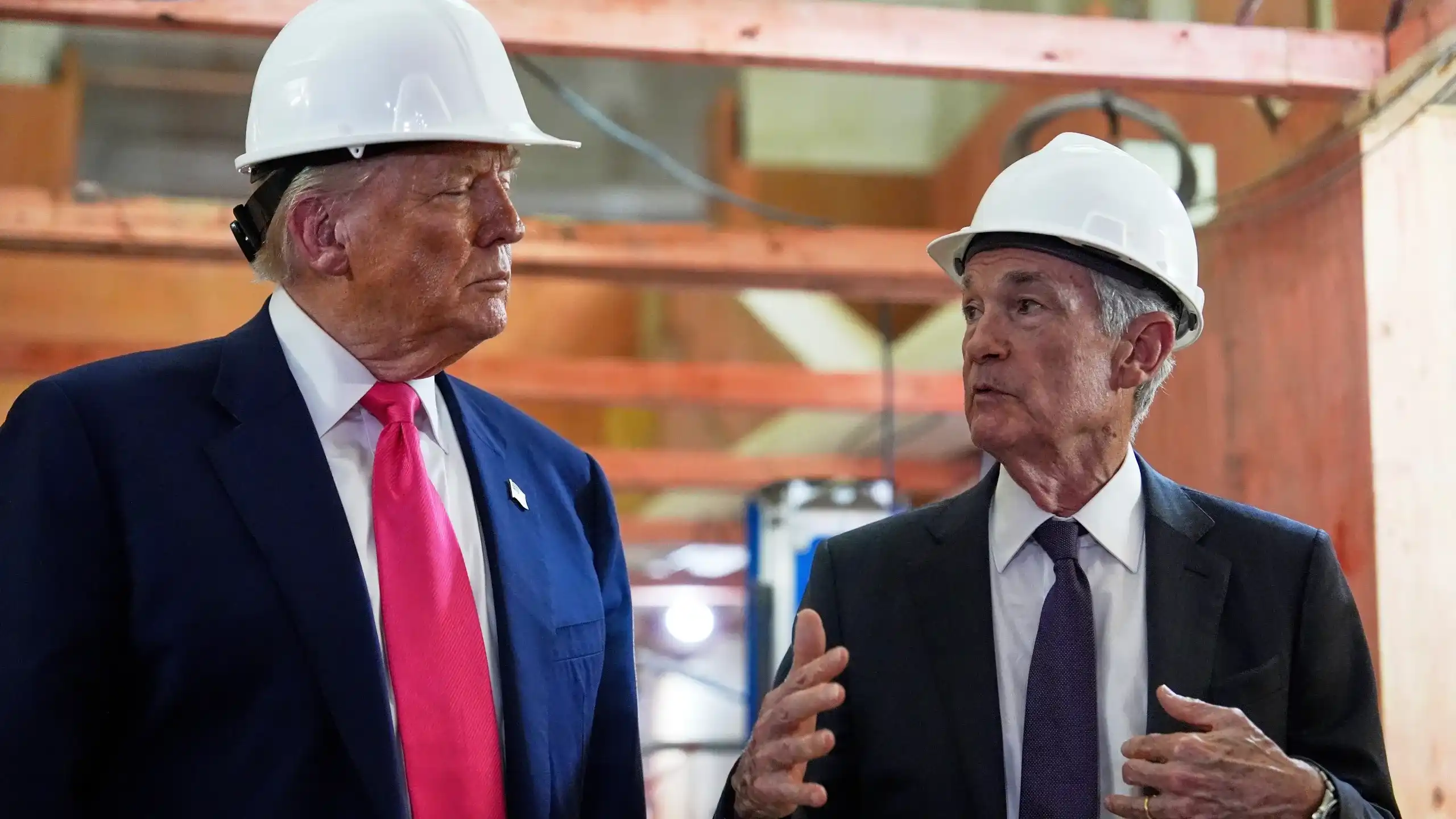
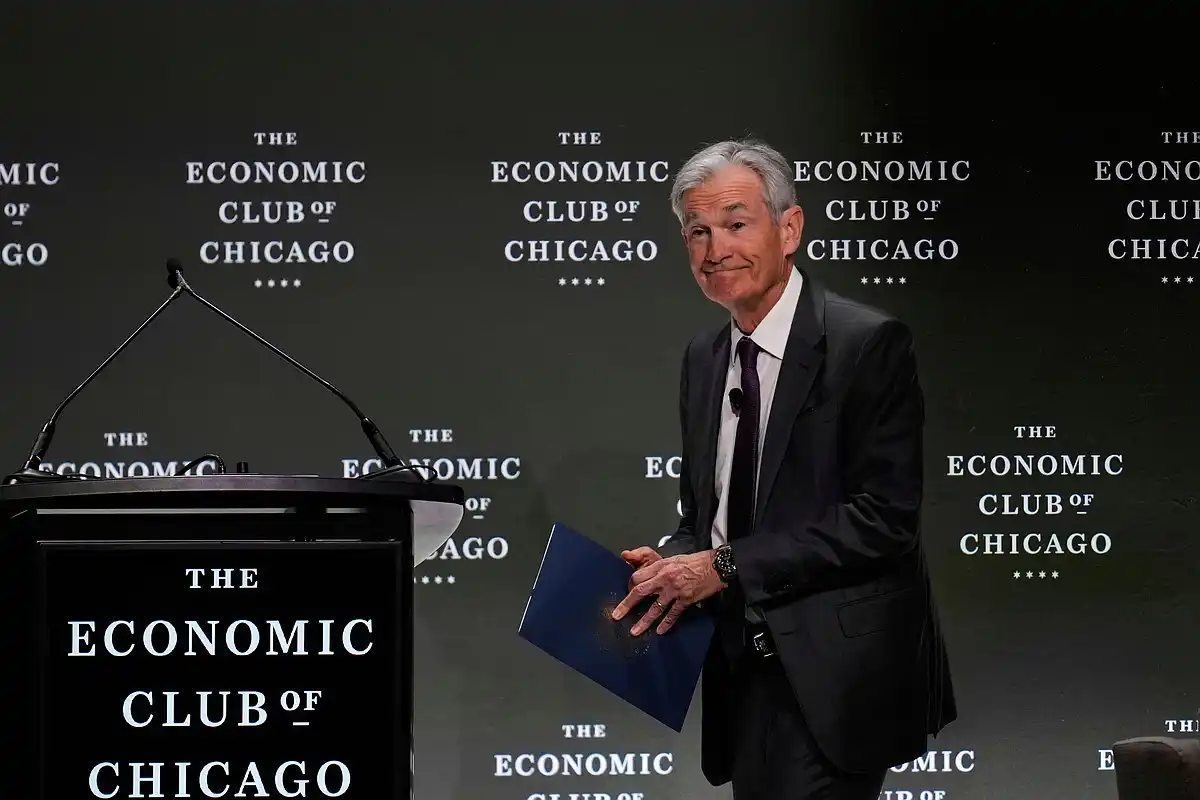
The trigger for the event occurred several days earlier. The U.S. Department of Justice subpoenaed Powell over a grand jury investigation, citing cost overruns and irregular procurement procedures related to the Fed headquarters renovation project.
But everyone knows what's going on. Over the past twelve months, President Trump has repeatedly demanded rate cuts from Powell to align with his tariff policy. Powell, citing "we do not take into account political considerations," has maintained his own pace. This criminal investigation is a retaliatory method chosen by the President when he feels he has exhausted normal means. Powell did not use the word "retaliation" in the video. But he used a plain language that almost everyone could understand.
To understand why this moment happened, we must go back eight years to Powell's first clash.
In December 2018, Powell's Fed conducted the fourth rate hike of that year, pushing the federal funds rate to the 2.25%-2.50% range. The market was already tired of continued tightening, and in the week before Christmas, the S&P 500 fell into a bear market. Trump broke tradition by openly criticizing the Fed Chair on Twitter, something no former White House resident would do.
Over the following year, the Fed carried out three "preventive rate cuts," each 25 basis points, totaling 75 basis points. Was this a surrender? There is still no consensus. The explanation given by Powell's team at the time was the global economic slowdown and weakening manufacturing PMI due to the US-China trade friction. However, the opposition insists that without Trump's pressure, these three rate cuts would not have occurred.
Trump's second term began in January 2025. This time, his pressure on Powell was not through Twitter but through a whole set of administrative tools.
In April 2025, Trump launched a new round of tariff policies. The market widely expected this to raise inflation, depress employment, and put the Fed in a stagflation dilemma of "rate hikes hurting employment, rate cuts adding to inflation." Trump repeatedly demanded rate cuts from Powell, wanting the loose monetary policy to offset the negative effects of tariffs.
In his speech at the Economic Club of Chicago on April 16, Powell responded. He did not directly refuse rate cuts; he used a typical Powell plain language: "We are currently in a favorable position and can wait for the situation to become clearer before considering any policy adjustments." In the middle of the speech, he used a well-known movie line from a Chicagoan to ease the tense atmosphere: "As the great Chicagoan Ferris Bueller (protagonist of the movie 'Ferris Bueller's Day Off') once said, 'Life moves pretty fast.'" There was laughter in the room, but the financial markets did not laugh. Powell's meaning was clear; the Fed would not cut rates in a panic due to tariffs.
In the following months, Trump threatened to fire Powell several times. In fact, this had already been addressed at the November 7, 2024 FOMC press conference. On that day, a reporter asked Powell, "If the President asked you to resign, would you resign?" He replied, "No." Another reporter followed up, "Does the President have the right to fire you?" He answered, "The law does not allow it." Both answers were short, without any hesitation.
In the history of the Federal Reserve, the last time a chairman faced such strong political pressure was in the 1970s. At that time, the Fed chairman was Arthur Burns, a Columbia University Ph.D. economist and a prominent figure in the central banking field. This used to be the most standard resume for a Fed chairman, but during his tenure, he was pressured by President Nixon through private phone calls, memos, and senior White House staff to loosen monetary policy in the period leading up to the 1971 to 1972 presidential election. Subsequent released Nixon tapes showed the president bluntly telling Burns that he needed the economy to be a bit "overheated" in an election year. Burns did not refuse. The result was the stagflation of the 1970s in the U.S. until Volcker took over in 1979.
Burns was an economics Ph.D., Powell is a lawyer. But faced with presidential pressure, Powell did what Burns did not.
The DOJ investigation ultimately did not materialize. In March 2026, a federal judge dismissed the subpoena on the grounds that "the sole purpose of the investigation was harassment and pressure," and the Justice Department subsequently quietly dropped the investigation. In the same month, Powell was awarded the "Paul Volcker Public Trust Award" in a small auditorium in Washington. The award ceremony was quiet and brief, without flashbulbs, attended by Volcker's family, as well as several former Fed governors and economists. This award is given to those who "uphold public integrity under immense political pressure," and the last sentence of the award speech was, "Independence and integrity are inseparable."
The award Powell received is named after Volcker. During Volcker's tenure, although he faced pressure from both the Carter and Reagan administrations, he never experienced the level of public humiliation, threat of dismissal, or criminal investigation that Powell faced. However, Volcker only faced policy disagreements, while Powell faced identity attacks from the highest political office in the U.S.
After Volcker in 1979, the Federal Reserve established a boundary independent of the White House, a boundary that was not breached during Powell's eight-year term.
In this morning's press conference, Powell officially answered a question that had been the subject of market speculation for the past few weeks. He will not actually leave the Fed on May 15. He will step down as chair but remain as a governor, with the duration TBD. His reason was straightforward: "The events of the past three months have left me no choice but to stay on until I see these issues through." That was three months after the DOJ subpoena was served.
He used his final act as chairman to ensure that his departure did not turn into a vacancy handed over to the executive branch. He declared he would not be a "shadow chairman." What he wanted was not the influence of monetary policy but to ensure that the night watchman position was not left vacant.
He will still move out of the chairman's office on May 15, leaving it to Kevin Wash. But Powell's desk will not be moved out of the Eccles Building; it will just move to a different floor, a different room.
「Good Afternoon」
During this morning's press conference, someone directly asked Powell how history would judge his eight-year chairmanship and legacy. He only responded with, "Let others comment on that."
Eight years ago, when Powell first sat in this office, no one thought he would reach where he is today. Over the eight years, he experienced a once-in-a-lifetime pandemic, a seemingly temporary inflation surge, and a period of political pressure that almost compromised the Fed's independence. But May 15 is not the end; it is more like halftime. After Powell steps down, all the forces that once cornered him are still there, leaving three questions for the market to ponder.
The first question is, how long can the monetary policy framework he left behind last? In August 2020, Powell announced at Jackson Hole that the Fed would adopt the "flexible average inflation targeting," allowing inflation to moderately exceed 2% for some time. This framework was reasonable in a low inflation era, but the high inflation in 2021 made it appear sluggish in response. The FOMC has already begun an internal review. The next chair must decide whether to modify, retain, or discard it.
The second question is central bank independence. Over the past eight years, Powell resisted almost all forms of pressure from the White House. He defended the boundary of central bank independence from the White House with three short phrases: "No," "The law does not allow it," and "This is not our job." However, this boundary is now at a new waterline. It has not been breached but is no longer a default fact. When the next chair enters the office, no one will assume that the White House will refrain from interference.
The third question is the most difficult to answer. What kind of political climate will the next chair face? Trump has two more years left in his term. Whoever the next chair is, they will not have the relatively calm start that Powell had. As they step into the office, they will no longer be met with mild policy debates but with various probing measures crystallized from 2018 to 2026. These measures will come back in the future.
During Powell's eight-year tenure, there was a popular recurring meme on social media that resurfaced after every FOMC meeting. The GIF's background was the Eccles Building's press room, with Powell walking up to the lectern, adjusting the microphone, saying two words: "Good afternoon," and then various asset markets rapidly plummeting as his words echoed.
This meme first appeared in December 2018 when netizens used it to mock how the stock market would drop every time Powell spoke, referring to this phenomenon as the "Powell plunge."
But over the eight years, the meaning of this gag has changed.
The lawyer who was considered "unfit" held the line during the pandemic, acknowledged mistakes during inflation and quickly corrected them, and stood firm against all pressures from the White House. Every time he took the stage and uttered those two words, he knew the market would drop and the president would tweet insults at him. But he stood up every time.
That opening line, initially taken as a joke, eventually became the most straightforward and powerful commitment of the era. He never quite figured out how to prevent the market from dropping, but he always showed up on time.
Welcome to join the official BlockBeats community:
Telegram Subscription Group: https://t.me/theblockbeats
Telegram Discussion Group: https://t.me/BlockBeats_App
Official Twitter Account: https://twitter.com/BlockBeatsAsia
