On May 4, the White House expressed hope that Congress would send the Clarity Act to the President's desk before July 4. This cryptocurrency market structure bill, which passed the House in July 2025 with 294 votes to 134, has been stuck in the Senate for nearly a year.
The Senate Banking Committee, chaired by Tim Scott, has set the markup to be completed in May, aiming for a full Senate vote in June or July. Stuck in the middle is a "ethics clause" requested by Democratic lawmakers, prohibiting senior government officials from profiting personally from cryptocurrency while in office. The primary target of this clause is the President himself.
Two days later, on May 6, E*Trade, owned by Morgan Stanley, opened Bitcoin, Ethereum, and Solana spot trading to its 8.6 million retail clients, charging a 0.50% fee, making it the lowest retail crypto fee among mainstream Wall Street brokerages. While the bill has not yet passed, traditional banks have already made their move.
Congress may be debating the bill, but Wall Street has already answered.
Wall Street Has Already Made Its Move
Although the bill is still pending, traditional brokerages made their move in April and May 2026, lowering retail fees to a new floor.
The timeline is as follows. On February 22, 2018, Robinhood was the first to introduce cryptocurrency trading to retail internet brokerages, offering commission-free trades (including spreads) from the start. The same year, Coinbase launched its retail app, with retail fees ranging from 0.99% to 2.99% plus a 0.5% spread. In 2022, Coinbase introduced Advanced Trade, lowering retail fees to 0.40% to 0.60%. In 2023, Fidelity Crypto went live with a 1% fee. Then there were two blank years.
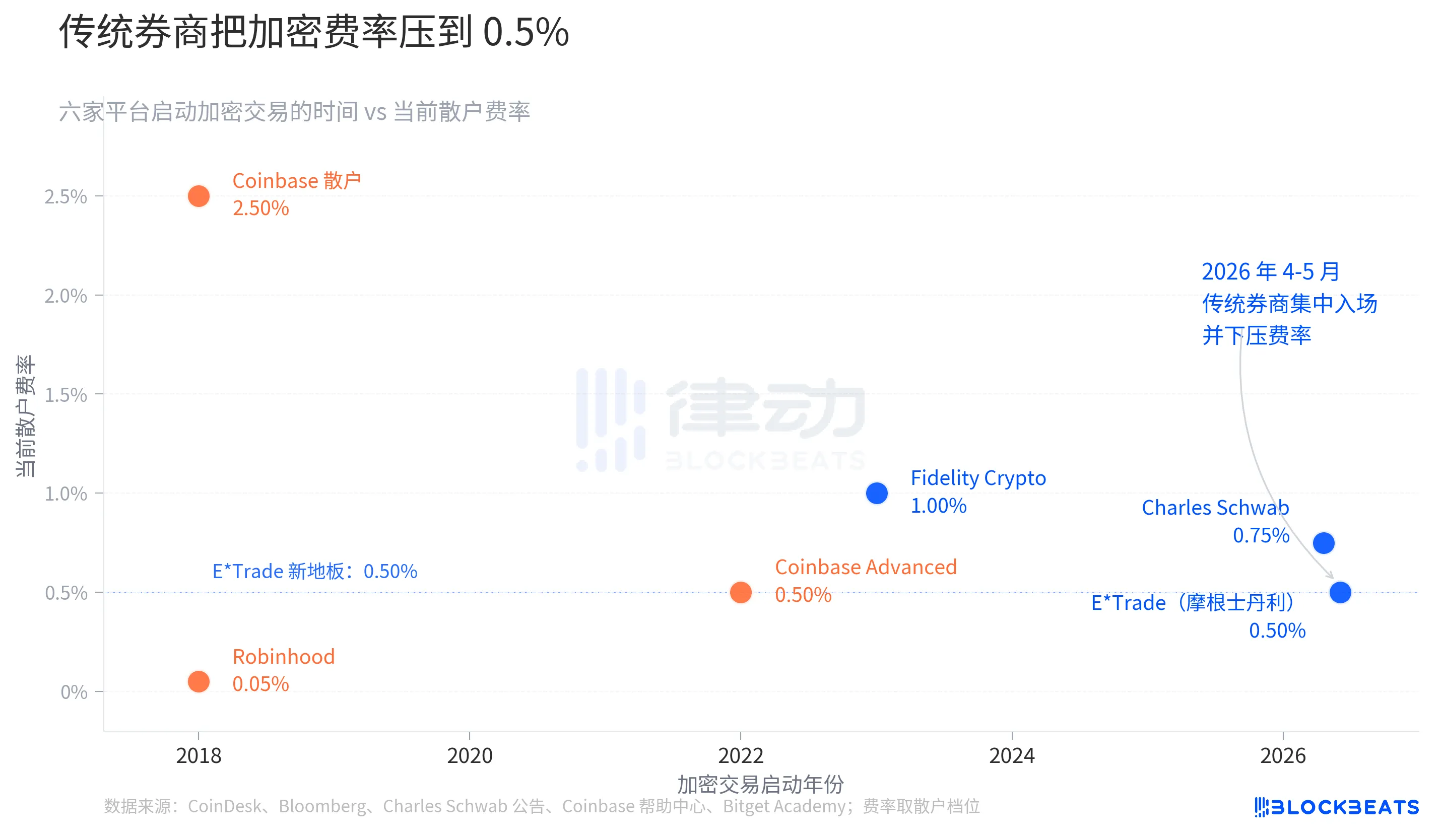
In early April 2026, Charles Schwab launched Schwab Crypto, gradually opening Bitcoin and Ethereum spot trading to retail clients at a 0.75% fee. A month later, on May 6, Morgan Stanley's E*Trade followed suit at 0.50%, covering Bitcoin, Ethereum, and Solana. According to BeInCrypto, this is the current lowest fee for retail crypto trading among traditional banks.
A quick look at the fee structures reveals the pressure. Coinbase's standard app most commonly charges retail investors 0.99%-2.99% plus a 0.5% spread, equivalent to a total of 1.5%-3.5% paid. E*Trade's 0.5% slashes this figure by two-thirds. Fidelity's 1% has now become the most expensive among its peers. Coinbase Advanced Trade remains competitive, but it is aimed at high-frequency and high-net-worth users through a professional interface, not the retail favorite for ordinary retail investors.
Why the concentrated opening in April-May 2026. Two timing anchors. One is the GENIUS Act, the stablecoin regulatory framework, which was signed into law in July 2025, providing a compliant face for traditional financial institutions to custody and settle stablecoins. The other is the impending Clarity Act's entry into the Senate markup. Regardless of the final outcome, the outline of the mainstream market structure has become clear, and traditional big banks are no longer concerned about entering and then being retroactively regulated. Wall Street is making decisions based on the probability distribution of "Clarity Act is likely to pass," rather than waiting for the bill to be signed.
The "Ethics Clause" Is A Barrier to the President
The ethics clause demanded by Democratic lawmakers has been repeatedly submitted to the White House from 2025 onwards, only to be repeatedly rejected. The reasons are not abstract. According to Bloomberg's January 2026 report, approximately one-fifth of the Trump family's $6.8 billion fortune comes directly from cryptocurrency projects.
Breaking down these projects reveals specifics. The realized cash flow is approximately $1.47 billion, mainly from four products. The token sale of World Liberty Financial (WLFI) is the majority, with the Trump family accumulating around $1 billion in profit through this DeFi project by December 2025, including $550 million raised in a public offering.
The $TRUMP memecoin was launched three days before the January 2025 inauguration, bringing the family $362 million in fees and trading profits. Melania's $MELANIA memecoin quickly followed, contributing approximately $65 million. The interest on the USD1 stablecoin reserve was $42 million.
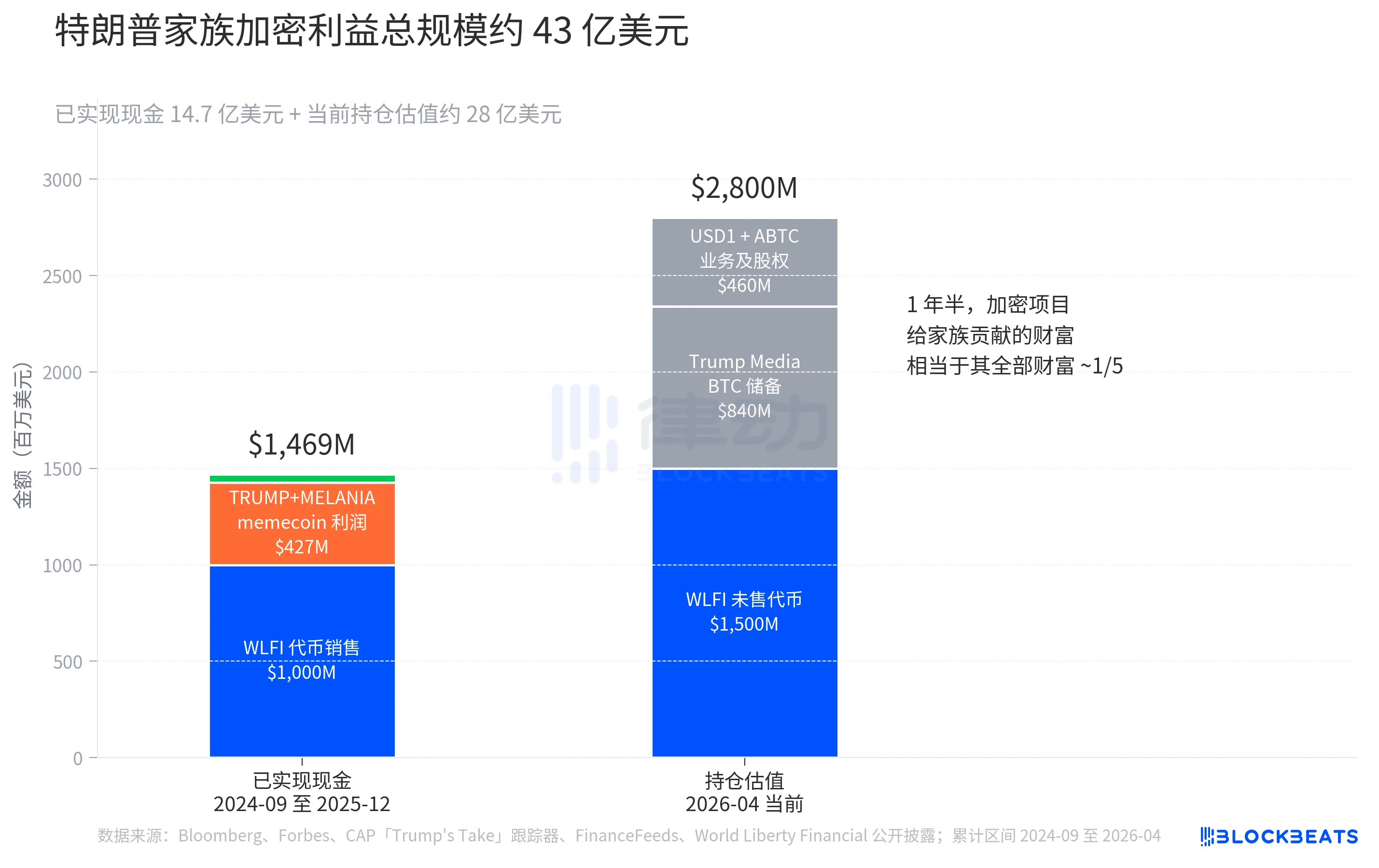
The unrealized holdings are valued at approximately $2.8 billion. WLFI still has $1.5 billion in unsold tokens on the books, but this part is heavily influenced by WLFI's price fluctuations. The Bitcoin reserve of Trump Media is estimated by FinanceFeeds to be between 9,500 and 11,500 coins, totaling about $840 million at the current Bitcoin price. The valuation of the USD1 business and equity stakes in American Bitcoin Mining amount to about $460 million.
When you add realized and unrealized gains together, it's about $43 billion. That's the actual figure of the ethical provision. The version pushed by lawmakers like Elizabeth Warren explicitly stated "banning current senior officials from profiting from cryptocurrency while in office," but the compromised version that made it to the White House was sent back. The fundamental question of whether the bill should come with this provision to a full Senate vote is asking each senator: Are you willing to cast a vote openly to cut off $43 billion from the President's family.
CLARITY Can It Pass This Year?
The Clarity Act forcefully categorizes all digital assets into three buckets. The first bucket is "Digital Commodities" regulated by the CFTC, corresponding to tokens running on "mature blockchain systems." The bill has two hard standards for "maturity": one is that the network has complete functionality and can achieve consensus, and the other is that it is sufficiently decentralized, with no single entity able to unilaterally modify the protocol or governance.
The second bucket is "Investment Contract Assets" regulated by the SEC, corresponding to tokens representing equity, debt, or similar rights, such as tokenized stocks, on-chain issued traditional securities, RWAs (real-world assets like real estate, notes, accounts receivable). The third bucket is for payment stablecoins, led by banking regulatory agencies, requiring capital, custody, and anti-manipulation measures to be fully compliant.
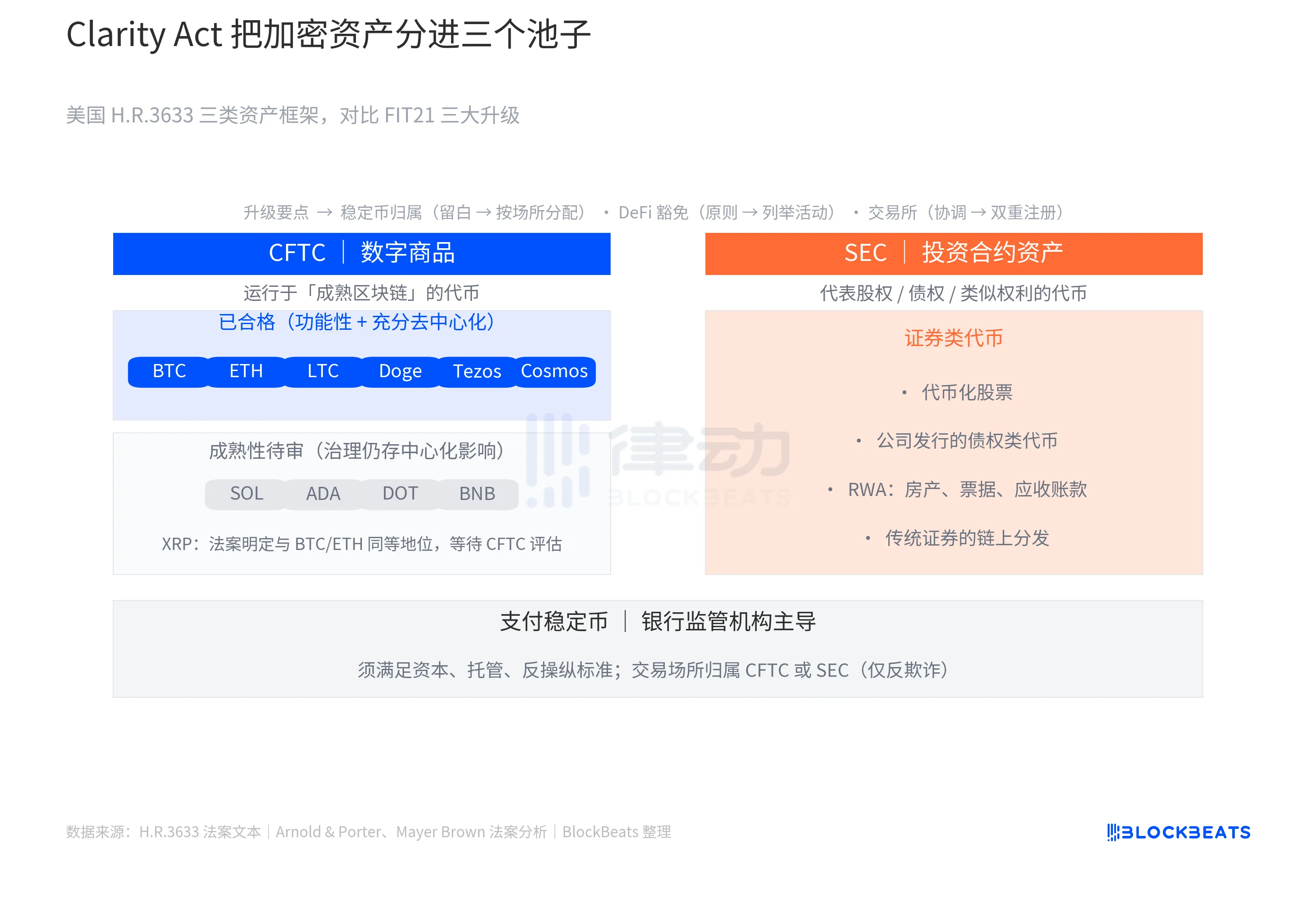
Compared to FIT21, which died in the Senate in 2024, the Clarity Act has three upgrades. Stablecoin categorization has shifted from "blank unspecified" to "allocation by trading venue," with CFTC overseeing stablecoin trading on CFTC platforms and SEC overseeing on SEC platforms, though SEC retains only anti-fraud authority.
The DeFi exemption has changed from a principled safe harbor to a specific activity exemption, where custody frontend, node operation, and code deployment do not trigger registration obligations. Exchange registration has shifted from "cross-institutional coordination" to mandating dual registration of intermediaries handling digital commodities, even if the intermediary is already an SEC-licensed broker-dealer.
The logic of the bill is clear: it aims to codify into law the biggest uncertainty in the crypto industry over the past few years, i.e., "who exactly regulates this stuff."
As it stands, the Clarity Act doesn’t have many allies.
According to a public statement from Congressman French Hill's office, over 40 crypto and blockchain-related bills were introduced in just the 116th Congress (2019-2020). None of these bills ultimately passed. The 118th Congress (2023-2024) saw the emergence of FIT21, which passed in the House in May 2024. It was the first crypto market structure bill to pass the House with a full House vote, but it also met its end in the Senate.
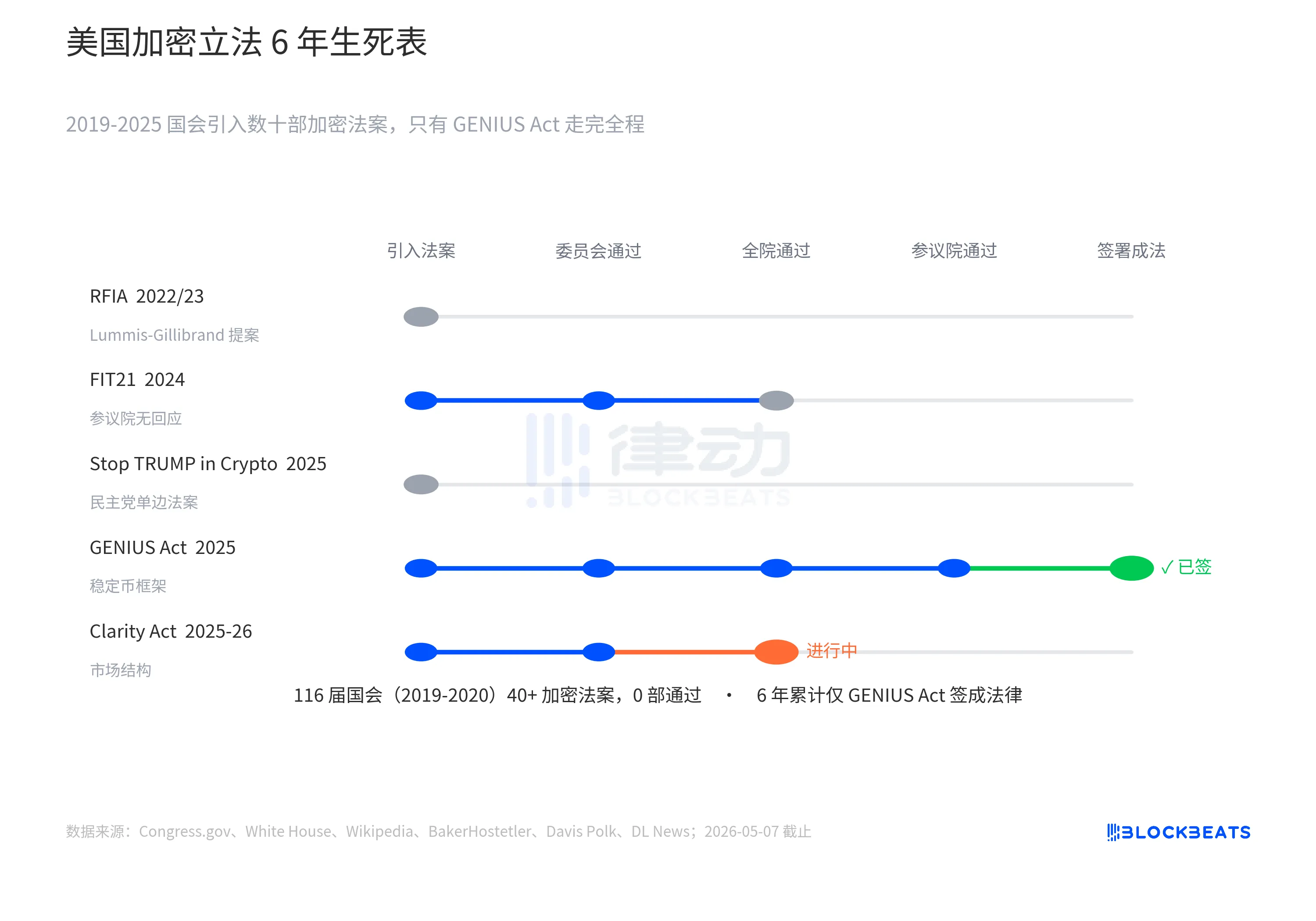
On July 18, 2025, Trump signed the GENIUS Act, establishing a legal framework for payment stablecoins. This is the first and so far the only crypto-related federal bill to be signed into law in 6 years. On the same day, the House passed the Clarity Act with 294 votes in favor and 134 against. In theory, the Clarity Act has reached the same stage as FIT21 did back in the day, with House approval and now awaiting a Senate vote.
The key difference lies in the political environment. During FIT21, the Democratic Party controlled the White House, and there was no top-level drive for crypto legislation, whereas the Trump administration is now openly pushing for it. However, the compromised version of the ethics clause was rejected by the White House, and key Democratic lawmakers remain unconvinced. If the first week of August is missed, the Senate will adjourn until September 14. Considering the midterm elections on November 3, whether it can be signed into law by 2026 is no longer solely determined by whether the White House wants it.
In historical terms, with over 50 bills in 6 years and only 1 signed into law, the question of whether the Clarity Act will be the second becomes clear in these two months.
Welcome to join the official BlockBeats community:
Telegram Subscription Group: https://t.me/theblockbeats
Telegram Discussion Group: https://t.me/BlockBeats_App
Official Twitter Account: https://twitter.com/BlockBeatsAsia
