Editor's Note: The crisis in the Strait of Hormuz is evolving from a military conflict into a stress test for global energy trade.
A key recent development in the situation is that the ceasefire did not bring about a real resumption of navigation. In early May, the U.S. announced the initiation of "Project Freedom" in an attempt to guide stranded vessels out of the Persian Gulf; Iran, on the other hand, warned external warships not to enter the strait. Subsequently, the U.S. and Iran engaged in a new round of clashes near the Hormuz Strait, with the U.S. claiming to have intercepted an Iranian attack on three U.S. vessels, while Iran accused the U.S. of violating the ceasefire, attacking vessels, and coastal areas. Although Trump stated that the ceasefire was still in effect, the market has begun to factor in the risk again, causing Brent oil prices to briefly rise to around $101 per barrel.
Iran has demonstrated that even without a strong traditional navy, it can render the world's most critical energy passage nearly paralyzed through drones, small boats, mine threats, passage permits, and toll mechanisms. For shipowners, insurance companies, and oil-producing countries, the issue is no longer just "can we pass through," but "how high a risk do we have to take to pass through once."
This means that the cost of the Hormuz Strait is being repriced. In the past, it was the default infrastructure for global energy trade; now, it is becoming a geopolitical bargaining chip in Iran's hands. Even if the U.S. and Iran reach an agreement in the future, the resumption of shipping is unlikely to immediately return to pre-war levels, because what has truly been damaged is not the waterway itself, but the market's trust in the security of this passage.
Below is the original text:
Nowhere in the world is the production of oil and gas more concentrated than in the countries along the Persian Gulf. Most of the energy exports here can only rely on oil tankers traversing the Strait of Hormuz - a waterway that has in reality been closed for over two months.
Since the end of February, Iran has restricted ships from passing through this strait following attacks by the U.S. and Israel. Iran has refused to reopen this critical shipping passage unless the U.S. lifts its maritime blockade on Iranian ports. Early May saw tensions rise once again, almost jeopardizing the maintenance of the ceasefire agreement. Prior to this, U.S. President Donald Trump announced that the U.S. would launch an operation called "Project Freedom" to guide stranded vessels out of the Persian Gulf.
The ongoing economic impact of the Strait of Hormuz blockade is accumulating globally. With the prices of oil, natural gas, and other commodities on the rise, the supply is becoming increasingly tight. Even if the United States and Iran ultimately break the deadlock in peace talks and reach an agreement to lift the strait blockade, free navigation may not necessarily fully resume. Iran has sent signals indicating its intention to use its de facto control of the Strait of Hormuz as a weapon that could be deployed in future confrontations against adversaries.
How Does War Impact the Hormuz?
How has the Iran war affected shipping in the Strait of Hormuz?
Since the outbreak of war on February 28, Iran has sporadically attacked ships in the Persian Gulf and its surrounding waters, causing most shipowners to be reluctant to attempt to cross the Strait of Hormuz, risking casualties, cargo losses, and vessel destruction. The average daily number of ships passing through this strait has dropped from around 135 during peacetime to less than 10.
Meanwhile, Iran continues to transport its own oil through the strait. It also permits some other ships to pass, typically along a corridor following the Iranian coastline; at times, Iran demands these ships to pay fees as high as $2 million.
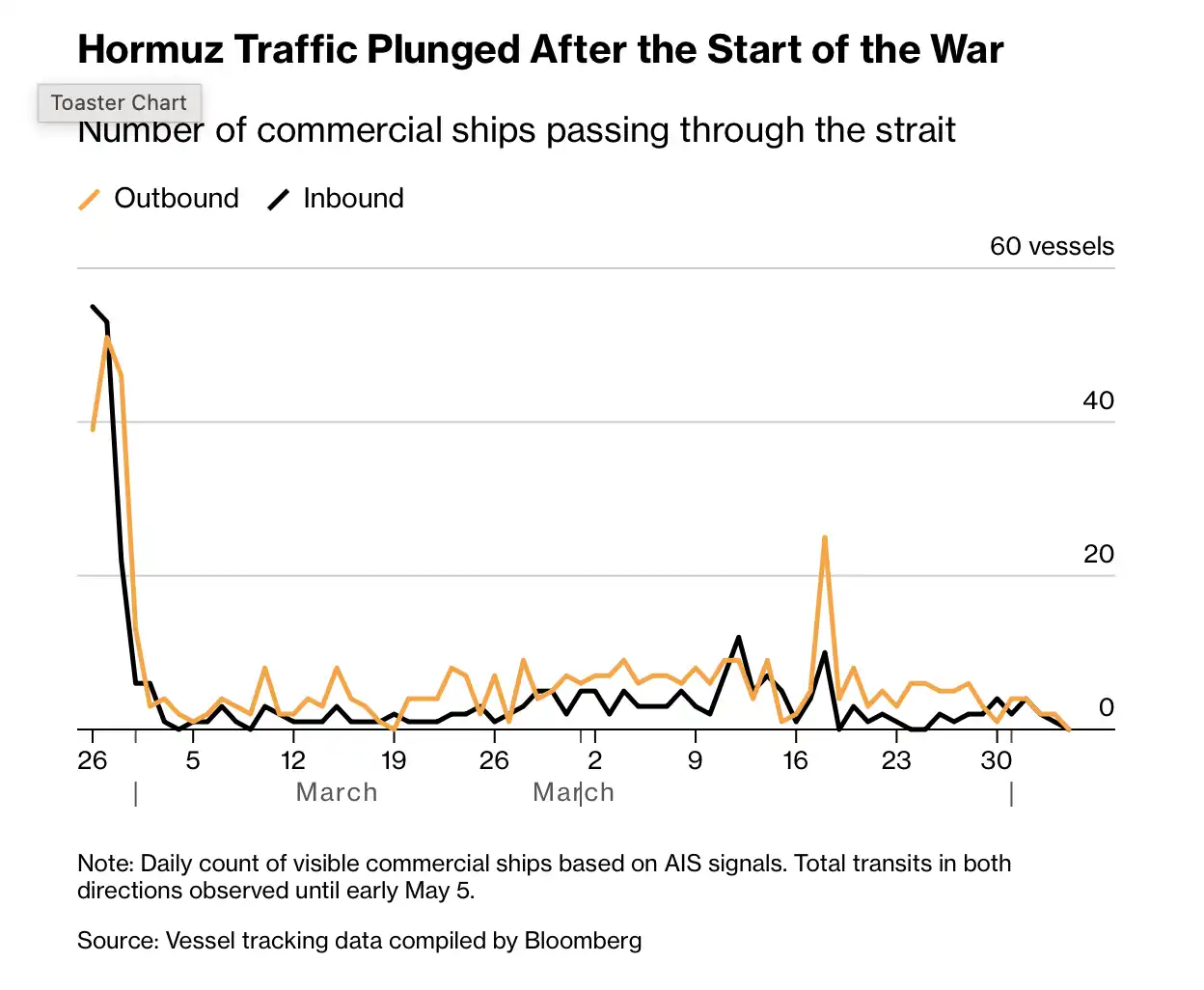
Even after the warring parties agreed to a ceasefire in early April, strait traffic remained almost stagnant. Starting on April 13, the United States began blocking ships that had previously called at Iranian ports or were heading to Iranian ports, attempting to pressure Iran's oil exports and compel the Iranian regime to restore the Strait of Hormuz's status as a "fee-free zone."
So far, Iran has managed to withstand the blockade pressure. According to Iran's semi-official Tasnim news agency, in early May, Iran even expanded its claimed area of control in the Strait of Hormuz. With the deadlock ongoing, the U.S. military said that over 1,500 merchant ships are currently stranded in the Persian Gulf. Due to the lack of crude oil storage space, oil-producing countries in the region have been forced to suspend most of their production.
What conditions are needed to reopen the Strait of Hormuz?
Even if a peace agreement is reached, reopening the Strait of Hormuz to normal navigation is unlikely to happen immediately. Shipowners need to be assured that the reopening is permanent and the passage is safe. One issue is the potential risk of sea mines. Iran has stated that it has laid mines in the most common shipping lanes in this narrow strait. Sweeping and clearing these explosives could take weeks.
Some shipping operators may be reluctant to transit the Strait of Hormuz without military escort. The U.S. Navy does not have enough vessels to protect over 100 ships that typically pass through the waterway daily, and the Trump administration has struggled to convince allies to immediately deploy their naval forces. The UK and France are leading discussions to try to form a multinational coalition to help restore Hormuz Strait shipping after a prolonged ceasefire.
Even if escort arrangements are eventually put in place, clearing the backlog of ships on either side of the strait may also take several weeks. The narrowness of the Strait of Hormuz restricts the number of ships that can be escorted at once and makes the escort fleet more vulnerable to attacks.
Trump announced that starting on May 4, the U.S. would launch "Project Freedom" to guide neutral ships out of the Persian Gulf. He did not provide further details on the operation, but the U.S. Central Command stated that military support would be provided, including the use of missile destroyers, aircraft, and drones. Iran referred to this move as "Project Deadlock" and claimed it violated the ceasefire agreement.
What does a prolonged Iran conflict mean for the future of the Hormuz Strait?
Shipowners, insurance companies, and customers have already seen that for Iran, with almost no conventional naval power, quickly stalling traffic in the Strait of Hormuz is not difficult; restoring normal operations, however, is much harder.
If a U.S.-Iran peace agreement fails to eliminate Iran's threat to Hormuz shipping, the economic calculus of this critical trade route may change in the coming years. The most cautious shipping operators may consider it too risky to transit the strait under any circumstances. Higher insurance rates could also erode the Gulf's trade competitiveness compared to other regions.
Iran has signaled that even if the war ends, it intends to continue exerting control over transit through the Strait of Hormuz and monetizing its influence over the waterway. The Iranian parliament is advancing a bill to enshrine Iran's sovereignty over the strait in domestic law and formally establish a fee system for ships passing through.
Energy Artery Repriced
Where does the significance of the Strait of Hormuz lie?
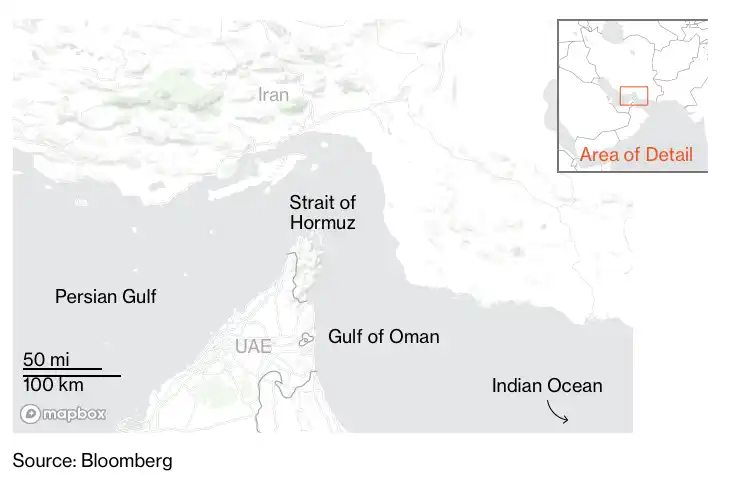
The Strait of Hormuz lies north of Iran and south of the UAE and Oman, connecting the Persian Gulf to the Indian Ocean. It is approximately 100 miles (161 kilometers) long, with a width of about 24 miles at its narrowest point. Each of the two traffic lanes is only 2 miles wide.
For the energy market, this strait is a crucial passage that carries about one-fifth of the global oil and liquefied natural gas supply. Normally, Saudi Arabia, Iraq, Iran, Kuwait, Bahrain, Qatar, and the UAE all export oil through the Strait of Hormuz, with most of the cargo heading to Asia.
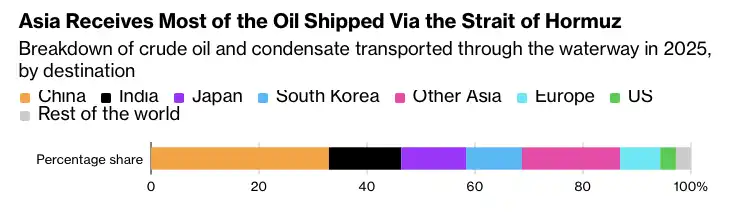
The Gulf countries also have multiple refineries that produce a significant amount of diesel, aviation fuel, naphtha used in plastic and gasoline production, and other petroleum products, which are exported to the global market through this strait.
Aside from energy, the Strait of Hormuz is also a vital route for transporting products like aluminum, fertilizers, and even helium. Helium is used in semiconductor manufacturing.
Can oil-producing countries bypass the Strait of Hormuz?
Kuwait, Qatar, and Bahrain do not have alternative maritime export routes.
Saudi Arabia is the largest oil transporter through the Strait of Hormuz and has already diverted some of its crude oil through a pipeline that extends west to the port of Yanbu on the Red Sea. Saudi Aramco plans to fully utilize this pipeline's capacity of 7 million barrels per day, although only about 5 million barrels per day can be used for export, with the rest allocated for domestic use.
However, the Red Sea route is not without risks. Iran has previously attacked a refinery in Yanbu and a pump station on the East-West Pipeline, and Iran-backed Houthi rebels in Yemen have threatened to resume attacks on vessels in the Red Sea.
The UAE can also partially bypass the Strait of Hormuz. However, its alternative capacity is limited, and the port of Fujairah has been targeted in the past by Iran. The port sits at the end of a pipeline that connects UAE oil fields to the Gulf of Oman. Additionally, while Iraq is attempting to restore exports through ports in Jordan and Syria, the volume currently under consideration represents only a small fraction of its usual exports through the Strait of Hormuz.
Does Iran have the right to control the Strait of Hormuz?
Under the United Nations Convention on the Law of the Sea, coastal states can exercise sovereignty over the waters up to 12 nautical miles (about 14 miles) from their coastline, known as territorial seas.
The Strait of Hormuz passes through the territorial seas of Iran and Oman. However, nations must allow foreign vessels to pass innocently through their territorial seas and cannot impede foreign ships' innocent passage or transit passage through straits used for international navigation. The convention also states that countries cannot charge fees solely for foreign ships passing through their territorial seas.
Despite signing the United Nations Convention on the Law of the Sea in 1982, the Iranian government has never ratified the treaty.
Welcome to join the official BlockBeats community:
Telegram Subscription Group: https://t.me/theblockbeats
Telegram Discussion Group: https://t.me/BlockBeats_App
Official Twitter Account: https://twitter.com/BlockBeatsAsia
