Editor's Note: Crypto regulation is becoming a new variable in the 2026 U.S. midterm elections.
A HarrisX survey reveals that nationwide voters not only across party lines support the U.S. maintaining leadership in digital finance and cryptocurrency but also widely endorse passing the CLARITY Act.
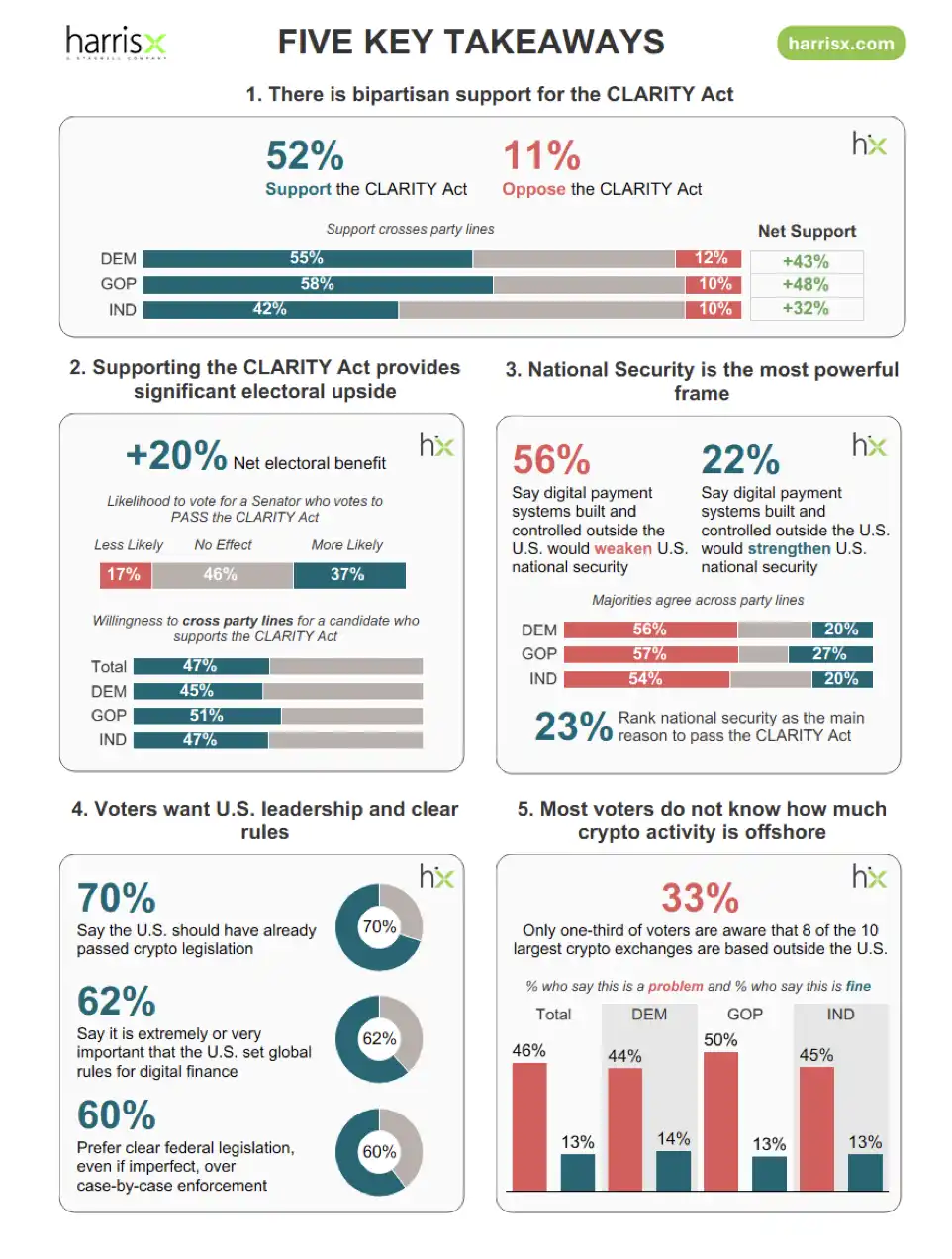
The bill was originally regulatory framework legislation, with its core aimed at clarifying the regulatory boundaries of the SEC and CFTC on digital assets, establishing registration rules for exchanges and custodians, and enhancing consumer protection. However, from HarrisX's survey results, its political significance has transcended the crypto industry itself: 37% of voters say that if a senator votes in favor of the bill, they would be more inclined to support that senator; overall, supporting the CLARITY Act could yield a net election gain of 20 percentage points.
Of particular interest is the bipartisanship flow. The survey shows that 47% of voters state that if a candidate supports the CLARITY Act and their preferred party does not, they would consider voting for a candidate outside of their party. This proportion is higher among cryptocurrency holders, voters familiar with digital assets, and those knowledgeable about the bill.
This implies that the CLARITY Act is not just a legislative attempt by the crypto industry to seek regulatory clarity but could also become a tool for candidates to court young voters, crypto holders, and swing voters. For the U.S. political scene, the core issue of crypto regulation is shifting from "whether to regulate" to "who can mobilize the vote using it".
Below is the original text:
Introduction
Digital assets and their federal regulatory framework are at a crucial turning point.
The 2025 Digital Asset Market Clarity Act (H.R.3633), currently under congressional review, will clarify three things: which types of digital assets are regulated by the SEC versus the CFTC, registration rules for cryptocurrency exchanges and custodians, and industry-level consumer protection standards. This is one of the most significant digital asset legislations Congress has deliberated on to date.
Building on its long-standing expertise in public opinion research, HarrisX conducted a nationwide survey of 2,008 registered voters aimed at measuring four key aspects: voter awareness of and ownership of digital assets, attitudes toward U.S. leadership in the digital finance space, support for the "CLARITY Act," and whether candidates' positions on crypto regulation would impact the 2026 midterm elections.
Among the top ten cryptocurrency exchanges globally, eight are based outside the United States. As digital payment systems and stablecoin infrastructure accelerate globally, if the U.S. fails to produce clear federal rules promptly, it may risk ceding control of a strategic financial technology to overseas jurisdictions—significantly impacting national security, the global status of the U.S. dollar, developer and business retention, and the overall U.S. competitiveness in financial technology innovation.
Bipartisan voters have recognized this risk and are calling on Congress to act swiftly.
The Importance of U.S. Leadership and Clear Federal Regulations
Voters' understanding of digital assets remains limited, but their views are clear and consistent: the United States should establish rules for digital finance, and should do so promptly.
Awareness of digital assets remains low, but crypto holders already represent a significant voting bloc
· 39% of voters say they are familiar with digital assets and blockchain technology, while 61% say they are not.
· Two-fifths of voters have purchased cryptocurrency, with 30% making purchases in the past year.
· Familiarity and ownership are mainly concentrated among male and voters under 35.
Voters Want U.S. to Maintain Leadership in Cryptocurrency Space
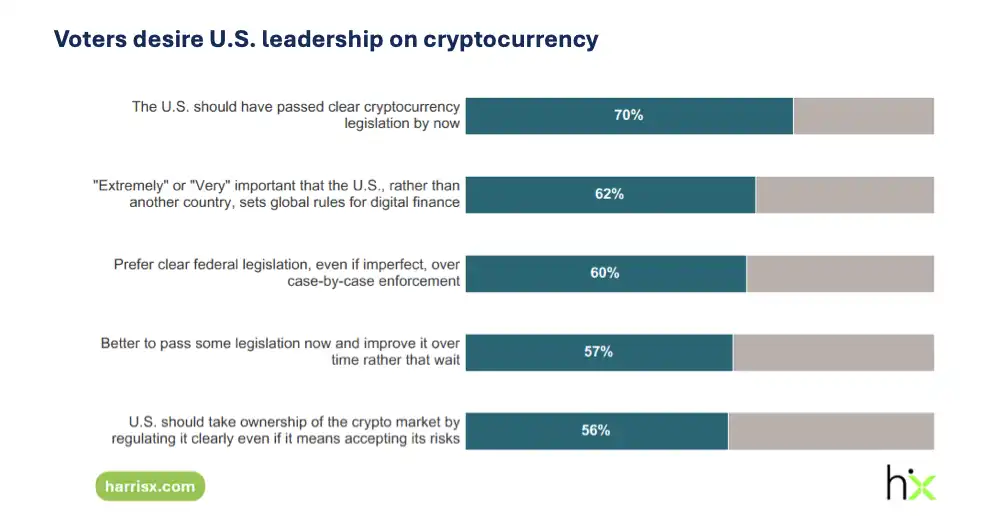
Although the majority of voters are not familiar with the technical details of digital assets, they have shown a strong, broad, and steady demand for U.S. leadership and clear federal rules.
70% of voters believe that the U.S. should have passed clear cryptocurrency legislation long ago; 62% of voters think it is very important for the U.S. to establish global digital financial rules.
Voters also do not agree with continuing to rely on a case-by-case enforcement approach: 60% of voters are more in favor of clear federal legislation, even if this legislation is not perfect; 57% of voters believe that, rather than waiting for a perfect law, it is better to pass partial legislation now and gradually improve it in the future.
Even when explicitly acknowledging the trade-offs involved, voters still tend to take action. 56% of voters believe that the U.S. should take control of the crypto market through clear regulation, even if it means accepting the risks involved.
Overall, these results indicate that voters are not asking Congress to continue discussing "whether to act," but are demanding that Congress take action promptly, clearly, and at the federal level.
Offshore Centralization is an Important Yet Underappreciated Issue
Voters support U.S. regulation. The high concentration of crypto exchanges offshore also provides another specific reason for voters to support federal crypto regulatory rules.
The survey shows that voters, in general, are not aware of how much digital asset market activity is outside U.S. regulation; but once informed of this fact, few find it acceptable.
- Only a third of voters know that eight out of the top ten cryptocurrency exchanges globally are based outside the U.S.
- After learning this fact, 46% of voters believe that most crypto trading taking place outside U.S. regulation is at least somewhat problematic; only 13% of voters think this is not a problem, or even a good thing.
National Security is a Key Driver of Voter Support for Federal Action
When framed within the national security context, voters' concerns about foreign-controlled digital payment systems potentially undermining U.S. security and the global status of the U.S. dollar are further heightened.
- 56% of voters believe that if digital payment systems in the future are built and controlled by countries other than the U.S., it will weaken U.S. national security. Only 22% of voters think this will enhance U.S. national security.
- Over two-thirds of voters believe that if foreign-issued stablecoins dominate, it will weaken the global status of the U.S. dollar; only 17% of voters think this will enhance the dollar's status.
Voters Have Long Wanted Better Rules and Regulation for Digital Assets
The demand for federal action is not new to the current debate. Over the past three years, multiple HarrisX studies have shown that voters consistently prefer clearer rules, stronger protections, and a more proactive U.S. approach to regulating digital assets.
Findings from our previous research include:
· Voters want clear crypto rules, not enforcement only. In a 2024 study, voters favored clear rules over enforcement by a ratio of 48% to 23%; by 2025, this gap remained largely unchanged with 49% supporting clear rules and 26% supporting enforcement.
· Voters believe the U.S. is falling behind, creating a leadership gap. In 2024 and 2025, only about one-fifth of voters believed the U.S. was leading in crypto regulation, while 36% of voters thought the U.S. was lagging.
· Yet voters want the U.S. to lead in this space. In 2025, 69% of registered voters and 84% of crypto investors believe that U.S. leadership in blockchain technology development is very important; 82% of voters support Congress imposing stricter rules on crypto exchanges and brokers.
CLARITY Act Gains Bipartisan Support
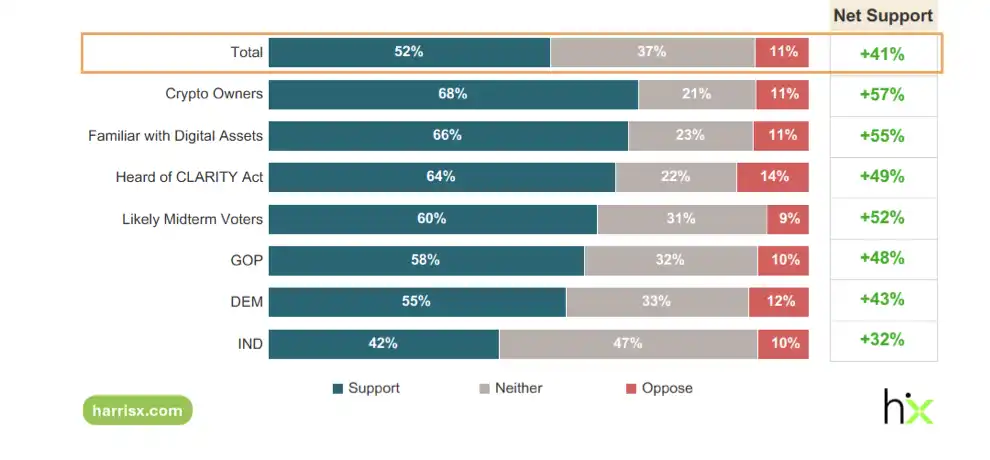
After receiving a neutral description, 52% of voters support the CLARITY Act, with 11% opposing. The support is bipartisan, and the persuadable middle is sizable.
Current Voter Awareness of the Act Remains Low
· 64% of voters have not heard of the CLARITY Act; 14% say they have heard a lot, and 22% say they have heard a little.
· How the Act is first explained to voters will determine the upper limit of political support for the Act. The neutral description used in this survey has generated a solid majority in favor.
Strong Support after Receiving Neutral Description, Limited Opposition
The CLARITY Act Gains Strong Support Among Key Groups
· Bipartisan Support is Evident: Net support among Republican voters is +48, Democratic voters +43, voters likely to participate in the midterm elections +52, and Independent voters +32.
· Only 10% of Independent voters oppose the bill, with the majority in the persuadable middle ground: 47% neither support nor oppose.
· Voters most familiar with the issue show the highest levels of support: Net support among cryptocurrency holders is +57, voters knowledgeable about digital assets +55, and those aware of the CLARITY Act +49. Education and information exposure increase support.
Support for the CLARITY Act Rooted in Broader National Security Concerns
When asked which reason most supports passing the CLARITY Act, voters cited:
· National Security and Dollar Dominance (23%): "Ensuring the dollar and U.S. payment systems remain at the heart of global finance is a national security priority."
· Enforcement and Anti-illegal Financial Activities (17%)
· Consumer Protection and Fraud Prevention (16%)
· Jobs and Businesses Leaving the U.S. (11%)
Election Impact of Supporting the CLARITY Act
Voting in favor of the CLARITY Act is a clear bipartisan electoral advantage. Nearly half of voters say such issues could lead them to cross party lines when voting.
Senators Supporting the CLARITY Act Will Gain Support Across Voter Types
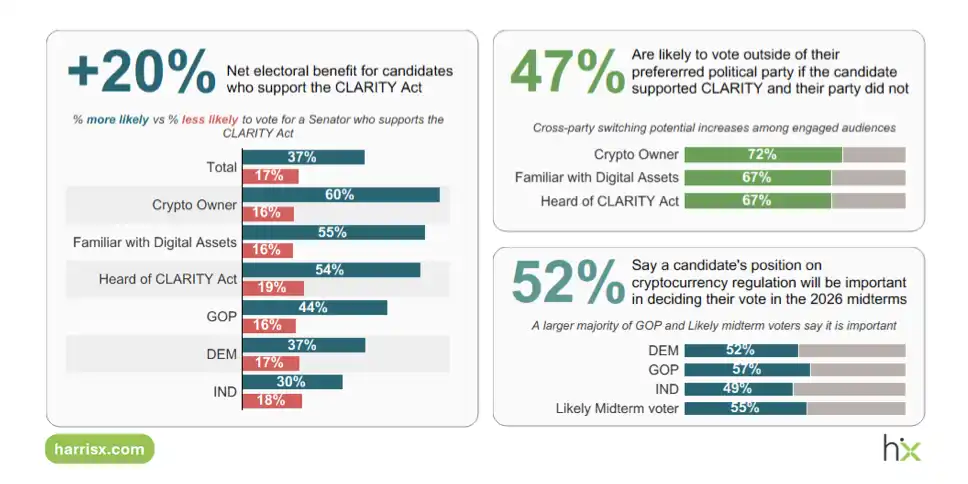
37% of voters say that if a senator votes to pass the CLARITY Act, they would be more inclined to support that senator; 17% say they would be less inclined to support, and 46% say it would have no effect. Overall, the net gain is +20.
This impact is strongest among Republican voters, with 44% indicating they would be more inclined to support; it also holds a positive impact among Democratic voters at 37%; and among independent voters at 31%.
Cross-Party Appeal: 47% of Voters Would Consider Changing Party Voting Choice Due to This Issue
· In a midterm election environment where most issues tend to reinforce existing party divides, the CLARITY Act is one of the few pieces of legislation that could potentially create cross-party movement.
· 47% of voters say that if a candidate supports the CLARITY Act and their preferred party does not, they would at least somewhat consider voting for a candidate outside their preferred party.
· Among cryptocurrency holders, voters familiar with digital assets, and those aware of the CLARITY Act, this willingness for cross-party switching rises to 72%, 67%, and 67%, respectively.
Majority of Voters Say This Issue Will Impact Their 2026 Vote
· 52% of voters say a candidate's stance on cryptocurrency regulation is "extremely important" or "somewhat important" to their vote in the 2026 midterm elections.
· Among cryptocurrency holders, this figure rises to 78%; among voters familiar with digital assets, it is 74%.
· The issue's intensity is moderate, with 16% of voters stating it is "extremely important." While not yet a top-tier voting driver, it has broad political reach: many voters are willing to factor crypto regulation into their 2026 voting considerations.
Crypto Voters Are a Sizeable and Influential Voting Bloc
In addition to general voter support for the CLARITY Act, the survey results also indicate that courting crypto voters holds unique political value. Crypto voters are a sizable, influential group; previous HarrisX research has shown they are highly engaged, issue-driven, and willing to cross party lines when a candidate's crypto policy aligns with their own views:
· High Engagement: 92% of crypto holders plan to vote in the 2024 U.S. presidential election.
· Issue-Driven: 49% of U.S. voters believe it is very important for a candidate to support pro-crypto policies; among crypto holders, this percentage rises to 85%.
· Persuadable Across Party Lines: If a candidate supports their preferred pro-crypto policy, U.S. voters are more likely to vote for a candidate outside their party, with a net increase of +13 percentage points; among crypto holders, this increase jumps to +58 percentage points.
·Swing State Influence: In Michigan, Pennsylvania, and Wisconsin, the number of crypto-driven voters has exceeded the margin of victory in the previous presidential election.
·Established Political Force: CBS News reported that in congressional races where the crypto industry actively participated, candidates supported by the crypto industry won 85% of the races.
Strategic Implications
Voters' positive response to the CLARITY Act is because it involves a broader issue: U.S. leadership, national security, and whether digital finance remains under U.S. regulation.
Voters do not need to be crypto enthusiasts to support the CLARITY Act. Their response is based on a simple judgment: digital finance is evolving anyway, much of it has already moved overseas, and the U.S. should bring it under regulation through clear federal rules.
The political rationale for passing the CLARITY Act outweighs the rationale for blocking it. Senators voting in favor of the bill will gain a +20 net electoral advantage and create conditions for bipartisan support.
For the target voter group, this may be a truly vote-influencing issue. Among crypto holders, voters familiar with digital assets, young males, and those already aware of the CLARITY Act, this issue is significant enough to change voting choices and even facilitate bipartisan voting. For a broader voter base, supporting the CLARITY Act is also a clear positive political label.
Welcome to join the official BlockBeats community:
Telegram Subscription Group: https://t.me/theblockbeats
Telegram Discussion Group: https://t.me/BlockBeats_App
Official Twitter Account: https://twitter.com/BlockBeatsAsia
