Editor's Note: In this speech to the Carnegie Mellon University Class of 2026 graduates, Jensen Huang did not portray AI as merely a technological wave but placed it within a broader context of personal destiny, industry cycles, and national capacity rebuilding.
Starting from his own immigrant experience, early job struggles, the founding and subsequent reboot of NVIDIA, he attempted to illustrate a core insight: what truly changes a life is not a path of certain success but the ability to embrace responsibility in uncertainty, learn from failures, and restart. NVIDIA's growth was also built upon repeated miscalculations of "how hard could it be" and the subsequent recreations.
Jensen Huang's definition of the AI revolution extends beyond mere "tool upgrades." In his view, AI is resetting computation itself: from humans writing programs and computers executing instructions to machines understanding, reasoning, planning, and utilizing tools. It will not only transform the software industry but also reshape the organization of manufacturing, energy, healthcare, education, and nearly every industry.
This is the most significant reality pointed out in this speech: AI is not just creating a new computing industry but is ushering in a new industrial era. Chip factories, data centers, power grids, energy systems, advanced manufacturing will together form the next wave of technological infrastructure development. For the United States, this signifies an opportunity for a new industrialization; for the graduates, it means the beginning of their careers, right at the dawn of a new industry cycle.
However, Jensen Huang does not shy away from the uncertainty brought by AI. He acknowledges that AI will automate many tasks and eliminate some jobs. But he distinguishes between "tasks" and "purposes": AI can replace some labor processes but will not replace the human ability to question, define goals, and take responsibility. The real risk is not AI replacing humans but rather those who do not use AI being left behind by those who do.
Just as Carnegie Mellon's motto says, "My heart is in the work." In an era where intelligence is being redefined, and industries are being reorganized, Jensen Huang's advice to the graduates can be summarized in one sentence: Do not just watch the future unfold, immerse your heart in it, and then build it with your own hands.
The original text is as follows:
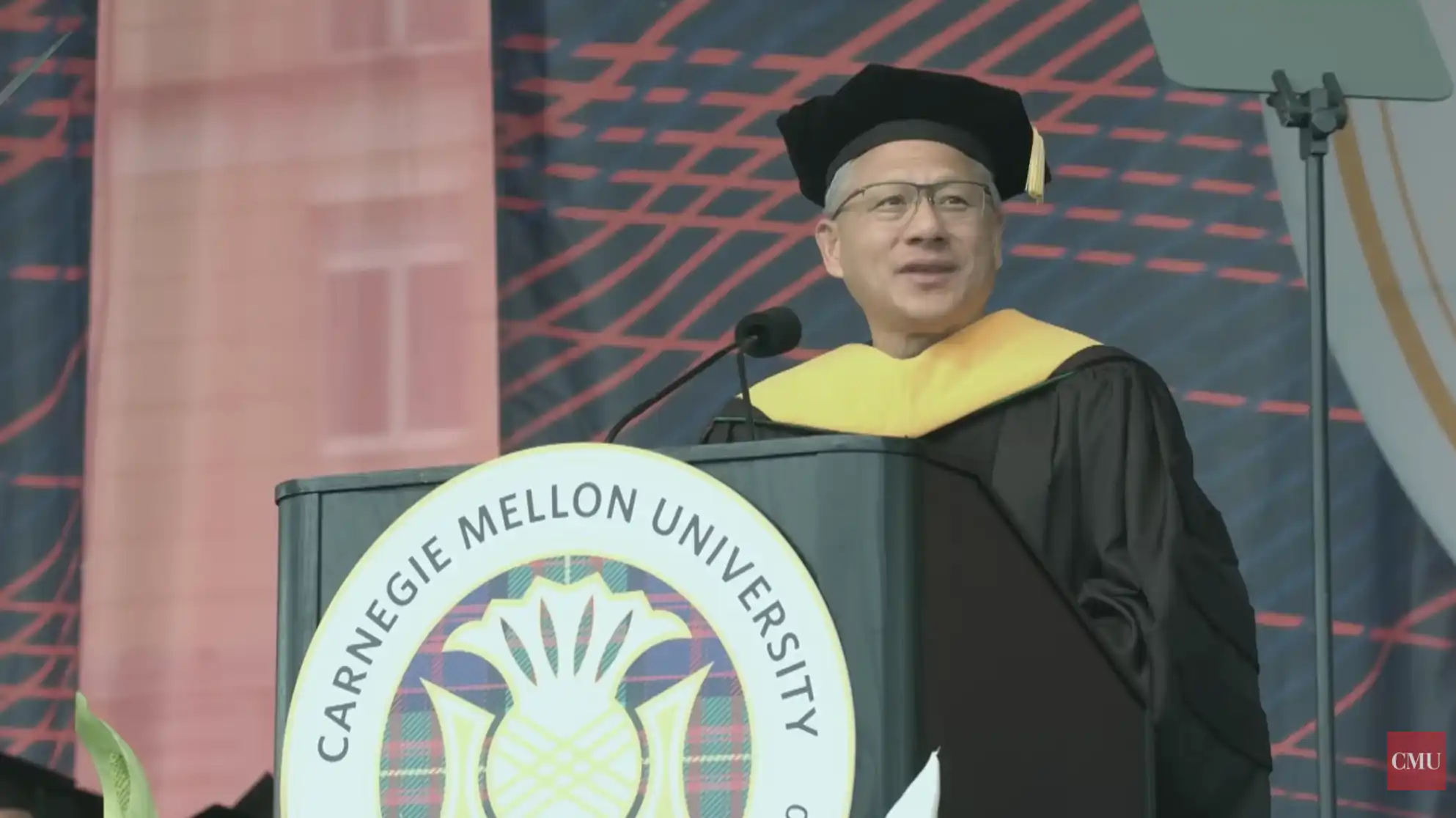
Chancellor, members of the Board, esteemed faculty, distinguished guests, proud parents and families, and most importantly—the graduating Class of 2026 of Carnegie Mellon University:
Thank you for bestowing upon me this extraordinary honor.
It is deeply meaningful for me to be at Carnegie Mellon University. This is one of the greatest universities in the world and one of the few places that can truly "invent the future."
Today is a day of pride and joy, a day where your dreams come true. But this day does not belong only to you. Your families, teachers, mentors, and friends have supported you all the way to this point. Before we talk about the future, let's first thank them. Today is their day too.
Graduates, please stand up. Stand up with me. Come on, everyone.
And now, please turn to your mothers and wish them a Happy Mother's Day. For you, this is just another step in life, but for them, it's a moment of dreams coming true.
Please be seated. Oh, CMU students, just like robots, only capable of executing one command at a time (laughs).
Alright, everyone, focus. I have something important to tell you. Being able to see you graduate from one of the world's greatest institutions of higher learning, this is also their moment. My parents have always been immensely proud of me. My journey is also their journey.
I am the result of their dreams coming true. And their dream is the American Dream.
Like many others here, I am a first-generation immigrant. My father had a dream: to raise his family in America. When I was 9 years old, he brought my brother and me to the United States. We eventually ended up at a boarding school in a Baptist church in Oneida, Kentucky. It was in a coal mining area, a small town of just a few hundred people.
Two years later, my parents gave up everything to reunite with us in America. They had almost nothing. My father, a chemical engineer, and my mother worked as a maid at a Catholic school. She would wake me up at 4 a.m. every day to deliver newspapers. Later, my brother helped me get a job washing dishes at Denny's. For me at that time, it was a significant career advancement.
That's my America: not easy, but full of opportunities. It's not a guarantee; it's a chance. My parents came here because they believed America could give their children a chance. How could we not hold a romantic view of America?
Later, I went to Oregon State University. I met my wife, Lori when I was 17. I was the youngest kid in school, and we were lab partners in our sophomore year. She was 19, an "older woman." I beat out 250 other guys in the class to win her heart. Now, we've been married for 40 years. We have two amazing children, both working at NVIDIA.
When I was 30 years old, I co-founded NVIDIA with Chris Malachowsky and Curtis Priem. They were two exceptional computer scientists. We wanted to create a new kind of computer, one that could solve problems traditional computers couldn't. We had no idea how to start a company, raise funds, or run NVIDIA.
At that time, I just thought: How hard could it be?
It turned out, it was really hard. Our first technology didn't even work.
We were almost out of money. Once, I had to fly to Japan to explain to Sega's CEO that the technology we were developing together was not feasible. I asked them to cancel the contract for the unrealizable project and then begged them to continue the payments. If we didn't get that money, NVIDIA would vanish.
It was embarrassing and humiliating, one of the toughest things I've ever done in my life.
And Sega's CEO agreed.
Early on, I understood that being a CEO didn't mean power, it meant responsibility – the responsibility to keep the company alive. I also learned that even in the business world, honesty and humility could lead to generosity and goodwill.
We rebooted the company with that money. It was in that desperation that we invented new chips and computer design methods that are still in use today.
For 33 years, NVIDIA has continually reinvented itself. Each time, we asked, "How hard could it be?" And each time, we learned, "Harder than we imagined."
But through these experiences, we learned never to see failure as the opposite of success. Every failure was just a learning moment, a moment to stay humble, a moment to build character. The resilience forged through setbacks gives you the strength to start again.
Today, I am one of the longest-serving CEOs in the tech industry. The career I've had at NVIDIA, alongside 45,000 outstanding colleagues, is my life's work.
Now, it's your turn to pursue your dreams. And the timing couldn't be better.
My career began at the dawn of the PC revolution. Your careers are starting at the dawn of the AI revolution. I can't imagine a more exciting or fitting moment to embark on your lifelong journey.
AI had its start right here at Carnegie Mellon. In the past 24 hours, I've heard countless AI jokes at Carnegie Mellon. Carnegie Mellon is one of the true birthplaces of artificial intelligence and robotics technology. In the 1950s, researchers here created the Logic Theorist, widely recognized as the first AI computer program.
In 1979, Carnegie Mellon founded the Robotics Institute. This morning, I visited some robotics-related projects. The Robotics Institute was the first academic institution dedicated entirely to robotics technology.
Today, artificial intelligence is beginning to reshape computing entirely.
I've witnessed every significant computing platform shift: mainframes, personal computers, the internet, mobile internet, and cloud computing. Each wave built on the previous one. Each expanded the reach of technology. Each changed industries and society.
But what's about to happen is bigger than anything before.
Computing is undergoing a thorough reset. Such a change has never happened since modern computing was invented. For the past 60 years, the way computing operates has remained largely unchanged: humans write software, computers execute instructions. That paradigm has now ended.
Artificial intelligence has reinvented computing. From human programming to machine learning; from software running on CPUs to neural networks running on GPUs; from executing instructions to understanding, reasoning, planning, and using tools. A new industry that can scale intelligence is emerging. Because intelligence is the foundation of all industries. Every industry will be transformed.
For many, AI brings uncertainty. People see AI writing software, generating images, driving cars and naturally ask: What's next? Will jobs disappear? Will people be left behind? Will this technology become too powerful? Throughout history, every major technological revolution has brought both fear and opportunity.
When society engages with technological progress in an open, responsible, and optimistic way, the extent to which we expand human potential far outweighs the extent to which we diminish it. So, first and foremost, we must stay vigilant.
Artificial intelligence, the automation of understanding, reasoning, and problem-solving, is one of the most powerful technologies humanity has ever created. Like all transformative technologies before it, it holds both great promise and real risk.
Our generation's responsibility is not just to push AI forward but to push AI forward wisely. Scientists and engineers carry a profound responsibility: to advance AI's capabilities and AI's safety simultaneously. Policymakers also have a responsibility to establish prudent guardrails that protect society while allowing innovation, discovery, and progress to continue unabated.
errorAI is unlikely to replace you. But those who are more adept at using AI than you might replace you.
So, a good thought experiment is: Do we want our children to be empowered by AI, or do we want them to be left behind by those who are empowered by AI? No parent wants their child to be left behind.
Therefore, let us build AI safely. And let us also envision an optimistic future: a future that our children are willing to engage with and feel inspired to help create.
Thus, we can and must do four things simultaneously: advance technology safely; develop prudent policies; ensure widespread access to AI; and encourage everyone to participate.
Everyone should have access to AI. Opportunity should not be the privilege of only those who can code.
Graduates of 2026, you are entering an extraordinary moment.
A new industry is emerging. A new era of science and discovery is dawning.
AI will accelerate the expansion of human knowledge, helping us solve once-unimaginable problems. We have the opportunity to bridge the tech divide, empowering billions of people for the first time with the power of computation and intelligence. We have the opportunity to reindustrialize America, restore our manufacturing capabilities, and help create a future that is more prosperous, more powerful, and more hopeful than the world you are inheriting.
No generation has entered the world with more powerful tools at their disposal than you, and no generation has had greater opportunities than you.
We all stand at the same starting line.
This is your moment to shape what comes next. So, run, don't walk.
Carnegie Mellon has a motto I particularly love: "My heart is in the work."
So, put your heart into your work. Create something that is worthy of your education, your potential, and the belief that some had in you even before the world believed in you.
Congratulations, Carnegie Mellon University Class of 2026.
Welcome to join the official BlockBeats community:
Telegram Subscription Group: https://t.me/theblockbeats
Telegram Discussion Group: https://t.me/BlockBeats_App
Official Twitter Account: https://twitter.com/BlockBeatsAsia
