Just now, Circle released its Q1 2026 financial report.
The two most anticipated data points by the market are: one is the USDC circulation, with analysts hoping to see $80 billion, a threshold repeatedly mentioned by Allaire during the IPO roadshow; the other is revenue, with Wall Street consensus expecting $7.17 billion, a slight decrease from the $7.70 billion in Q4 of last year.
However, the Q1 financial report released by Circle shows that these two data points are $77 billion and $6.94 billion, respectively. This means that Circle did not meet expectations for these two key data points.
This is the first financial report from Circle since going public that has significantly missed expectations.
When dissecting the financial report, there are many things to talk about, not just the simple conclusion that "Circle's growth is starting to slow down."
Firstly, the year-over-year growth of USDC circulation is 28%, with a 39% quarterly average circulation growth rate. However, reserve revenue only increased by 17%. The reserve return rate, which is the interest rate Circle earns for holding one USDC reserve dollar, decreased by 66 basis points year-on-year.
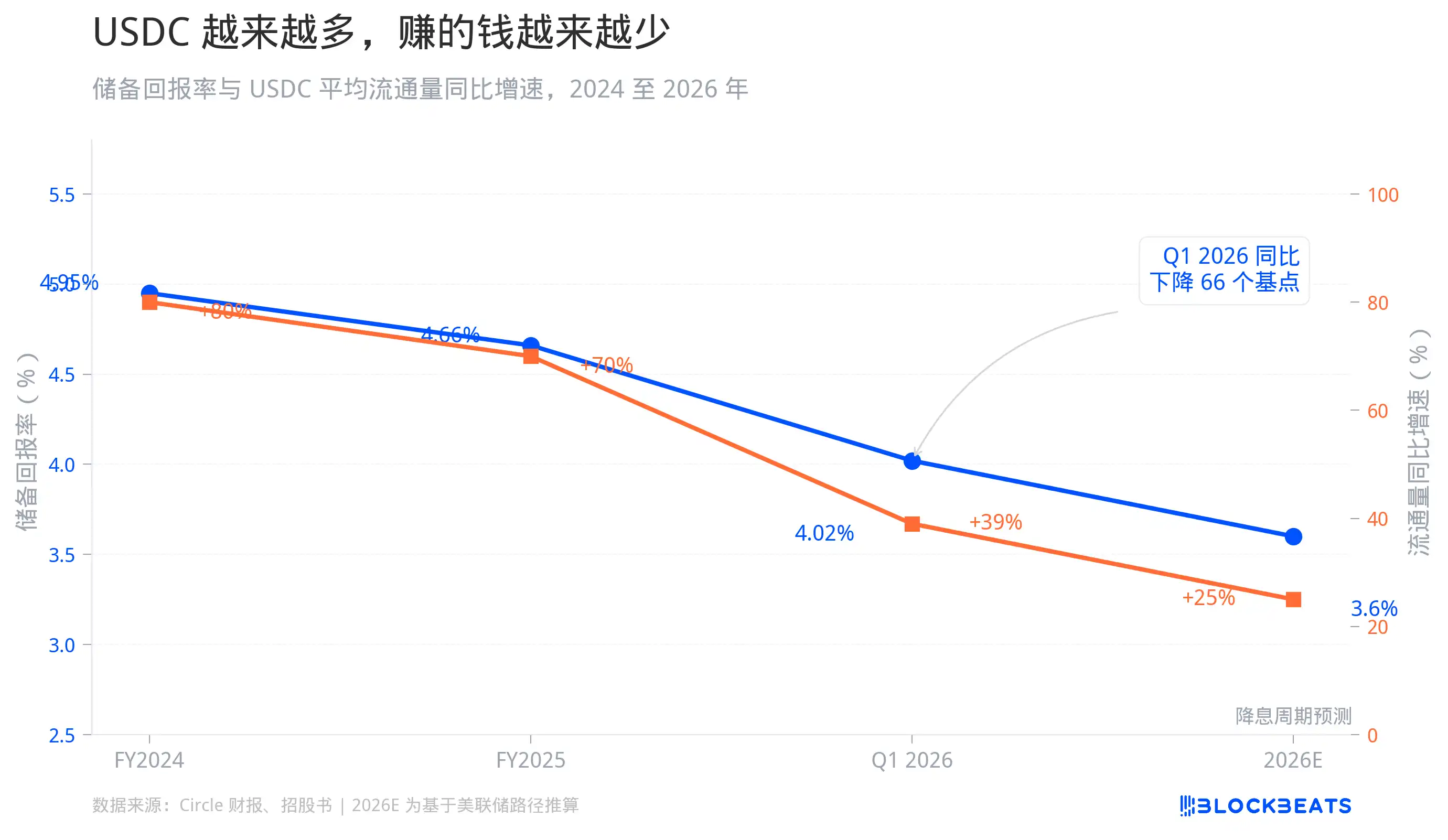
In other words, there is an increasing amount of USDC. But the revenue Circle generates for each USDC dollar is decreasing.
This is not a one-quarter anomaly. The FY25 full-year reserve return rate was about 4.7%, which has dropped to around 4% in Q1 2026. Extrapolating this on the current path of the Fed cutting rates by 50 to 75 basis points in 2026, it could slide to 3.5% within the year.
In its prospectus, Circle defined itself as a "stablecoin infrastructure company." However, the FY25 financials reveal another story, where of the $27.5 billion total revenue for the year, reserve revenue accounted for approximately 90%. The remaining 10% came from transaction fees, subscription services, and other platform businesses.
In other words, Circle is a company disguised in a stablecoin outfit, highly sensitive to short-term Treasury rates.
During the rate-hike cycle from 2023 to 2024, this was the best business in the world.
Circle holds customer funds, invests the money in short-term Treasuries, and earns a 4 to 5 percentage point interest differential annually. Customers do not receive this interest because USDC is a non-interest-bearing stablecoin. This difference is all retained in Circle's account.
But when the rate-cutting cycle came, business wasn't so good.
On the day of the Q1 earnings report disclosure, CRCL was trading near $115 in premarket trading, up 3%, but far below its post-IPO high of $298.99. Short interest accounted for 12.2% of the float. Over the past 12 months, funds shorting Circle increased by 579%. The market's divergence is much greater than its peers.
Circle CEO Allaire is well aware of this. So, in this Q1 earnings report, the most important part is not revenue or circulation. Instead, it is the two major weapons he unveiled alongside the financial report:
The ARC Token presale raised $2.22 billion, valuing the network at $30 billion; Agent Stack was officially launched, including Circle CLI, Agent Wallets, and Agent Marketplace.
The Ceiling of Arbitrage Business
To understand why Allaire rolled out Arc and Agent Stack at this time, one must first understand the type of money Circle is currently making.
USDC is a non-interest-bearing stablecoin. Users give dollars to Circle, and Circle gives them a $1 token. This token freely circulates on the chain but does not accrue interest. The majority of the dollars behind it are used by the Circle Reserve Fund, managed by BlackRock, to buy short-term US Treasury bonds and repurchase agreements. The interest on the Treasury bonds goes to Circle.
This is an arbitrage business. Essentially, it is no different from a bank's demand deposit account. The only difference is that banks are constrained by reserve requirements, capital adequacy ratios, and deposit insurance premiums, while Circle is not constrained.
From 2022 to 2024, this business enters its sweetest historical window. The Federal Reserve raised the federal funds rate from 0 to 5.5%, and the 3-month US Treasury yield briefly exceeded 5.4%. The USDC circulation increased from $44.2 billion at the end of 2022 to $437 billion at the end of 2024 (with a retreat during the Silicon Valley bank scandal) and then to $753 billion at the end of 2025. For every extra dollar issued, Circle gains an additional percentage point of annualized interest differential.
This is the foundation for Circle to restart the IPO process in the second half of 2024 and the core narrative that allowed it to price at $31 per share in June 2025 and triple on its first day of trading.
But the rate hike cycle will not last forever.
In September 2024, the Fed began cutting rates. By May 2026, the federal funds rate had returned to the 3.75% to 4.00% range. The -66 basis points reserve return rate erosion in Q1 earnings was the first clear mark of this easing cycle on Circle's report. It signaled to the market that the rapid growth in USDC circulation could no longer entirely offset the unit income collapse from the rate reductions.
According to one unofficial estimate, if the Fed cuts rates by another 50 to 75 basis points in 2026, the reserve return rate could slide to 3.5%. Even if the circulation grows to $90 billion, it would be challenging for the annual reserve income to exceed $3.15 billion, showing limited growth compared to the FY25 figures. Allaire's vision of USDC circulation reaching $500 billion, as mentioned in roadshows, is no longer a simple linear story in the 2026 interest rate environment.
This is why in Q1 earnings, all focus must shift from "revenue figures" to "revenue structure."
Tether chose a different path.
As the world's largest stablecoin issuer, USDT's circulation has long been more than twice that of USDC. However, Tether has not been listed to date, and its financial disclosures are limited to quarterly audit reports. CEO Paolo Ardoino has expressed the same sentiment on multiple occasions: Tether does not need to be listed as listing would expose a "quietly making money" business to the public market's discount mechanism. Tether's net profit disclosed in 2024 was $13 billion, with the vast majority coming from the exact same interest spread structure as Circle, but its profit distribution is only accountable to a few shareholders. There is no need to explain the reserve return rate erosion to the public market, answer analysts' questions on the Fed's path every quarter, or make the accounting impact of employee stock incentives transparent. Ardoino's strategy can be summarized in one sentence: in an interest rate-sensitive business, the more opaque, the more sustainable the valuation.
Allaire chose the opposite path. Listing, disclosure, and accepting the public market's PE discount for a "quasi-bank" business. The cost of this path is that every -66 basis points will be magnified into market sentiment swings. However, the benefit is that Circle has achieved something that Tether can never achieve, which is the ability to integrate with the TradFi world using stocks and tokens.
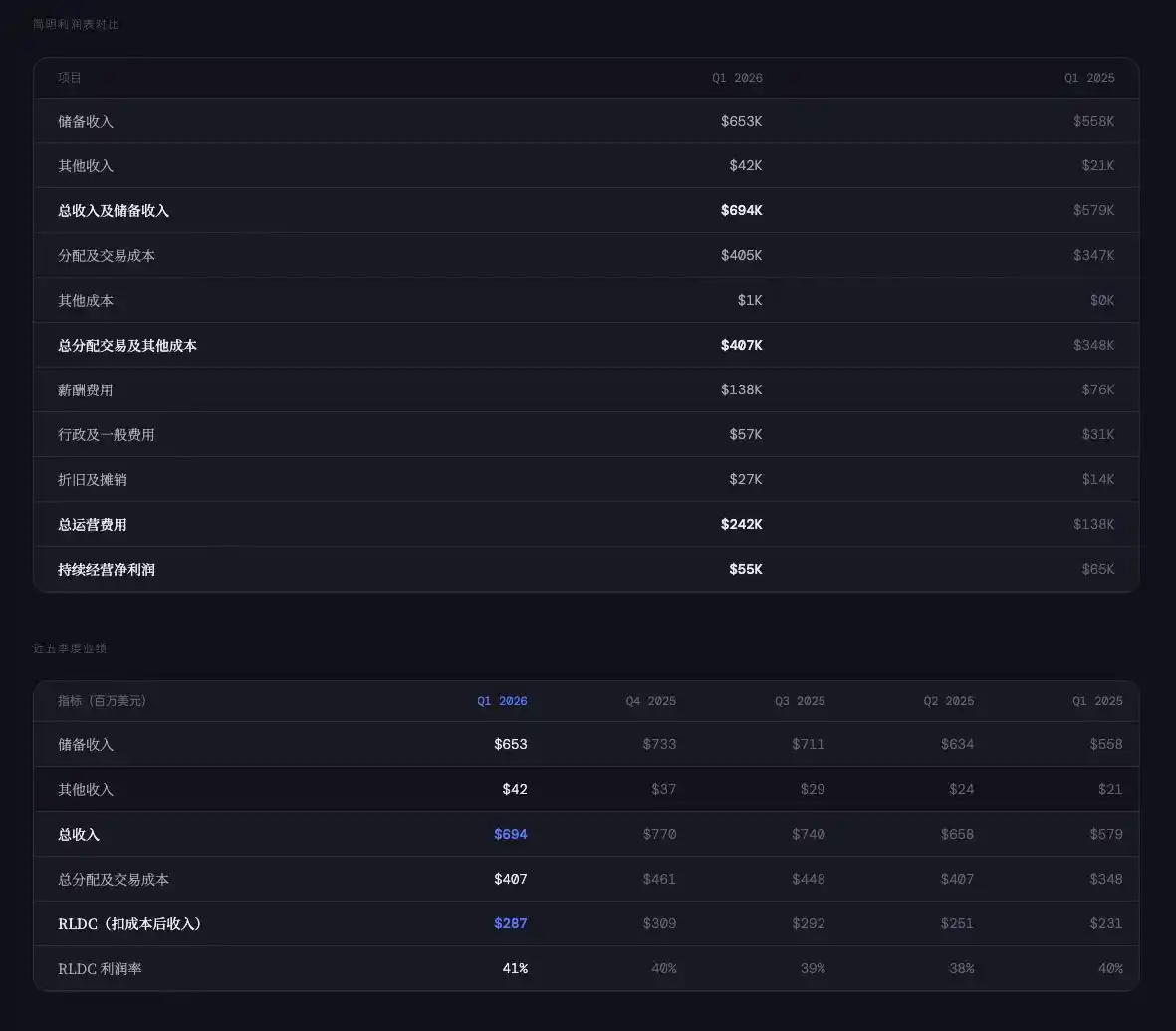
There's one more thing to consider. The distribution and transaction costs disclosed in the Q1 earnings were $407 million, a 17% year-on-year increase. The majority of this money flowed to Coinbase.
According to Circle's IPO prospectus, Coinbase takes 100% of its platform's USDC reserve revenue, plus a fixed percentage of all USDC reserve revenue. A rough estimate indicates that out of the $653 million in reserve revenue in Q1, approximately 60% was distributed back to Coinbase through the agreement. The net amount of reserve revenue that Circle truly retains in its own account is around $250 million to $270 million.
This is a fact that cannot be avoided in any discussion of Circle's financial structure.
When the market values Circle as the "stablecoin leader," it is effectively valuing a company that receives 60% of reserve revenue to be distributed to its largest channel partner. Allaire has very limited maneuvering room in this matter. Coinbase, as an early and key distributor of USDC, jointly launched the Centre Consortium in 2018. The agreement cost to Circle when it regained full control of USDC in 2023 was to permanently enshrine the distribution split in the contract.
As spreads tighten, distribution costs are rigid, and employee stock incentives drove a 76% increase in operating expenses in Q1. These three factors combined are the real reasons for the 15% year-on-year decline in Q1 net profit and the real reason Allaire must present something new to the market in this earnings report.
Arc's $30 Billion Valuation
Let's now look at the first ace up Circle's sleeve in this Q1 report, its new blockchain's native token, ARC.
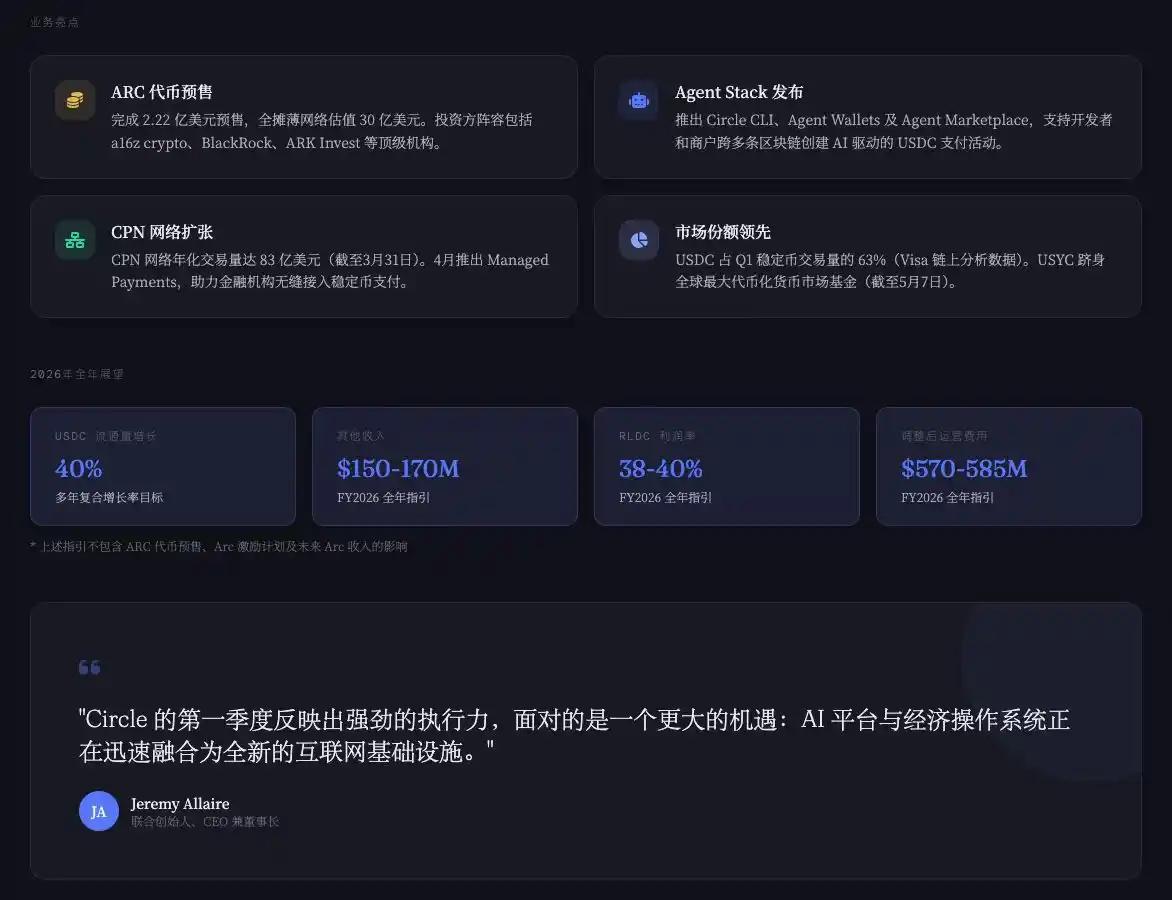
The ARC Token presale raised $222 million, valuing the project at a fully diluted $30 billion.
The number itself is not particularly large. After all, in the crypto market, similar-scale L1 network fundraises for 2024-2025 are not uncommon. What truly stands out is the impressive list of investors and buyers.
a16z crypto, Apollo Funds, ARK Invest, BlackRock, Bullish, General Catalyst, Haun Ventures, Intercontinental Exchange, IDG Capital, Janus Henderson Investors, Marshall Wace, SBI Group, Standard Chartered Ventures.
First, BlackRock is the manager of the USDC Reserve Fund. It oversees the batch of short-term U.S. Treasury bonds that back the USDC value. In the ARC Token presale, it transitioned from being the "asset-side service provider" to being a "network-layer token holder." This is the first time BlackRock has directly held ownership in this reserve system's network layer outside of the stablecoin reserve it manages.
Next, Intercontinental Exchange is the parent company of the New York Stock Exchange. Circle, the company, is listed on the NYSE. In a way, it is Circle's "landlord." It now holds Arc's tokens.
Furthermore, Standard Chartered Ventures is the strategic investment arm of Standard Chartered Bank. Standard Chartered is a top-ten global U.S. dollar clearing bank and one of the most important banking partners for USDC in Asia and the Middle East.
Additionally, Apollo Funds, Janus Henderson, and Marshall Wace are three traditional asset management and hedge funds with a combined AUM of over $1 trillion. a16z crypto, ARK, Haun Ventures, and Bullish are crypto-native capital. SBI Group is one of Japan's largest financial groups and Circle's issuing partner in Japan. IDG Capital is a well-established tech investment firm in Asia.
In essence, the uniqueness of this list lies in the fact that for the first time, TradFi asset management and clearing systems are substantively entering Circle's ecosystem at the token level. It's not equity, it's not debt, it's a network governance token. In the ARC Token whitepaper, Allaire positions this token as the "Steward Asset of the Arc Network," assuming responsibilities for governance, security staking, and network operation. From a financial structure perspective, it represents a claim on future cash flows of the Arc network independent of Circle company equity.
Circle, the company, had a market capitalization of approximately $28 billion on the day of the financial disclosure. The fully diluted valuation of the Arc network at the presale stage is $3 billion. The market is pricing the two business segments of the same company differently. Stocks correspond to past margin business, while tokens correspond to future network business.
To understand why Allaire has taken this step, we need to look back at the individual himself.
Allaire is a serial entrepreneur, 53 years old this year. In 1995, he co-founded Allaire Corporation with his brother J.J. Allaire, creating the ColdFusion web development platform. In 2001, the company was sold to Macromedia, where he served as CTO for three years. In 2004, he founded Brightcove, a company focused on enterprise video cloud services, and took it public in 2012. In 2013, he started Circle, with a focus on digital currency. In 2018, he co-founded the Centre Consortium with Coinbase, and in 2023, Circle took back full control of USDC.
The keyword for this resume is not "fast" but "slow." Every company Allaire has worked on has taken 7 to 10 years to develop. In an interview with Fortune, he mentioned that when he started Circle, he knew that "to realize this vision, changes need to happen at a global policy level. Changing the laws of several of the world's largest countries. This is not typically what an entrepreneur does, but I felt this is what I had to do." He has repeatedly stated on LinkedIn that Circle needs 10 to 20 years of infrastructure build-out to achieve its original vision.
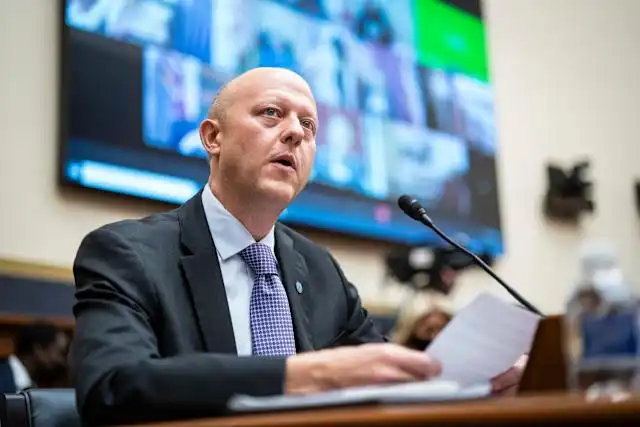
This is a specific management style. Allaire is not a CEO who habitually jumps into quarterly earnings reports. In a 2023 interview with Art of Leading, he mentioned that he leads with optimism and deep conviction, believing that "the best entrepreneurship comes from deep conviction because you will face extraordinary challenges." Circle's corporate culture is 100% remote work, characterized by "values-led" collaboration. He has testified multiple times in the U.S. Senate and serves as a senior advisor on financial technology to the IMF. In the 2026 TIME 100 list, he was jointly recognized with another figure from the crypto industry: Coinbase CEO Brian Armstrong.
This style has shaped the way Circle operates. It has never been a company focused on short-term growth. After the 2023 Silicon Valley Bank incident, USDC circulation was halved, dropping from $56 billion to $24 billion. Allaire did not use aggressive incentives to quickly boost circulation but instead spent two years on compliance, policy-making, and institutional client onboarding. By FY25, circulation returned to $75.3 billion, driven by a compliance narrative, the passage of the GENIUS Act, and endorsements of the USDC reserve system by BlackRock and NYDFS.
However, Allaire is also aware that this approach has its limitations during the interest rate cycle. Interest spread is passive income, and even with compliance, it cannot hedge against the Federal Reserve's policy direction. To shift Circle's valuation anchor from the "US Treasury interest rate" to somewhere else, there must be an independent network layer. This is the reason for Arc's existence.
Arc was not something Circle started thinking about in 2026. The Arc testnet was launched in Q4 2025, with over 100 participating institutions in the public testnet covering banking, capital markets, digital assets, payments, and technology. In the Q1 financial report, the Arc public testnet has completed over 166 million transactions, with nearly 100% uptime. The Circle Payments Network (CPN) annualized transaction volume has grown from $57 billion in Q4 to $83 billion in Q1.
The ARC Token presale is completed, serving as Allaire's first "network valuation" credential presented to the market. The implication is that Circle is not just a company earning interest spreads; it has its own chain.
Circle is Adapting AI
In the first section of the Q1 financial report, Allaire juxtaposes Arc and the Agent Stack. The former is the infrastructure, and the latter is the application layer narrative.
The Agent Stack consists of three components. Circle CLI, a command-line tool that allows developers to directly access Circle's wallet, smart contracts, and payment capabilities. Agent Wallets, wallet infrastructure for AI agents. Agent Marketplace, a marketplace for automatic settlement between agents and between agents and merchants. All three components are built on top of Circle's existing Gateway, Nanopayments, CCTP, and other infrastructure.
The financial report does not include revenue data for Agent Stack, indicating that these products are likely not fully launched yet.
It can be inferred that Allaire is betting on one thing: the rise of AI agent economies.
When AI agents need to pay each other, pay for computing power, pay for data, or pay for services, traditional credit cards and bank account systems are ineffective. AI agents have no IDs, no social security numbers, and banks will not let them open accounts. Stablecoins are the only payment medium that AI agents do not need to adapt KYC for in the AI agent era. This is a structural advantage exclusive to Circle.
But the other side of the gamble is time.
If the AI-driven economy doesn't scale by 2027, Circle's two main weapons (Arc + Agent Stack) won't have time to deliver, and the user base has already been diluted to below 3.5% due to the interest rate reduction cycle. In the meantime, what will Circle rely on to support its $28 billion market cap.
Meanwhile, there are things not clearly explained in the ARC Token whitepaper, including the mechanism for the distribution of interests between token holders and Circle company shareholders. If the Arc network really takes off, how will validator income, network fees, and app revenue be divided between these two types of shareholders. In the Q1 financial report, the management reiterated the existing full-year guidance but explicitly stated that it "does not include the impact of the ARC Token presale, Arc incentive plan, and Arc future revenue." This is a typical omission.
Allaire presents Arc as a story separate from Circle's company valuation, but he is not ready to tell the market how these two stories will eventually merge into one financial statement.
As for the remaining questions, we will patiently wait to see what kind of response Circle will provide.
Welcome to join the official BlockBeats community:
Telegram Subscription Group: https://t.me/theblockbeats
Telegram Discussion Group: https://t.me/BlockBeats_App
Official Twitter Account: https://twitter.com/BlockBeatsAsia
