In November last year, Justin Sun tweeted:
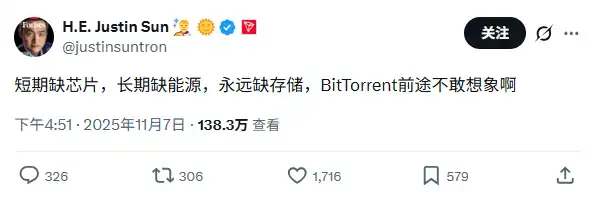
If we consider this sentence as an industry judgment rather than a catchy phrase, looking back, we will find:
These three pillars are almost the most realistic profit path in the AI market.
If someone had bought into US stock storage concept stocks after that tweet, what would be the result today?
· Micron: +214%
· Seagate: +180%
· Western Digital: +190%
· SanDisk: +552%
This article will dissect along these three pillars:
Why does AI first benefit chips, then force out energy bottlenecks, and finally sustainably boost storage demand? Which assets have already emerged in this structural cycle?
I. Chips: The First to Cash In on the AI Boom is Not a Narrative, But Orders
What caught fire first in AI was not the application layer, but the underlying computational power.
Whether it's training large models or everyday inference, agent invocation, multimodal processing, the first step is to get the computation running, and all these computations ultimately rely on GPUs, HBMs, high-speed interconnects, and advanced processes.
In other words, AI demand growth will not first trickle down to later stages, but will first manifest in a more direct reality:
More chips are needed, stronger chips are needed, and higher-bandwidth chips are needed.
That's why AI demand is first reflected in the chip sector.
Industry data has made this point very clear. Based on the fiscal year 2026, NVIDIA's revenue increased by 65% year-on-year, indicating that the demand for high-end computational chips is still steadily growing.
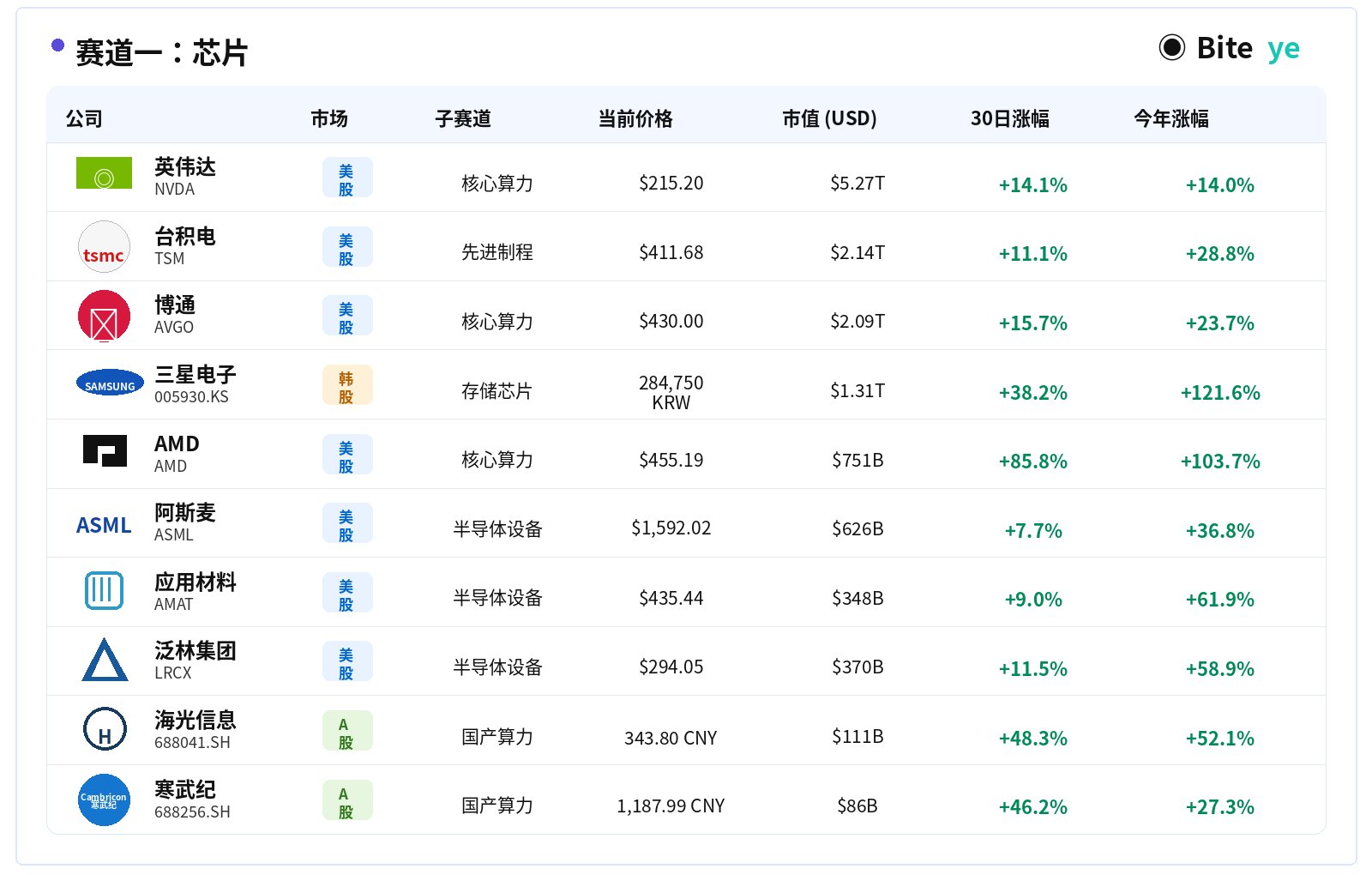
What assets are in this direction
Core Hash Rate Layer: NVIDIA (NVDA), AMD, Broadcom (AVGO), TSMC
Domestic Hash Rate Layer: Hygon (688041.SH), Cambricon (688256.SH), etc. Among them, Hygon is one of the domestic x86 server CPU representatives, with a 2024 revenue of 9.162 billion yuan, a year-on-year increase of 52.4%.
Semiconductor Equipment Layer: ASML, Applied Materials (AMAT), Lam Research Corporation (LRCX). The ADR price of ASML, the giant of lithography machines, hit a record high at the beginning of 2026, with a single-day increase of over 8% on January 2nd. Since the beginning of 2026, the price has risen by as much as 27%; Lam Research Corporation has risen by 30% since the beginning of the year; Applied Materials has risen by 28% since the beginning of the year. The stock prices of the three major semiconductor equipment giants have significantly outperformed the S&P 500 index.
Performance in the Past Year
The chip track was the first to start and has the largest increase in this wave of AI market. As the leader, NVIDIA has accumulated a growth rate of over 1000% since early 2023. The equipment end continued to hit new highs at the beginning of 2026, and the overall industry is still in a strong upward cycle.
Citi Group released a research report predicting that the global semiconductor equipment sector will usher in a "Phase 2 Bull Market Cycle," with ASML, Lam Research Corporation, and Applied Materials clearly leading the semiconductor stock trend in 2026.
II. Energy: After AI Expands, the Bottleneck Shifts from Chips to Electricity
No matter how many chips you have, they won't run without electricity.
Buying chips is just the beginning. To operate long-term large models, data centers, and inference services, continuous power supply is needed, in addition to bearing the extra heat dissipation and cooling load.
The power consumption of a traditional data center per cabinet is usually between 5 to 15 kilowatts, while AI data centers have significantly increased to 50 to 100 kilowatts, with power consumption and heat dissipation pressure being on a completely different level.
The IEA's analysis this year mentioned that data center electricity consumption will increase to around 945 TWh by 2030, nearly doubling from the current level, with AI being the main driving force. The US Department of Energy also explicitly stated that the increasing power demand of data centers is putting significant pressure on regional power grids.
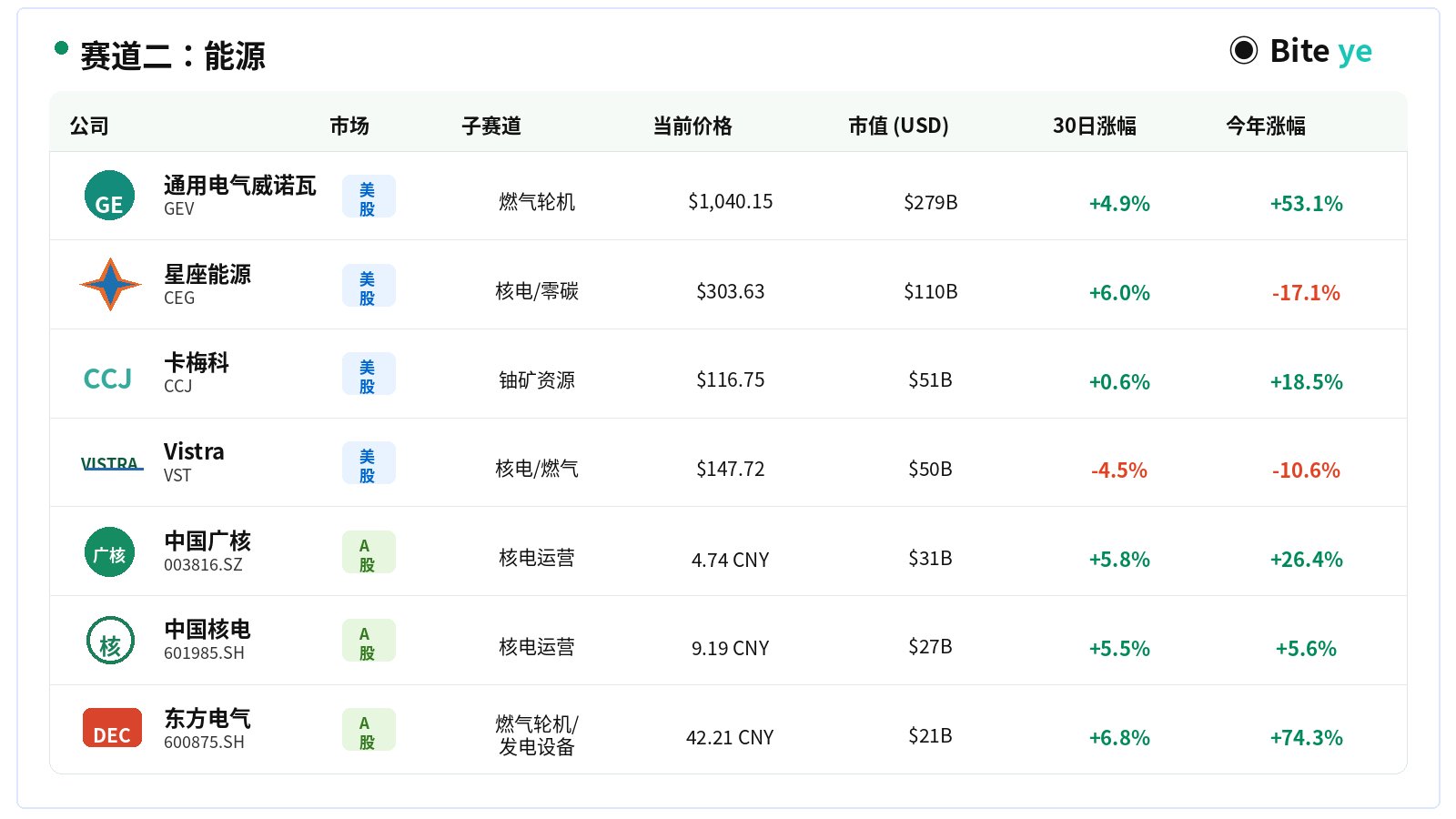
What Assets Are in This Direction
Gas Turbine: GE Vernova (GEV): Gas turbine orders are booming, with full-year orders reaching $59 billion in 2025 and backlog growing to $150 billion. Management has raised the 2026 revenue guidance to $44 billion to $45 billion.
Independent Power Producer: Constellation Energy (CEG): The largest zero-carbon electricity operator in the United States, signed a direct agreement for nuclear power assets with a tech giant for a long-term power purchase agreement;
Vistra (VST): With both nuclear and gas assets, the mid-point of the 2026 EBITDA guidance is about 30% higher than 2025
Uranium Resource: Cameco (CCJ): The world's largest publicly traded uranium miner, benefiting from the restart of nuclear power
One-Year Performance
GE Vernova's stock price has risen by 167% in the past year. The 52-week low was $408, and the peak reached $1,181, nearly doubling within the range.
Constellation Energy reached a record high in 2025, then retraced about 28% from the peak due to regulatory policy disruptions and is currently at a relatively low level.
Vistra remains strong overall, with long-term power supply contracts with data centers continuing to be implemented. The energy sector as a whole has repositioned from a traditional defensive position to pricing AI infrastructure as a core beneficiary.
3. Storage: The Most Easily Overlooked Direction, But Long-Term Beneficial
The core logic of bullish sentiment toward storage is simple: AI is not a one-time call; it is essentially a system that continuously processes, precipitates, and calls data.
Training requires reading a large amount of data, storing checkpoints during training, inference requires model calling and caching, while RAG and Agent constantly read knowledge bases, logs, and memories.
As a result, what AI brings is not just "more data" but:
· More frequent data read/write
· Real-time calls
· More complex management
· Increased pressure on migration and caching
Looking further, the more expensive GPUs, the less idle they can be, so the industry will pay more and more attention to how to deliver data to the computing power end faster and more stably.
In other words, as AI advances, storage is becoming more than just a "data warehouse," but rather the data foundation that ensures the entire AI system can operate smoothly.
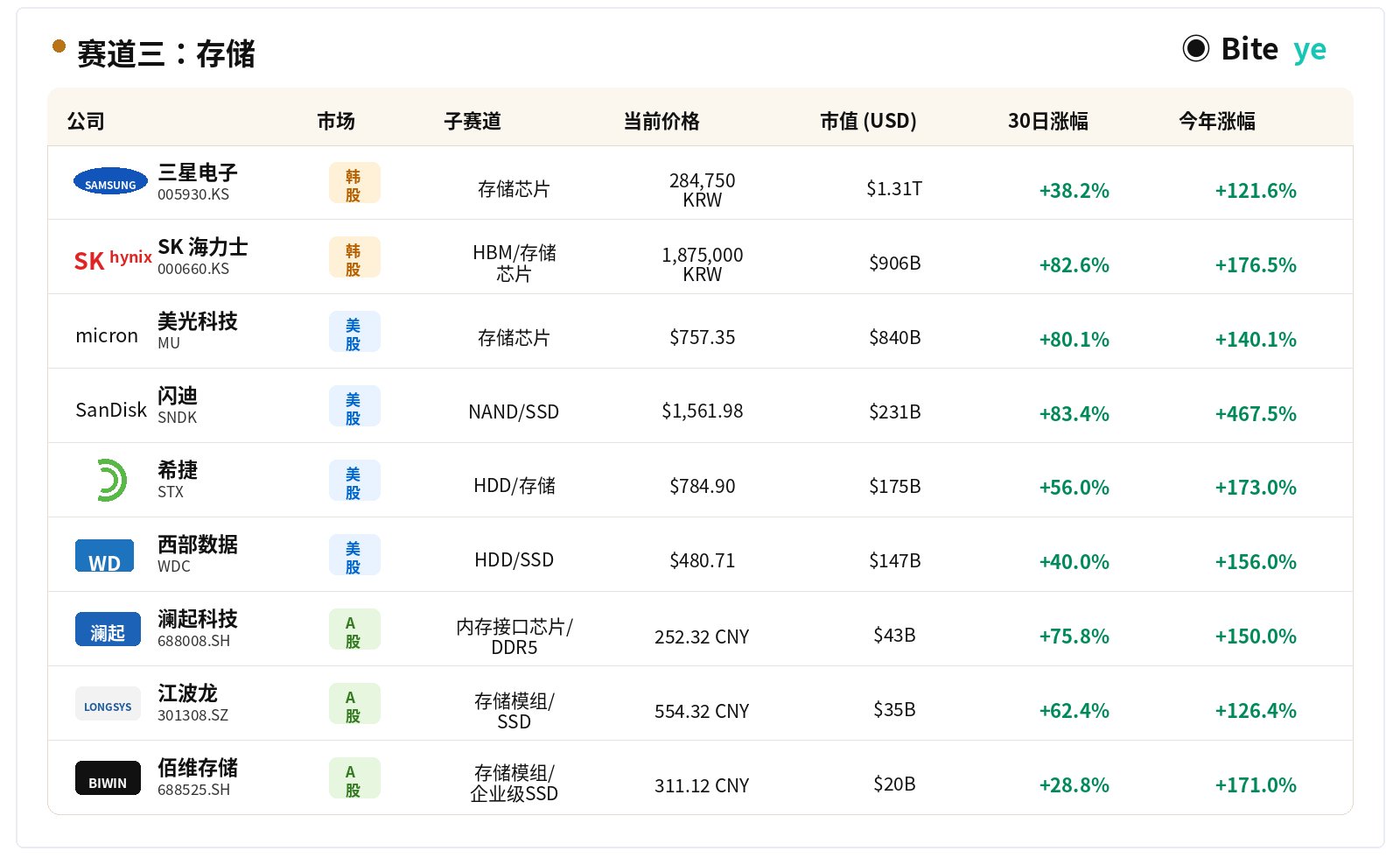
Key Players in This Direction
Storage Chip Manufacturers: SK Hynix (000660.KS), Samsung Electronics (005930.KS), Micron Technology (MU)
NAND / SSD / HDD Manufacturers: SanDisk (SNDK), Seagate Technology (STX), Western Digital (WDC)
Domestic Storage Design: Zhiyun Semiconductor, Phramongkutklao College of Medicine, Dongxin Technology, Beijing Junzheng, Lanqi Technology, as well as storage module manufacturers Delimly, Shannon MicroCo, and Jiangbolong.
Performance in the Past Year
Since 2026, the storage sector has been one of the strongest branches in the AI industry chain.
In the U.S. stock market, driven by AI infrastructure investment and high-capacity storage demand, Seagate, SanDisk, and Western Digital have all seen significant increases in the past year. Reuters mentioned at the end of April that Seagate and Western Digital have more than doubled since the beginning of the year, while SanDisk has seen an increase of around 350%.
Storage chip manufacturers have also shown strength, with Micron rising significantly this year. SK Hynix, benefiting from HBM shortages and major factory capacity expansion, reported a 198% year-on-year revenue growth in the first quarter, a 406% year-on-year operating profit growth, further strengthening its profitability.
Final Thoughts: Chips Come First, Energy Comes Next, Storage Comes Last
The first wave of AI realization is in the chips; the second wave bottleneck is in energy; the long-term beneficiary is in storage.
Having a sound rationale does not necessarily mean it's a good buying opportunity. Structural opportunities exist but are not about blindly chasing highs.
What's truly valuable is not the excitement itself but where you stand in the industry chain.
Welcome to join the official BlockBeats community:
Telegram Subscription Group: https://t.me/theblockbeats
Telegram Discussion Group: https://t.me/BlockBeats_App
Official Twitter Account: https://twitter.com/BlockBeatsAsia
