Lately, every time I open my phone, the group chat is mostly discussing these few things:
NVIDIA has hit a new high, the US stock market is also at a historic high; the memory sector has surged, with Micron more than quadrupling this year, and Intel experiencing its strongest weekly gain since 2008, even the A-share memory sector is taking off.
Group members are simultaneously discussing "What is the next investment target to get on board?" and "Is this a replay of the dot-com bubble at its peak?"
It sounds contradictory, but it's actually the same sentiment—fear of missing out and fear of a crash.
However, in reality, what we are discussing as "bubbles" right now may not even be the true bubble of this AI wave. Or more accurately, the most dangerous part of this AI bubble may not be visible when you open your trading account.
A few days ago, it was revealed that OpenAI arranged a stock sale for its employees in October last year. 75 people cashed out at the $30 million maximum limit, while the remaining 500+ employees took home an average of about $6 million each. The company originally intended to raise $6 billion, but due to too many external investors, it was temporarily increased to $10.3 billion. This round of funding valued OpenAI at $500 billion, more than three times its valuation six months ago.
This happened back in October last year, but most people only found out in May this year. If it weren't for the Wall Street Journal's report, many people might still be unaware. And in these seven-plus months, OpenAI's valuation has grown from $500 billion to $852 billion, another 70% increase.
The memory surge, NVIDIA's new high—these are all real, but they are not the most dangerous part of this AI bubble. The real bubble is increasingly happening where you can't see and can't buy.
This time, it's not that ordinary people didn't see the bubble. It's that by the time they saw the bubble, the most critical deals had already concluded.
The Valuation Has Soared, Yet You Might Not Even See It
Yesterday, OpenAI released a statement on its official website, stating that OpenAI's equity cannot be traded privately, and any transfer or pledge without written authorization is invalid. The announcement specifically prohibited several types of products: selling equity to investors through a shell company, turning equity into a cryptocurrency token and selling it on the chain, and committing to transfer the profits to the buyer using "forward contracts" after OpenAI goes public.
Comparing this to the dot-com bubble of 2000, the biggest difference is when the bubble burst, companies like Google, Amazon, Yahoo, and various .com companies were already listed, and retail investors could directly buy shares of these companies with P/E ratios of 100 times, 200 times in their brokerage accounts. The bubble formed in the public market and also collapsed in the public market.
OpenAI is now valued at $852 billion, up from $157 billion a year and a half ago. Anthropic is valued at nearly $900 billion, up from $615 billion a year ago, more than a tenfold increase. xAI, established just 3 years ago, is now valued at $2.5 trillion, while Databricks saw its valuation surge from $620 billion to $1.34 trillion in a year. However, these eye-popping numbers, growing faster than a rocket, did not originate from the public markets.
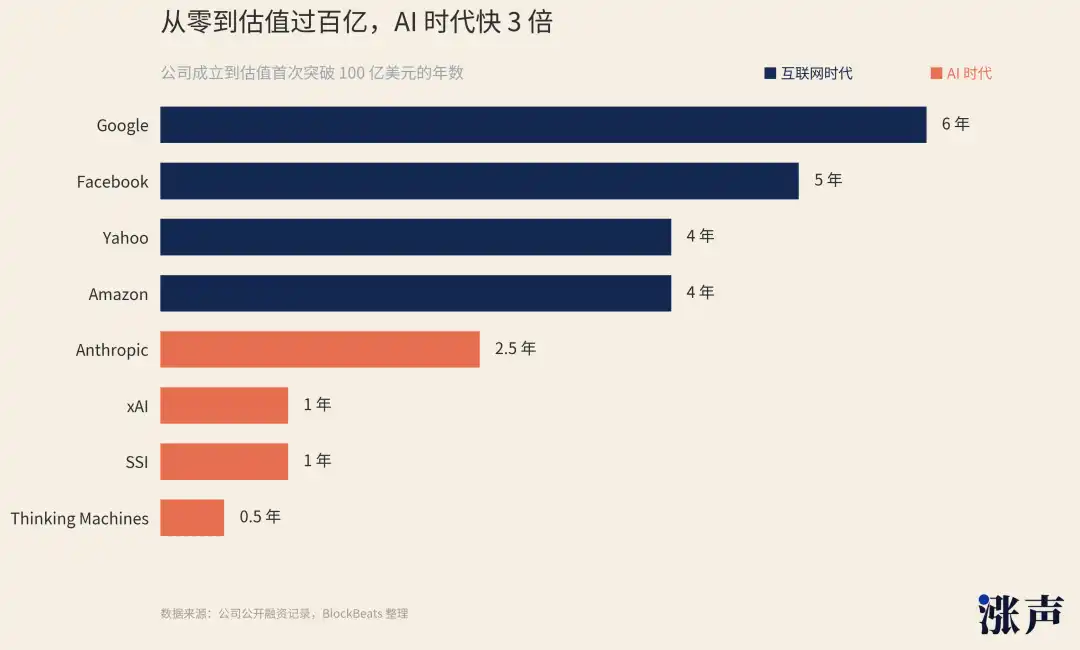
This AI bubble frenzy is happening in a space where the public cannot participate.
When anxiety can't find an entry point, it will look for alternatives. Recently, there were numerous media reports of Anthropic surpassing an eye-popping $1.2 trillion valuation, overtaking OpenAI. This figure came from a decentralized, pre-IPO platform, which packaged Anthropic's equity into tradable synthetic assets (the kind of trading expressly prohibited by OpenAI). However, this platform only has a trading volume of less than $1.4 million in a 24-hour period, with just over 300 participants.
Users are not buying actual Anthropic common stock but rather a type of "anxiety exposure." This $1.2 trillion is not Anthropic's true valuation but more like an eruption of AI anxiety at a liquidity breaking point. Silicon Valley bigwigs understand this anxiety all too well, to the extent that they even hope for greater anxiety, enabling them to sell more anxiety-inducing products.
Last month, Silicon Valley's most prominent investor, Naval, launched a "retail fund" called USVC, with the concept of allowing ordinary people to participate in investing in AI companies. The fund's portfolio includes shares of the most sought-after AI companies like OpenAI, Anthropic, and xAI, which even non-accredited investors can buy, starting at $500.
However, this is a closed-end registered fund, with shares not traded on the stock exchange, a quarterly redemption limit of 5%, and the board can decide not to redeem. Upon closer examination of the prospectus, you will find that the fund hopes investors "view shares as illiquid assets," and many on social media outright criticize it as a "sell-off fund."
The surge in the memory sector also follows a similar logic. Mag 7, especially Nvidia, has become too expensive, OpenAI and Anthropic are out of reach, but one can still invest along the AI industry chain: chips, memory, electricity, and even helium, copper, and silver.
What you see and discuss in the public markets actually resembles fund anxiety overflowing from the private markets.
Cashing Out Like Breathing, Exiting Before Even Waiting for an IPO
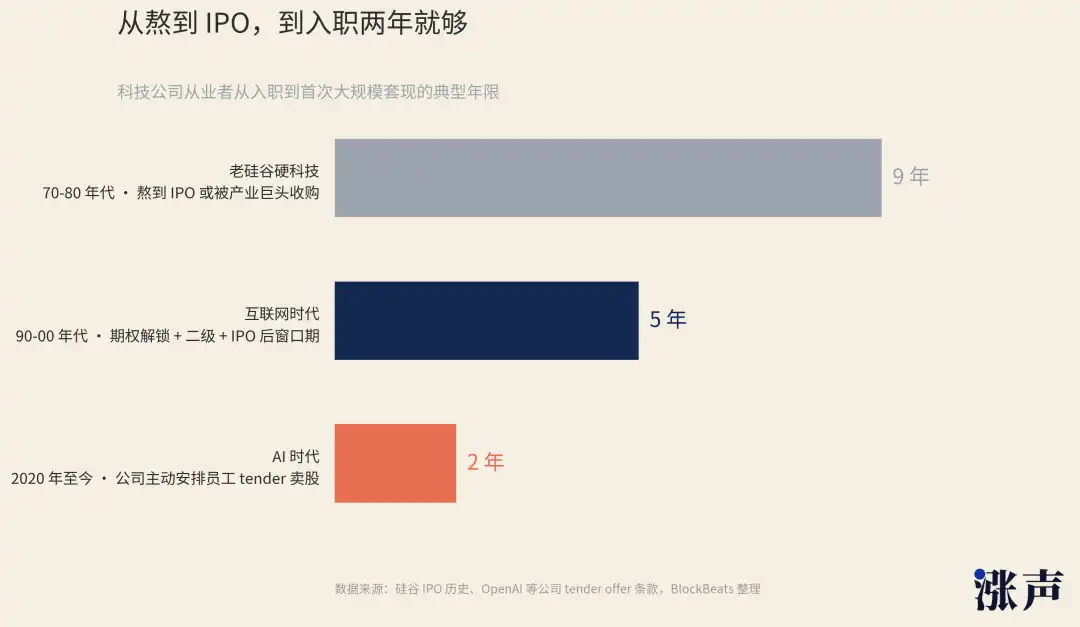
In the old Silicon Valley, employees had to wait 7 to 10 years to cash out, either enduring until an IPO or waiting for acquisition by an industry giant. After the Internet era, this cycle was compressed to around 5 years, with options unlocking, secondary market transfers, post-IPO lock-up periods, and wealth distribution starting to have multiple points, but IPOs still being the biggest one.
In the AI era, cashing out has been completely front-loaded to the pre-IPO stage.
This time, OpenAI set a selling threshold for employees at only two years. ChatGPT was released in November 2022, and then the influx of employees just happened to start unlocking their selling eligibility in the second half of 2024, coinciding with last October's $6.6 billion cash-out.
It's not just within OpenAI. The founders and core teams of AI companies are all using a new way to exit early, without needing to be acquired or IPO.
In 2024, Google acquired Character.AI, which, placed in the old Silicon Valley, would not have been a true acquisition. Google didn't buy the entire company; instead, they spent $3 billion to obtain the rights to use Character.AI's technology, of which $2.5 billion was used to distribute to existing Character.AI shareholders, with the remaining $500 million as a technology licensing fee.
In simple terms, it's technology licensing plus team migration; the company itself is still there, but the most valuable people and critical technology have already exited in a non-public transaction. The two co-founders of Character.AI hold over 30% of the company's shares, and just this deal alone could bring them nearly $1 billion.
Similarly, Microsoft acquired Inflection AI, spending $650 million to bring the technology over and then directly hiring the founders and core team. Amazon also used this method to acquire Adept AI.
The Federal Trade Commission (FTC) initiated an investigation into these types of transactions in early 2025, focusing on whether large companies are using this structure to circumvent merger reviews. However, the "acquisitions" mentioned earlier all took place in 2024, without regulatory scrutiny, and without needing to list names in a prospectus.
Looking at it from a primary market perspective, AI today doesn't even need to be compared to the dot-com bubble era because the hype has long surpassed it by several orders of magnitude.
For any AI startup, a funding round starts at tens of billions of dollars. Most importantly, the team and founders don't need to wait for an IPO to exit. The money from the private market is already substantial, and more of this money is going into the pockets of employees and founders, in increasingly discreet ways.
Prior to the employee stock sale by OpenAI in October last year, similar internal transactions had been conducted twice, as had large unicorns like Anthropic and Databricks. AI companies no longer need to wait for an IPO; they have a "liquidity window" every so often.
Founders also have their own channels. Silicon Valley is now witnessing a trend in "founder-led secondary" transactions, where entrepreneurs sell a portion of their equity without leaving the company. This way, they can benefit from the continued increase in company valuation while also getting cash upfront.
Alternatively, they can opt for equity-backed loans. There is a company called Pluto that specifically handles this, assisting AI founders and early investors in using their private shares as collateral to secure cash, with a loan-to-value ratio of 20% to 35%. This allows them to get cash without selling shares.
Early investors don't have to wait for a company IPO to provide liquidity to limited partners (LPs). They can establish a new fund with the original VC and sell the star assets from the old fund to the new fund. The old LPs can choose to cash out and leave or continue to hold with the new fund. This method is known as a "GP-led continuity fund," with the size of such transactions in the first half of 2025 nearly reaching $500 billion, double the amount from 2024.
Another indirect exit route is through starting a new venture. At least 7 unicorn companies have been founded by individuals who left OpenAI, such as Anthropic, Thinking Machines Lab, and SSI. With the original team leaving, regrouping, and securing new funding, each new venture triggers a fresh round of wealth distribution.
Each of the aforementioned exit methods bypasses regulatory scrutiny and the need to disclose valuations in an IPO prospectus. AI is the primary beneficiary of this trend because numerous high-quality AI assets are temporarily unable to conduct an IPO.
AI Infrastructure Resembles More of a Real Estate Bubble
Many people compare today's AI industry with the Internet in 2000; however, this comparison is somewhat inaccurate. The current AI bubble actually more closely resembles the real estate bubble of 2008.
During the 2008 subprime mortgage crisis, houses were real, rent was real, but house prices, mortgages, ratings, securitization—all of these were built on the same overly optimistic expectation. When Lehman collapsed, mortgage-backed securities became worthless.
Similar financialization is now happening in AI data centers, GPUs, and compute contracts, and on a much larger scale.
AI training and inference require data centers, which need land, power, water, cooling, network, and long-term customers. Therefore, data centers are no longer just tech companies' back-end machine rooms but assets contended for by real estate funds, private credit, and insurance funds.
Last year, Meta announced a partnership with Blue Owl to develop the Hyperion data center in Louisiana, with a total development cost of $27 billion, almost enough to build 30 Shanghai Center towers. Blue Owl's managed funds hold 80% of the project, with a significant portion of the funds raised through private bond issuance. Meta holds 20%, contributing the land and ongoing construction, and then signs a 4-year operational lease with the joint venture, plus a 16-year residual value guarantee. If the lease is not renewed upon expiration, Meta bears the loss based on the data center's value at that time.
Meta did not simply say, "I'm going to spend $27 billion to build a data center." Instead, it turned the data center into a joint venture, transformed capital expenditures into leases, converted residual value into guarantees, and then sold a portion of the project's debt to private bond investors. This logic is strikingly similar to the packaging of mortgages into financial derivatives in 2008.
CoreWeave is another example. In 2023, it completed a $2.3 billion debt financing using NVIDIA chips as collateral. In 2024, it signed another $7.5 billion debt financing round led by Blackstone. In 2026, it completed an $8.5 billion GPU collateralized financing, received an investment-grade rating of A3 from Moody's, marking the first-ever investment-grade-rated GPU collateralized financing.
And it's not just CoreWeave. This year, Lambda completed a $1 billion senior secured credit facility; Crusoe secured a $750 million credit facility from Brookfield, in addition to $11.6 billion for building OpenAI's Stargate compute factory, while Broadcom is reportedly in talks with Apollo and Blackstone for a $35 billion AI chip financing.
Each of these transactions is turning AI compute assets into financeable, securitizable credit products.
Regulators have already given a name to this phenomenon. In its 2026 report, the Bank for International Settlements referred to this structure as "shadow borrowing." Tech giants hold data center assets through joint ventures and SPVs, taking on debt in the form of long-term leases and guarantees, but this debt does not appear on the companies' balance sheets. They borrow money to buy GPUs to build data centers while waiting for GPU depreciation. Moreover, the borrowed money has a long term, while GPUs depreciate quickly.
The bubble risk on this road didn't need to wait for the AI wave to validate it. The recent private equity fund explosion was like a rehearsal.
In 2020, the private equity fund Vista Equity bought an online technology training SaaS company called Pluralsight for $3.5 billion. The creditors lending to it were all top players in private credit, including Blue Owl, Ares, Goldman Sachs, and BlackRock. By 2024, Pluralsight couldn't sustain itself anymore, and Vista had to "transfer" the entire company to the creditors, resulting in a $4 billion loss for itself and co-investors.
The reason it couldn't sustain was not "how much money the company is making now," but "how stable the company's future subscription renewal revenue will be." After AI changed the renewal logic of the software market, all "seemingly stable cash flows" needed to be reinterpreted. The moat of SaaS private credit suddenly turned from water to sand.
Blue Owl, which lent to Pluralsight, is one of the top players in the private credit field. Earlier this year, its private credit fund backed by OCIC faced a 40% retail investor run on redemptions due to AI disrupting SaaS. Nevertheless, Blue Owl continued to lend to AI data centers. In addition to Meta's data center mentioned just now, it is also a major blood supplier behind OpenAI's Stargate compute project.
The most dangerous aspect of private credit lies in its opaqueness, leading to widespread valuation distortions. The underlying assets of the fund are impossible for external investors to verify.
In August last year, HPS, Belad's private credit department, was defrauded of over $400 million by an Indian-origin telecom entrepreneur using forged invoices. HPS lent to several telecom companies owned by this entrepreneur, with the collateral being these companies' accounts receivable. It was only when an HPS employee noticed issues with the customer email addresses that the entire collateral was found to be non-existent.
Even top players of Belad's scale cannot see clearly whether the money they lent has real collateral. How much can the investors buying their fund shares know?
All this AI data center financing, GPU collateralized loans, and new SPV structures are built on one assumption: that the underlying assets are valuable.
But how fast do GPUs depreciate? Will the data center customer contracts be renewed? Will AI inference demand materialize to sustain this computing power? These questions, even the rating agencies evaluating the assets and the banks underwriting the funds, can only give judgments "based on existing information." What the average investor sees is just a prospectus, a rating report, a name.
The Real Bubble Doesn't Necessarily Quote You a Price First
Going back to the initial question, "What is the next target that we can get in on?"
Currently, what most people can get in on is actually the shadow cast by core assets. In the 2000 Internet bubble, the peak was in the public market, and the crash was also in the public market. You could see it, feel it, and read about it in the news that day.
This time, the most bubbly and most dangerous part happened where you couldn't see. By the time you see these, the most significant trades have already concluded.
Welcome to join the official BlockBeats community:
Telegram Subscription Group: https://t.me/theblockbeats
Telegram Discussion Group: https://t.me/BlockBeats_App
Official Twitter Account: https://twitter.com/BlockBeatsAsia
