On May 14, the U.S. Senate Banking Committee passed the "CLARITY Act" with 15 votes in favor and 9 votes against, sending the bill to the full Senate for a vote.
This moment had been a year in the making for the crypto industry. The House had already passed the bill with a bipartisan vote of 294-134 back on July 17, 2025. However, disputes over stablecoin provisions, DeFi exemptions, and ethical requirements in the Senate version caused repeated delays.
It wasn't until May 12 that the Senate Banking Committee released the latest 309-page draft of the bill.
This bill, referred to as a "game-changer" by the industry, aims to end the years-long regulatory tug-of-war between the SEC and CFTC by legally defining the jurisdictional boundaries of digital assets for the first time at the federal level. It not only provides clear rules for exchanges, brokers, and DeFi developers but also includes provisions for consumer protection, anti-money laundering, and anti-CBDC measures.
However, little-known is the fact that the CLARITY Act once caused a rare rift in the U.S. government and business alliance, facing joint opposition from the AFL-CIO. What does the CLARITY Act draft actually entail?
Key Contents of the 309-Page Draft
The Clarity Act, officially titled the Lummis-Gillibrand Responsible Financial Innovation Act of 2026, was introduced by French Hill (R-AR), chairman of the House Financial Services Committee, on May 29, 2025.
In June of the same year, the bill passed joint markups in the Financial Services Committee and the Agriculture Committee, culminating in a full House vote on July 17. The bill was officially named the "CLARITY Act of 2025" and included a section known as the "Anti-CBDC Surveillance State Act."
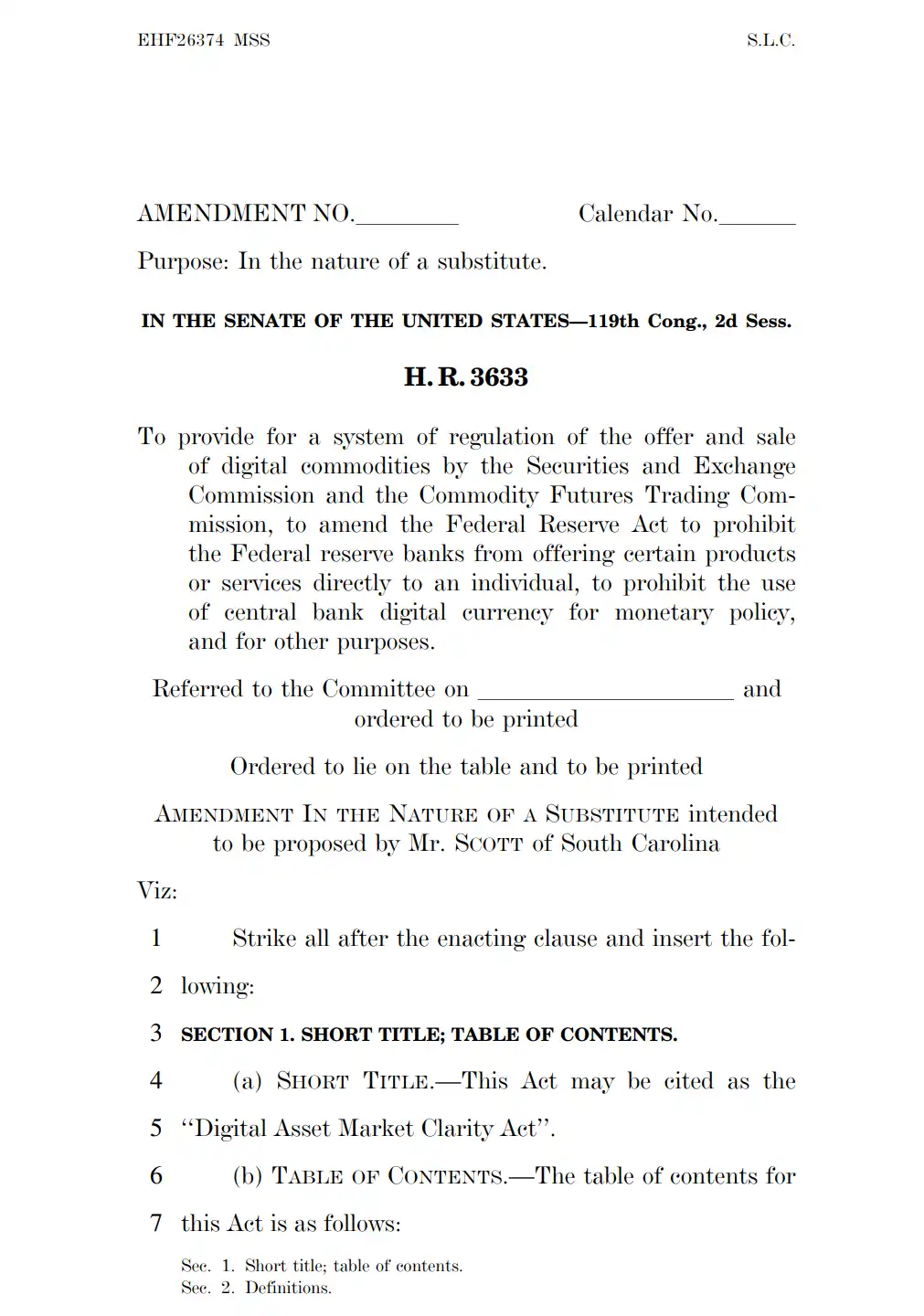
The draft, totaling 309 pages, consists of 9 main sections:
1. Securities Innovation, which sets out disclosure requirements and exemptions related to affiliate asset transactions, clarifies the characteristics of "network tokens," and deems them non-security assets under specific conditions.
2. Combatting Illegal Finance, brings digital assets under the purview of the Bank Secrecy Act (BSA) and sanctions regulations.
3. Regulation of the DeFi industry, establishing rules for existing securities intermediaries and BSA requirements applicable to decentralized finance protocols.
4. Banks and Regulation, clarifying the permissibility of banks engaging in digital asset activities. Prohibiting the payment of interest or yield on Payment Stablecoins.
5. Establishment of a CFTC-SEC Micro-Innovation Sandbox, international cooperation, automated compliance research, security tokenization, voluntary adoption of post-quantum cryptographic standards, etc.
6. Protecting Software Developers and Customer Assets, safeguarding software developers, NFT safe harbor, non-fungible token research, deterministic blockchain regulatory framework, Keep Your Coins Act (self-custody protection).
7. Protecting Customer Assets
8. Customer Protection
9. Other Matters
The core of the draft revolves around the regulatory boundaries of the SEC and CDTC, the treatment of tokens as non-securities (staking distribution, governance tokens), etc.
The draft first clarifies the boundary between "digital commodities" and "securities," thereby delineating the jurisdiction of the SEC and CFTC. According to the latest excerpted text, the CFTC will exclusively regulate "digital commodities" — native tokens of mature networks whose value is primarily derived from decentralized blockchain functionality; while the SEC retains jurisdiction over "investment contracts" and assets in the initial issuance stage. The draft introduces the "Mature Blockchain Test," which requires blockchain systems to meet conditions such as no single entity control, distributed ownership, and open-source, as exemplified by BTC and ETH.
Once certified, the relevant tokens will automatically be classified as non-securities, allowing issuers to exempt certain SEC registration requirements, but they must continue to make initial and semi-annual disclosures.
In simple terms: it transitions from "potentially a security in the early stages" to "a regular commodity once mature," significantly simplifying regulation and allowing for greater innovation.
Regarding intermediaries, digital commodity brokers, dealers, and trading platforms must register with the CFTC and fulfill obligations such as customer asset segregation, risk disclosure, and anti-money laundering (BSA) requirements. The bill specifically incorporates provisions of the "Blockchain Regulatory Clarity Act," providing clear exemptions for non-custodial DeFi protocols, node operators, and open-source developers — they are not required to register as money service businesses or brokers as long as the protocol is genuinely decentralized (decentralized governance itself does not constitute "control").
The stablecoin clause is the latest focus of compromise. The bill defines it as a "licensed payment stablecoin" (such as compliant payment stablecoins like USDC), excluding it from the digital commodity category. The new text prohibits covered digital asset service providers from paying passive, staking rewards or income to U.S. customers but allows for rewards based on actual activities or transactions.
On May 12, the new text included stablecoin reward-related restriction language, as well as the provisions of the Blockchain Regulatory Certainty Act, clarifying that non-custodial developers are not considered money transmitters. Coinbase, which had previously withdrawn support due to controversy over the stablecoin reward clause, has now switched to support, but banking industry groups still believe the restrictions are inadequate.
Furthermore, the bill explicitly prohibits the Fed from issuing or directly providing CBDC to individuals and requires federal agencies not to restrict the use of self-hosted wallets, while reinforcing bankruptcy isolation protection by treating digital commodities as "customer property."
These provisions are the result of extensive negotiations with regulatory agencies, law enforcement, financial institutions, innovators, and consumer advocates. The Senate version has expanded to nine titles, with a greater emphasis on anti-money laundering and consumer education than the House version.
End of Regulatory Ambiguity, Institutional Funds to Return to the U.S.
Over the past decade, U.S. crypto regulation has been in a "gray area." The SEC's "enforcement-led regulation," with lawsuits against platforms like Coinbase and Ripple, has long created uncertainty in the industry, leading to capital outflows and projects moving to places like Singapore and Dubai. The passage of the Clarity Act will, for the first time, provide a federal-level certainty framework.
For the market, this means that institutional investors and traditional finance can enter with more confidence. The CFTC's clear jurisdiction over the spot digital commodity market will drive more ETF product expansions, bank custody services, and payment innovations. According to estimates from supporters of the bill, clear rules are expected to attract institutional funds back to the U.S.
Michael Saylor stated that the deliberation of the "CLARITY Act" last night will unleash the next wave of digital capital, digital credit, and digital equity for the U.S. and the world, providing institutional validation for BTC.
a16z partner Chris Dixon and other crypto leaders have long called for the "path of clear rules," believing that the bill will allow the U.S. to continue to lead in innovation.
For users and developers in the crypto industry, DeFi developers will receive a "safe harbor," while ordinary users will benefit from mandatory disclosures, asset segregation, and anti-fraud provisions. The CFTC will gain new tools to combat market manipulation and illegal financial activities. At the same time, the bill retains regulatory jurisdiction over unfair deceptive practices and requires the publication of educational materials on digital asset fraud.
In terms of national competitiveness, Senate Banking Committee Chair Tim Scott explicitly stated: "This bill prioritizes consumers, combats illicit finance, suppresses crime and foreign adversaries, and keeps the financial future in America."
On May 8, Securities and Exchange Commission (SEC) Chair Paul Atkins, speaking at the "AI + Expo Special Competitive Research Project," expressed support for a limited innovation exemption path and called on Congress to pass the "CLARITY Act" to provide long-term certainty in legislative form. Atkins warned that overregulation or uncertainty could push innovation overseas, and the U.S. should continue to lead the global market through understanding and adaptation.
However, there are also opposing voices. According to Bloomberg, the American Federation of Labor-Congress of Industrial Organizations (AFL-CIO) on Tuesday sent a letter to senators opposing the "CLARITY Act." The union expressed deep concerns that the bill would result in a large influx of digital assets into pension plans, retirement accounts, and the broader financial system, putting working people at risk.
Controversies and Disagreements: Bank Lobbying, Democratic Party Resistance, and Industry Intrigues
Despite strong bipartisan support, the Clarity Act still faces multiple obstacles. The major point of contention lies in the stablecoin yield provision.
Let's first clarify the core concept: the so-called "licensed payment stablecoins" are those compliant stablecoins, such as USDC, that are 1:1 pegged to the U.S. dollar and primarily used for everyday payments and transfers.
The bill explicitly prohibits these stablecoins from offering users any interest or "savings account"-like passive income to prevent crypto platforms from capturing traditional bank deposit business. Any asset classified as a "Payment Stablecoin" must not generate interest as its core characteristic; otherwise, it will face significant compliance pressure.
The traditional banking industry has long been a staunch ally of the Republican Party, but this bill is seen as directly impinging on their core interests. Lobbying groups like the American Bankers Association (ABA) from traditional banks strongly oppose any form of "savings account" yield, believing it would erode the bank deposit base and lead to massive fund outflows.
They sent an urgent letter to all American bank CEOs at the beginning of this week, urging them to completely shut down loopholes that circumvent the GENIUS Act prohibition.
On the other hand, the crypto industry believes that excessive reward restrictions will severely stifle innovation and user incentives.
Coinbase CEO Brian Armstrong previously withdrew support in January 2026 due to similar provisions, causing a delay in the deliberation process. However, after the release of the latest compromise text in early May, he only publicly replied "Mark it up" (to advance the deliberation), indicating that the industry has accepted the compromise.
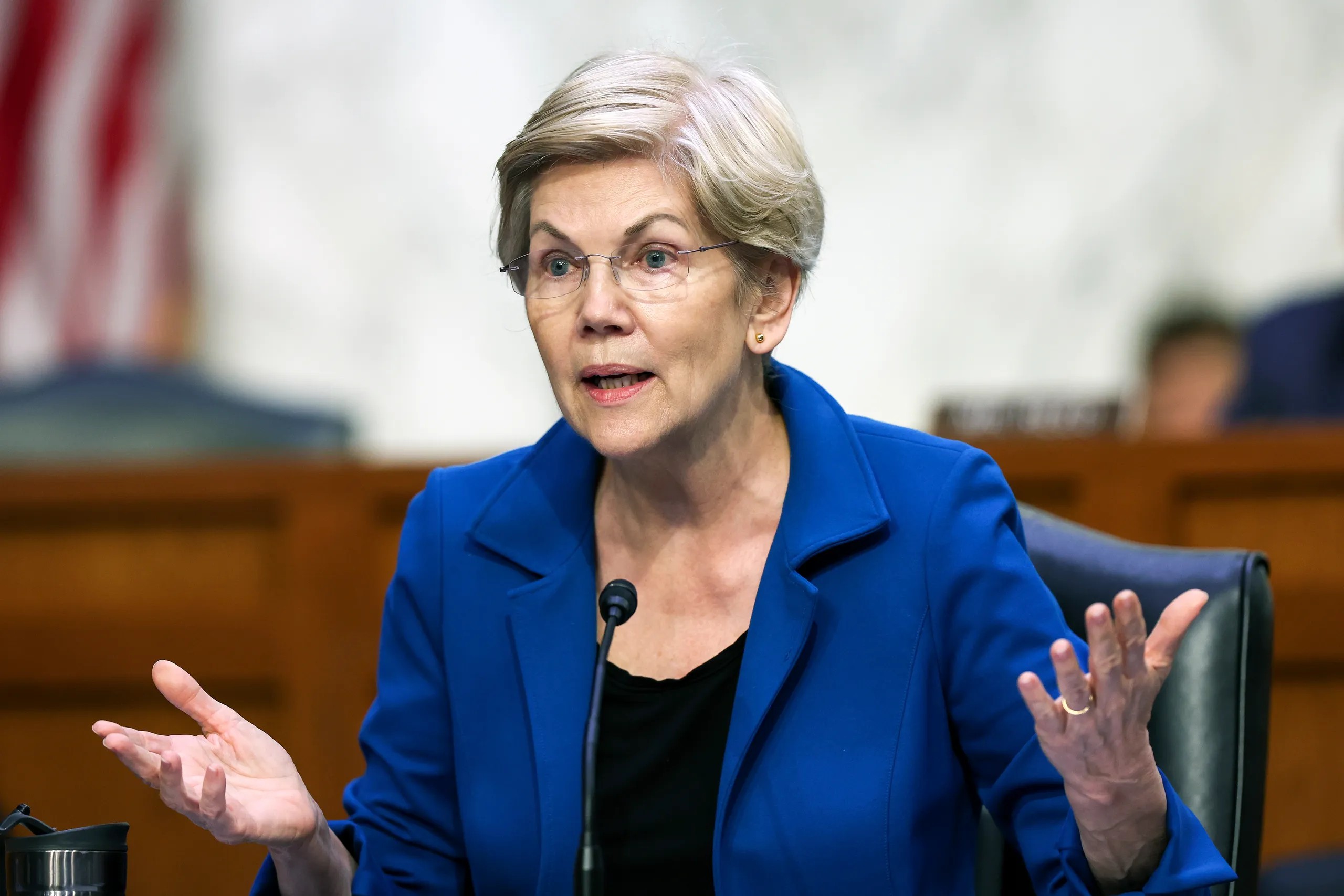
She had criticized the bill for "weakening securities laws" and "greenlighting Trump's corruption," pushing for 38 amendments to strengthen AML requirements, official coin holding disclosures, and to prevent public officials and their families from benefiting from crypto. Warren pointed out that the Trump family had profited through crypto transactions by at least hundreds of millions of dollars during his tenure, and without sufficient firewalls, the bill would jeopardize investor and national security.
The harsher political reality lies in the Senate's voting threshold: Currently, the Republicans hold about 53 seats in the Senate, Democrats 45 seats, and independents 2 seats (usually acting with the Democratic caucus). To end the debate and move to a final vote, a supermajority of 60 votes is needed. This means the bill must garner support from at least 5 Democratic senators who may "defect."
The banking lobby group seized on this key point, creating resistance by uniting some Democratic lawmakers — the stablecoin interest provision tug-of-war has been the biggest variable in advancing the bill so far.
There was also division within the industry. Some viewed the DeFi exemption as a money laundering risk, and the lobbying battle between banks and crypto has been intense. Senator Thom Tillis acknowledged that after months of tough negotiations with stakeholders, this is a bipartisan compromise.
After the Clarity Act is passed, it will be formally reported to the full Senate by the committee, entering the debate and voting stage (requiring 60 votes to end the debate). Once passed by vote, it will then need to reconcile with the House's 2025 version to unify the text, and after both houses vote again unanimously, it will be sent to the President for signing. Upon the President's signature, the SEC and CFTC will have 360 days to jointly establish detailed rules, and the core regulatory framework will be officially implemented.
Welcome to join the official BlockBeats community:
Telegram Subscription Group: https://t.me/theblockbeats
Telegram Discussion Group: https://t.me/BlockBeats_App
Official Twitter Account: https://twitter.com/BlockBeatsAsia
