Yesterday, Base officially launched the Base MCP. By connecting the Base Account to an AI Agent through Base MCP, users can interact with the Agent in plain language, similar to chatting, to perform operations such as swaps, transfers, position tracking, and query transaction history.
Those familiar with Base know that the current focus of Base on-chain is AI, so the update from Base is not surprising to players. Some players are even looking forward to new gameplay on the Base chain, similar to the AI meme coin $SHIT on Ethereum, where they can directly engage in IDO through Base MCP using a chat interface with the Agent.
However, if we take a step back from the on-chain degens and look at it from the perspective of Agent-to-Agent payments competition, perhaps there is a new answer to why AI has become the main theme of Base.
Rapid Development of Agent Payments
Let's rewind to September 2024. At that time, if you wanted an AI Agent to make a payment for a certain expense, humans basically had one option: using browser automation tools (such as Playwright, Selenium, or other headless browsers) to simulate human actions for the AI Agent to complete the checkout process on a webpage.
Because it was necessary to provide payment credentials (such as the full card number, CVV, expiration date of a credit/debit card) to the AI Agent, this single choice was not secure.
By May 2025, Coinbase introduced x402, providing an encrypted wallet for AI Agents and addressing this issue in a native encrypted manner. However, not only Coinbase recognized this as a potential market, and the solution was not only native encryption. In 2025, Google launched AP2, allowing users to grant spending permissions to Agents. Visa expanded its existing card payment channels, introducing Visa Intelligent Commerce. Instead of exposing sensitive credit card information like the card number and CVV to the Agent, it provides specific and restricted tokens for the Agent to complete the payment.
Today, x402 has processed over 176 million transactions from AI Agents, with a total transaction volume exceeding $70 million. While this amount may seem small, whether it's Coinbase or traditional giants, no one underestimates the competition in this emerging payment method:
- On January 22, 2026, Capital One, the sixth-largest bank in the U.S. with $470 billion in assets and $330 billion in deposits, announced the $5.15 billion acquisition of Brex, the third-largest credit card issuer in the U.S., to enhance its AI payment capabilities.
- In March 2026, Mastercard acquired the stablecoin infrastructure company BVNK for $1.8 billion.
- In February 2025, Stripe acquired the stablecoin payment platform Bridge for $1.1 billion.
While not explicitly stated, the acquisitions of stablecoin-related companies were to prepare for the upcoming Agent Payment era. However, stablecoins are indeed crucial for Agent Payments.
Why Are Stablecoins Essential for Agent Payments?
According to Keyrock data, the median transaction value of Agent transactions processed on x402 so far ranges from $0.01 to $0.10, with 76% of transaction values below $0.30.
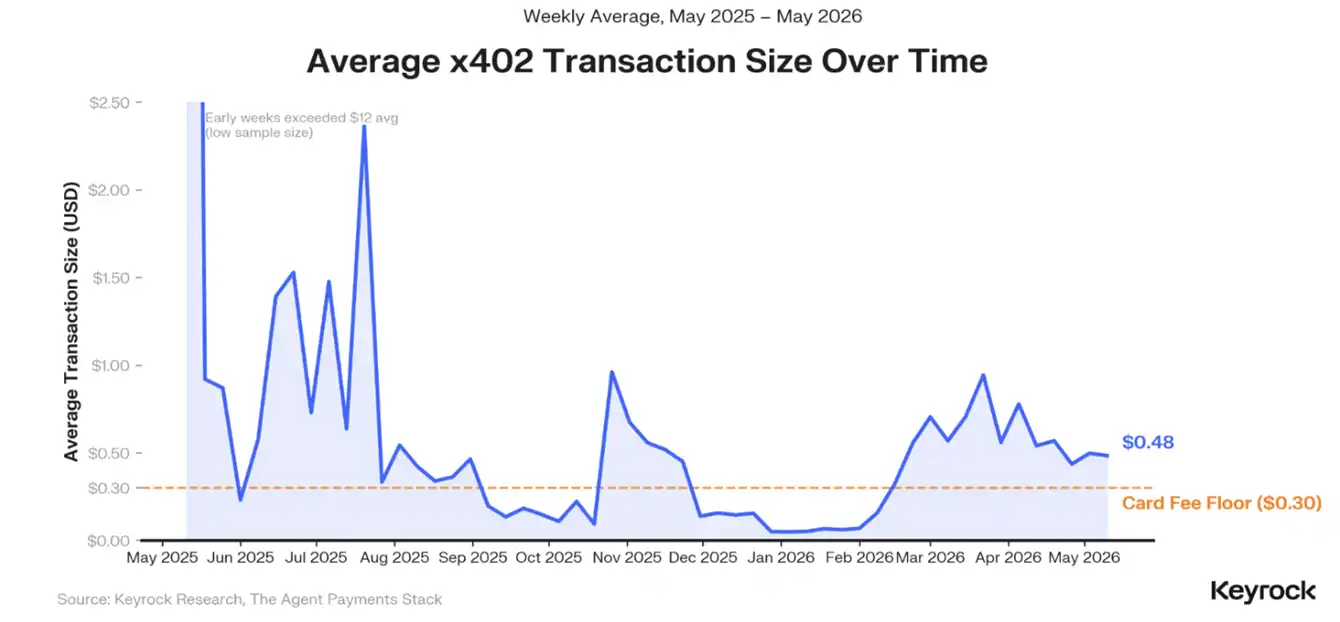
$0.30 is the most common fixed fee per transaction in the U.S. and most mainstream markets. This fee acts as a barrier, making microtransactions below $1 highly uneconomical. For example, a $0.03 API call incurring a $0.30 fee translates to a 10x call cost, making credit card payments by Agents prohibitively expensive.
Blockchain effectively addresses this challenge. On Base, transaction settlement costs are $0.0001. With this significant advantage, stablecoins have almost naturally excelled in Agent Payments, competing against traditional payment behemoths.
Out of 176 million Agent transactions processed on x402, 98.6% were settled in USDC. Given the close relationship between Coinbase and Circle, it can be said that Coinbase is also a major winner at the settlement layer.
However, the settlement layer is just one aspect of Agent Payments. In the race to solve Agent Payments through native crypto solutions, Coinbase faces a competitor—Stripe.
The Challenge from Stripe
In March of this year, Stripe introduced the Agent Payment Protocol MPP, which put Stripe on a par with Coinbase in the Agent payment architecture.
- From the settlement layer perspective, Coinbase has Base, while Stripe has Tempo
- From the wallet layer perspective, Coinbase has Agent Wallet, and Stripe has Privy
- From the routing layer perspective, Coinbase has built-in routing infrastructure, whereas Stripe has Bridge, acquired for $1.1 billion
- From the payment protocol perspective, Coinbase has x402, and Stripe has MPP
Now, let's revisit the Base MCP mentioned at the beginning of the article. Since both contenders have the above four layers of supporting infrastructure, the next area of contention will naturally be the application layer.
This is where AI can become the core reason for AI to become the mainline of Base—Base wants to ensure that AI (at least in the cryptocurrency AI field) occurs on Base. In fact, it is not to provide an angle for degen on the Base chain but to broaden the scope of Agent payments to enable more Agents to facilitate more transactions for more applications. This, in turn, ensures its leading position in the Agent payment race.
Once the dominance-level scale advantage is established, when Agent payments enter the commercial realm in the future, Coinbase will be even more victorious.
From this perspective, the launch of Base MCP can be seen as just a small step in Coinbase's vast ambitions.
Welcome to join the official BlockBeats community:
Telegram Subscription Group: https://t.me/theblockbeats
Telegram Discussion Group: https://t.me/BlockBeats_App
Official Twitter Account: https://twitter.com/BlockBeatsAsia
