Editor's Note: RWAs are moving from concept to the real market. According to a16z crypto's data, excluding stablecoins, the size of the tokenized asset market has surpassed $300 billion, currently around $340 billion. Compared to the size of less than $30 billion in mid-2024, this market has grown tenfold in less than two years.
This growth is mainly driven by U.S. Treasuries and gold. They are clearly priced, have a clear demand, and are easier to move onto the chain. For investors, tokenized treasuries can allow idle stablecoins to generate returns; for institutions, it means more efficient settlement, collateral circulation, and access to digital financial markets.
But what is truly worth noting in this article is not just that the RWA market has grown, but that it still has a long way to go to reach true "on-chain finance." Many tokenized assets today are essentially digital certificates of off-chain assets, mainly used for holding and transferring, and have not yet become financial modules that can be freely combined, called, and reused in DeFi.
This means that the next stage for RWAs is not just to tokenize more assets, but to truly integrate these assets into the on-chain financial system. The key question going forward is whether it will ultimately remain a digitized version of traditional finance or become part of a new generation of financial infrastructure.
The following is the original text:
The tokenized asset market—also known as Real World Assets (RWAs) by some—broke through $300 billion last month. Since then, the market size has consistently remained above that level, currently approaching $340 billion. (This does not include stablecoins.) This market is roughly equivalent to a regional bank or the endowment of a top university; it is large enough to have an impact but still very small relative to the global financial system.
Just in the mid-2024, the tokenized asset market was less than $30 billion. Growth then began to accelerate: the "GENIUS Act" brought a clearer regulatory framework for U.S. stablecoins; institutional-grade on-chain infrastructure gradually matured; and a batch of financial institutions almost simultaneously shifted from blockchain pilot projects to production-level systems. (Although stablecoins were not included in this article's statistics, they have facilitated the growth of the entire market by making on-chain payments and settlements easier.)
Under these changes, the tokenized asset market has grown 10x in less than two years.
Tokenization Takes Flight
The U.S. Treasury bond has been a key driver of the recent market growth.
The appeal is straightforward: investors can hold a familiar, income-generating asset in a faster, more flexible, and digitally native form; while institutions can benefit from enhanced settlement, collateral mobility, and integration with digital markets.
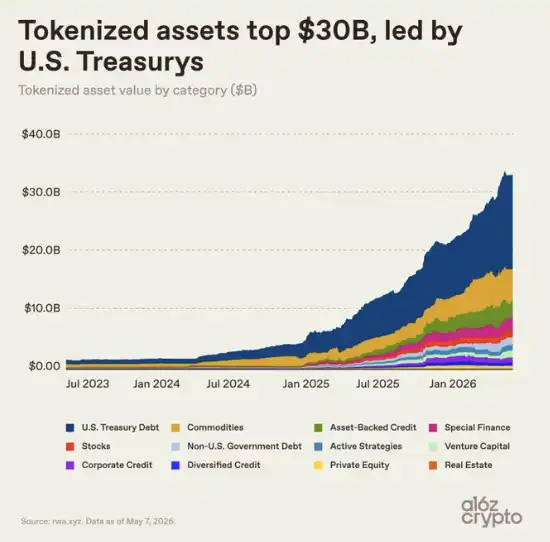
For crypto investors, tokenized U.S. Treasuries also offer a way to let idle stablecoins earn yield while tapping into traditional fiat market returns. BlackRock, Franklin Templeton, and an increasing number of asset managers are swiftly responding to this demand, establishing a market in the billions of dollars around this logic.
Different categories of tokenized assets have expanded at vastly different rates. This reflects both the complexity of bringing various asset classes on-chain and how quickly early products found market fit.
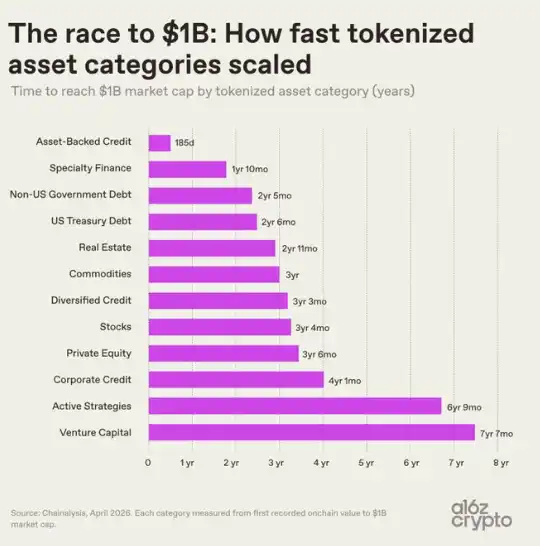
Asset-backed lending — including tokenized home equity lines of credit (HELOCs) and loan pool tokens — saw its market cap reach $1 billion just 185 days after its first on-chain activity, making it the fastest-growing category of all tokenized assets by a significant margin.
Specialty finance products — such as tokenized reinsurance contracts and Bitcoin mining bonds — were the second-fastest category, breaking the same threshold in under two years.
On the other end, venture capital-style assets took over seven years to reach $1 billion, while actively managed strategies took nearly as long, highlighting the greater complexity, longer cycles, and increased operational and regulatory overhead of these asset structures.
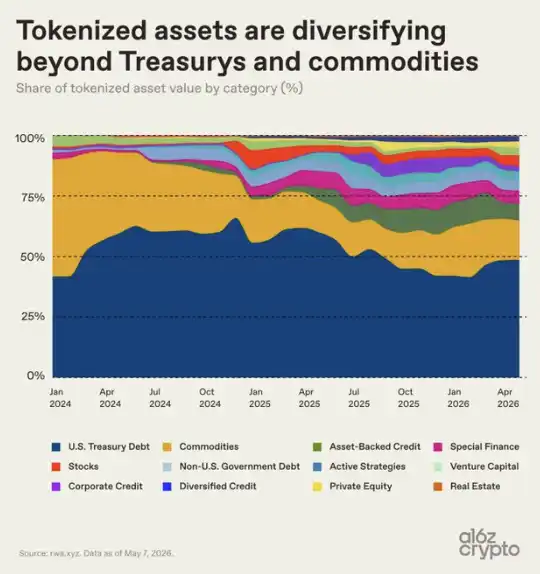
Growth in government debt and commodities was relatively swifter, taking around 2 to 3 years to hit $1 billion, and they gradually became the most dominant categories. By early 2024, these two asset classes nearly made up the entire tokenized asset market.
While the market share of other categories like asset-backed lending, specialty finance, equities, and actively managed strategies has steadily expanded since 2024, the overall market remains highly concentrated. Today, tokenized U.S. Treasuries and commodities together represent about two-thirds of the market.
Further Dissecting the Tokenized Asset Market
Commodity concentration is even higher within the asset class: Gold occupies almost the entire market, with about $5.1 billion out of a total size of approximately $5.1 billion coming from gold. In contrast, products related to silver and other commodities are almost negligible, with a total size of only $57.6 million, accounting for 0.01%.
Gold is naturally suited for tokenization: It has attributes of global standardization, is easy to store, does not perish, and has long been widely traded in paper form. Crypto investors have also long felt close to gold; even before the emergence of tokenized gold products, Bitcoin was already referred to as "digital gold." Products like Tether's XAUT and Paxos's PAXG have transferred a familiar ownership model to blockchain infrastructure: what used to be a certificate representing ownership of gold in a vault has now become a token held on-chain through a wallet.
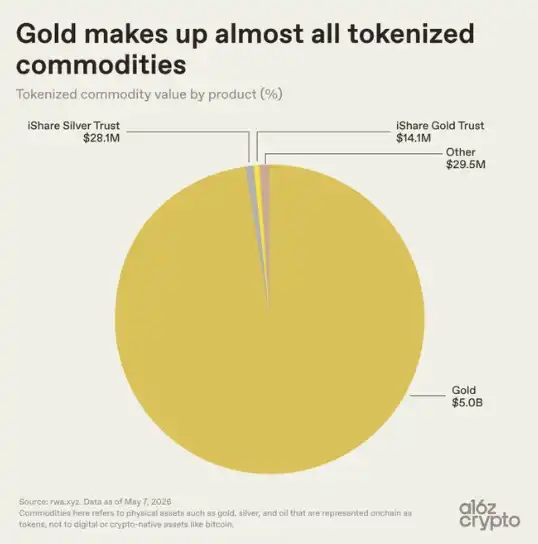
Tokenization of oil, agricultural products, as well as emerging categories such as energy, computing power, etc., still have very low market shares and are still in a very early stage. Currently, the tokenized commodity market is almost entirely a tokenized gold market.
As for the network that hosts the entire tokenized asset market, the landscape is more diverse. Ethereum still holds a dominant position, with just over half of the market share, reaching a size of $15.7 billion. This is consistent with its first-mover advantage in DeFi and institutional adoption.
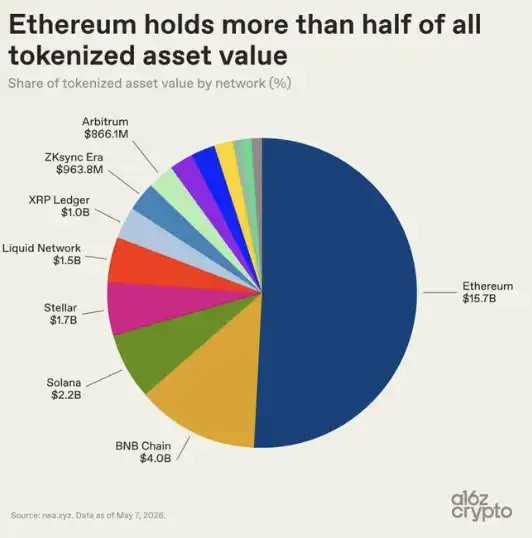
However, the rest of the tokenized asset market has shown a multi-chain pattern: BNB Chain holds $4 billion, Solana has $2.2 billion, Stellar has $1.7 billion, Liquid Network (Bitcoin sidechain) has $1.5 billion. XRP Ledger, ZKsync Era, and Arbitrum are each close to $1 billion.
Tokenized assets have not converged on a single public chain but have dispersed across multiple blockchain ecosystems based on factors such as cost, liquidity, compliance requirements, and market access relationships.
However, the most inspiring data is not how large the tokenized asset market is, but how these assets are being utilized.
Most Tokenized Assets Are Not Truly "Composable" Yet
Bonds are currently the largest category of tokenized assets, with a market value of $15.2 billion. However, only about 5% of the supply, approximately $800 million, is deployed in DeFi protocols.
The utilization of precious metals is also very low. Most of these assets are simply held on-chain rather than being used as composable financial building blocks that can be further extended, restructured, or made to interoperate with other assets and protocols.
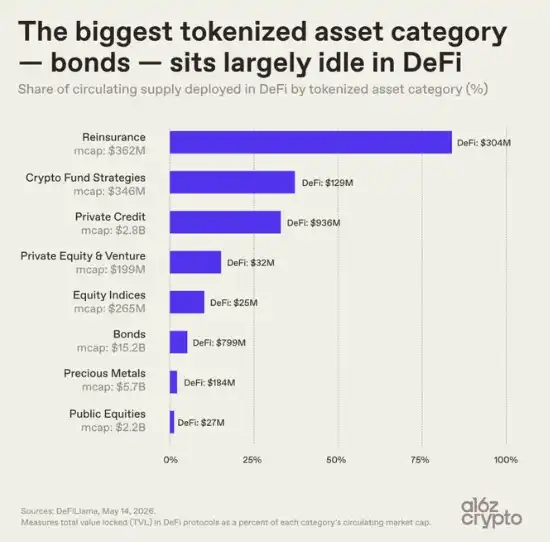
A different scenario is presented by smaller asset categories. The market capitalization of reinsurance tokens is only $362 million, but 84% of their supply is deployed in DeFi; a similar ratio of 33% is seen in private credit.
This data is not surprising: the category with the highest DeFi utilization was designed for on-chain composability from the start, as seen in protocols like Nexus Mutual and Maple Finance. In contrast, the largest tokenized asset categories—U.S. Treasury bonds and gold—were initially aimed at making familiar assets easier to hold and transfer on-chain rather than fundamentally altering how they operate.
This difference points to a larger divide within the tokenized asset market: not all tokenized assets possess the same level of "on-chain-ness."
Some assets can freely move around and be used in various on-chain applications, while others primarily treat the blockchain as a record-keeping infrastructure with limited transferability and composability. (For example, RWA.xyz makes a distinction between "distributed assets" and "representational assets.")
Many things referred to as "tokenized" today are actually closer to being digitized: simply moving a record onto the blockchain without truly unlocking composability. This is crucial because composability is a core value proposition of on-chain financial systems and could make them significantly more powerful.
Other attempts to measure the "on-chain-ness" have led to similar conclusions. Pantera Capital's "Token Existence Index" scores tokenized assets based on their native on-chain attributes, revealing that over three-quarters of assets are at the lowest level. In practice, many tokenized assets function more as digital receipts representing a claim on some off-chain asset, which is still predominantly managed by off-chain ledgers and intermediaries.
This divide—between assets that are "ported" to the chain in a "mimetic" way as digital records versus assets that truly harness the unique attributes of blockchain technology and are natively on-chain—is one of the clearest signals of the market still being in its early stages.
The infrastructure for composability already exists, and the assets are there. But deeper integration is only just beginning.
Where Are Tokenized Assets Heading?
Looking to the future, different institutions have widely varying forecasts for the scale of tokenized assets, but the direction is highly consistent: they all point to expansion.
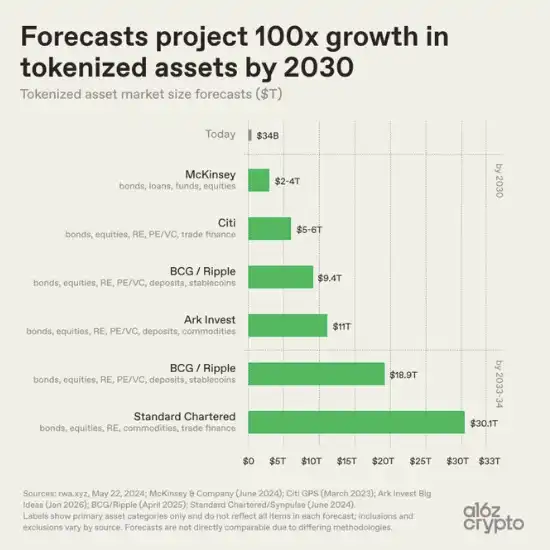
McKinsey's base case scenario envisions this market reaching $20 trillion to $40 trillion by 2030. Ark Invest forecasts $11 trillion. BCG and Ripple expect the market size to reach $9.4 trillion by 2030 and rise to $18.9 trillion by 2033. Standard Chartered Bank, on the other hand, predicts that this market will exceed $30 trillion by 2034.
Almost all major forecasts suggest a nearly 100-fold growth compared to today's market size of around $300 billion. Their differences mainly lie in the scope of statistics.
The gap between $20 trillion and $30 trillion is less about differing judgments on adoption speed and more about different definitions. Different institutions measure different content: which asset categories should be included, whether stablecoins and deposits should be counted, how broad the definition of tokenization should be, and so on. McKinsey primarily focuses on bonds, loans, funds, and equities. Standard Chartered Bank includes commodities and trade finance. BCG and Ripple include deposits and stablecoins in addition to more traditional asset classes.
Despite methodological differences, the overall direction behind all forecasts is consistent: asset tokenization is expected to far exceed today's market size.
Relative to the size of the global financial system, today's tokenized asset market is still just a tiny dot. The global bond market exceeds $140 trillion; tokenized bonds account for about $15 billion, representing only about 0.01%. The total value of above-ground gold is calculated in the tens of trillions of dollars; tokenized gold is about $5 billion, accounting for less than 0.02%. The global stock market is worth well over $100 trillion; tokenized stocks account for about $15 billion, representing only about 0.001% of the underlying market.
But a nascent market has already begun to take shape. The earliest successful categories are often the assets that are easiest to move onto the blockchain: U.S. Treasuries, gold, private credit, and other assets with clear pricing, existing demand, and relatively simple ownership structures.
In most cases, tokenization has not reinvented these underlying assets. What it changes is the way these assets circulate and settle, while just beginning to make them more directly connected to digital financial infrastructure. The current tokenized asset market is still largely more digitalized than truly on-chain composability. Many assets exist on blockchain infrastructure but have not yet become truly programmable financial building blocks.
The next, more challenging task is to move the more complex parts of the financial system onto the blockchain and to enable deeper integration of tokenized assets into composable, internet-native financial infrastructure.
Acknowledgement: Special thanks to Ryan Holloway for his valuable input, including the concept for the third chart.
Welcome to join the official BlockBeats community:
Telegram Subscription Group: https://t.me/theblockbeats
Telegram Discussion Group: https://t.me/BlockBeats_App
Official Twitter Account: https://twitter.com/BlockBeatsAsia
