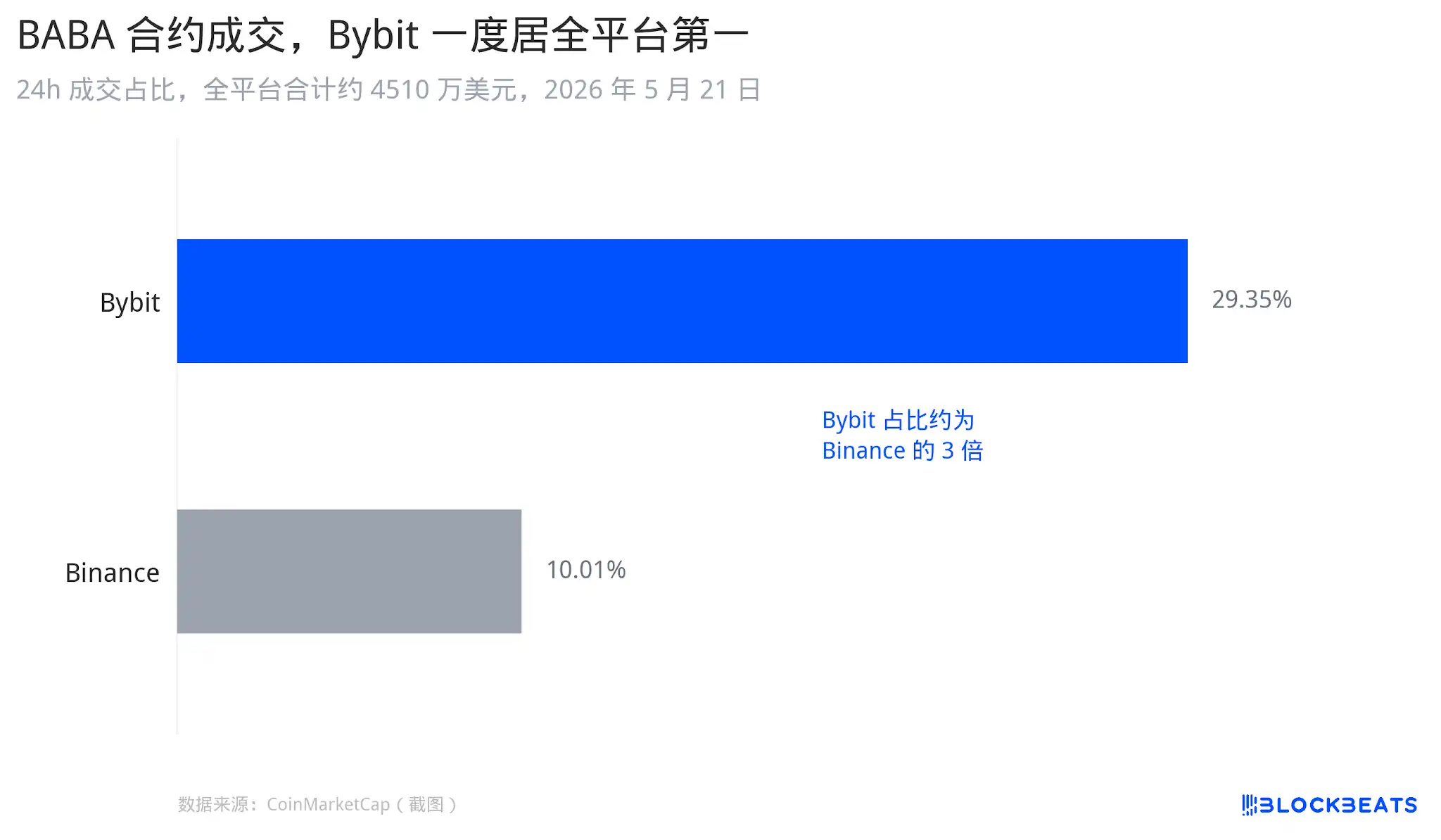
On May 21, a screenshot from the BABA derivatives market brought the changes happening in the crypto trading platform to the forefront. That day, Bybit's BABA/USDT perpetual contract trading market share reached as high as 29.35%, ranking first among mainstream platforms.
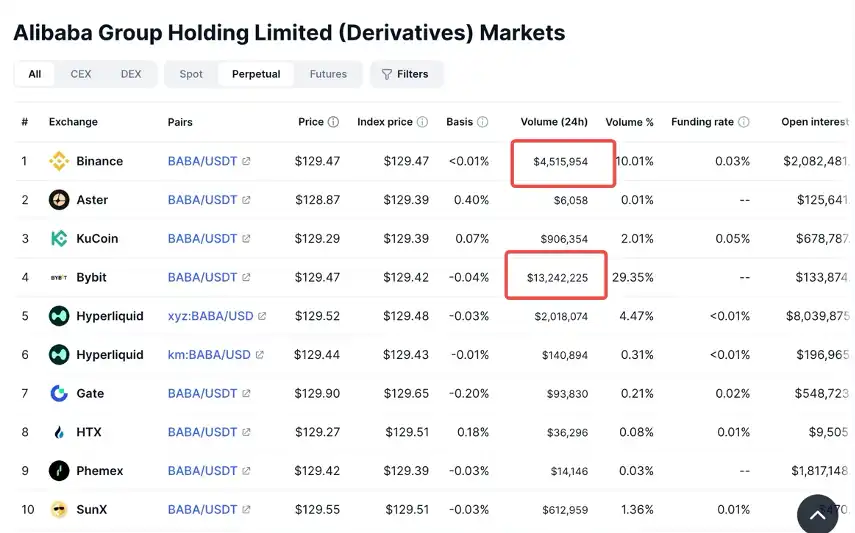
According to third-party platform data, the BABA/USDT perpetual contract across all platforms had a 24-hour trading volume of approximately $45.1 million that day, with Bybit accounting for nearly one-third, exceeding $13 million.
This is a very typical depiction of the industry's current situation.
The crypto-native trading market has entered a stock game involving BTC, ETH, altcoins, contract depth, and listing speed. Dimensions that used to differentiate trading platforms are becoming increasingly crowded. For trading platforms, the most apparent incremental entry now comes from traditional financial assets such as stocks, ETFs, gold, and crude oil.
This is also why almost all top platforms are rushing toward TradFi. The information flow has been flowing 24/7 for a long time, but the traditional financial market still has fixed opening hours. Financial reports, regulations, macro data, AI industry news, and geopolitical events do not wait for the U.S. stock market to open. What crypto trading platforms excel at, namely USDT pricing, leverage, long and short positions, unified accounts, and round-the-clock trading, align with this. When traditional assets enter this system, the time difference that used to be just a "waiting for the market to open" window becomes a new trading opportunity.
But why did BABA/USDT see this surge in volume on Bybit? What does this surge imply? With these questions in mind, BlockBeats and Bybit's Derivatives Operations Director, Max Xu, had a discussion.
Where Did Bybit's TradFi Volume Come From?
In any business model, timing is the most critical factor.
Trading products are no different. Whether an underlying asset can be traded depends not only on its popularity but also on the moment it is presented to users, whether the market has sufficient disagreements and impulses. For stocks, the most natural trading window is during the financial report release. The financial report itself is the most information-dense, expectation-confused, and frequently traded period. Price movements are just the result; what truly drives volume is uncertainty.
In mid-May, Bybit launched the BABAUSDT perpetual contract, while Alibaba released its quarterly earnings during the same financial reporting window. Over the following days, the market continued to digest the earnings performance, macro environment, Chinese concept stock sentiment, and company investment pace. By May 21, the trading volume of BABAUSDT surged on Bybit.
“We have recently introduced many traditional financial products and stock-related contract trading pairs because we have seen the liquidity flowing in the futures market,” said Max Xu. On May 21, Bybit’s market share of BABAUSDT contract trading once took the top spot, with a total platform-wide trading volume of approximately $45.1 million within 24 hours, accounting for 29.35% on Bybit, ranking first among major trading platforms.
The quarterly earnings report released on May 13 and the macro environment at that time together brewed this wave of stock price volatility. For the futures trading market, whether up or down, volatility means opportunity, and trading activity naturally surged.
“But I don’t think this surge in trading volume is because cryptocurrency users suddenly turned bullish or bearish on Alibaba. More accurately, it is that cryptocurrency trading platforms have provided a new venue for stock product traders. This is the first time many investors can easily and conveniently trade real-time macro events.”
In Max Xu’s view, BABA is a mega-cap stock among Chinese concept stocks, and international news, company disclosures released during off-hours, or regulatory trends could cause 5% to 10% price swings in such large-cap stocks within a single off-market cycle. “Therefore, when global traders see the news and realize they can achieve 24/7 trading via contracts on Bybit, liquidity will naturally be boosted.”
The same logic also applied to NVIDIA.
On May 20, before NVIDIA’s earnings report was released, the market had already focused on Blackwell chip shipments, AI demand sustainability, and future performance guidance. NVIDIA is now not just a tech stock; it is almost a common anchor point for the AI industry chain, Nasdaq risk appetite, and global capital market sentiment. Before and after the earnings report, it was already the most crowded time for trading.
At this juncture, Bybit provided three entry points: TradFi stock CFDs, NVIDIA perpetual contracts, and NVDAX tokenized stocks. One is traditional stock price difference trading, one is USDT perpetual familiar to cryptocurrency users, and one is tokenized stock spot with a 1:1 peg to real US stocks.
So what Bybit is doing is not simply listing popular stocks. Instead, it's more like organizing products around an events calendar: the Alibaba earnings window corresponds to BABA, the NVIDIA earnings window corresponds to NVIDIA.
Asset selection is one part, and timing selection is another. For a trading platform, earnings seasons, AI narratives, macro data, and regulatory events can all be transformed into liquidity entries.
Industry First, Bybit's TradFi Layout
Looking back from the NVIDIA case, Bybit's TradFi layout is not a single-product point, but a product matrix.
The first layer is the CFD products within Bybit TradFi. It is closer to traditional stock CFD trading, suitable for those who want to trade the price changes of US stocks, commodities, stock indices, and forex but are not necessarily involved in on-chain asset logic. As early as 2024, Bybit was the first to launch a traditional asset CFD approach among major exchanges and integrated it into Bybit TradFi last June. According to the Bybit official Help Center, Bybit TradFi supports over 400 trading pairs, covering assets such as metals, stocks, indices, forex, and commodities; in the stock CFD section, users do not hold the underlying stocks but instead trade the price changes through contracts, supporting up to 5x leverage, and using USDT as the funding gateway. After funds are transferred to the TradFi account, they will be displayed in USDx, an internal accounting unit, maintaining a 1:1 conversion with USDT.
The second layer is TradFi perpetual contracts. It is closer to the trading style familiar to crypto users: USDT pricing, USDT settlement, long and short positions, margin, leverage, and 24/7 trading. Starting from April 21, 2026, Bybit began to launch the first batch of 20 US stock perpetual contracts, including GOOGL, NVDA, ORCL, and MSTR, and then expanded on a weekly basis. According to information released by Bybit on May 8, at that time, TradFi perpetual contracts already covered over 20 US stocks, 3 commodities (gold, silver, crude oil), and 3 global ETFs. Different targets have different leverage ratios; for example, BABAUSDT and NVDAUSDT have a maximum of 10x, while SPYUSDT has a maximum of 20x; the SpaceX Pre-IPO perpetual SPCXUSDT, launched on May 21, also offers up to 10x leverage.
The third layer is xStocks tokenized stocks. For example, products like NVDAX are closer to RWA and on-chain spot logic. xStocks are issued by Backed, designed to correspond 1:1 to real US stocks or ETFs, and traded on Bybit Spot/Alpha in USDT, supporting 24/7 spot trading. It is important to note that xStocks are different from stock perpetuals and stock CFDs: xStocks emphasize on-chain transfers, tokenized asset exposure, and spot trading, but they are not equivalent to directly holding real stocks, and users do not enjoy traditional stock dividends and shareholder rights.
Looking at it this way, Bybit's three-tiered products actually correspond to three different needs: CFDs address traditional asset margin trading, perpetual contracts address real-time volatility trading based on financial reports and macro events, and xStocks address tokenized stocks and on-chain asset exposure. They are all integrated into Bybit's account system and product ecosystem, allowing users to access stocks, ETFs, commodities, and tokenized assets using cryptocurrency without having to switch between traditional brokers, futures platforms, on-chain wallets, and crypto exchanges.
In Max Xu's view, the ability of traditional assets to enter a crypto exchange platform should not only be based on the asset's fame. Internally, Bybit first looks at four dimensions: real market interest, volatility characteristics, user trading demand, as well as market-making and risk management acceptability.
"Assets like NVIDIA, QQQ, gold, and crude oil already have a clear market narrative, sustained trading enthusiasm, ample price volatility, a mature market-making ecosystem, and a relatively transparent pricing mechanism that can support the continuous operation of 24/7 perpetual contracts," he said. "In addition, we also need to evaluate whether market makers can provide stable quotes and spreads, and consider risk models and compliance requirements to assess controllability under different regions and leverage levels."
"Bybit may not be the fastest platform to list new assets every time or have the largest number of products, but we value our own infrastructure capability and product lifecycle more."
For a trading platform, listing a traditional financial asset is not difficult, but what's challenging is ensuring that the product can continue to operate, keep up with prices, maintain spreads, and settle transactions without issues during the most volatile periods such as financial reports, macro data releases, and regulatory news. In an industry accustomed to "whoever lists first gains the advantage," Max Xu expressed a different product philosophy: all TradFi assets on Bybit are valued and part of a long-term product line.
The Entire Industry Is Fighting for the Same Table
Bybit is not the only one who sees the table.
TokenInsight's Q1 2026 Exchange Report shows that in the first quarter, the total trading volume on cryptocurrency exchanges dropped to $17.9 trillion, a 32% decrease from the previous quarter. With the decline in traditional crypto trading volume, exchanges need to find new sources of liquidity and user entry points. TokenInsight also mentioned that Equity Perpetuals have become a new competitive frontier, with daily trading volumes reaching around $423 million despite still being in the early stages.
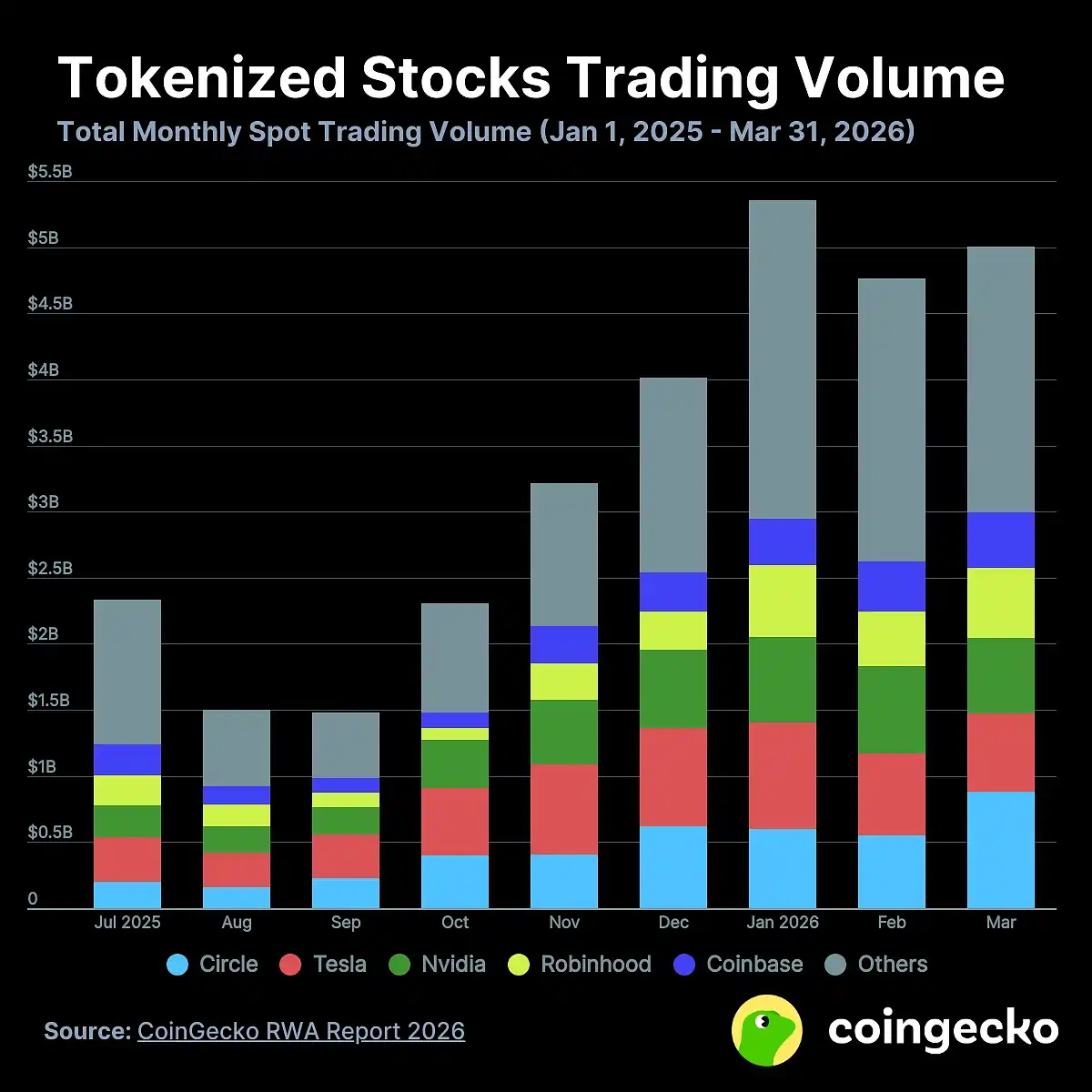
Looking at CoinGecko's "RWA Report 2026," the data shows that the trading volume of tokenized stocks increased from around $2 million in mid-2025 to $486 million by the end of Q1 2026. In just Q1 2026, the spot trading volume of tokenized stocks reached $15.1 billion, exceeding the total volume of $14.8 billion in the second half of 2025.
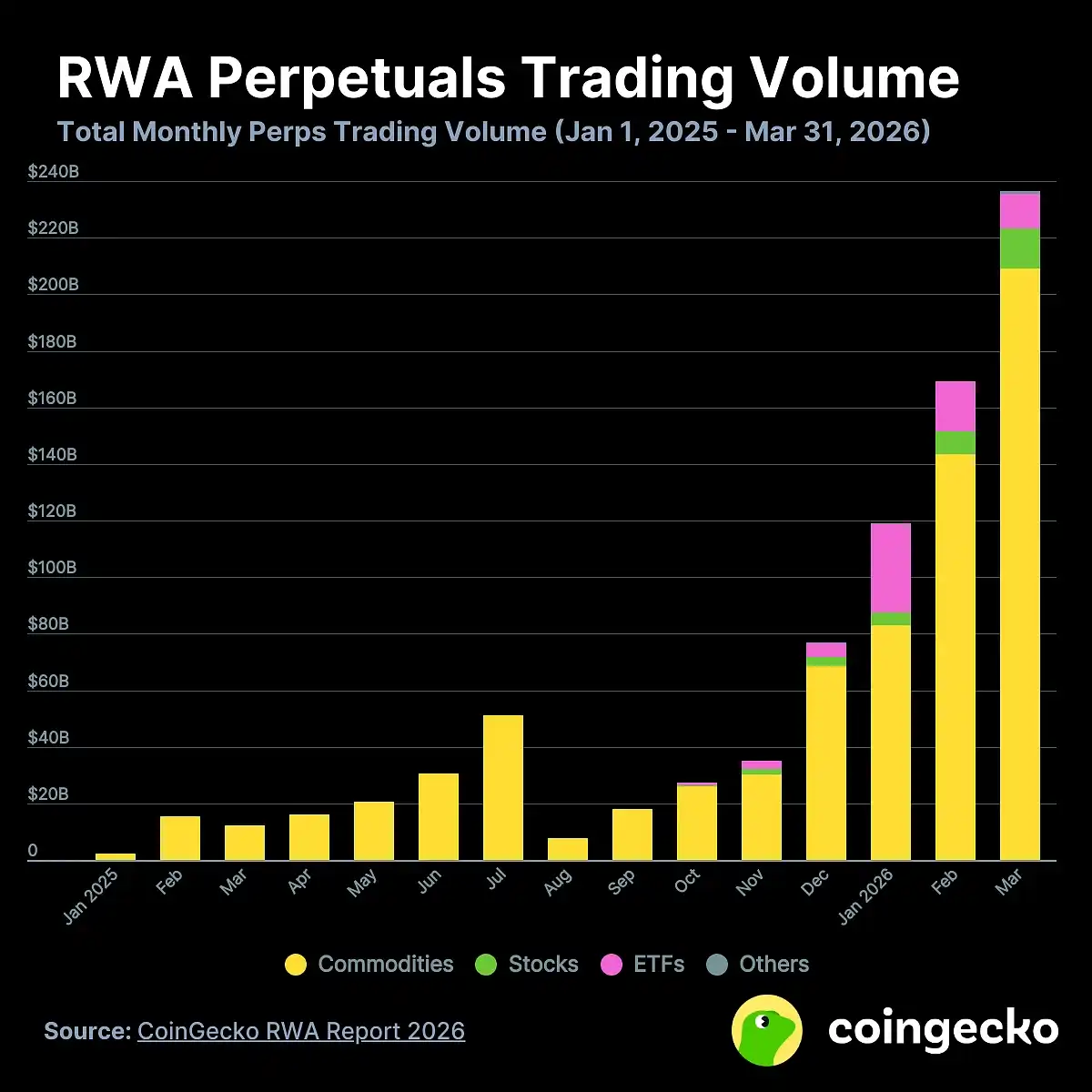
The derivative side of the curve is even more impressive. The same report shows that the RWA perpetual contract's Q1 2026 volume reached $524.79 billion, surpassing the full-year 2025 volume of $313.02 billion and marking the fourth consecutive quarter-over-quarter growth; the daily open interest of RWA perpetuals surged from $140 million at the beginning of 2025 to $6.68 billion on March 31. Hyperliquid, with its HIP-3, had captured 28.6% of the monthly RWA perpetual volume by March.
This may be the crypto industry's final incremental market.
On the other hand, the boundaries between CEXs and DEXs are also shifting. According to CoinGecko's CEX/DEX Trading Activity Report, the DEX spot trading share rose from 6.9% in January 2024 to 13.6% in January 2026; in the perpetual contract market, DEXes, mainly led by the Hyper series, increased their share from 2.0% to 10.2%. On-chain transactions are gradually expanding from meme coins and long-tail assets to a more comprehensive risk asset trading infrastructure.
The emergence of new growth markets implies that CEXs may need to reposition themselves, prompting CEXs to accelerate their TradFi layout.
For example, even Binance has joined this competition, emphasizing a multi-asset financial gateway offering trading for over 7,000 US stocks and ETFs; Kraken/xStocks focuses more on tokenized stocks and on-chain composability; and the Hyper series is attempting to transform perpetual contracts into an on-chain price discovery market for any asset.
In contrast, Bybit's roadmap emphasizes event windows, product matrices, and contract takeovers.
This also explains why the same stock may appear in two different forms within Bybit's product ecosystem, such as two forms of NVIDIA: one is a derivative, NVDAUSDT, settled in USDT and tracking the NVDA price, while the other is a tokenized spot asset, NVDAx.
The difference is that one is a perpetual contract used to trade price fluctuations, while the other is a tokenized stock closer to on-chain spot trading. The former addresses the need to "trade the ups and downs of this stock immediately," while the latter addresses the desire to "hold an on-chain asset pegged to the real stock."
Bringing US Stocks Onto the Blockchain: Where Are We Stuck?
Despite the increasing activity on trading platforms, Max Xu's view on RWAs and tokenized stocks is not radical.
In his opinion, US stocks embody a core part of modern commercial society and represent the grandest business imagination of this era. "You can buy into the traditional narrative of Coca-Cola, bet on SpaceX's ambition to reach Mars, or simply invest in a broad market ETF."
In a way, this illustrates the uniqueness of US stocks.
From consumer goods, technology, and AI to aerospace, indexes, and cash-flowing assets, US stocks have encapsulated almost all of modern commercial society's most essential risk appetites. It is precisely because of this that fully integrating this force into the world of blockchain in a short period of time is not realistic.
Max Xu believes that compliance, liquidity, custody transparency, on-chain composability, and user awareness are all real bottlenecks, and they interact with each other. As user numbers increase, liquidity improves. With improved liquidity, market makers are more willing to provide quotes. As market competition intensifies, custody transparency and compliance standards are also forced to rise.
Therefore, he does not quite agree with viewing "user education" as the only issue. "Many times, users are not educated first and then start using the product. On the contrary, users first have a demand, and then explore the answers while using it."
Early users just wanted a more convenient way to buy stocks, which gave rise to a compliant tokenized stock market. As these assets attract more holders and deeper trading, they will continue to spawn yield products, derivative products, collateral, and portfolio strategies. An ecosystem does not grow up by discussing concepts but by demand layer by layer.
However, if we only consider the current stage, Max Xu still prioritizes compliance.
Liquidity is the second hurdle. Without sufficient depth and reasonable spreads, users will not be willing to deposit real funds, and market makers will not continue to provide quotes. For TradFi assets, compliance determines feasibility, while liquidity determines whether anyone will use it after it's made.
What Are Trading Platforms Really Competing for in Two to Three Years?
If we only look at today, TradFi assets are still a novelty on cryptocurrency trading platforms. Whether it's perpetual stocks, CFDs, or tokenized stocks, they are still relatively small compared to the real US stock market.
However, a trading platform will not wait for a market to fully mature before taking action. Especially as crypto-native exchanges enter into stock competition, whoever finds a new asset entry first will have the opportunity to reorganize user trading behavior.
Max Xu believes that if we fast forward 2 to 3 years, TradFi assets are likely to replace crypto assets and gradually become a key driver of trading platform growth.
He mentioned that starting in April 2026, Bybit systematically introduced TradFi perpetual contracts, expanding within a few months to include dozens of U.S. stocks, global ETFs, as well as commodities like gold, silver, and oil. The trading interest shown by users in these 24/7 products has opened up a new avenue for the entire industry.
In Max Xu's view, crypto users themselves are a group of highly curious individuals who are also accustomed to seeking opportunities across markets. "They could see the blue ocean of crypto back then, and now naturally see the blue ocean of traditional financial innovation."
In today's trading platform competition, there are already signs that support this statement: Crypto users may not necessarily only want to trade crypto assets. What they are used to is a faster market, higher capital efficiency, fewer account switches, and more direct risk exposure. As long as these experiences exist, the assets themselves can transition from BTC and ETH to underlying equities such as BABA, NVIDIA, QQQ, gold, and oil.
Therefore, Bybit's foray into TradFi is not just a unilateral creation of demand by the platform. Max Xu prefers to see it as a mutual achievement between users and the trading platform: Users want a more diverse asset allocation, so the trading platform is motivated to onboard more global risk assets; the more complete the trading platform's product offering, the more willing users are to keep more assets and trading behavior within the same system.
The battlefield of trading platform competition is shifting to new incremental entries.
Whoever can transform the most intense moments of traditional finance, such as earnings seasons, AI narratives, macro data, and commodity cycles, into trading moments within their platform will secure a larger user entry point in the next round of trading platform competition.
Bybit's venture into TradFi is not just "adding another product line"; it is finding a way forward in stock competition. This is also why Max Xu said, "TradFi assets are likely to gradually become a key driver of trading platform growth."
A new era is about to dawn.
Welcome to join the official BlockBeats community:
Telegram Subscription Group: https://t.me/theblockbeats
Telegram Discussion Group: https://t.me/BlockBeats_App
Official Twitter Account: https://twitter.com/BlockBeatsAsia
