Editor's Note: In a liquidity-constrained bear market, listing on centralized exchanges is no longer just an action for exchanges to compete for traffic, but more like a set of gradually solidified market screening mechanisms. This report from IOSG Ventures tracks 207 listing events from early 2026 to mid-May on Coinbase, Binance Spot, Bybit, OKX, Bithumb, Upbit, and Binance Perps, attempting to answer a more specific question: What path does a token take from market discovery, to mainstream platform confirmation, to later-stage exchange adoption?
The core finding of the report is that CEX listings are forming a highly structured "Validation-Liquidity Transmission Chain." Coinbase and Bybit act more like early discoverers, assuming the initial price discovery function; Binance Perps then follow up at a rapid pace, becoming an intermediate validator testing derivative liquidity and market demand; Binance Spot is relatively conservative, typically choosing to list projects selectively only after multiple rounds of market validation; Korean exchanges often appear at the end of the path, providing broader market coverage but users are also more likely to onboard liquidity at higher levels.
This implies that the meaning of a listing event itself is changing. In the past, a project listing on a top-tier exchange was often seen as a catalyst for price increase; however, in the 2026 sample, almost all new coin 30-day average returns on exchanges were negative, with listings more often becoming a window for early holders to release liquidity rather than a starting point for continuous inflow of new funds. For traders, what determines returns is not only "which coin gets listed" but also "at which stage, on which platform it gets listed." The earlier one enters the listing path, the more likely they are to capture price elasticity; the later they enter, the more likely they are to become the recipient of early profits being cashed out.
The value of this report lies not in providing a single trading signal, but in breaking down CEX listings into an observable market structure: who is responsible for discovery, who is responsible for validation, who is responsible for confirmation, and who is responsible for final adoption. For project teams, it hints at a more refined listing strategy; for investors, it offers a new dimension to evaluate Alpha— the listing sequence on trading platforms itself is becoming one of the few information asymmetries that can be systematically tracked in the crypto market.
The following is the original text:
Every bear market cycle quietly reshapes the listing logic of centralized exchanges (CEXs). As liquidity tightens and retail interest wanes, each listing decision becomes more cautious, and therefore more signaling. Our system tracked the new listings on six top exchanges from early 2026 to mid-May—Coinbase, Binance Spot, Bybit, OKX, Bithumb, and Upbit—as well as Binance Perpetuals, covering both spot and perpetuals, totaling 207 listing events across 92 different tokens. The data reveals a clear core pattern: listing is not a random event for tokens but unfolds along a highly structured validation and liquidity transmission path.
Who first discovers and prices the project? Who absorbs and amplifies liquidity in the middle of the cycle? Who provides market coverage in the final stage? Different exchanges play highly differentiated roles in this chain. By the time a token reaches Binance Spot, it has usually undergone multiple rounds of market validation on other platforms. This article will deconstruct this listing path along three key dimensions:
· Structure and Path: How roles differ among exchanges, and how tokens flow between platforms
· Binance Perps' Filtering Logic: What features make a token more likely to enter Binance perpetual contracts
· Price Impact: How listing timing affects entry prices, and the performance differences after listings on different exchanges
For projects, understanding this path can help formulate a more precise and efficient listing strategy. For investors, identifying the positional differences in this flow path may be one of the most critical Alpha sources in 2026.
2026 CEX Listing Landscape and Path
1.1 Exchange Listing Overview
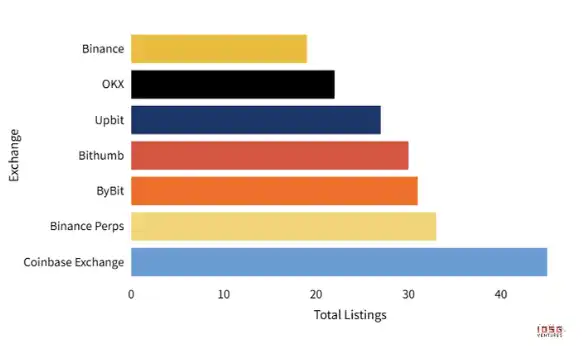
Total Number of Listings on Each Exchange
From early 2026 to mid-May, we tracked new listings on six top-tier exchanges—Coinbase, Binance Spot, Bybit, OKX, Bithumb, and Upbit—as well as Binance Perpetuals, totaling 207 listing records across 92 different tokens.
In terms of listing quantity, there is a clear hierarchy among different exchanges. Coinbase leads with 45 new listings; followed by Binance Perps (33) and Bybit (31). Bithumb (30) and Upbit (27) form the second tier, while OKX listed 22 tokens. It is noteworthy that Binance Spot only listed 19 tokens, the fewest among all observed exchanges.
Looking at the monthly trend, January is the peak season for listings throughout the year. Binance Perpetual Futures alone listed 15 tokens in that month, while Bybit also listed 14. Starting from February, the overall listing pace has notably slowed down, with each exchange adding only 5–8 tokens on average per month, entering a more cautious and selective screening phase. However, Coinbase's listing pace is not synchronized with other exchanges. In February and April, it experienced two concentrated listing peaks, with 13 tokens listed each month, demonstrating its relatively independent and rapid decision-making process.
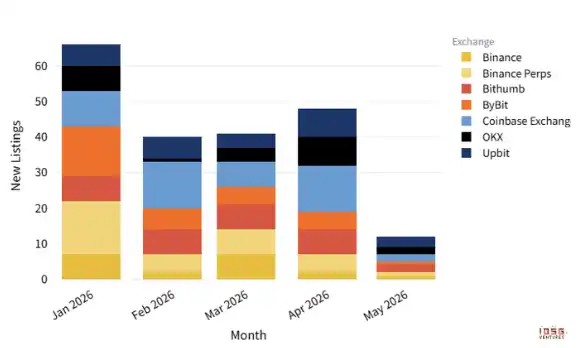
Monthly Number of Listings on Various Exchanges
The simple difference in numbers only reflects surface-level activity. More importantly, the timing and roles of different exchanges in the listing lifecycle have undergone profound differentiation. The following section will further analyze this.
1.2 Listing Role Differentiation: Discoverers, Screeners, and Validators
In the multi-exchange listing landscape, a clear sequence is gradually emerging. The first exchange to list a particular token within our tracking scope is defined as the "First Mover," while exchanges listing subsequently are categorized as "Followers."
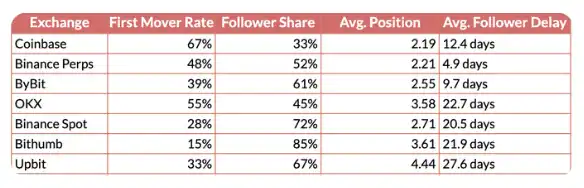
Coinbase stands out as the most prominent First Mover in 2026. Among the tokens it listed, 67% were projects that were the earliest to be listed within our tracked exchange scope, making it a primary venue for initial price discovery. Bybit (with a 39% First Mover ratio) and Binance Perpetual Futures (48%) similarly maintain high activity, often forming the top tier along with Coinbase and listing the same tokens in the same week.
The Korean exchanges Bithumb and Upbit systematically find themselves at the tail end of the listing path. Bithumb has a high Follower percentage of up to 85%; Upbit has an average listing position of 4.44 and is most likely to list tokens in the final stages, lagging behind the First Mover by an average of about 28 days. This aligns with Korea's longer regulatory review period and the local exchanges' tendency to list projects only after a broad market consensus has been established.
Within Binance, a clear funnel-shaped division of labor is evident: Binance Perpetual Futures is roughly half of the time serving as the proactive First Mover, while also having a very rapid follow-up speed for spot listings, averaging only a 4.9-day lag, making it the most responsive exchange. Its core function is to quickly test liquidity and market demand through the derivatives market. In contrast, Binance Spot has the lowest number of listings at only 19, with a First Mover ratio of only 28%, indicating a preference to wait for thorough market validation before proceeding with selective listings.
OKX has demonstrated strong independent screening capabilities, with a First Mover Ratio of 55%. However, its overall number of listings is relatively conservative, with only 22 projects listed. The average listing position is 3.58, indicating a higher entry barrier and a more cautious strategy.
1.3 Listing Path Paradigm
After analyzing tokens listed on three or more exchanges, a highly stable and well-defined listing sequence can be observed: Early discoverers such as Coinbase and Bybit lead the way, followed swiftly by Binance Perpetual Futures for validation within days. Binance Spot then selectively confirms and lists projects, while OKX, Bithumb, and Upbit mainly provide supplementary market coverage later on.
Case Study: ROBO (Fabric Protocol)
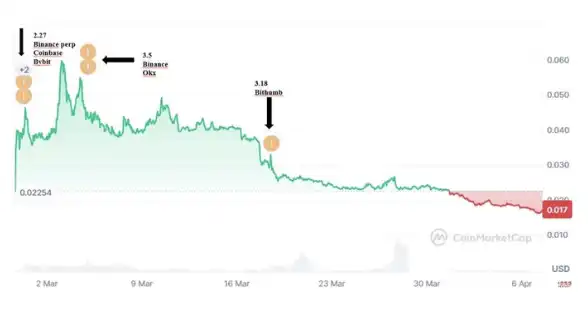
On February 27, the DePIN project Fabric Protocol (ROBO) was first listed on Binance Perpetual Futures, with Coinbase and Bybit following suit on the same day. ROBO opened at $0.022 and saw a price surge of over 80%, reaching $0.0405, nearly doubling its listing price. The project, which had previously raised $20 million in funding led by Pantera Capital, focuses on the integration of blockchain and the robot economy. Combined with the hype around the Kaito public sale and the "AI + Robotics" narrative, it quickly attracted market attention.
On March 5, Binance Spot officially listed ROBO, with the price reaching $0.0493 on the same day, marking the high point of the cycle. By the time OKX listed the token, its opening price was already lower than when it was listed on Binance Spot. On March 18, Bithumb listed ROBO at $0.0303. While this briefly caused a rebound, the price subsequently continued to decrease and has now fallen below the initial listing price.
From its initial appearance to the listing on Bithumb, ROBO took about 20 days to complete a typical 2026 listing path: Binance Perpetual Futures, Coinbase, and Bybit led the initial listings → OKX and Binance Spot confirmed near the peak → Korean exchanges provided liquidity in the terminal stage.
ROBO is not an isolated case. In the sample of the first five months of 2026, a total of 28 tokens were listed on three or more exchanges. The positional distribution of these cross-exchange listings exhibits a highly consistent hierarchical pattern similar to ROBO. While the specific order may vary slightly due to project attributes, the overall structural path is stable and predictable.
This path clearly reflects the risk preferences of different trading platforms: Coinbase, Bybit, and Binance Perps aggressively front-run the early window; Binance Spot prioritizes post-validation security; Korean exchanges and OKX tend to enter the market after a more mature market consensus.
Listing Criteria for Binance Perps
As a key entry point into the derivatives market, Binance Perps' listing decisions directly guide the flow of a large amount of leverage capital. By analyzing 33 Perps listing cases, we can more clearly distill Binance's core coin selection logic in a bear market environment.
2.1 Preliminary Signal: Coinbase and Bybit Listings
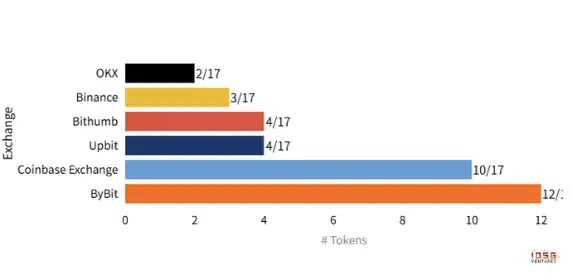
Platforms where Perps were listed before their Perps listing
Among the 33 tokens listed on Binance Perps, 17 were first listed on other spot trading platforms before entering Binance Perps. Tracking this subset reveals that Coinbase and Bybit are the most important preliminary signals for Perps listings.
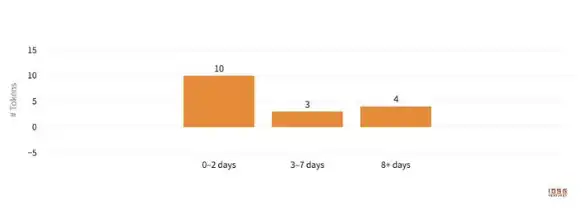
Number of days between the first spot listing and the Perps listing
In these cases, Bybit preceded the Perps listing in 71% of the cases, while Coinbase did so in 59%. More importantly, Binance Perps' response time is very fast: out of the 17 follow-up listing cases, 10 occurred within 0–2 days after the spot listing, with an average lag of only 4.9 days. This rapid follow-up indicates that Binance Perps closely monitors the listing dynamics of Coinbase and Bybit and uses them as key inputs for decision-making.
In a broader sample, 75% of tokens listed on Coinbase eventually enter Binance Perps; the proportion of tokens listed on Bybit entering Binance Perps also reaches 70%. When a token is supported by both Coinbase and Bybit and its price remains relatively stable after listing, the probability of it entering Binance Perps within a week is high. This is one of the strongest and most easily observable preliminary signals in the current market.
2.2 Price Performance Is the Key Screening Criterion
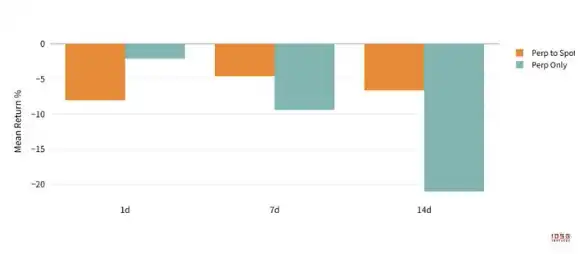
Post-Listing Price Performance: Converted Group vs Perp Only Group
Projects listed on Coinbase and Bybit typically have an initial FDV of over $100 million, so the FDV itself is not a differentiating factor. What truly determines whether a token can enter Binance Perps is its price performance after listing.
Tokens that failed to enter Binance Perps after being listed on Coinbase and Bybit usually have the following three characteristics:
Continuous Weakness: The price remains soft after listing, lacking market support.
Speculative Meme Coins: Tokens with an overly speculative nature, such as WHITEWHALE and ELON. Binance's screening for these tokens is significantly stricter compared to Bybit.
Lack of Binance Alpha Path: Not passed through Binance Alpha. As a pre-screening channel within the Binance ecosystem, Alpha is an important prerequisite for entering Perps.
The impact of price performance goes beyond "entry into Perps" and further affects the possibility of "transitioning from Perps to Spot." Data shows that tokens that eventually transition to Binance Spot, known as the Converted group, had a 7-day return of -4.6% and a 14-day return of -6.6% after Perps listing. In contrast, tokens that remained in Perps-only status had a 7-day return of -9.4% and a significant drop to -21.0% in the 14-day return. Although both groups experienced negative returns in a bear market environment, the Converted group demonstrated significantly stronger price resilience. This indicates that during the Perps stage, Binance considers the "sustainability" of price performance as an important factor.
Listing Impact on Price
The actual impact of listing events on token prices is the most concerning issue for projects, institutions, and traders. We analyze from two core dimensions: Price Position (the relative price position at listing) and Post-Listing Return (7-day, 14-day, and 30-day returns after listing).
3.1 Price Discovery Focuses on the First Mover Window, but Significant Price Differences Exist Across Different Trading Platforms
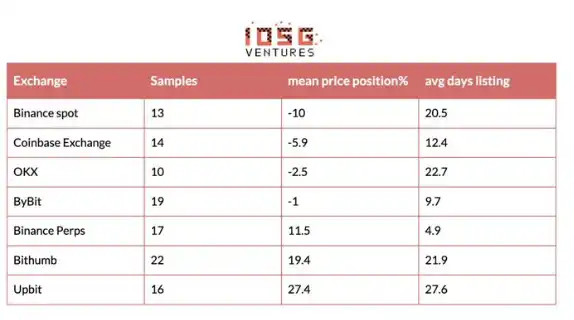
Price discovery mainly occurs during the First Mover window. When Bybit and Coinbase act as Followers, their entry prices are roughly equal to or slightly lower than the initial listing price, indicating a fast price convergence among first-tier exchanges.
When Binance Perps acts as a Follower, the average entry price is already 11.5% higher than the initial listing price. However, thanks to its extremely fast response time—averaging only a 4.9-day lag—it can still capture a relatively early position. Binance Spot has a Price Position of -10%, indicating a tendency to list tokens after a price dip, often providing users with a relatively better entry point.
The entry positions for Korean exchanges are the most disadvantageous: Bithumb averages 19.4% higher than the initial price, while Upbit goes as high as 27.4%. With an average lag time of over three weeks, users often find themselves buying near the peak.
3.2 2026 Listing Pressure: Listing is No Longer a Growth Catalyst, but More Like a Liquidity Release Valve
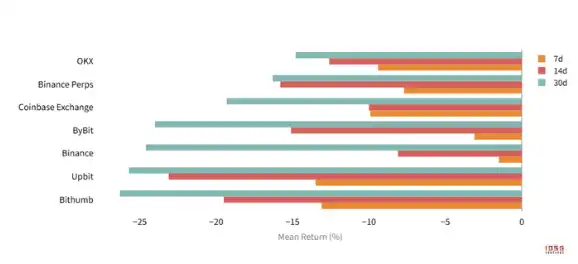
Average Return on Investment (7-day / 14-day / 30-day) for each exchange post-listing
In the 2026 bear market environment, post-listing performance has been generally weak, with no exchange recording a positive 30-day average return.
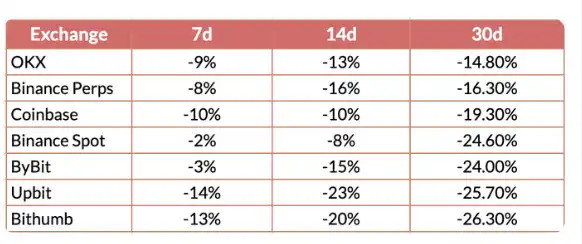
From Day 7 to Day 30, the decline deepens gradually, indicating that the post-listing downturn is not a short-term fluctuation but a sustained downward trend. In the current market environment, newly listed tokens mainly serve as a "liquidity release" mechanism, providing an exit window for early holders rather than acting as a growth catalyst to attract continuous inflows of new capital.
The performance of the two Korean exchanges is particularly noteworthy: Upbit's 7-day ROI is already at -13.5%, dipping further to -25.7% by Day 30. Combined with its +27.4% Price Position, this means that Upbit users not only entered at the highest price but also endured the deepest drawdown.
3.3 Peak Performance in Listing Price Highs
Although the eventual 30-day ROI is generally negative, the short-term rebound highs post-listing, known as Peak Returns, exhibit a distinctly different distribution structure. A more detailed breakdown of token price data reveals that the listing order directly determines the upper limit of short-term speculative space.
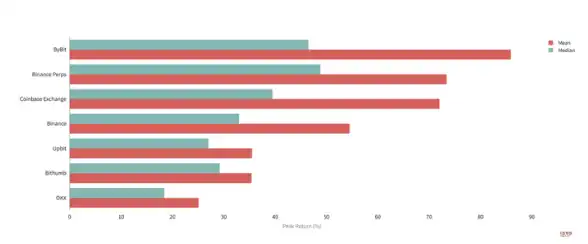
Peak Profitability of Various Exchanges in the Last 14 Days
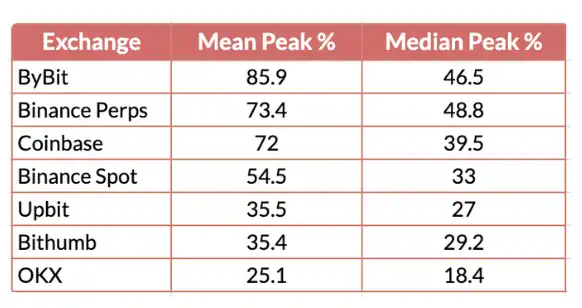
First Mover Holds Absolute Advantage: Bybit recorded an average peak of +86%, while Binance Perps had the highest median peak return (+49%). The top-tier exchanges—Bybit, Coinbase, and Binance Perps—captured the highest price elasticity, providing early holders with a significant liquidity premium. Even if the price eventually retraced to zero, these peaks offered early holders a relatively ample window to exit at a high point.
Limited Upside for Later-Cycle Followers: The peaks for Bithumb and Upbit were roughly capped at around +35%, with OKX even lower at only about +25%. Due to entering later, the buyer base on these exchanges was mainly profit-taking from early holders rather than driving a new uptrend.
This difference validates the liquidity transmission pathway: First Movers bear the primary price discovery task and also provide early holders with optimal exit liquidity. Over time, the buyer base on subsequent exchanges is more about absorbing realized gains, with marginal utility gradually diminishing. For traders, this means that the later one enters the listing cycle, the lower the probability of capturing excess returns.
3.4 Exchange Selection Determines Risk-Reward Structure
Considering three metrics together—Price Position (entry position), Peak Return (upside potential), and Mean Return (final outcome)—it can be observed that users on different exchanges face completely different risk-reward structures.
First Mover exchanges, namely Coinbase and Bybit users, also face negative returns but have the best downside cushion. They have the lowest entry price, around 10% to 5.9% lower than the initial peak; at the same time, they have the highest upside potential, with an average peak of over +70%. Even if they fail to sell at the peak, their absolute loss is relatively manageable, and they still have the opportunity to profitably exit during the initial uptrend.
In stark contrast, users of Korean exchanges face a typical "buy high, deep retracement" scenario. They enter at a significant premium, priced 20% to 27% higher than the initial price; however, as the most powerful parabolic rally has already occurred on earlier platforms, their upside potential is limited to about +35%. This creates a "capped upside, open downside exposure" structure, ultimately resulting in the deepest 30-day market-wide loss.
Binance Spot is a special case. Although its 30-day return rate dropped to as low as -24.6%, the actual capital loss suffered by users is not as severe as the numbers suggest due to its usual practice of listing after a 10% price correction. This is a time-for-space strategy: avoiding the initial intense volatility upon listing and instead accepting a longer period of gradual decline.
This differentiation is very clear at a quantitative level. The most significant return difference is observed in the first 14 days after listing: First Mover averages at -12.2%, while Follower averages at -16.7%. Simply by choosing a different trading platform, the result can vary by 4.5 percentage points. In the 2026 market environment, the listing event has evolved from a general uptrend to a zero-sum game. For traders, what often determines the investment outcome is not "what is listed" but "where it is listed".
Conclusion
In the 2026 bear market environment, the logic of CEX listings is shifting from being "traffic-driven" to "validation-driven". Exchanges are no longer blindly chasing hot trends but are instead building a structured path for screening and liquidity release through clear role division: Coinbase and Bybit act as early discoverers, Binance Perps as rapid validators and liquidity testing grounds, Binance Spot as the final confirmation point, and Korean exchanges providing exit liquidity at the terminal stage.
This path is not randomly formed but is the result of a rational game among all market participants. It provides a ladder for high-quality projects from early exposure to mainstream recognition and offers staged exit windows for early investors and institutions. At the same time, it clearly delineates the differentiation in the environment of different participants:
Investors should consider the order of exchange listings as a key Alpha signal: focus on projects that simultaneously list on Coinbase and Bybit with stable price performance, consider them as precursors to entering Binance Perps; look for better entry points during the initial listing window or Binance Spot pullback phase; avoid buying at a high point during the terminal stage on Korean exchanges.
Exchanges themselves achieve ecological balance through differentiated positioning: aggressors seize opportunities, conservatives manage risks, collectively maintaining orderly liquidity transmission in the listing market.
However, against the backdrop of overall tightening liquidity, listing events are increasingly resembling a mechanism for reallocating existing funds rather than a catalyst for incremental growth. Looking ahead, with the improvement of the macro environment, this path may gradually shift from "defensive screening" to "aggressive expansion", with a further increase in the premium for First Movers and a possible reduction in validation cycles. Understanding and adapting to this path cannot guarantee the success of every listing, but it can significantly improve decision-making certainty. In the crypto market, information asymmetry always exists; and a structured understanding of the listing chain is one of the few sources of Alpha that can be transformed into long-term sustainable advantages.
Welcome to join the official BlockBeats community:
Telegram Subscription Group: https://t.me/theblockbeats
Telegram Discussion Group: https://t.me/BlockBeats_App
Official Twitter Account: https://twitter.com/BlockBeatsAsia
