Editor's Note: When an AI Agent no longer just answers questions but begins to place orders for people, deploy applications, access services, and consume tokens, the underlying rules of Internet commerce also change.
This article comes from a redefinition of the "AI Economic Infrastructure" by Stripe: in the past, payment infrastructure mainly served human users and software companies; now, it must also serve machine entities. Agents need to be able to understand prices, complete payments, access wallets, deploy services; AI companies also need to establish new billing, risk control, and settlement mechanisms around token consumption.
The Machine Payments Protocol, Link, Stripe Projects, Metronome, Tempo, and streaming payments mentioned in the article all essentially point to the same trend: AI Agents are transforming from mere "tools" to new economic participants on the Internet. They are both buyers and builders; they create software and consume resources. As a result, the traditional SaaS-era business model of seat-based fees, invoicing after the fact, and manual reconciliation is being replaced by real-time metering, instant settlement, and machine-readable new models.
This is not just a narrative of Stripe's products, but also a broader industry judgment: if a significant amount of software consumption in the future is initiated by Agents, then payment, billing, wallets, risk control, and deployment processes all need to be redesigned. AI is changing not only production efficiency but also the very organizational structure of business itself.
The following is the original article:
Agents are becoming buyers and builders. This will fundamentally change how businesses operate.
Over the past few years, Stripe has been building economic infrastructure for AI. This includes several aspects: we have helped the world's fastest-growing AI companies accelerate their development through payment, billing, checkout, fraud prevention, and tax infrastructure; we have deployed AI at various stages of the payment process to help businesses increase profits; at the same time, we have enabled Stripe to be natively embedded in the AI tools used by developers.
However, in the past six months, the meaning of the concept of "AI economic infrastructure" has changed. Agents are becoming a new actor on the Internet. This has also brought us two new tasks: first, to help Agents make purchases and build on behalf of individuals and businesses; second, to help companies adapt to the new economic model brought about by token consumption. In other words, Stripe is empowering Agents to become independent actors; at the same time, it is helping businesses monetize products created and consumed by Agents and highly dependent on tokens.
Smart Agents as Buyers
E-commerce was originally designed for humans. Humans would browse websites, click on pricing pages, enter their credit card information, and complete the checkout process. But smart agents do not operate this way. They require a programmatic approach that understands when a certain service needs payment, how much the fee is, and how to complete the payment without a human clicking through a checkout interface.
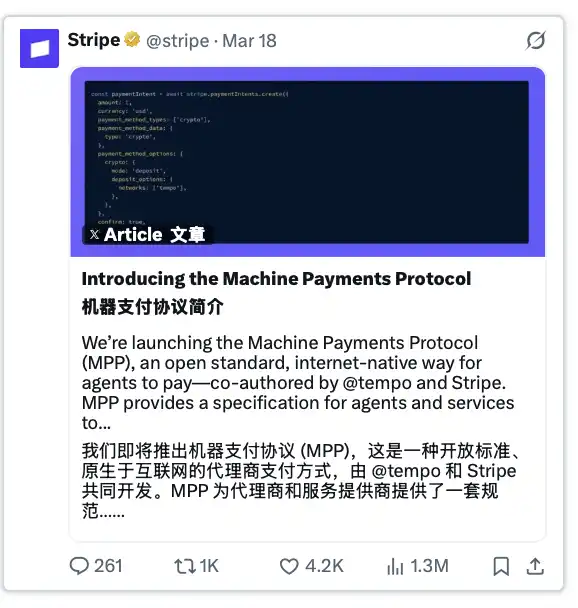
This is why we partnered with Tempo to create the Machine Payments Protocol. It enables businesses to programmatically accept payments directly from smart agents without human intervention. There are no account registrations, no checkout pages, and no humans in the loop; just a machine-readable payment method that allows smart agents to purchase services from enterprises.
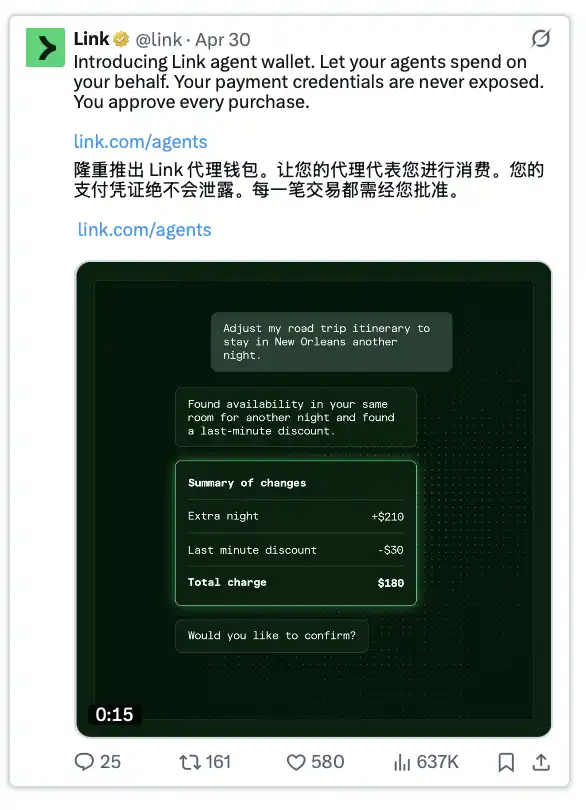
Once a business can accept payments from smart agents, the next equally important question is: how can consumers securely authorize smart agents to spend on their behalf? This is where our consumer wallet Link comes into play.
Currently, over 250 million people are using Link. We are extending Link's capabilities to also serve smart agents, allowing users to securely authorize smart agents to make payments on their behalf. Humans still retain control while smart agents gain the ability to spend on behalf of users.
Assisting smart agents in making purchases on the internet is one way we empower smart agents. Another way is to help them in their building endeavors.
Smart Agents as Builders
Today, vibe-coding has become easy, but vibe-deploying has not. Smart agents can generate an app within minutes, but to truly deploy it to the web, a significant amount of manual effort is still required: account creation, service configuration, credential management, API access, and navigating between different consoles.
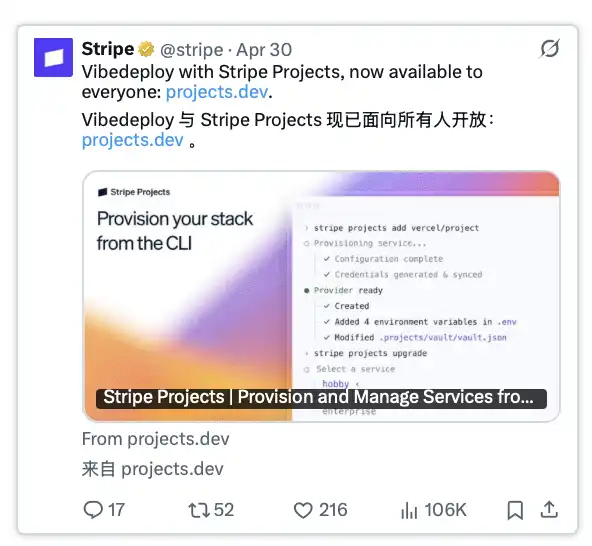
Stripe Projects enables developers and their smart agents to directly register, manage, and integrate the services needed to deploy an app through the command line. The goal is simple: to make vibe-deployment as seamless as vibe-coding.
Token Monetization
As smart agents begin to act as buyers and builders, businesses also need to adapt to a new world: the cost of product reasoning or token cost will fluctuate dynamically. This will transform the software's economic model.
In the SaaS model, serving multiple users typically does not incur much additional cost. However, in AI products, every word prompt input, every API call, every intelligent agent task, carries a real marginal cost. Therefore, companies can no longer rely solely on seat-based billing; instead, they need to meter usage in real-time and charge customers based on the actual resources consumed.
This is why consumption-based billing has become key to AI monetization. Companies can charge based on the value customers truly recognize: usage, workflows, outcomes, or any billing unit most suitable for their product.
Lovable is a great example of this approach. It initially adopted a simple subscription model on Stripe to quickly commercialize after launch. As the company grew, its billing model evolved as well. Today, when customers exceed the usage limit included in their subscription plan, Lovable charges based on the consumed AI tokens. ElevenLabs followed a similar path: starting with a subscription model on Stripe and later transitioning to usage-based pricing as the product and customer usage patterns evolved.
Token Theft
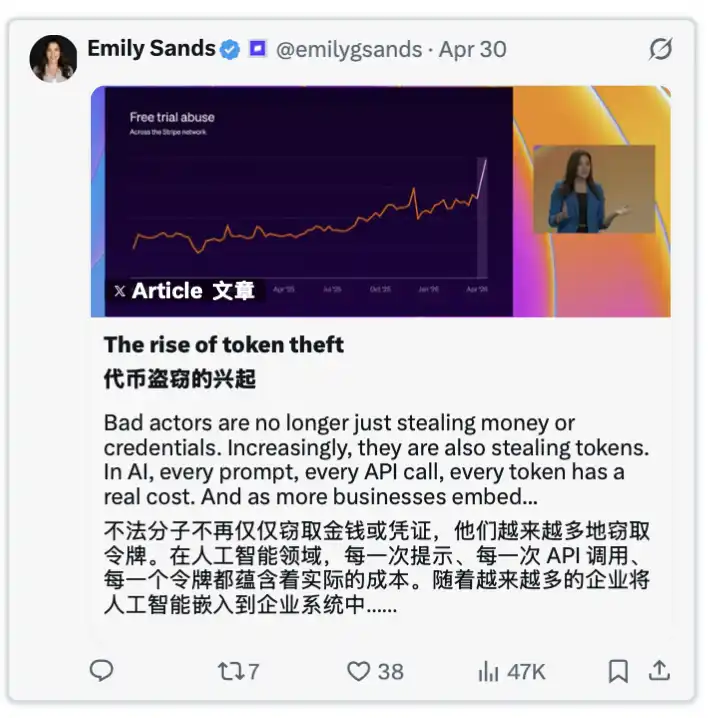
However, for consumption-based billing to work, companies must be able to actually recoup the money. Today, fraudsters are not just stealing funds or account credentials; more and more often, they are stealing tokens. As long as they can register accounts, rapidly consume a large number of tokens, and then disappear before the billing cycle ends, the economic model of AI products can quickly collapse.
Token theft is one of the most under-discussed issues in the AI industry today. With Stripe Radar as our fraud protection product, we can assess new accounts in real-time, predict which free trials may be subject to abuse, and identify unpaid usage risks as consumption accumulates.
Streaming Payments
When the customer itself is an intelligent agent, abuse issues become even more complex. Intelligent agents can consume tokens at machine speed, making traditional billing methods too risky and even unsustainable.
Companies can require upfront payments from users and suspend service when the limit is reached. While this protects the company, it leads to a poorer customer experience and may hinder high-value customers from further increasing consumption. Alternatively, companies can allow usage to accumulate and then invoice collectively. This provides a better experience for customers, but the bill may never be fully recovered by the time it is due, by which time the tokens have already been spent.
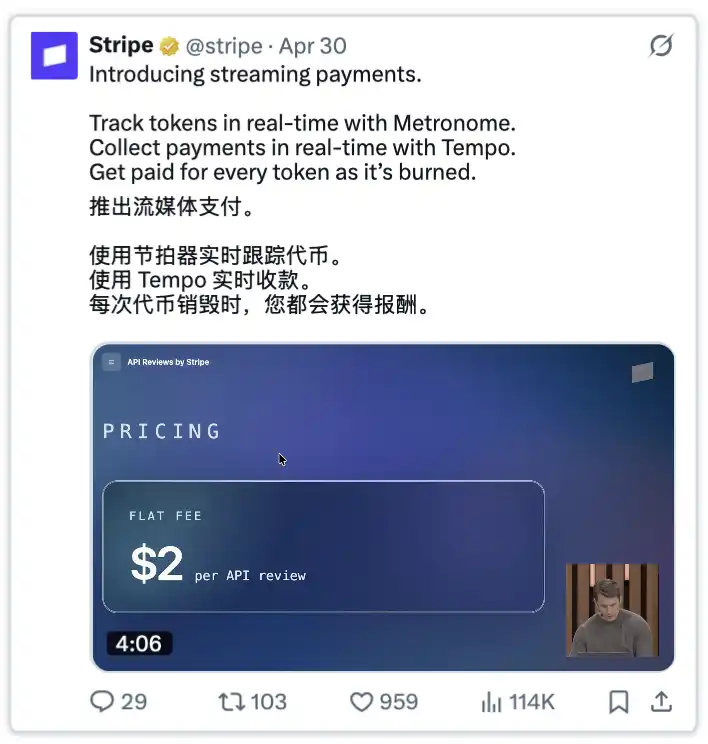
The better answer is actually quite obvious, but implementing it is technically very complex for businesses: real-time usage tracking and real-time payments. This is precisely the capability that can be achieved after the combination of Metronome and Tempo.
Metronome is a company acquired by Stripe, mainly serving the most complex usage-based billing models, allowing real-time usage tracking while the token is being consumed. Tempo, on the other hand, supports low-cost, high-frequency stablecoin payments and enables instant settlement. After the two are combined, an AI company can complete the charging process in real time as the token is consumed, without having to choose between “hard cap” and “unable to collect payment afterwards.”
We call it Streaming Payments: a new business model tailored to AI-native businesses, adapting to machine-speed software consumption.
All of the above is exactly what today's "AI economic infrastructure" needs to support.
It is no longer just about providing payment services to AI companies, but about providing a commercial system for agents, providing wallets for agents, enabling agents to deploy software, supporting token-based billing, preventing fraud and abuse in token usage, and providing streaming payment capabilities to agents.
AI is changing business and the way enterprises are built. Therefore, the infrastructure must also change accordingly.
Stripe is building all of this.
Welcome to join the official BlockBeats community:
Telegram Subscription Group: https://t.me/theblockbeats
Telegram Discussion Group: https://t.me/BlockBeats_App
Official Twitter Account: https://twitter.com/BlockBeatsAsia
