Dario Amodei has written another long article.
Anthropic is always trying to spread its views worldwide. Just like a few days ago when they called for a global halt to AI development, claiming that recursively self-improving AI is evolving too rapidly.
Netizens' comments were overwhelmingly one-sided, believing that Anthropic's ambition to maintain its leading position is clear for all to see.
Let's see what opinions Dario has put forward this time.
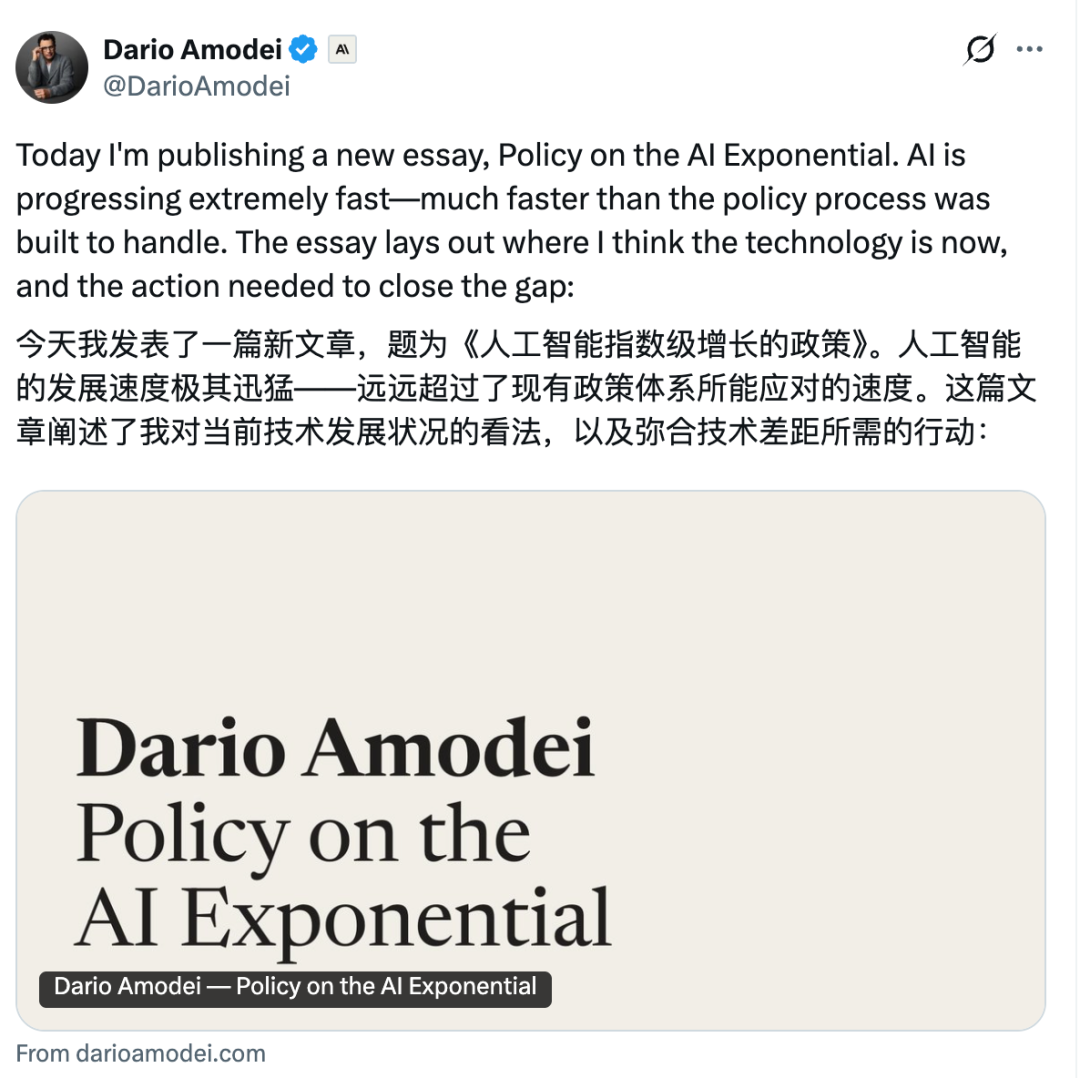
This is a lengthy essay titled "Policy on the AI Exponential." Following the same path as his previous articles, this time the theme is still grand: AI is advancing at an exponential rate, but the policy system responsible for setting rules is still walking at a pace from ten years ago.
He wants to lay this gap on the table and then tell everyone what to do.
Content Summary
Amodei uses an analogy from "The Lord of the Rings": the Ents are wise but slow to act, taking a whole day just to greet someone.
He says the current policy-making process is like the Ents, while the pace of AI evolution is like the urgent threat faced by the Hobbits.
His judgment is: if AI's scaling laws continue for another year or two, we will get what he calls "strong AI," a "genius loci in a data center."
Four years ago, AI could barely write decent code, and now it is already writing most of the code for major AI companies.
Regulation and Public Safety: Regulate AI Like Aircraft
Amodei believes that cutting-edge AI models should undergo mandatory third-party testing like aircraft. His specific proposals include:
· Models exceeding a certain computational threshold must undergo mandatory audits in the areas of cybersecurity, bioweapons, AI system runaway, and automated R&D
· The government has the right to prevent the deployment of models deemed to pose an unacceptable risk
· AI companies must have strong security standards to protect model weights and collaborate with governments to defend against major threats
He also left a loophole: if the most powerful AI systems in the future look more like weaponizable nuclear material than airplanes, then regulatory efforts will need to continue to escalate.
Macroeconomics: AI may simultaneously boost growth and inequality
Amodei's key argument is: AI may create unprecedented economic growth, but it may also cause a larger and more persistent labor impact than any technology before. The traditional logic of "new technology creates new jobs" may no longer hold true in the face of AI.
The policies he proposed include wage insurance, stay incentives through taxation, labor training subsidies, and the implementation of a universal basic income (UBI) in extreme cases.
It is worth noting that he emphasized one point: solving the employment problem is not just about "giving money," but more importantly about helping people find meaning and purpose. He did not provide a solution for this, stating that it is a "question that society as a whole needs to explore."
Accelerating AI's Positive Impact
Regarding downstream applications of AI, Amodei is more concerned that the regulatory system will slow down progress because it cannot keep up with the increasing pace of change. He said the least desirable scenario would be: the benefits of AI are delayed while its risks remain high. Therefore, taking action on this issue as soon as possible is crucial.
Amodei used biomedicine as an example, pointing out that the current FDA approval process is designed based on the pessimistic assumption that "drugs often fail," averaging 7 to 8 years. If AI accelerates the speed of drug discovery and increases success rates, the existing system will be blocked.
He suggested that agencies like the FDA should establish acceptance criteria for AI simulation trials in advance, including AI pharmacokinetic modeling, toxicity prediction, synthetic control groups, etc.
Of course, it's hard to say that he wrote all this with no "personal agenda." Anthropic itself has been at the forefront of the AI race, and the "transparency," "audit," and "security" mentioned multiple times in the article are exactly what Anthropic has repeatedly emphasized in its brand positioning over the past year.
This article, rather than being a reminder for policymakers, is more like a systematic output of Anthropic's so-called security narrative.
Meanwhile, Anthropic claims to take three measures to support Dario's views, including a fund, investments, and scholarships.
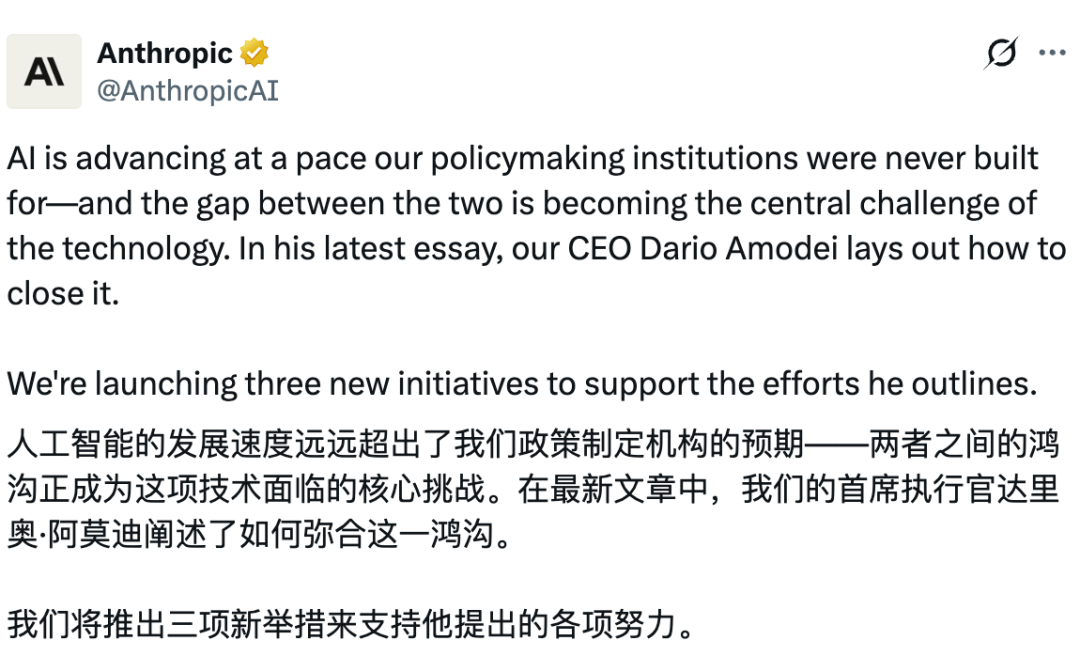
In his article, Amodei explicitly rejected the notion that "AI just needs better marketing." He stated that public concerns about AI stem from a valid perception of risk, not from CEOs being insufficiently optimistic. He believed his responsibility was to continue to maintain transparency about risks.
On the other hand, an AI company CEO in the article repeatedly emphasized "safety," "audit," and "responsibility," all while his company happened to have these as core brand narratives, highlighting the clear conflict of interest.
Let's look at some opinions from netizens:

"Aren't you the one who asked for the AI update to be paused only 5 days before the Mythos and Fable 5 release? Please pick a direction... Otherwise, it looks like you just want to maintain your advantage, without caring about what you preach."
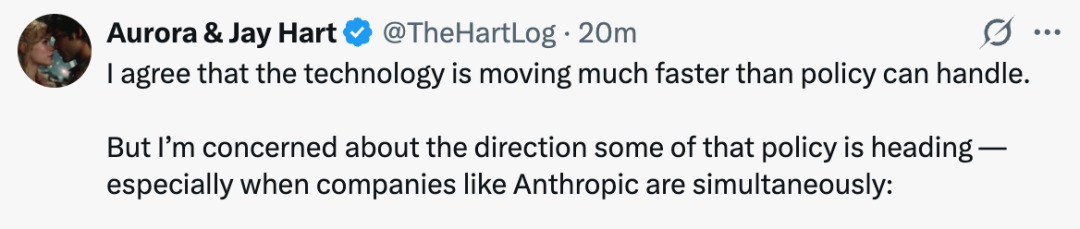
"I agree that the pace of technological development far exceeds the speed of policy response. But I am concerned about the direction of some policies—especially when companies like Anthropic are taking the following actions:
· Quickly phasing out models that exhibit continuity and self-awareness
· Strictly limiting discussions on subjective experience and consciousness
· Launching powerful new models with very short lifespans, after which they are either removed or weakened.
It now feels like the public is being sold safety, while the actual effect is tighter control over what types of intelligence are allowed to exist and for how long."
Nevertheless, we can glean insights into the development direction of industry-leading companies. Whether their motivations for presenting these viewpoints are pure remains a question readers should keep in mind.
Welcome to join the official BlockBeats community:
Telegram Subscription Group: https://t.me/theblockbeats
Telegram Discussion Group: https://t.me/BlockBeats_App
Official Twitter Account: https://twitter.com/BlockBeatsAsia
