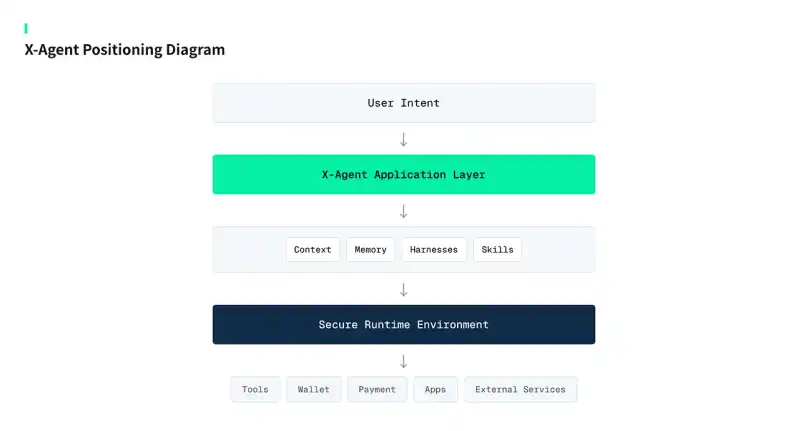
When you say to an Agent, "I want to do this," the X-Agent is the gateway that takes on this intent and makes it happen—it sits at the forefront of the entire Agent system's application layer.
Supporting it are four strong architectural pillars: Context, Memory, Harnesses, and Skills. X-Agent packs these four pillars into a "Secure Runtime Environment (SRE)," thereby creating a rigorous execution infrastructure dedicated to turning your grand goal in mind into a series of autonomously achievable complex workflows.
It is due to this structured design that the entire transformation process, from an abstract idea to a fully operational system, becomes reliable, verifiable, and always within your control. This is what makes the X-Agent the crucial bridge connecting the underlying technical infrastructure with the user application layer.
The design philosophy is quite straightforward: just as iOS and Android provide the lowest-level system capabilities for mobile applications, X-Agent provides the same foundational application layer for "autonomous execution." It abstracts and packages the core pillars mentioned above, ultimately consolidating them into unified Agent units.
1.1 Context
Context defines the real execution environment in which the Agent currently resides.
It is much more than just the conversation history between you and the Agent. It also includes who you are, your social relationships, the current state of the application, session state, the progress of a task, the boundaries of permissions, whether your wallet is connected, the tools available to you, and the current status of external services.
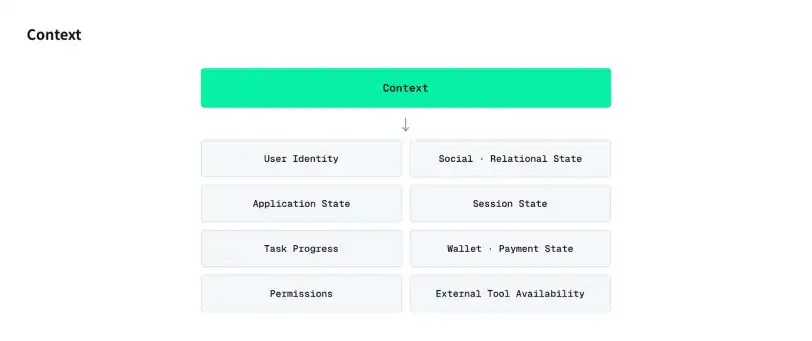
For an autonomous Agent, the context is far from a static set of information. It is a constantly flowing, real-time updated state that truly gives the Agent a "sense of the moment"—it knows:
• Who it is serving at that moment;
• Which application environment it is currently operating within;
•At this moment, what task is it performing;
•At this moment, what capabilities can it invoke;
•And, what constraints must it abide by.
By continuously loading and refreshing the context, the X-Agent ensures that each execution step is firmly rooted in the actual runtime environment, rather than dangling on a piece of isolated cue.
1.2 Memory
If context is about the "now," then memory is about the "long-term." It provides the Agent with the ability for long-term state persistence across sessions, applications, and multiple Agent workflows.
With it, the Agent can recall past tasks, remember your preferences, reuse previous execution results, and maintain coherence in those long-running workflows, never "forgetting in the midst of doing."
Unlike the fleeting short-term context, memory allows the Agent to grow over time. It can hold: conversation history, task records, execution traces, application snapshots, user preferences, vectorized knowledge, and the unique long-term state of each Agent.
It is with memory that X-Agent, supported by it, is no longer just a one-off conversation. It enables a whole new class of Agent applications – ones that can run continuously, accumulate knowledge, and quietly get better over time.
1.3 Harnesses
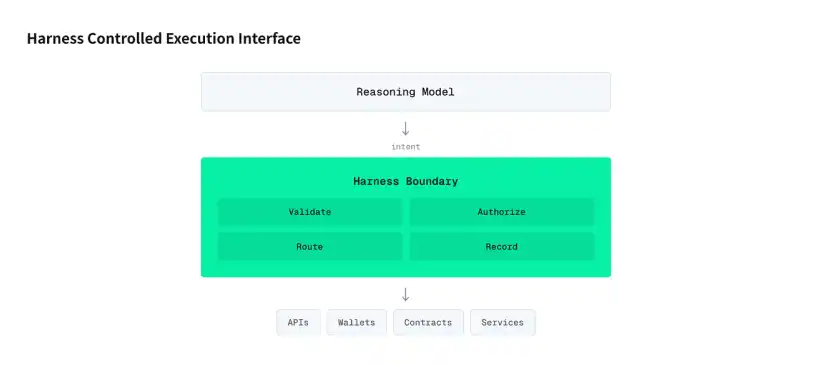
Harnesses are the controlled interface bridging the reasoning model and the real-world systems.
Their duty is to translate the model-generated intent into validated, authorized, and fully logged execution actions.
But it is by no means a mere simple API wrapper – it is a true "execution boundary."
Before any action touches an external system, the harnesses meticulously oversee: validating parameters, checking permissions, enforcing policies, routing calls, and logging every execution.
They can connect to a wide array of objects: external APIs, blockchain oracles, smart contract bindings, wallet adapters, payment interfaces, deployment environments, and various enterprise services.
Within the framework of X-Agent, the division of labor is clear: the model is responsible for "suggesting what to do," while the harnesses answer "how can this intent be securely transformed into actual execution."
1.4 Skill
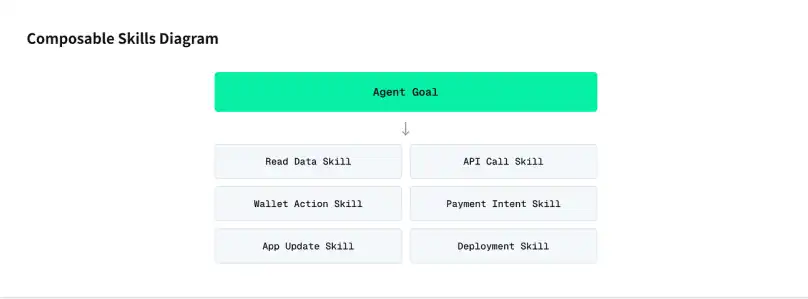
A skill is a professional, reusable, and freely combinable unit of execution capability.
It packages a specific action into a callable unit so that the Agent does not need to directly control the underlying complex infrastructure, enabling it to easily complete a complex workflow.
A skill can handle many tasks: read data, modify application state, call external APIs, interact with a wallet, generate payment intents, update workflows, deploy applications, or complete a business task in a vertical industry.
By modularizing the execution capability into individual skills, X-Agent can break down the originally tangled autonomous workflow into verifiable, reusable, and auditable execution units.
It also means that the Agent's capabilities can be freely combined and flexibly assembled like building blocks between different applications and in a multi-Agent collaborative environment.
2 Secure Runtime Environment (SRE)
When an autonomous Agent truly begins to interact with external APIs, private documents, encrypted wallets, payment systems, or application state, a standard LLM application is exposed to a series of severe execution risks.
These risks include: injection attacks, state leakage, unauthorized data modification, credential exposure, and operations that are nearly impossible to trace after the fact.
Faced with these challenges, X-Agent's answer is the Secure Runtime Environment (SRE).
The core idea of SRE can be summarized in a single, yet crucial sentence: completely separate "reasoning" from "execution."
The reasoning model is only responsible for understanding your goals, generating plans, and producing intents, while the runtime environment filters, validates, authorizes, executes, and records these intents within controlled boundaries.
This architecture results in a reassuring outcome: the Agent never directly holds unrestricted access to original credentials, private keys, wallet permissions, private data, or production systems.
On the contrary, any sensitive action must pass through a controlled runtime interface, and only when all the checkpoints of policy, permission, context, and audit are met, is it allowed to execute truly.
Thus, through SRE, the X-Agent transforms the somewhat unsettling concept of "autonomous execution" into a bounded, verifiable, and observable process.
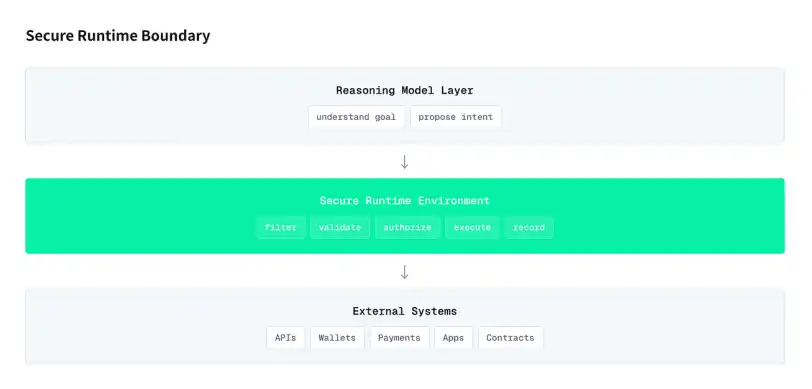
Whether it's a tool invocation, a state update, a wallet-related operation, a payment-related intent, or an interaction with an external system—each step can be distinctly traced back to its corresponding user intent, workflow step, runtime decision, and execution record.
2.1 From Intent to Verifiable Workflow
The entire execution path of the X-Agent starts with a user intent and ends with a verifiable workflow record.
The process is roughly as follows: You express a high-level goal, the X-Agent promptly loads the relevant context, retrieves stored memories, generates an execution plan, oversees each step through the execution framework, accomplishes specific tasks with skills, and records the results one by one in a secure runtime environment.
For those workflows involving wallets or payments, the X-Agent can even generate a structured payment intent before actually executing the payment downstream.
Thus, financial actions are no longer individual, opaque transactions. They have become part of a complete, traceable workflow that everyone can understand and see clearly.
3 Product Architecture
The X-Agent has implemented the above technical architecture into three core product capabilities:
Builder, Agent Runtime, and Tool / Wallet / Payment Integration Layer.
3.1 Builder
The Builder is the gateway to "app generation" open to creators and developers.
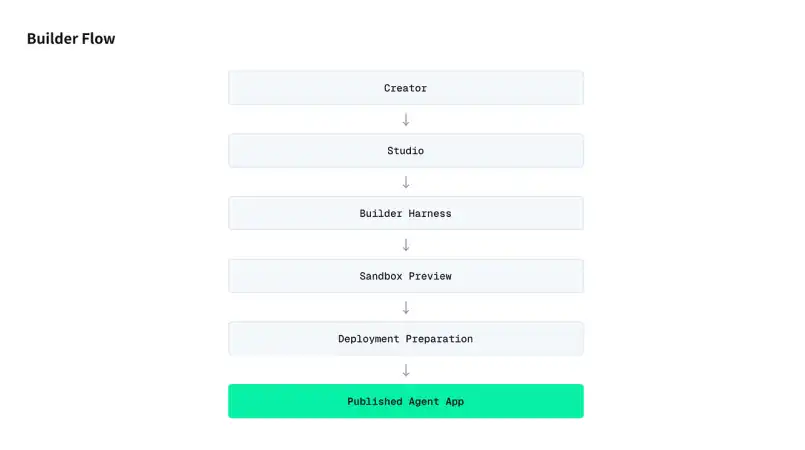
You only need to describe in natural language the appearance of the Agent app in your mind, and the X-Agent will step by step transform this goal into application structure, workflow logic, interface status, tool configuration, and even pre-deployment preparations.
Here, a path has been opened up from "idea" straight to "application".
You describe what you want to create, and X-Agent helps you generate, preview, iterate, and prepare it for runtime execution.
3.2 Agent Runtime
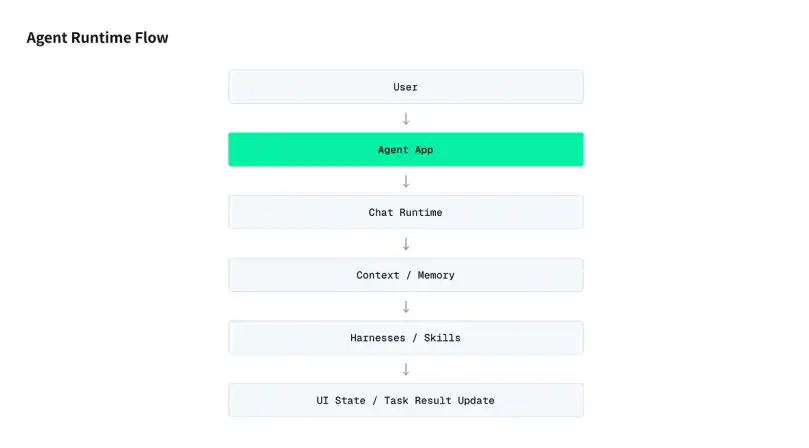
The Agent Runtime is the stage where deployed Agent applications truly come to life.
Once the application is created, you can directly interact with the embedded Agent, trigger workflows, update application state, access memory, invoke tools, and perform various controlled actions within the runtime boundaries.
It is this step that transforms the application from a static interface into an active Agent system driven by objectives.
3.3 Tools, Wallets, and Payment Layer
Using an execution framework and skills, X-Agent firmly integrates the Agent with external tools, wallets, and payment-related infrastructure.
At the tool layer, the Agent can access external APIs, enterprise systems, data services, and application state;
At the wallet layer, the Agent can generate wallet-related intents and route them through controlled adapters;
At the payment layer, the Agent can sharply identify points in workflows involving value transfer, generate structured payment intents, and hand off these intents to downstream systems responsible for payment execution, governance, compliance, settlement, and liquidity management.
As a result, X-Agent becomes the central hub: it integrates user intent, Agent intelligence, real-world tools, wallets, and the underlying value network into a unified whole—responsible for both generation and execution of applications.
4 Technical Differentiation
X-Agent is not just another chatbot in a shell.
It is not a simple tool router.
It is certainly not just a wallet access point.
Its true distinctiveness lies in: combining application generation, Agent workflow execution, context awareness, long-term memory, controlled execution interfaces, composable skills, wallet connections, payment intent generation, and a secure runtime environment—all these capabilities fused into a single unified, Agent-native application layer.
Building on this architecture, X-Agent is able to translate your high-level intent into a verifiable workflow that seamlessly integrates context, memory, tools, wallet, payments, and a secure runtime environment.
In a nutshell: X-Agent offers an application layer to build, deploy, and execute Agent-native systems—systems that are not just smart, but also controllable, auditable, and ready to join real-world value networks with a handshake.
Welcome to join the official BlockBeats community:
Telegram Subscription Group: https://t.me/theblockbeats
Telegram Discussion Group: https://t.me/BlockBeats_App
Official Twitter Account: https://twitter.com/BlockBeatsAsia
