TL;DR
· STRC dropped to around $89, implying a simple current yield of approximately 12.9% based on an $11.5 annualized dividend.
· The market debate is not about whether Strategy can immediately afford the dividend, but how BTC reserves, high-yield financing, on-chain leverage, and competition from similar products should be discounted.
· Related assets: STRC, MSTR/Strategy, SATA, BTC, Pendle, and related on-chain yield products.
Over the past two days, Strategy's perpetual preferred stock STRC has dropped to around $89, significantly deviating from its $100 face value, also pushing its simple yield to approximately 12.9% based on the current price.
The anomaly lies in the fact that STRC was originally designed as a high-yield instrument that operates around par. Strategy maintains an 11.5% annualized dividend, with shareholders also approving a change in dividend frequency from monthly to bi-monthly on June 8. The public arrangement is expected to start in July, with the first bi-monthly payment date expected to be July 15, subject to board declaration. Intuitively, more frequent dividends should help the price converge towards $100.
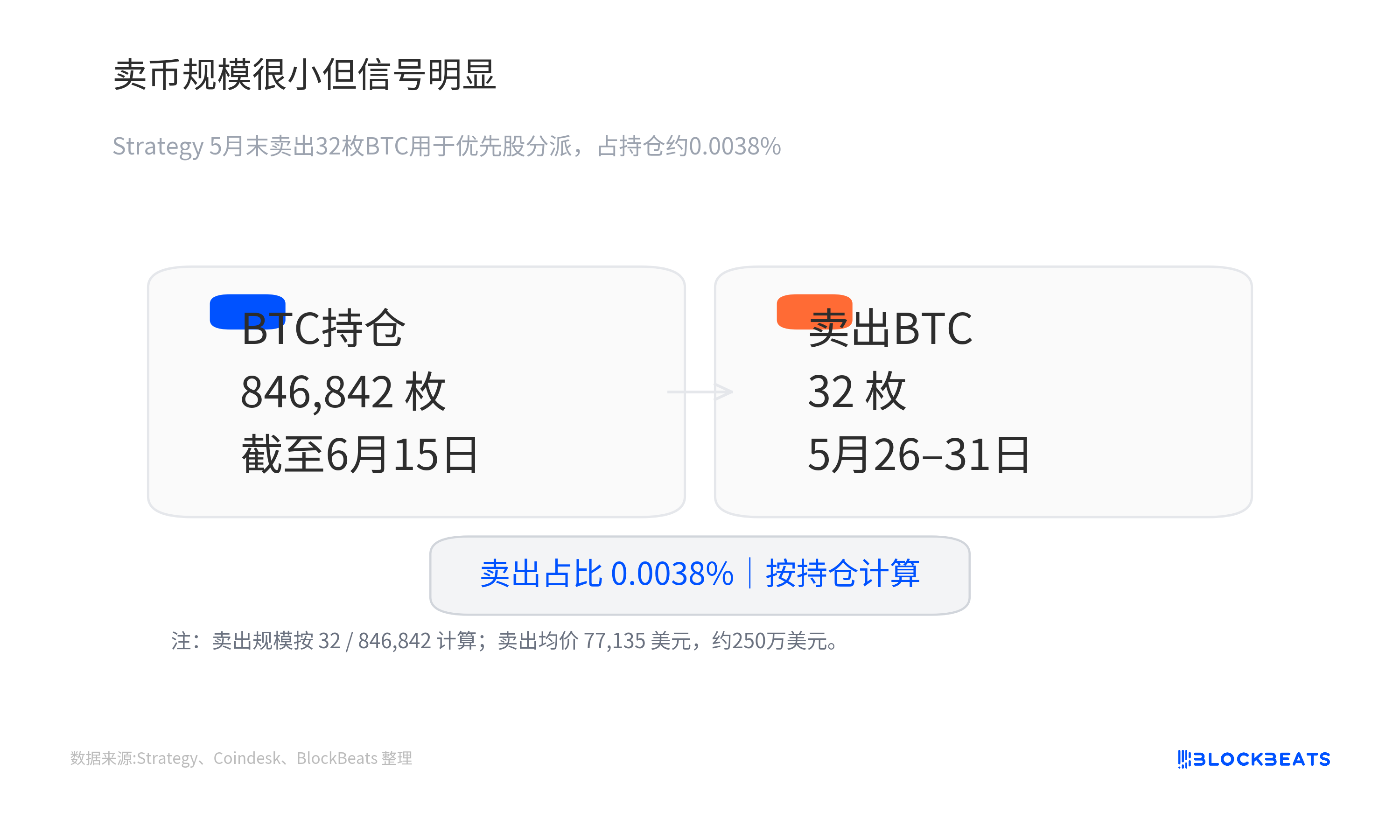
The market did not price it this way. Strategy and Michael Saylor emphasize the asset coverage logic: as of June 15, the company disclosed holding 846,842 BTC, with the credit page showing BTC Years of Dividends at around 31.6 years and an STRC BTC Rating of 3.1x. The market's concern expressed in $89 is another layer: this type of high-yield financing instrument supported by BTC reserves needs to account for higher leverage, liquidity, competition, and cash flow discount.
For holders, the question is not whether 12.9% seems high enough but why the high yield has not pulled the price back to par. This determines whether the current discount on STRC is a temporary overshoot or a new starting point for risk premium.
High-Yield Assets Can Also Trigger Deleveraging
After STRC dropped to $89, one of the most discussed explanations in the market is the potential occurrence of a carry trade unwind.
A carry trade involves borrowing low-cost funds to buy high-yield assets. Investors borrow USD or stablecoin funds to buy STRC, earning the spread between the 11.5% nominal dividend and the financing cost. As long as STRC remains stable around $100, this trade appears relatively stable, backed by Strategy's BTC narrative.
The risk arises when the price anchor loosens. Once STRC drops from around $100 to $95, $92, $89, the risk management logic of leveraged accounts will change. Some investors may need to top up margin, deleverage, or even sell STRC to repay the loan. Selling pressure depresses the price, triggering further risk controls, leading to a scenario where high-yield assets are sold off as the price drops.
It is crucial to maintain boundaries here. Currently, there is no publicly available data at the exchange, brokerage, or custodian level to prove large-scale institutional liquidation. More accurately, if the high-yield narrative of STRC has attracted enough leveraged funds over the past few months, the drop near $89 may not just be a fundamental reassessment but also involve mechanical deleveraging.
This explains why a rise in yield does not necessarily immediately attract buyers. For unleveraged cash buyers, a 12.9% yield is more appealing. For leveraged buyers, a price drop first creates margin pressure, and a higher yield may not be realized in time.
On-Chain Packaging Amplifies Price Adjustment
A new variable for STRC is that it no longer exists solely in traditional brokerage accounts but is also wrapped into DeFi yields and leverage structures.
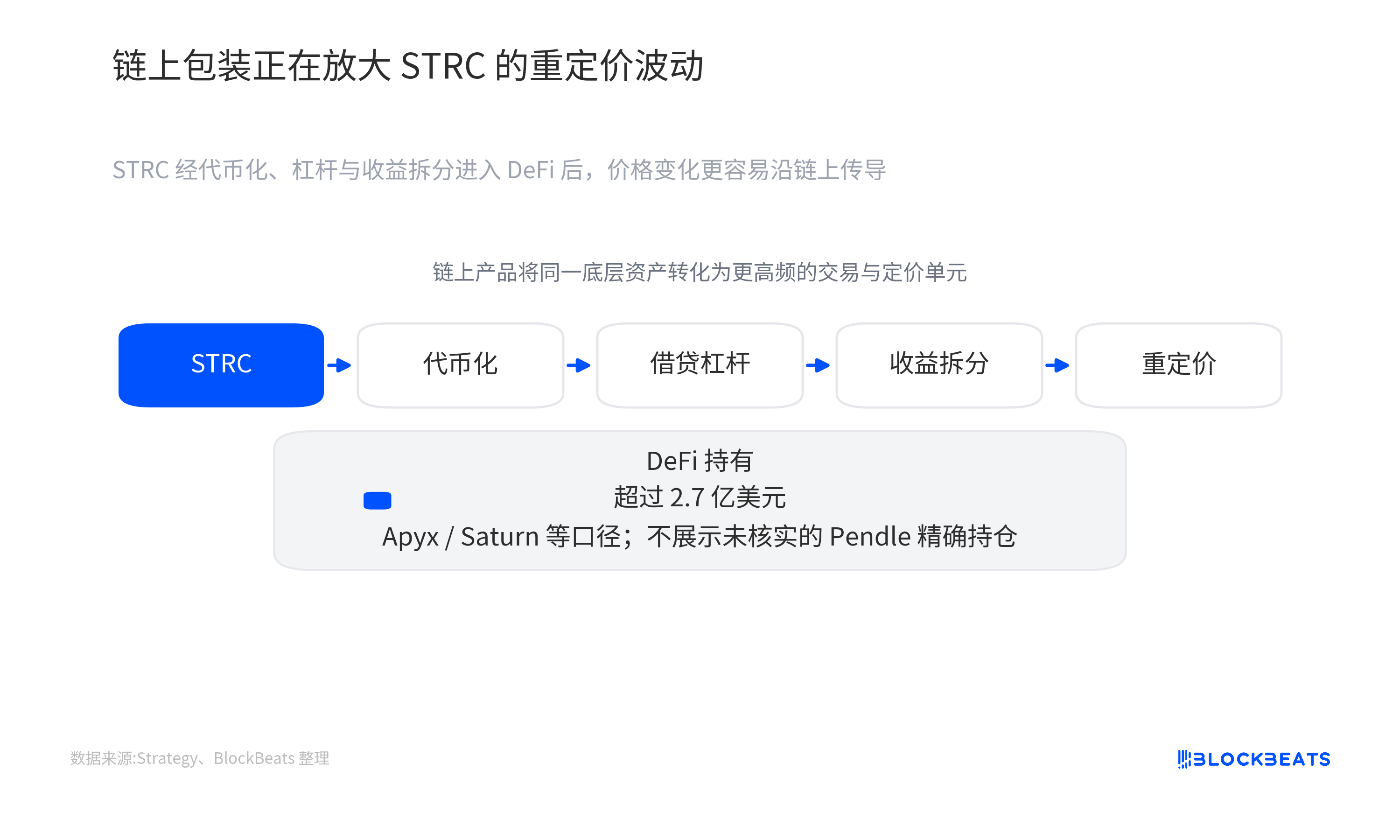
Preferred stocks were originally considered slow assets: with periodic dividends, secondary market trading, and prices revolving around yield volatility. When STRC is tokenized and enters lending, leverage, and yield farming systems, it taps into the faster settlement and speculative mechanisms of the crypto market.
Protocols like Apyx, Saturn, Pendle have built various on-chain products around STRC. Saturn tokenizes it into interest-bearing assets, Apyx provides leveraged yield aggregation, and Pendle can split the asset into PT/YT parts, where PT represents the principal amount and YT represents future yield rights. Investors can trade not only the STRC itself but also bet on discounted principal or future dividend expectations.
In simple terms, this is like breaking down a traditional high-yield preferred stock into multiple layers of encrypted income components. Some buy for stable income, some leverage to amplify the APY, and some individually bet on future dividends. While capital efficiency has increased, so has fragility. Once the underlying asset price drops, on-chain collateral ratios, lending positions, and yield prices may all adjust simultaneously.
A more cautious assessment at present is that STRC has entered the on-chain yield, leverage, and splitting system. The Strategy document mentions around $280 million in Apyx, around $83 million in xSTRC, and around $70 million in STRC-backed stablecoins. The Pendle-related pools and transactions have also reached a considerable scale, but public information is not sufficient to support claims of vault holdings reaching the billion-dollar level.
Therefore, the DeFi packaging is more suitable to be understood as a volatility amplification channel. It may not necessarily be the first domino to fall, nor can it directly prove that this round of decline was led by on-chain liquidation. However, it has made the originally slow price adjustment faster, more transparent, and easier for leveraged funds to trade repeatedly.
SATA Has Changed the Yield Reference Point
The past attractiveness of STRC partly came from its scarcity. It is an important product in the Strategy BTC financing system aimed at yield funds, combining high interest, a BTC narrative, and a relatively clear face value anchor.
The emergence of SATA has weakened this scarcity. According to Coindesk, Strive's SATA offers a 13% annualized yield and has switched to daily dividends from June 16. Compared to STRC, SATA is smaller in scale, has weaker liquidity, and cannot be simply seen as a replacement of the same magnitude. However, for pure yield funds, it provides a new point of comparison.
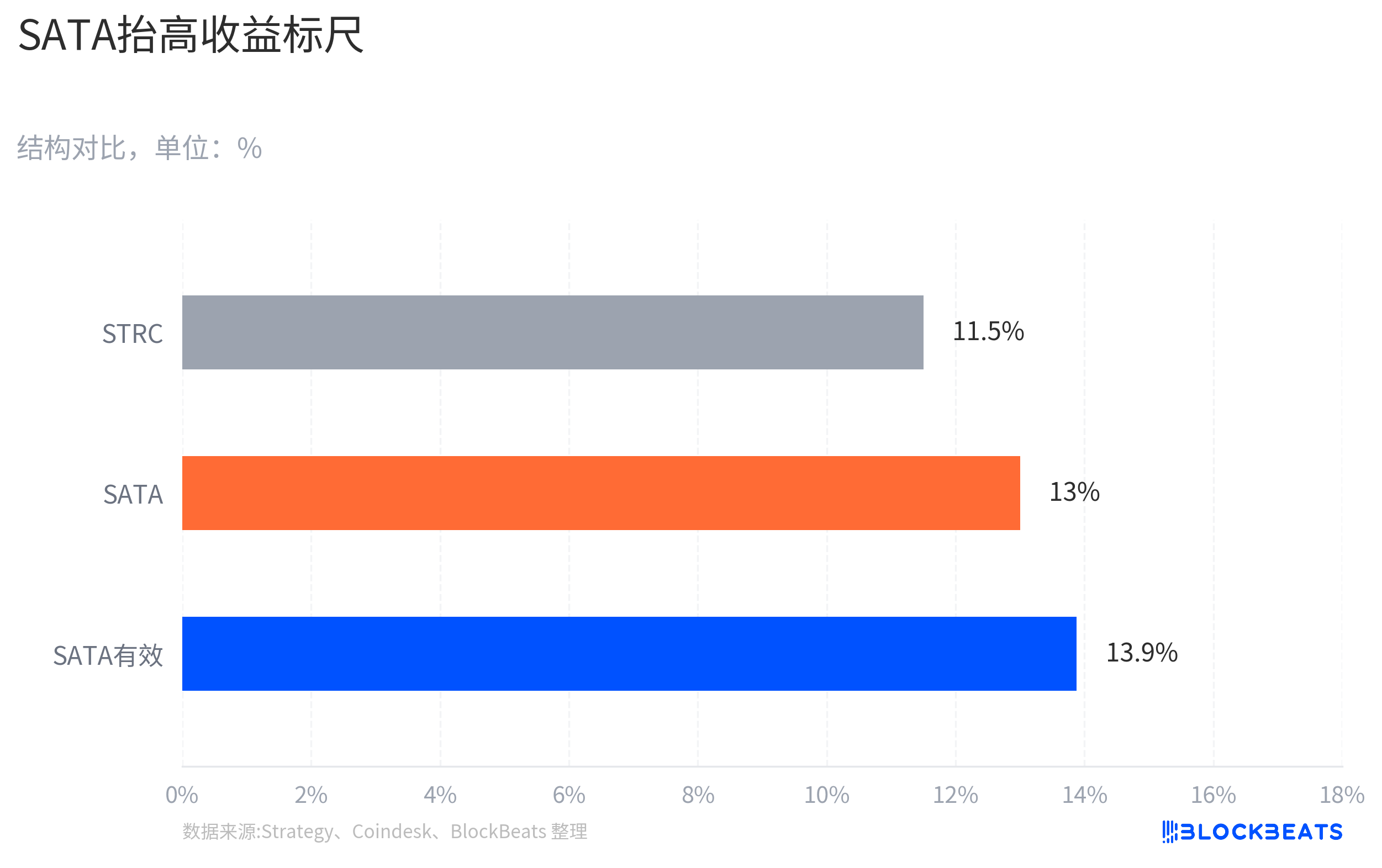
This impact does not need to be based on the premise that funds have already shifted in scale from STRC to SATA. Yield-type funds will compare nominal yield, dividend frequency, liquidity, issuer credit, asset coverage caliber, and secondary market discount. As long as there is a reference with higher yield and more frequent dividend payouts in the market, the original narrative of STRC as a "uniquely high-yield BTC tool" will be reexamined.
At around $100, a 11.5% yield on STRC might be attractive to buyers. But when the price drops to $89, the question becomes: Is a 12.9% simple current yield enough to compensate for the Strategy financing structure, BTC volatility, potential leverage squeeze, and cash flow uncertainty?
The anchor for STRC used to be "Strategy + BTC Reserves + $100 Parity." Now the market has introduced a similar product yield curve. When similar products offer higher nominal yields and more frequent dividends, for STRC to return to parity, it will require stronger buying pressure, more explicit rate expectations, or lower leverage pressure.
Parity Mechanism Faces Cash Flow Doubts
STRC can be understood as a perpetual high-yield preferred stock, with a face value pegged to $100. It has no fixed maturity date, and investors primarily look at two things: whether dividends can be sustained and if the secondary market price can approach par value.
Strategy has designed an adjustable dividend mechanism for STRC. It is not a fully fixed dividend, market-priced preferred stock; the company can adjust the dividend level monthly, aiming to keep the price around $100. Shareholder approval for a bi-weekly payment arrangement is also part of the same price stability strategy: to shorten the dividend waiting period and reduce uncertainty for yield-oriented funds holding the asset.
Another layer of endorsement provided by the Saylor System is BTC Reserve. The Strategy packages STRC into a special security: not a regular bank preferred stock, not a pure crypto token, but a high-yield financing tool backed by one of the world's largest corporate BTC holdings.
However, asset coverage does not mean there is no cash flow risk. The approximately 31.6-year dividend coverage refers to a balance sheet-level buffer, relying on BTC price, financing ability, and the company's long-term capital market access. It does not mean that there is a stable operational cash flow source for every dividend payment, nor does it mean that the secondary market must return to $100.
On June 1st, Strategy disclosed that it sold 32 BTC at an average price of around $77,135, totaling about $2.5 million, between May 26th and 31st for dividend-related arrangements. This scale only accounts for a small proportion of the holdings, far from creating reserve pressure. However, it reminds the market to reorientate two things: having a large amount of BTC and having a consistent cash flow.
Can the Parity Anchor Fix the Determination of Financing Costs
The most crucial validation point for STRC now is not the approximately 31.6-year coverage statement itself but whether Strategy will use an actual mechanism to pull the price back towards $100.
If Strategy continues to maintain an 11.5% annual dividend, and STRC remains around $90 for a long time, the market may perceive that the company's tolerance for rising financing costs has increased, or that the adjustable dividend mechanism has not immediately fixed the detachment from the anchor. Conversely, if the company further raises the dividend rate, adjusts the issuance pace, or enhances secondary market confidence in other ways, $89 is more likely to be seen as an excessive discount after the leverage tide recedes.
On-chain indicators also need to be observed. Whether STRC-related positions in products like Apyx, Saturn, Pendle have cooled down, whether collateral and yield-split transactions are stable will determine whether DeFi amplifiers continue to increase volatility or become a source of demand again after deleveraging. The size and liquidity of SATA are also critical. If it is just a small-scale high-yield benchmark, its impact on STRC is more about valuation comparisons; if it continues to expand and maintain daily dividends attractiveness, the scarcity discount of STRC will be harder to dissipate.
For investors, $89 is not just a cheap price tag, nor is it evidence of the failure of the Strategy model. It is more like a stress test: when BTC reserves, high nominal dividends, on-chain leverage, and competitive products are all presented to the market simultaneously, how high of a yield rate are investors willing to hold such instruments for. The next dividend adjustment, whether STRC can return to near parity, and whether leveraged positions continue to unwind will better answer this question than the coverage statement of the years.
Welcome to join the official BlockBeats community:
Telegram Subscription Group: https://t.me/theblockbeats
Telegram Discussion Group: https://t.me/BlockBeats_App
Official Twitter Account: https://twitter.com/BlockBeatsAsia
