SK Hynix American Depositary Receipt (ADR) will be listed on the U.S. stock market in July, with plans to raise up to 45 trillion Korean won through the ADR listing, equivalent to approximately $29 billion.
In simple terms, this means that SK Hynix will have a direct presence on the U.S. stock market. The most immediate question is whether the DRAM ETF will be affected.
DRAM refers to the Roundhill Memory ETF, which mainly invests in the memory chip industry. Its core holdings include SK Hynix, Samsung, Micron, and other companies, essentially representing a "memory + HBM + AI storage" thematic ETF. Previously, U.S. stock investors who wanted to directly buy SK Hynix found it inconvenient, so the DRAM ETF to some extent served as a "U.S. stock proxy for SK Hynix." In other words, some of the funds invested in DRAM may not actually want to buy the entire memory basket but rather SK Hynix.
If SK Hynix ADR is listed, allowing investors to directly buy SK Hynix on the U.S. stock market, will the funds that previously bought DRAM due to the unavailability of SK Hynix now sell off DRAM and switch to buying SK Hynix ADR?
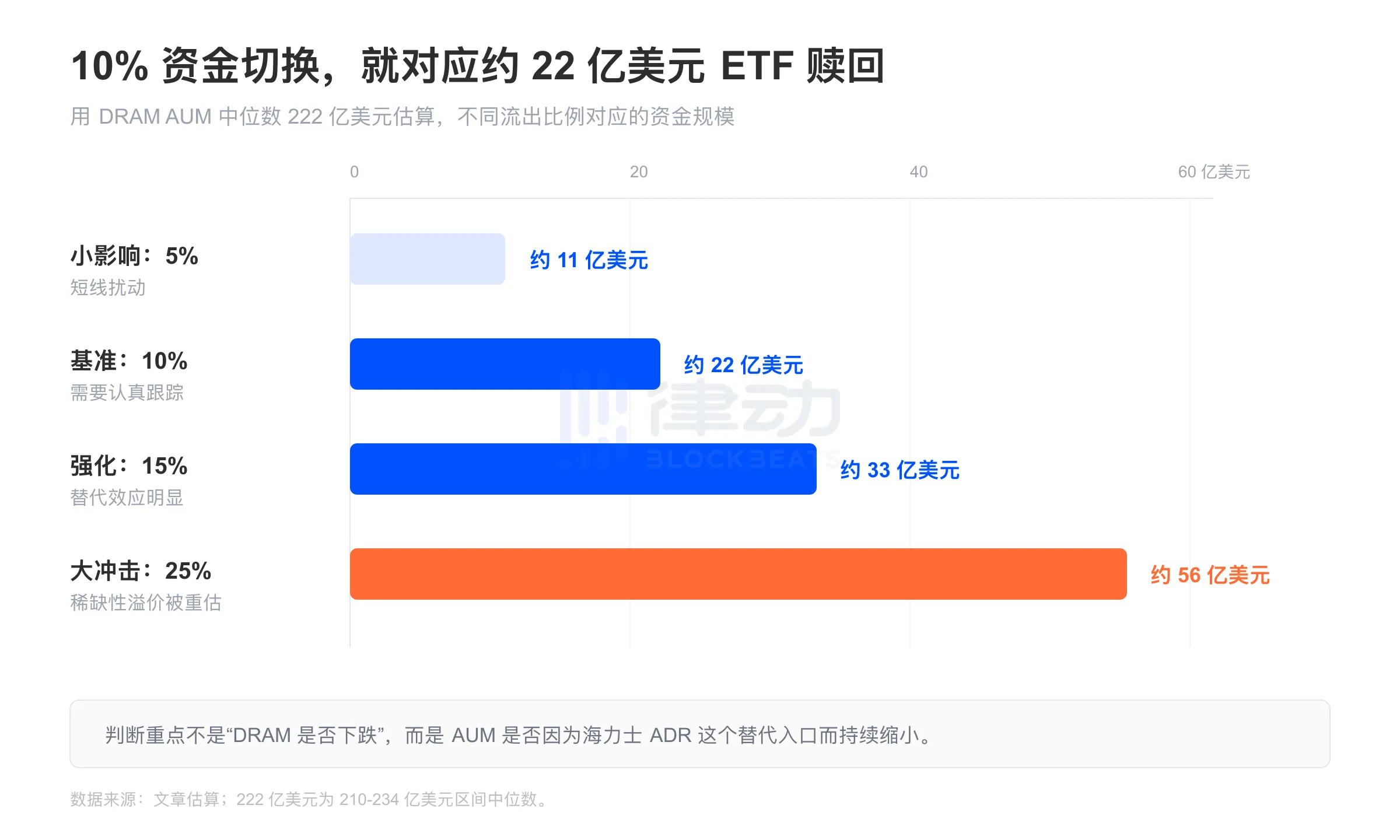
Based on current data, the size of the DRAM market is estimated to be in the range of $210-234 billion, with SK Hynix's weight accounting for approximately 24%-27%. This means that there is an implicit SK Hynix exposure within DRAM of about $50-63 billion. If 10% of the DRAM funds flow out due to the listing of SK Hynix ADR, it would correspond to ETF redemptions of $21-23 billion.
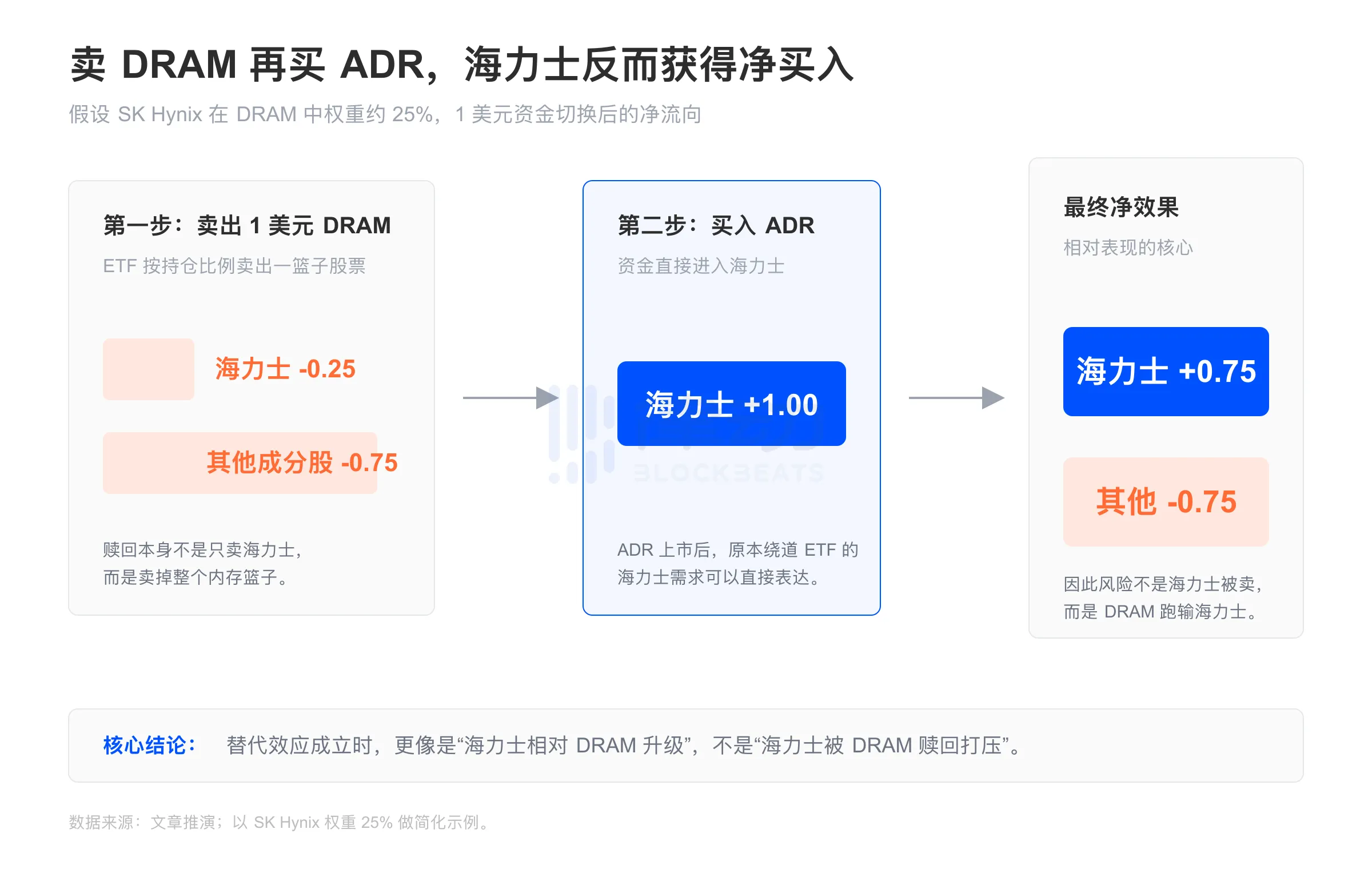
However, there is a crucial detail here: when selling $1 worth of DRAM, the fund does not only sell SK Hynix but sells a basket of stocks according to their weightings. Assuming SK Hynix has a 25% weight, selling $1 worth of DRAM would result in the fund selling $0.25 worth of SK Hynix and $0.75 worth of other component stocks. If investors then use this $1 to buy SK Hynix ADR, the net effect would be: SK Hynix receives approximately $0.75 in net purchases, while other component stocks face about $0.75 in net selling pressure.
Therefore, after the listing of SK Hynix ADR, the most likely scenario is not SK Hynix being suppressed but SK Hynix outperforming DRAM. The issue with DRAM is that its scarcity as a "SK Hynix substitute" will decrease. If funds indeed start flowing towards ADRs, DRAM may experience shrinking scale, relative underperformance, and decreased liquidity.
However, this does not mean that DRAM will immediately lose its value. Because DRAM is not only supplied by Hynix, but also by other companies in the memory and storage industry chain such as Samsung, Micron, and SanDisk. In particular, Samsung is still not a target that ordinary US stock investors can directly buy, so there is still some scarcity in DRAM.
If you hold DRAM, you can pay attention to the following indicators (as mentioned by GPT5.5):
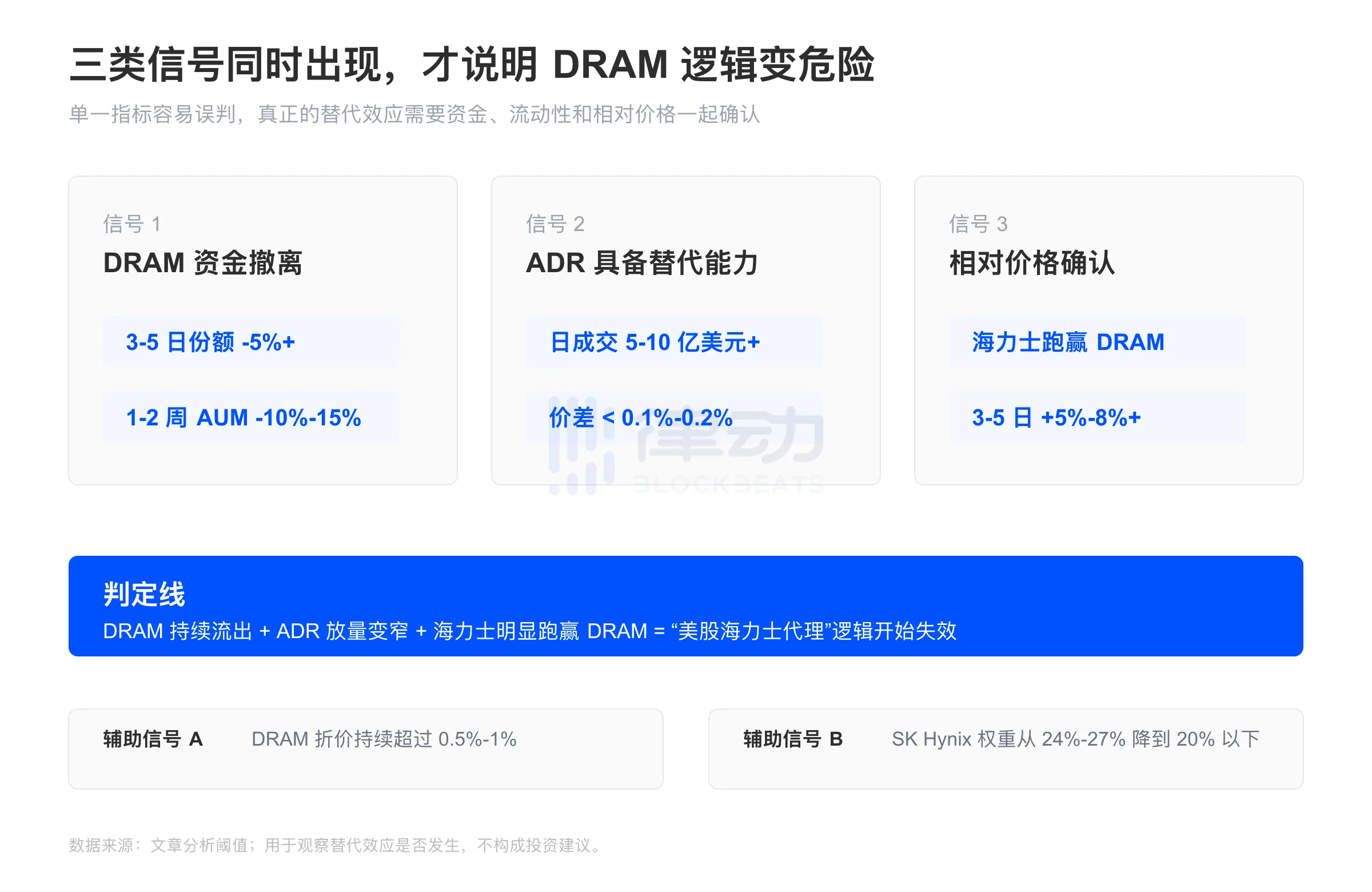
First, look at the number of DRAM shares and net inflows. If after the ADR listing, the number of DRAM shares decreases by more than 5% within 3-5 trading days, or if AUM outflows by 10%-15% within 1-2 weeks, while memory stocks do not experience a synchronous sharp decline, it indicates that funds are indeed actively exiting the ETF.
Second, look at the trading volume and liquidity of Hynix ADR. If the daily trading volume of the ADR consistently reaches $500 million to $1 billion or more, with a bid-ask spread of less than 0.1%-0.2%, it means that it has the necessary trading conditions to replace DRAM. Otherwise, even if the ADR is listed, institutions and large funds may not be able to switch smoothly.
Third, see if Hynix significantly outperforms DRAM. If after the ADR listing, within 3-5 trading days Hynix outperforms DRAM by more than 5%-8%, and at the same time DRAM experiences net outflows, this is a strong signal of substitution effect.
Fourth, observe if DRAM is consistently trading at a discount. If the ETF closes at a continuous discount of more than 0.5%-1%, or if it trades at an intraday discount, it indicates that there is significant selling pressure in the secondary market, and the market making and creation/redemption mechanism are under pressure.
Fifth, see if the weight of Hynix in DRAM holdings is decreasing. If the weight of Hynix decreases from around 24%-27% to below 20%, then DRAM is becoming less like a "Hynix proxy" and more like a typical memory basket.
Welcome to join the official BlockBeats community:
Telegram Subscription Group: https://t.me/theblockbeats
Telegram Discussion Group: https://t.me/BlockBeats_App
Official Twitter Account: https://twitter.com/BlockBeatsAsia
