The frenzy around meme coins continues to heat up, further fueling the ecosystem of Robinhood Chain. Just two weeks after its mainnet launch, this new public chain has rapidly entered the market's spotlight with astonishing growth, continuously breaking on-chain activity records, and several key metrics are approaching or even surpassing mainstream chains like Solana and Base.
With the continuous influx of funds, users, and liquidity, while Robinhood Chain firmly holds the spotlight, its ecosystem projects are also leveraging this wave of growth.
$4 Billion in Two Weeks of Trading, Multiple On-Chain Metrics Skyrocket
Robinhood Chain is rising at a faster-than-expected pace, rapidly becoming one of the most active public chains and attracting market attention as a new "dark horse."
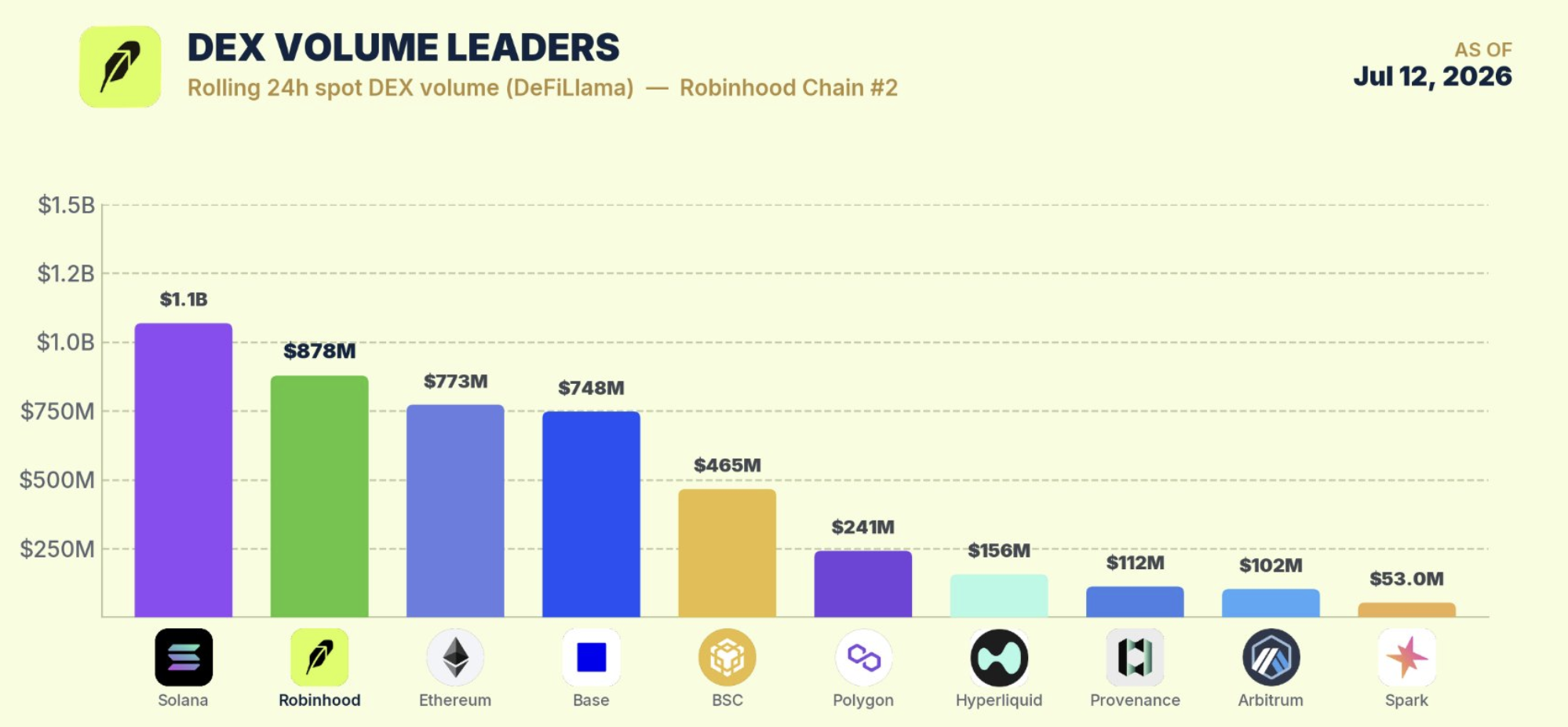
According to DeFiLlama data, since the mainnet launch, Robinhood Chain's cumulative DEX trading volume has surpassed $3.98 billion. In the past 24 hours, its DEX trading volume is second only to Solana, ranking second globally and surpassing Ethereum, Base, and BNB Chain, among other public chains.
When observing in the Ethereum L2 space, this growth trend becomes even more apparent.
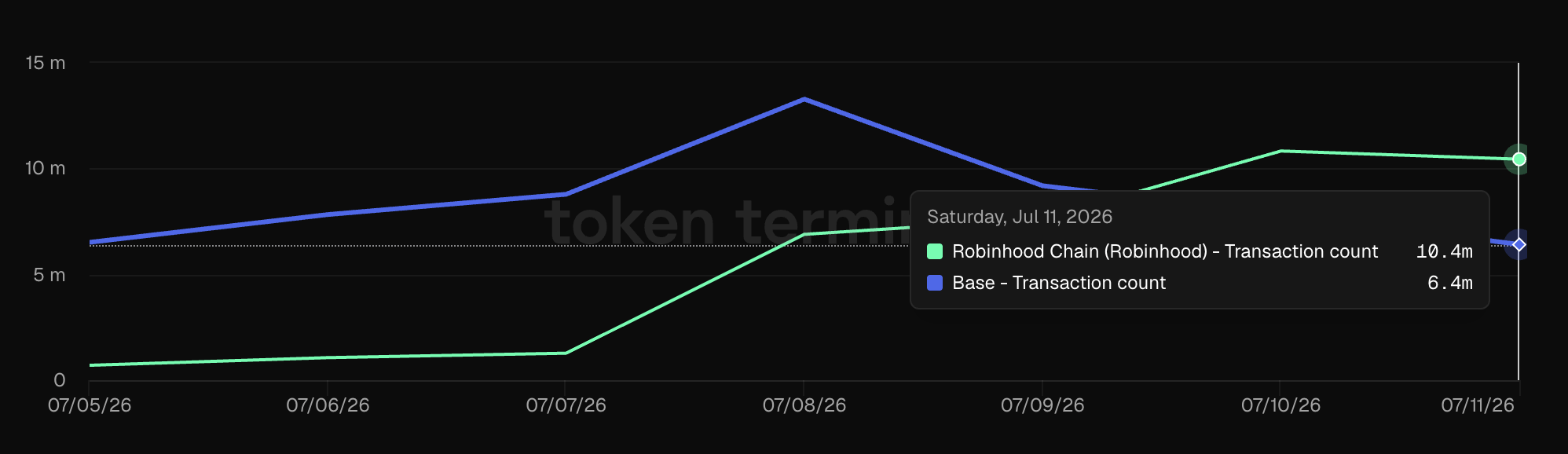
Also as an Ethereum L2 solution, Robinhood Chain, less than half a month after its launch, has already exceeded Base in on-chain transaction activity. Token Terminal data shows that on July 11th, Robinhood Chain had a daily transaction count of 10.4 million transactions, while Base had around 6.4 million transactions. Meanwhile, L2BEAT data indicates that Robinhood Chain's Ethereum DA (Data Availability) usage has also surpassed Base, making it the second-largest consumer of Ethereum DA.
In addition to transaction activity, the growth in the number of users is also noteworthy.
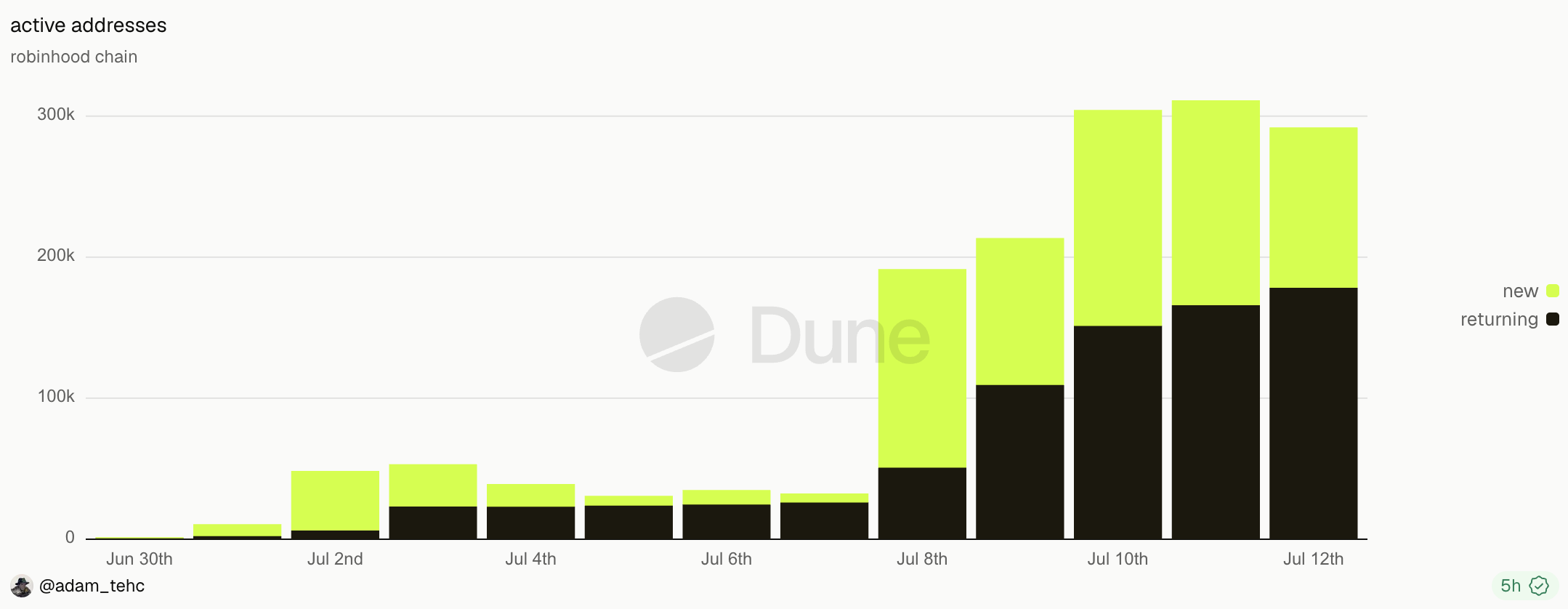
According to Dune data, the number of active addresses on Robinhood Chain has increased approximately 5 to 8 times compared to the previous week, and in the past three days, new addresses accounted for over 45.4% of active addresses. This indicates that the current growth is not reliant on high-frequency trading by existing users but is continuously attracting new funds and users.
From the perspective of the entire EVM ecosystem, Robinhood Chain has become one of the fastest-growing public chains in terms of wallet activity recently, with DEX active wallets quickly rising to second place in the EVM, second only to BNB Chain.
Whether in terms of transaction volume, transaction frequency, or new users, for a new player that has been live for less than two weeks, Robinhood Chain's growth rate has far exceeded market expectations.
Meme Contributes Over Half of the Transaction Volume, Risks Hidden Behind the Buzz
The current rapid growth of Robinhood Chain is largely driven by the on-chain prosperity brought by Meme coins.
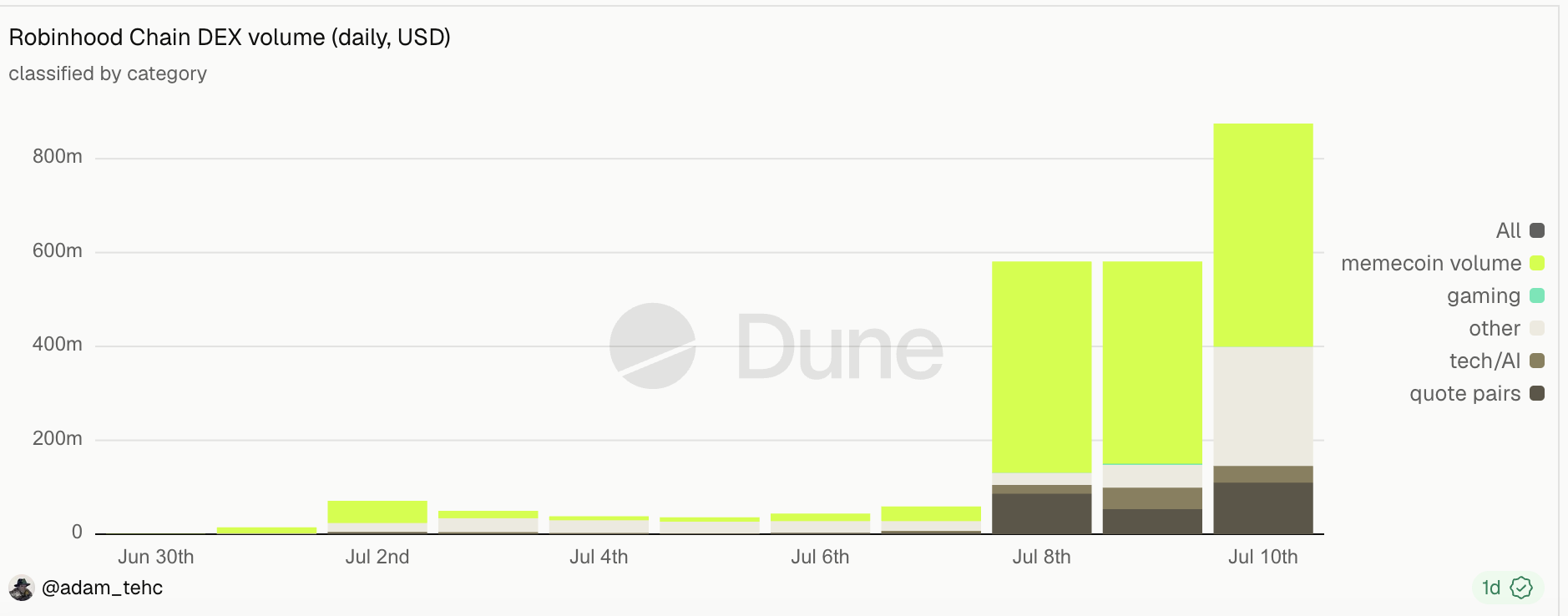
According to Dune data, on just July 10, Meme coins contributed approximately 54.3% of Robinhood Chain's on-chain transaction volume, becoming the most core liquidity source in the ecosystem.
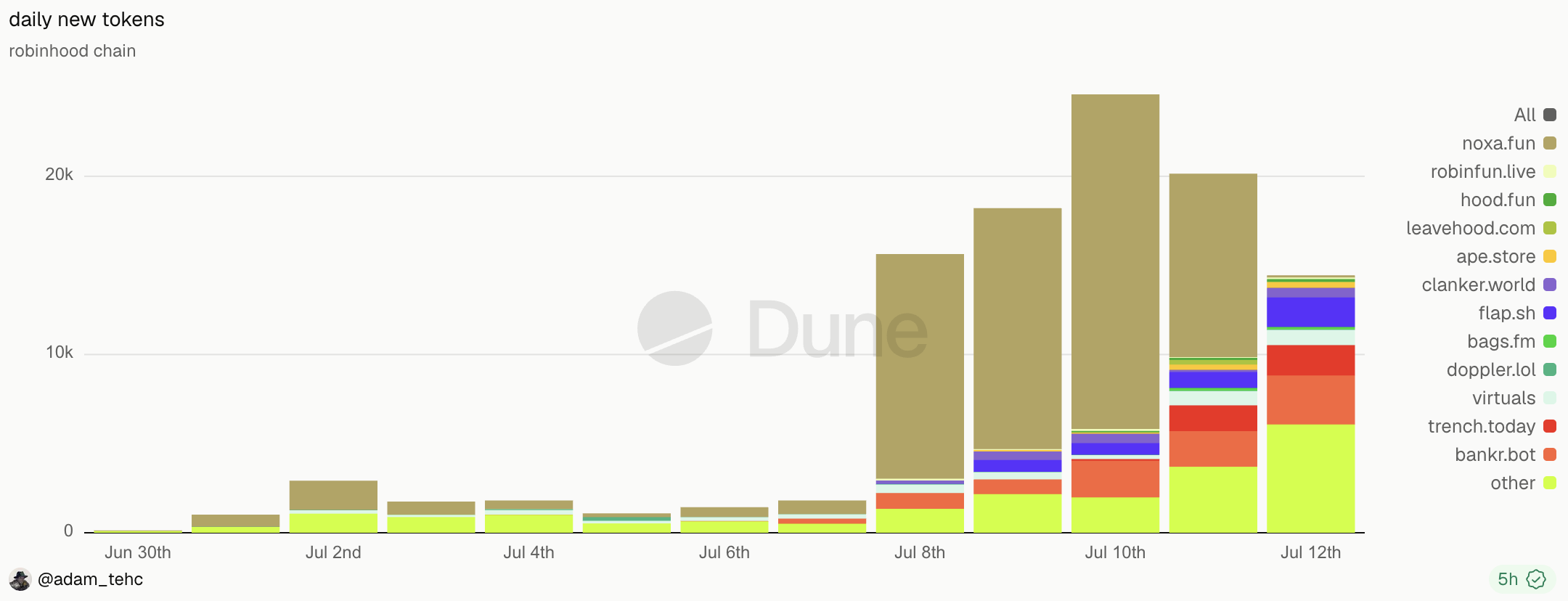
With the continuous increase in trading activity, the on-chain token issuance speed is also rapidly rising. Dune data shows that the number of new tokens created daily on Robinhood Chain recently surpassed 24,000 at one point; at the same time, the Meme launch platform has expanded from just a few to over a dozen.
However, the market funds are still highly concentrated in a few top tokens. Currently, the total market value of Meme coins on Robinhood Chain has exceeded $240 million, with Cashcat alone accounting for about 59.6% of the market value. Apart from the top tokens, there are only around 20 Meme coins with a market value reaching the million-dollar level, and overall liquidity for long-tail projects remains limited.
As the Meme ecosystem rapidly heats up, security risks are also on the rise. Cross-chain interoperability platform Relay Protocol recently issued a security warning stating that a large number of honeypot scam tokens have appeared on Robinhood Chain, where tokens disappear from wallets automatically after users purchase them, and funds cannot be recovered.
Relay Protocol pointed out that these attacks do not involve wallet intrusions, and users' private keys and other assets remain secure; the malicious logic only exists within the scam tokens' smart contracts. Typically, these honeypot tokens allow normal purchases by users but restrict selling through preset rules, and can even directly transfer funds to wallets controlled by the attacker. Some community users have discovered that certain malicious contracts also exploit hidden storage mappings to bypass standard ERC-20 security checks, thereby facilitating asset theft.
In response, the Relay Protocol suggests that users should transact with tokens verified by trustworthy sources, verify the contract address before transactions, and first conduct a small-value transaction as a test. Of course, becoming a hotbed for scammers in the early days of a new chain launch is not a phenomenon unique to the Robinhood Chain. Previously, many Layer 1 and Layer 2 networks have gone through similar stages.
In addition, there have been incidents of hype and manipulation. For example, community users revealed that the Robinhood founder allegedly leaked his mnemonic phrase during a live broadcast. Subsequently, hackers took control of the associated address and used that address and multiple related wallets to heavily buy the Meme coin on Robinhood Chain for $1, attracting a large number of investors to follow suit. In a short period, they quickly pumped the token's market value from around $500,000 to $14 million. After the related address was frozen, the attacker swiftly moved to the BNB Chain, continued to use the same group of associated addresses to issue new tokens, created trading activity through wash trading, and ultimately cashed out.
The on-chain analysis platform Bubblemaps also disclosed that there is a high degree of concentration in the lending protocol ArrowFinance's token ARROW on the Robinhood Chain, with 80% of the chips concentrated in associated addresses. Among them, a massive cluster consisting of 200 wallets had no on-chain EVM activity records before and all completed purchases within 3 minutes of the token launch, with simultaneous funding from the same source, indicating a potential sniper attack on the token issuance. In addition to ARROW, they also found several similar large associated address clusters on the Robinhood Chain.
It can be seen that the Meme coin has successfully achieved a cold start on the Robinhood Chain.
Behind the On-Chain Frenzy, Who Is Capturing This Ecosystem Dividend?
The on-chain activity on the Robinhood Chain continues to rise, also driving various sectors such as DEX, lending, Launchpad, and infrastructure to benefit simultaneously.
· Uniswap
As the primary DEX on the Robinhood Chain, Uniswap has almost single-handedly handled the entire ecosystem's trading volume.
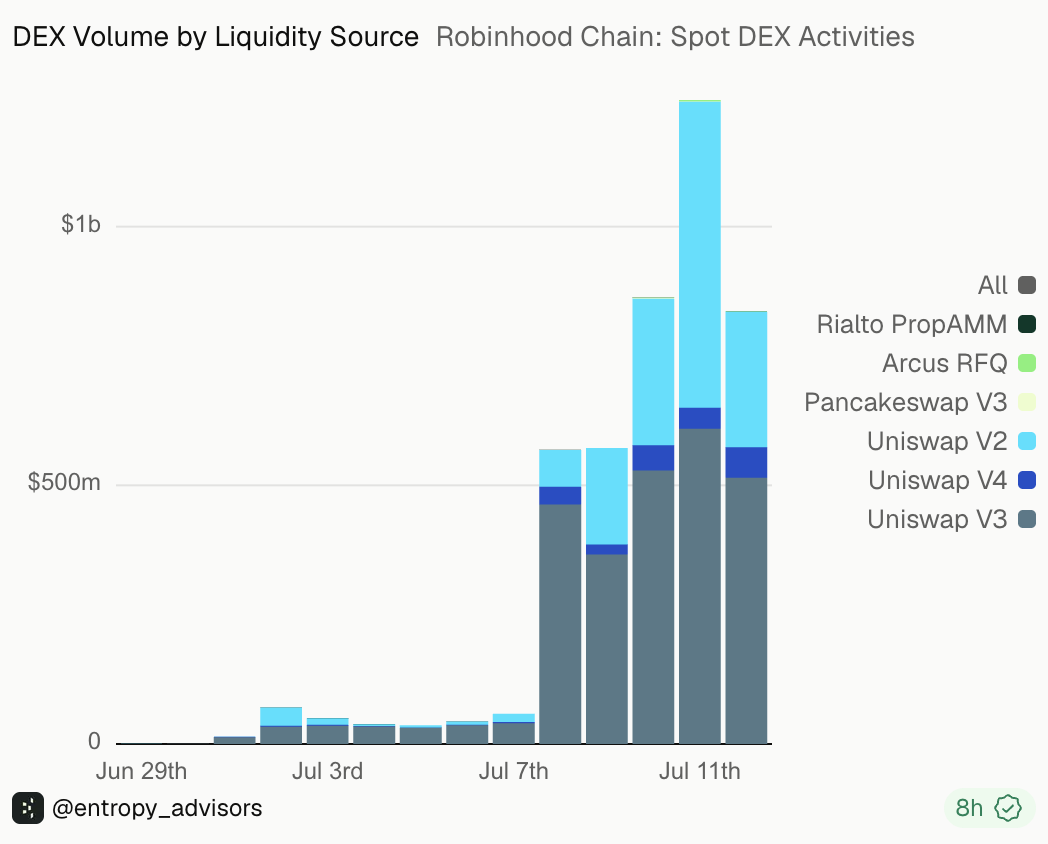
According to Dune Analytics, on July 12, the total trading volume of various versions of Uniswap on the Robinhood Chain exceeded $830 million, accounting for 99.8% of the DEX trading volume on the chain, creating an almost monopolistic market situation.
The increase in transaction activity has directly contributed to the protocol's revenue growth. Data from DeFiLlama shows that in the past 24 hours, Uniswap protocol has generated approximately $4.97 million in transaction fees, ranking behind only Tether and Circle, and surpassing popular protocols such as Hyperliquid and Pump.fun.
It is worth noting that Uniswap has now implemented a protocol fee burning mechanism for UNI and has proposed to extend this fee mechanism to networks like the Robinhood Chain. If implemented in the future, the transaction growth on the Robinhood Chain is also expected to further enhance UNI's value-capture capability.
· Morpho
With its DeFi yield products, Morpho has become the largest capital pool on the Robinhood Chain. Data from Dune shows that as of July 12, the total value locked (TVL) in the Robinhood Chain protocols is approximately $306 million, with over $120 million deposited in Morpho, accounting for 39.2% of the total TVL and ranking first in the ecosystem.
· Ethena
As the primary collateral asset issuer for Robinhood Earn, Ethena has also benefited from continuous capital inflows. Data from Dune shows that as of July 12, Ethena's TVL on the Robinhood Chain has reached $99.59 million, accounting for 32.4% of the total TVL, ranking second only to Morpho.
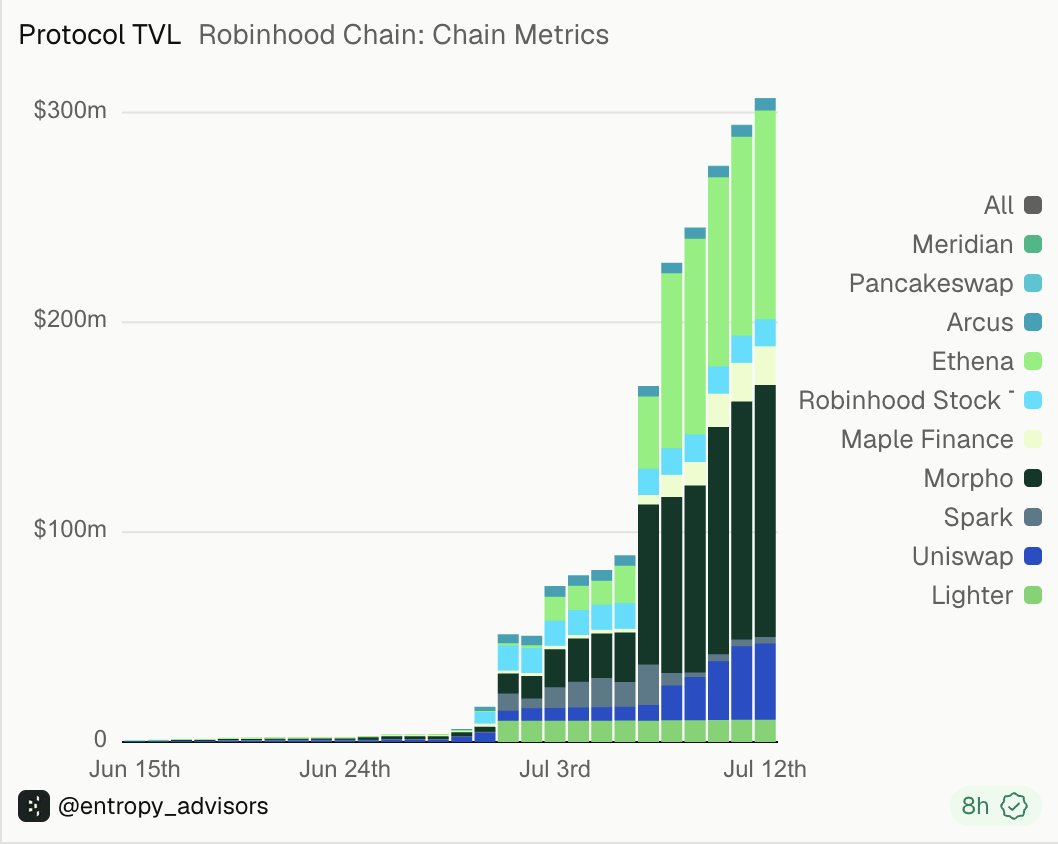
Meanwhile, the total stablecoin supply on the Robinhood Chain has exceeded $290 million. Among them, the USDe issued by Ethena is approximately $99.59 million, and the USDG treasury jointly operated by Ethena and Steakhouse holds around $50 million in assets, totaling nearly $150 million.
· NOXA.fun
As the leading Launchpad on the Robinhood Chain, NOXA.fun has undertaken most of the ecosystem's coin issuance demands, and is also the issuance platform for the flagship Meme project Cashcat.
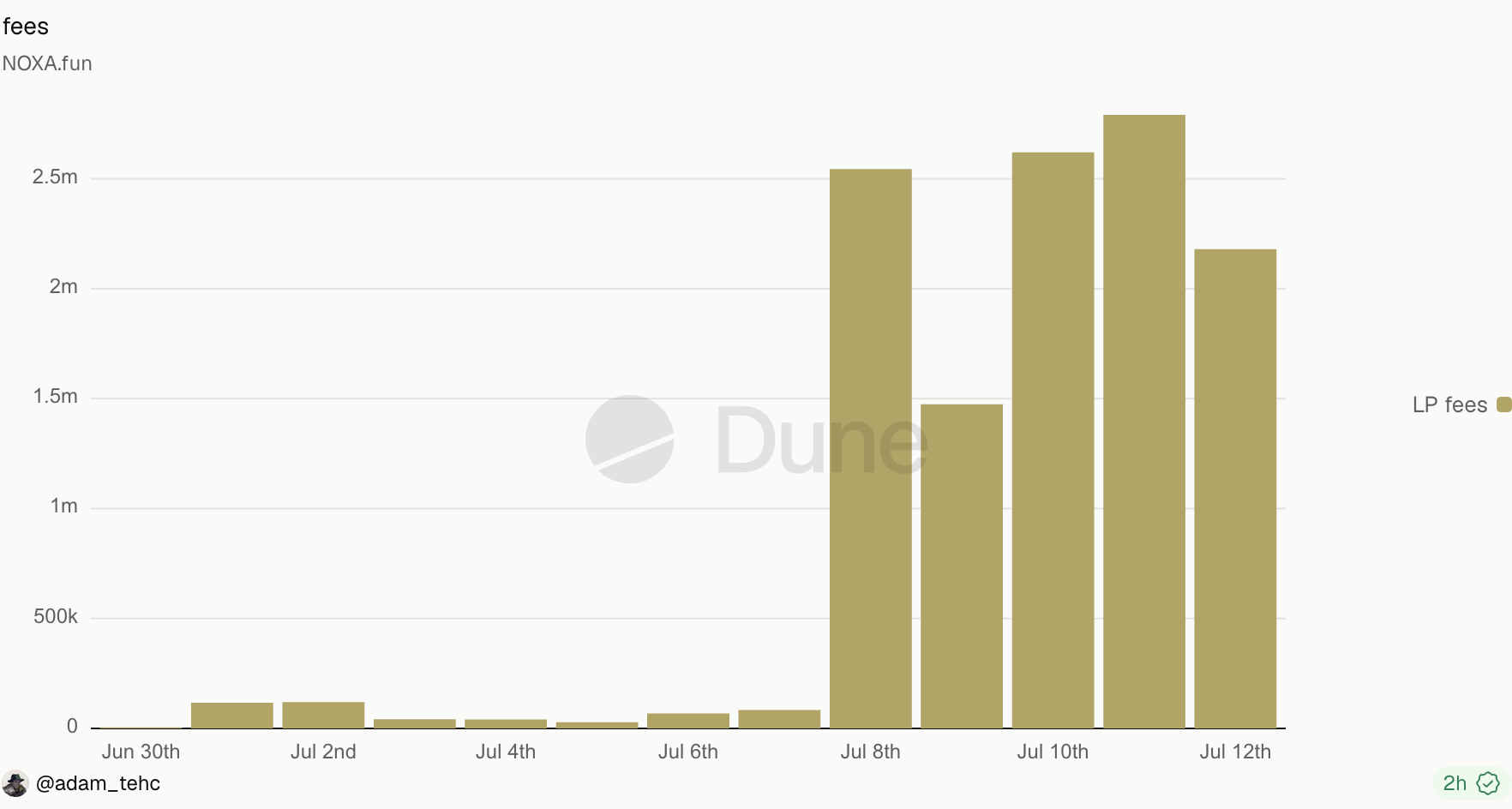
According to Dune data, on July 11th, the amount of tokens issued by NOXA.fun accounted for 51% of the total new tokens issued on the chain. Currently, the platform has accumulated over 260,000 active addresses, and the protocol's total revenue has exceeded $13 million. In just the past 24 hours, the protocol's fees have reached $1.94 million, surpassing even the $1.61 million of Pump.fun, a leading Solana launchpad during the same period.
However, due to the increasing prevalence of copycat projects and the mass creation of tokens by bots, NOXA.fun has temporarily disabled the new token issuance function and stated that they are looking for a suitable solution. Additionally, on July 12th, the team burned 40% of the NOXA token supply, which was issued on the DBK Chain developed by the team in 2025 on DeBank, which has been inactive since then.
· Arbitrum
As the underlying technology provider for the Robinhood Chain, Arbitrum has also benefited from ecosystem expansion. Propelled by the Robinhood Chain, ARB has risen by approximately 16.1% in the past week.
Brendan Ma, Investment Strategy Lead at the Arbitrum Foundation, recently stated that the annualized transaction revenue on the Robinhood Chain has reached $12.5 million. According to their collaboration agreement, 10% of the protocol's net revenue will be returned to the Arbitrum ecosystem, with 8% going to the DAO treasury and 2% allocated for ecosystem development.
However, in terms of actual revenue, Dune data shows that the cumulative protocol net revenue of the Robinhood Chain is only around $717,000 so far. Therefore, ARB's current price increase is more attributed to market expectations of future revenue growth rather than actual revenue contribution.
· Arcus
Another noteworthy project is Arcus, a perpetual contract trading platform built by the original dYdX team. DeFillama data indicates that in the past 7 days, Arcus has accumulated a trading volume exceeding $5.16 million, making it the second largest DEX on the Robinhood Chain. However, the current rapid growth in Arcus's trading volume is largely seen by the market as related to expectations of potential airdrops.
However, for Robinhood Chain, the real test may just be beginning, and the duration of the Meme hype remains unknown. More importantly, it is worth paying attention to whether this wave of traffic can truly settle into its real users, long-term capital, and a more resilient ecosystem.
Welcome to join the official BlockBeats community:
Telegram Subscription Group: https://t.me/theblockbeats
Telegram Discussion Group: https://t.me/BlockBeats_App
Official Twitter Account: https://twitter.com/BlockBeatsAsia
