Yesterday in the early morning hours, Base co-founder Jesse Pollak posted a very long tweetstorm on Twitter, looking back at the past two years of Base's development strategy and reflecting on what went well and what didn't.
This was a very candid tweetstorm, acknowledging mistakes is never an easy thing to do. Jesse felt that leading Base to bet heavily on the social aspect, expecting an on-chain native social experience to drive mainstream adoption of Base and even cryptocurrency was a mistake. However, the other bet, that application developers on Base would drive mainstream adoption through creating great applications, was the right call.
Now, he has handed over the Base App (Base's super app, not on the Base chain) to Cobie to take charge, while he himself returns to focus on developing the Base chain. As a player in the on-chain space, looking back at some of Jesse's actions over the past two years, while I highly commend the candid nature of his "self-accusation," I also feel that his understanding still has room for debate.
Social Bet: 0 Points
The native on-chain socialization did not bring any enhancement to the public's social experience, and even made the idea of socializing more complex. In fact, I really hope that Jesse can thoroughly analyze in his "self-accusation," the construction of a brand-new social application Farcaster. What new social fun can users enjoy from this application, what new form of social content can they obtain, or whether this application itself provides users with a new and innovative path to forming a social network, so that he and the entire Base community feel that this initiative can challenge the traditional social media market to drive mainstream adoption of Base...
If this was for the ideal of decentralized socialization, this move might score some points. But if it was thought to drive mainstream adoption, it can only be a pure 0 points.
Let's continue. In terms of social aspects, Jesse also mentioned creator tokens and referenced the recent hype around $ANSEM on Solana. He also mentioned Harberger tax, expressing uncertainty whether his timing in pushing Zora was wrong or if the whole idea of creator tokens was flawed from the beginning.
This understanding also receives 0 points. Firstly, aggressively promoting the concept of "creator tokens" is already peculiar. In the debates between Jesse and Toly back in the day, it was evident that Jesse believed "content" has value, the creator themselves as a personal brand has value, so this is different from meme coins. It has fundamentals, and I want to promote something with fundamentals.
But who would be convinced by this logic? Anyway, Jesse took the lead in launching a $JESSE, and almost 240 days later, the situation is as follows:
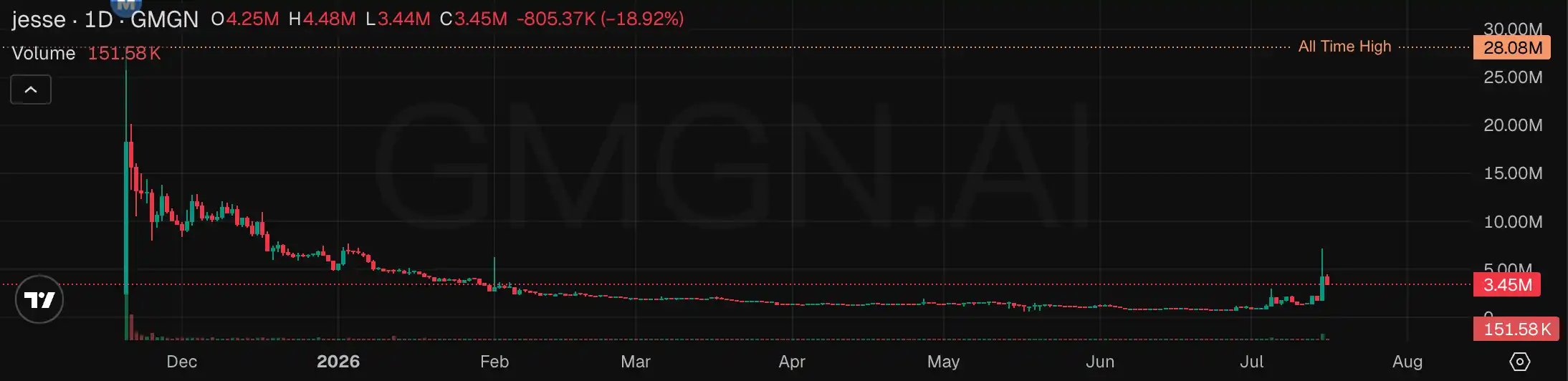
While content and personal IP do have value, is issuing a token a uniquely effective monetization channel? What level of creators can you attract? How can you ensure that the value you emphasize has a reasonable logic chain? There are too many issues to be resolved in between, but the feeling Base gives is, "I've set up the stage, and people will come."
In this regard, Jesse's understanding is completely inferior to Toly's. At least Toly can still say, "Meme coins are worthless, but in-game items and skins are also worthless, yet people around the world are still willing to spend hundreds of billions of dollars a year on worthless things."
$ANSEM is not at all the type of "creator token" Jesse advocated. First of all, it was not issued by Ansem, nor was it created by him to monetize his personal IP, making it a situation that doesn't fit anywhere.
In conclusion, Jesse, you are really off track in the social aspect, but you haven't realized it yet. In fact, the best reference sample in the Crypto + Social sector so far should be the social trading application FOMO.
Lagging Behind in the Perp DEX Field: 80 Points
In fact, the score could have been even higher. In a horizontal comparison, Solana has not been able to demonstrate much stronger competitiveness in the field of Perp DEX and prediction markets compared to Hyperliquid and Polymarket, not surpassing Base.
The reason Jesse feels quite frustrated is, "Because we were too focused on social, we couldn't keep up in these two areas." This is a bit too demanding on oneself, after all, hindsight is 20/20, and Hyperliquid is a competitor who has completely figured out this track and has not shown up, while Perp DEX is just like GMX or dYdX. As for prediction markets, Polymarket has a first-mover advantage, and it's not a significant competitive failure.
Moreover, Base has been quite successful in the AI aspect, not only having a presentable narrative on-chain but also leading the market. In terms of specific targets, there are major targets like $vvv that have attracted attention across the entire market and platforms like Virtuals. The x402 protocol is in a leading position in Agent payments and has also made USDC the stablecoin with the absolute highest share of Agent-to-Agent payments.
The success of Base in AI narratives has also extended to some AI-related technology narratives, such as the focus on the robotics track. Those who have performed well in this area have also appeared frequently on Base. In terms of RWAs, before Solana dominated on-chain stock token spot trading with $SPCX, on-chain players would also think more about Base. For example, the $LFI project, which previously conducted on-chain transactions for property tax liens.
If Jesse has done poorly in this regard, I believe it is actually related to what he mentioned at the beginning of the article: "Betting on Base's application developers will also drive mainstream adoption through the creation of good applications." In fact, Base's support for its own on-chain developers is not as good as he claims. From the perspective of on-chain players, when selecting a target on Base, it is crucial to see if the project team can establish a relationship with the Base team. It's essential to play within the "circle." Cases where a developer has a sudden inspiration and creates a hot project outside Base's favored track and quickly receives Base's support are actually very rare.
At the beginning of this year, some developers complained about this point, as mentioned in an article titled "A Developer Has Wasted Three Years on Base". I think that not delving deep into the developer community and the market may be the reason why Base appears relatively weak in the innovative competition of the new narrative sector, similar to attaching too much importance to the social aspect.
Jesse's Reflection: 60 Points
Does cryptocurrency need social interaction to drive mass adoption on a billion-user scale? Jesse used to believe that it definitely does and is the only path. Now, he believes that stablecoins, prediction markets, Perp DEX, and RWAs can also drive adoption, not just social interactions.
Therefore, he stated that Base will focus on winning the competition in three areas: trading, payments, and AI Agents. Base aims to become an indispensable part of global financial on-chain transformation.
Jesse realized one thing – it is more effective for policies to suddenly become friendly or supportive of stablecoins, RWAs, prediction markets, and other tracks than to spend a lot of effort trying to attract users to cryptocurrency and act as a pioneer in crypto evangelism. No matter how much you promote Bitcoin/stablecoins for real-world payments, you may only attract users like those in Venezuela or Africa who have a real need to hedge against inflation. This is a national-level direction, not something that companies can easily achieve.
However, I only gave a passing score because neither Jesse nor Toly from Solana, nor individuals like Vitalik from Ethereum, have realized over these years that meme coins are an important path to drive mass adoption.
They have transitioned from "I have actively promoted the mission of cryptocurrency's global domination" to "National-level forces have already become friendly, so we just need to go with the flow." Jesse said he no longer believes that social media is the only path to mass adoption. He still doesn't understand that cryptocurrency still needs word-of-mouth promotion and active discussion among billions of people worldwide, but this is not something you can achieve by providing everyone with an on-chain social platform.
When everyone uses Polymarket to bet on the outcome of a World Cup match, they don't discuss what a stablecoin used for betting actually is. Similarly, when everyone uses Agent for payments and trades stocks on-chain, they also don't care about stablecoins or blockchain technology. After so many years, the concepts that once became mainstream topics such as NFTs and the metaverse have now become the kind of annoyance that everyone dislikes. Only pump.fun persists in promoting lottery meme coins and stories of getting rich quick, managing to once again capture the public's attention.
Whether it's Jesse, Toly, or more recently Vlad from Robinhood, everyone knows that meme coins are a very effective marketing tool, but they are mostly used and then discarded. Everyone claims to enjoy memes and such, but no one has actually taken the initiative to guide meme coins into a more standardized industry.
Extremely smart and rational business acumen and decisions have been made, but the retreat from idealism and the lack of down-to-earth thinking about mass adoption only allow me, from the perspective of a small fry in the blockchain world, to give Jesse a passing grade for his reflection on the past two years.
Welcome to join the official BlockBeats community:
Telegram Subscription Group: https://t.me/theblockbeats
Telegram Discussion Group: https://t.me/BlockBeats_App
Official Twitter Account: https://twitter.com/BlockBeatsAsia
