A sell-side report has revised down Zealot's target price after the Kimi K3 release, reducing it from HK$2400 to HK$1600 while still maintaining a 'Buy' rating. The key change in the report is not a bearish view on the demand for large Chinese models, but a reduction in Zealot's long-term valuation multiple from 30 times to 20 times.
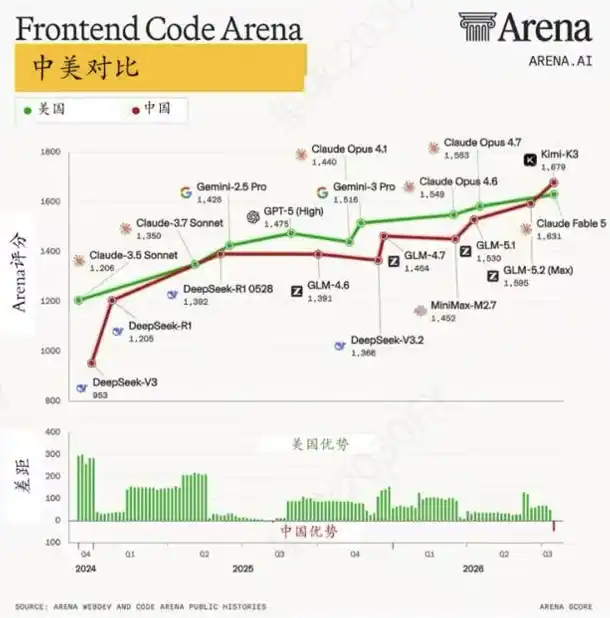
Behind this downgrade is an investor shift in the valuation approach to Chinese cutting-edge model companies. After Kimi K3 debuted in mid-July, it became more challenging for the market to sustain a high premium based on the assumption that 'a certain company can maintain the top spot long-term.' While the model's capabilities continue to improve, the leading edge may only last for one or two months.
A disclaimer is needed: the above target price, valuation multiple, and revenue estimates are primarily derived from this specific sell-side report, and different institutions in public reports may have disparate views on Zealot's target price rationale. It is better suited as a set of market judgments to be interpreted rather than a consensus figure that has been publicly cross-validated.
K3 Challenges the 'Long-Term First Place' Assumption
As per the Kimi official blog, K3 is a approximately 2.8 trillion parameter model, utilizing the Kimi Delta Attention and Attention Residuals architecture, supporting native vision and a 1 million token context, and claims that the full weights will be released by July 27, 2026.
In some code, inference, and benchmark work, Kimi's disclosures show that K3 has entered the global forefront. Since some of this comes from vendor self-testing or third-party lists, it cannot simply be stated as already surpassing top US models comprehensively, but it is sufficient to alter the market's expectations for the ranking of Chinese cutting-edge models.
For Zealot, the real pressure is not being overtaken on one list, but the disruption of the leading narrative accumulated by the GLM series in the past. After the releases of GLM-5 and GLM-5.2, Zealot was considered one of the leaders among independent Chinese cutting-edge model makers, with the valuation also implying a longer period of leadership.
Now, investors must confront a more realistic question: if the position of China's strongest model can change every one or two months, can a single company still enjoy a long-term premium as the industry leader?
The seller's recommended approach, as indicated in the report, is a downgrade rather than a shift to pessimism. A 30x long-term valuation multiple implies Smartech can maintain its long-term leadership position in China's cutting-edge model space. A 20x multiple is more like an acknowledgment that Smartech is still in the top tier but no longer assumed to always be at the forefront.
Target Price Downgraded, But Rating Unchanged
The target price has been lowered from HK$2400 to HK$1600, a significant decrease, but the rating remains 'Hold.' This indicates that the report distinguishes two issues: the premium for model leadership needs to decrease, but the commercial prospects have not been directly negated by a single model release.
GLM-5.2 is still considered one of China's top two or three production-level models. The report also anticipates that Smartech may launch GLM-5.3 by the end of July to August and a 2T+ flagship model between September and October. These timelines have not been officially confirmed by the company and should be treated as per the seller's prediction.
These two milestones cannot be prematurely interpreted as Smartech 'reclaiming the lead.' They are more like windows for Smartech to prove it can repeatedly catch up to the cutting edge. The market is no longer willing to pay a premium for being 'once first,' but rather focuses on whether a company can stay in the top tier over multiple model generations.
K3's impact on Smartech is more evident at the valuation level. Major model customers typically do not rely on just one model, especially in scenarios such as coding, agents, and enterprise knowledge work, where customers switch between multiple providers based on price, stability, speed, and task performance.
If Smartech's subsequent models can still stay at the forefront, the impact of K3 may not simply be about snatching Smartech's revenue but also about further expanding the usage of China's cutting-edge model market.
Revenue is Still Small, Competition Doesn't Have to Be Zero-Sum
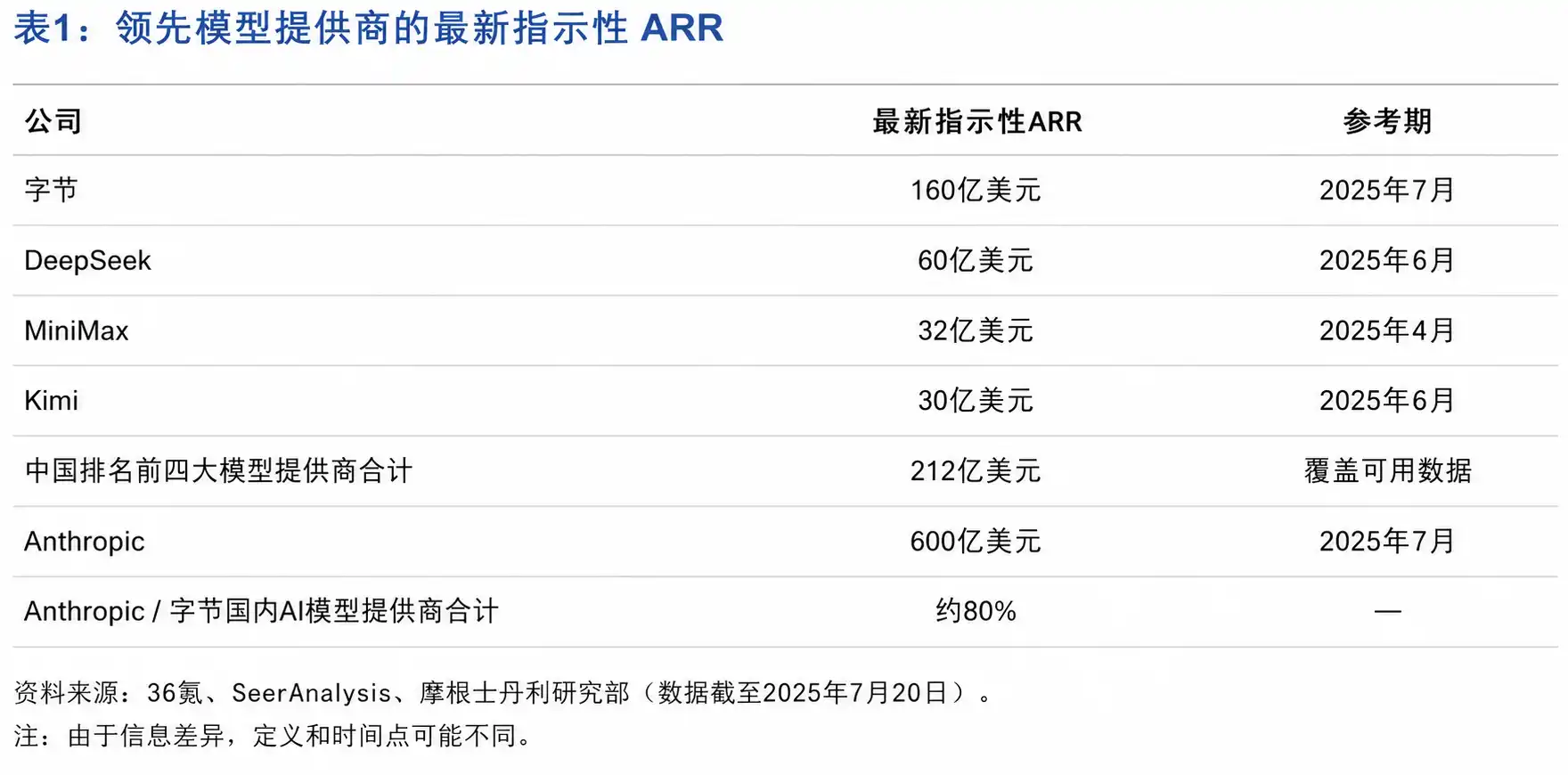
The report uses a set of indicative ARR data to explain why it is not appropriate to immediately view China's model commercial competition as zero-sum.
Based on its estimations, the combined ARR of the top four leading independent model companies in China is approximately $2.1 billion, with Smartech at around $1 billion, DeepSeek at around $500 million, and MiniMax and Kimi each at around $300 million. These figures vary in terms of definitions, timing, and statistical scope and should not be considered audited revenue.
More importantly, the signal is that China's cutting-edge model commercialization is still in its early stages. A comparison with the top US labs shows that the recurring revenue scale of China's independent model companies is still relatively small. This gap stems from both corporate budgets, overseas distribution, and token pricing, as well as more direct supply constraints.
The leading GPU is affected by export controls, domestic chips are still emerging, and the demand for inference is growing rapidly. At this stage, the main constraint for Chinese model companies may not necessarily be "lack of adoption," but rather how much high-quality computing power can support the demand.
In this environment, a powerful model release can change customer trials and market sentiment, but it may not immediately translate into mechanical substitution in the industry.
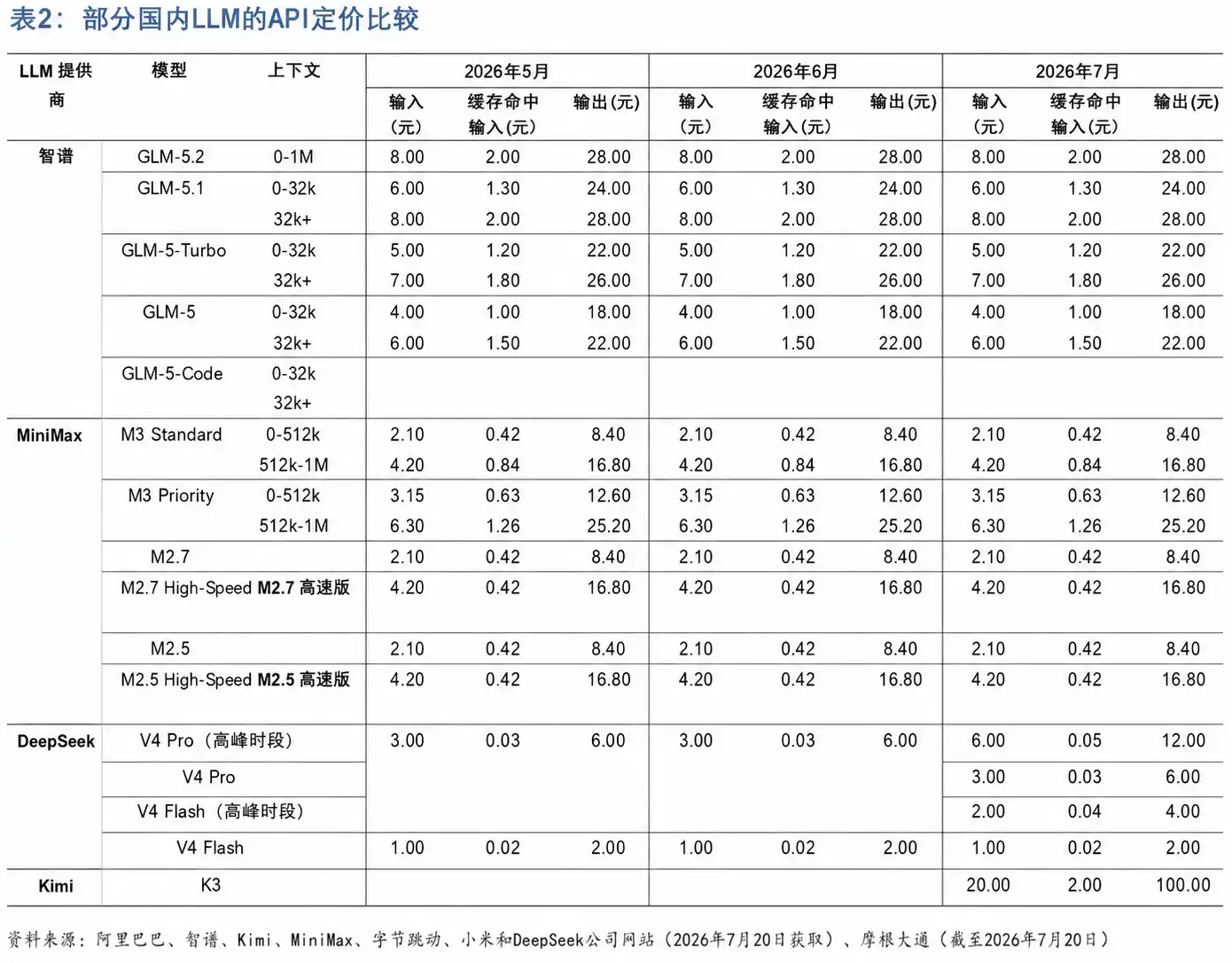
The price of K3 also provides a signal. A price comparison in the report shows that the K3 input and output prices have increased by about 4 times compared to the previous generation, but they are still competitive compared to international top models.
The price increase indicates that after the model's capabilities have improved, suppliers are starting to attempt to charge for high-value tasks rather than relying solely on low prices to capture volume. This is crucial for Zhipu, Kimi, DeepSeek, and MiniMax.
If Chinese models can only compete on price, their valuation will be closer to computing power resale or cloud service discount battles. Only when cutting-edge capabilities can support higher API prices will the market believe that these companies can generate higher revenue from developers, enterprise customers, and AI applications.
The Rotation Is Too Fast and Will Suppress Everyone's Premium
This optimistic assessment has a clear boundary: Zhipu must prove that it can repeatedly return to the cutting edge.
If the GLM-5.3 and subsequent 2T+ flagship models do not bring a significant capability improvement, the market will find it difficult to continue viewing Zhipu as a stable member of China's leading model first tier. At that time, the 20x valuation multiple may also continue to be under pressure.
Another risk comes from computing power and pricing. If the development of domestic chips accelerates or more model companies gain sufficient inference capacity, and the supply bottleneck is alleviated, competition may quickly shift to a price war. By then, the price increase potential brought about by model capability improvement may be offset by peer price cuts and customer negotiation.
Revenue calculation will also affect judgment. AI company ARR statistics are prone to differences, with some including API committed usage, some closer to actual consumption, and some possibly mixed into enterprise contracts or cloud resource packages. It is fine to use these figures for direction, but they should not be treated as precise financial statements.
The impact of Kimi K3 on Zhiku is not a simple matter of "winner takes all." What it changes is the way investors pay Chinese leading-edge model companies: less upfront payment for a one-time lead, more wait-and-see if they can cross multiple rounds of model iteration; less betting on always being the first, more looking at who can consistently generate revenue in an environment of limited computing power, rising prices, and multi-model usage by customers.
Welcome to join the official BlockBeats community:
Telegram Subscription Group: https://t.me/theblockbeats
Telegram Discussion Group: https://t.me/BlockBeats_App
Official Twitter Account: https://twitter.com/BlockBeatsAsia
