The Four Generations of the Payment Industry
As the storm approaches, the wind fills the building. Once again, Stripe is attempting to acquire PayPal. The tides have turned. The last time this happened was 30 years ago when Peter Thiel's PayPal merged with Musk's original X.com.
I don't understand why everyone is discussing PayPal's stagnant growth, as if this FinTech race is stacked against us. Twenty years ago, Peter Thiel embarked on a journey from payments, starting his first entrepreneurship, and the PayPal gang was unified. Where Musk went, the people welcomed wholeheartedly. It truly was a time of opportunity, full of vitality and endless possibilities, still vivid in our minds. Just twenty short years later, has Payment really become our graveyard?
Growth is a Miracle, Stablecoins Are Not
"Stripe's Failure to IPO During the Pandemic Is Now Evident"
All of Stripe's efforts have been for the elusive dream of going public. In the context of the pandemic-induced liquidity flood, Stripe reached a $100 billion valuation for the first time.
However, failing to follow the path of IPOs like Coinbase, its valuation plummeted time and time again. Mistaking the opportunity of the times as personal achievements, in deep pain and reflection, Stripe embarked on the path of acquisitions.
Stripe started with a Dev-friendly model, with API integration as simple as a push of a button, making it highly appealing to developers. This is the most unique strategy in the payment industry, not entangled with rates and scenarios, but reaching the actual people behind the scenes.
Stripe hopes to reuse its experiences time and time again, entering the acquiring system from the B-end, stablecoins from the C-end, and even laying out the ACP/MPP protocol for the Agent end, hoping to reshape the entire payment industry.
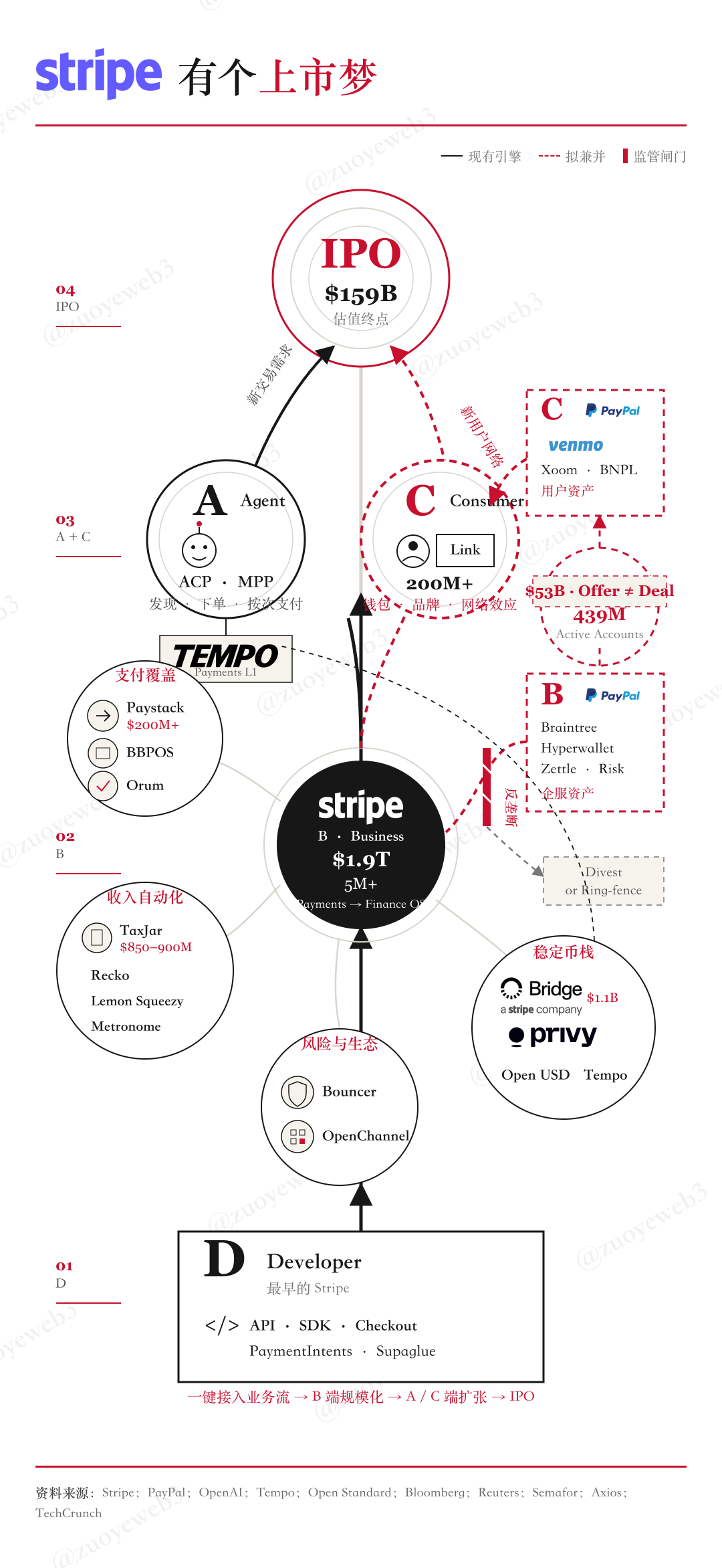
The payment industry has always had two characteristics that also hinder Stripe's continued progress:
1. The highly fragmented payment industry landscape remains unchanged, where surviving within the confines of a single country, a single industry, or even a few companies is possible, and cannot be easily disrupted from the outside;
2. Payment as an accessory to the banking industry, with developers and B/C-end companies ultimately externalizing the banking process, and stablecoins eventually being integrated into the banking system.
In particular, the series of stablecoin acquisitions, from the issuance of Bridge, to Privy's wallet entry point, and even Tempo and OpenUSD, make it challenging to replicate Stripe's past successes.
The motivation behind the acquisition of PayPal this time is actually an interim result of Stripe's attempt to use stablecoins to overcome the failure in the C-end market segment, trying to complement its own business with PayPal's C-end business.
The issue with PayPal is not its inability to keep up with the times, as neither Venmo nor PYUSD have been able to reverse PayPal's downward trend.
In other words, PayPal is simply too old, with structural incapacities across the entire company, and launching new businesses will not revive it.
Stripe, which launched slightly later, still hopes to increase its narrative possibilities before IPO.
If Stripe's backend dominance captures the developer market, then the stablecoin market encapsulates the frontend—the narrative of the issuance network has likely ended, Tempo and OpenUSD may impact Circle's stock price, but they cannot touch Tether.
If Stripe's ceiling is marked by Coinbase or Circle, then its listing is destined to experience a price drop, contrasting Adyen's market value and the valuation of Airwallex, making Stripe's stablecoin narrative and X Agent narrative valuable.
Stablecoins are not part of the current payment system's daily operations but are a visible trend;
Agent still needs to find a way to enter the existing system.
In a positive news context, Agent has been using stablecoins to buy hashing power and tokens rampantly, but aside from suspicions about the amount, Agent has yet to enter Web3 business, let alone the more conservative corporate and banking systems.
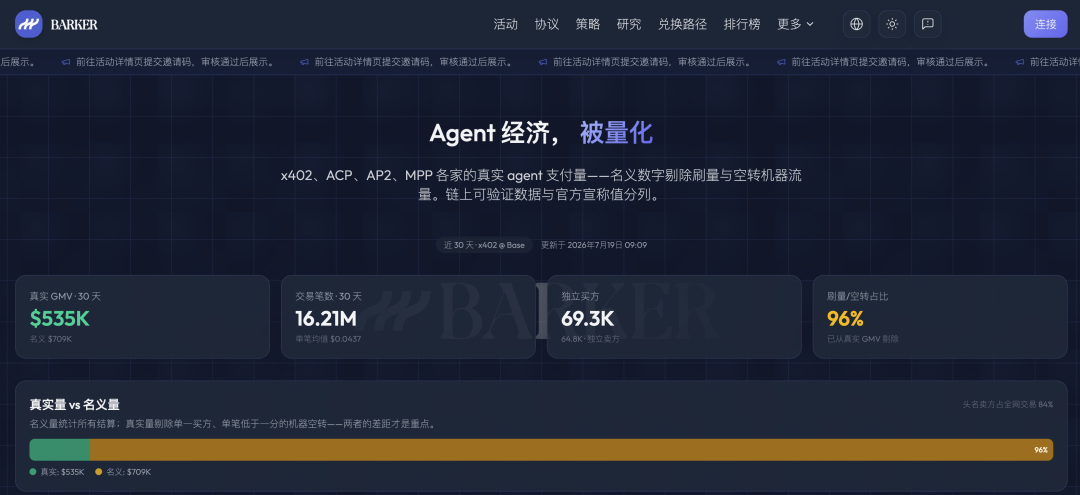
End A (Future), End B, End C, End D (Rising Star), but Stripe's valuation is unlikely to escape the reasonable value cap of $500 billion in FinTech, and $1 trillion includes too much wishful thinking.
If it is impossible to briefly reach the future, then expanding scale and the ecosystem, are the only points where Stripe can exert force, you can understand Stripe as an option product.
· Agent will use the OUSD stablecoin, running on Tempo, and Stripe should be on the scale of Visa;
· Agent will use stablecoins, but if OUSD fails and Tempo captures part of the market, Stripe should have a valuation of $1 trillion + Tempo's public chain valuation;
· It is very difficult for the Agent economy to come true, with Agentic Payment being covered by new concepts, then at the very least, Stripe still has its own business.
Of course, investment losses are regrettable, but missing out will lead to lifelong regrets. Starting from the challenges Stripe presents to the primary market, how the entire payment industry will evolve is also worth further consideration.
Payment is just an entry point, value-added services are profitable
“Agent is the foreseeable future visible to the naked eye, provided it can live to that day.”
Standing in the middle of 2026 is a very delicate node, with clear bills passing through the final time window, stablecoin returns may be finalized.
At the same time, the long-term future of the Agent economy, the current focus is on alternative models for white-collar and blue-collar workers, as well as hardware areas such as new wearables, AIOS phones, and more.
Regarding the transformation of payments by Agent, which has not attracted social attention, there is reason to believe that this is an opportunity hidden by stablecoins, a beta opportunity brought by the times.
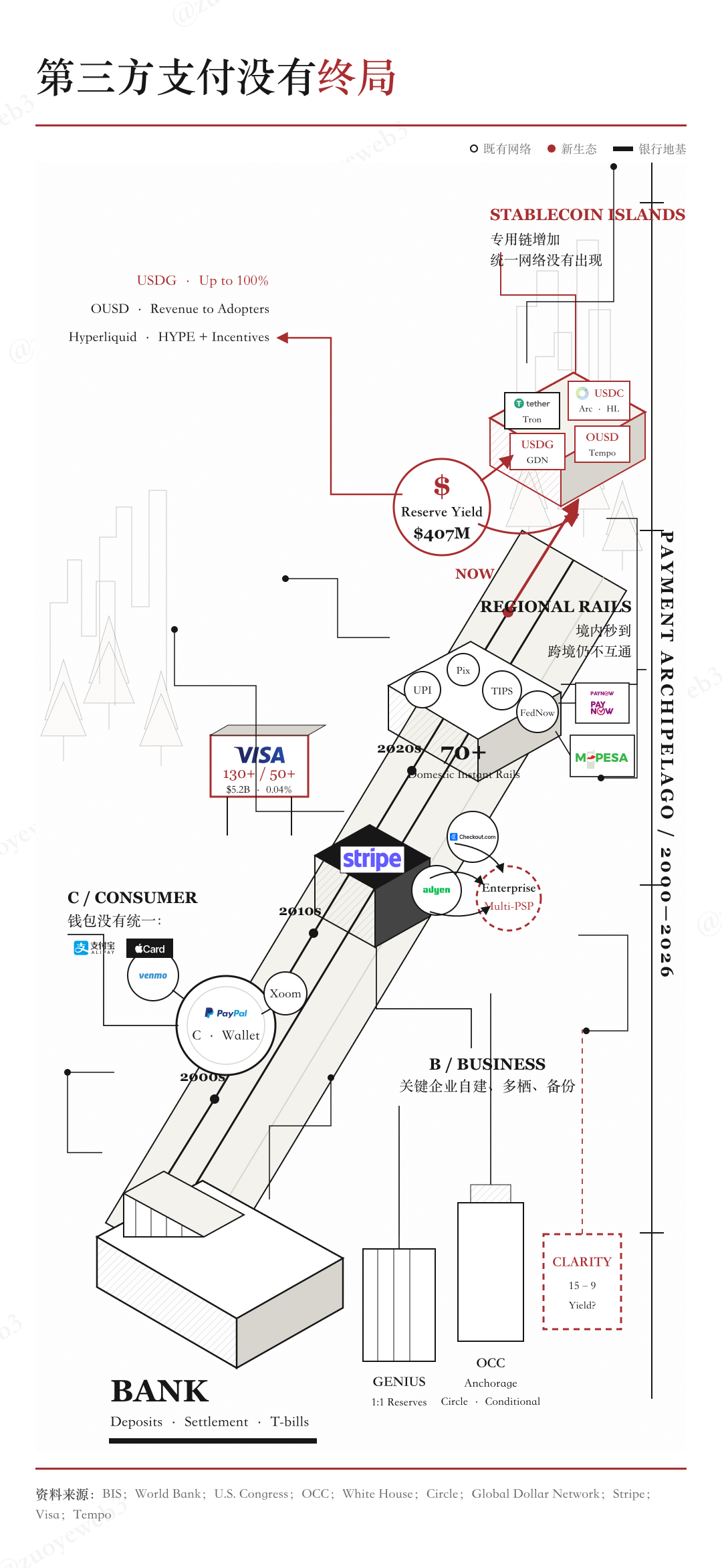
However, the operating model of the payment industry, which was previously built on the combination of "licenses + localization," may face continued challenges from clearing networks.
Stablecoins still need on-ramps at the front end, as well as off-ramps for on-chain circulation, receipt, and liquidation, which is also the regulatory bottom line of the banking industry.
In the FinTech wave driven by the internet over the past 30 years, although the banking industry has become more influential in payments, it has not been directly transformed or even disappeared like publishing, consumption, entertainment, or catering.
Under the tide of technology, although banks have become increasingly transparent, they still hold the terminal touchpoints for cash and account opening. In a sense, the fragmentation of the payment industry can be attributed to the territorial division of banks, and licenses and sovereignty boundaries are nothing but an acknowledgment of reality.
However, within the actions of Stripe and Circle lies another possibility for payments—front-end stablecoin acquisition and back-end clearing profitability.
Stripe and Circle are actually quite similar, representing a future cross-over form between FinTech and Crypto, both working on public blockchains (Tempo vs. Arc), stablecoins (OUSD vs. USDC), and clearing networks.
The reason it is not a revenue-sharing model for stablecoin issuance is that Circle has already started subsidizing Hyperliquid channel partners, and OUSD directly shares profits with partners. Both sides have begun to compete internally, which is inevitably not the future.
However, for the first time, through the clearing system, the public blockchains of the two parties do not need to subsidize partners forcibly but rely purely on capital efficiency to earn income from payment and stablecoin network effects.
The clearing system is not complicated. Traditional fiat currency clearing relies on card networks, SWIFT, central banks of various countries, and commercial banks, which have long been overburdened.
On the other hand, emerging stablecoin public blockchains have no historical burdens and can focus on improving clearing efficiency. As Circle and Stripe secure OCC special bank charters (conditionally approved), after sharing stablecoin profits, they are bound to move towards clearing.
As for the settlement network, it is possible to partially detach from the commercial bank system and retain the profit within itself.
Conclusion
Stripe missed the IPO window during the pandemic and embarked on a trench warfare of third-party payments. This battle follows the eternal Verdun pattern, where the small players in various industries cannot be crushed solely by scale.
A different way of living is necessary to confront the banking industry. From PayPal to Stripe, from stablecoins to Agents, all four generations of the payment industry are now present. Will they succeed this time?
Welcome to join the official BlockBeats community:
Telegram Subscription Group: https://t.me/theblockbeats
Telegram Discussion Group: https://t.me/BlockBeats_App
Official Twitter Account: https://twitter.com/BlockBeatsAsia
