On the morning of July 30, Samsung Electronics released its official financial report for the second quarter of 2026. Operating profit was 89.5 trillion won. This number is 19 times higher than the 4.68 trillion won in the same period last year and is also Samsung's highest single-quarter operating profit in history. Revenue was 171.5 trillion won, also a quarterly record high. Converted at an exchange rate of 1 USD to 1500 won, this quarter's operating profit is approximately $59.7 billion.
According to a report by The Korea Economic Daily, this number exceeded NVIDIA's previous single-quarter operating profit record of $53.5 billion. A company that produces memory chips and smartphones, using a quarter's profit, has surpassed the most profitable company in this AI cycle.
The market's reaction to Samsung's stock price was almost nonexistent. The intraday price on July 30 was around 210,000 won, up 0.72%.
How Far from Normal Is This Record?
The front row of columns in the chart represents 2023 when Samsung's operating profits for the first and second quarters were 6.4 trillion and 6.7 trillion won, respectively, almost zero. By the fourth quarter of 2025, this number had reached 20.1 trillion won. In another year and a half, it had become 89.49 trillion won.
There are two reference points to help readers establish a scale. First, Samsung's full-year operating profit in 2025 was approximately 43.6 trillion won, making this quarter's profit more than double that of that year. Second, this number for this quarter is 4.45 times the previous peak in the fourth quarter of 2025.
The financial report also concealed a one-time expense. According to The Korea Economic Daily, this quarter saw the setting aside of approximately 17 trillion won for the semiconductor division's performance bonuses, equivalent to 10.5% of operating profit. Yahoo Finance reported that excluding this bonus, operating profit would have exceeded 100 trillion won.
Why No Market Reaction to this Record?
Because revenue did not meet expectations.
The consensus was 172.68 trillion won, but the actual figure was 171.5 trillion won. This is a somewhat rare combination, with profits exceeding expectations by about 4% to 6%, but revenue falling below expectations.
Future Asset Securities explained to The Korea Times on July 8 the market's interpretation at the time, stating that the market viewed Samsung's performance as a "late-cycle signal driven by chip price increases rather than shipment volume growth." This sentence is the most critical judgment in this round of the market. Profit driven by price increases and profit driven by shipment volume may appear the same on the income statement but are in completely different positions in the cycle. The former implies supply constraints, the latter implies demand expansion, and there will always be a day when supply constraints are lifted.
The official statement itself also supports this interpretation. The financial report describes the storage business as follows: "The continuous upward trend in industry-wide prices also contributed to record-breaking performance," while stating that both DRAM and NAND set new quarterly shipment records. The specific percentage of shipment growth was not provided in the official press release but was verbally disclosed during the conference call.
How Much Momentum Does the Price Hike Have Left?
This chart uses SK Hynix's perspective because it breaks down the volume and price changes more granularly. According to TradingKey's summary of SK Hynix's July 29th financial report, the company's DRAM average selling price increase decreased from around 60% in the first quarter of this year to around 30% in the second quarter, while NAND decreased from around 70% to 50% to 55%.
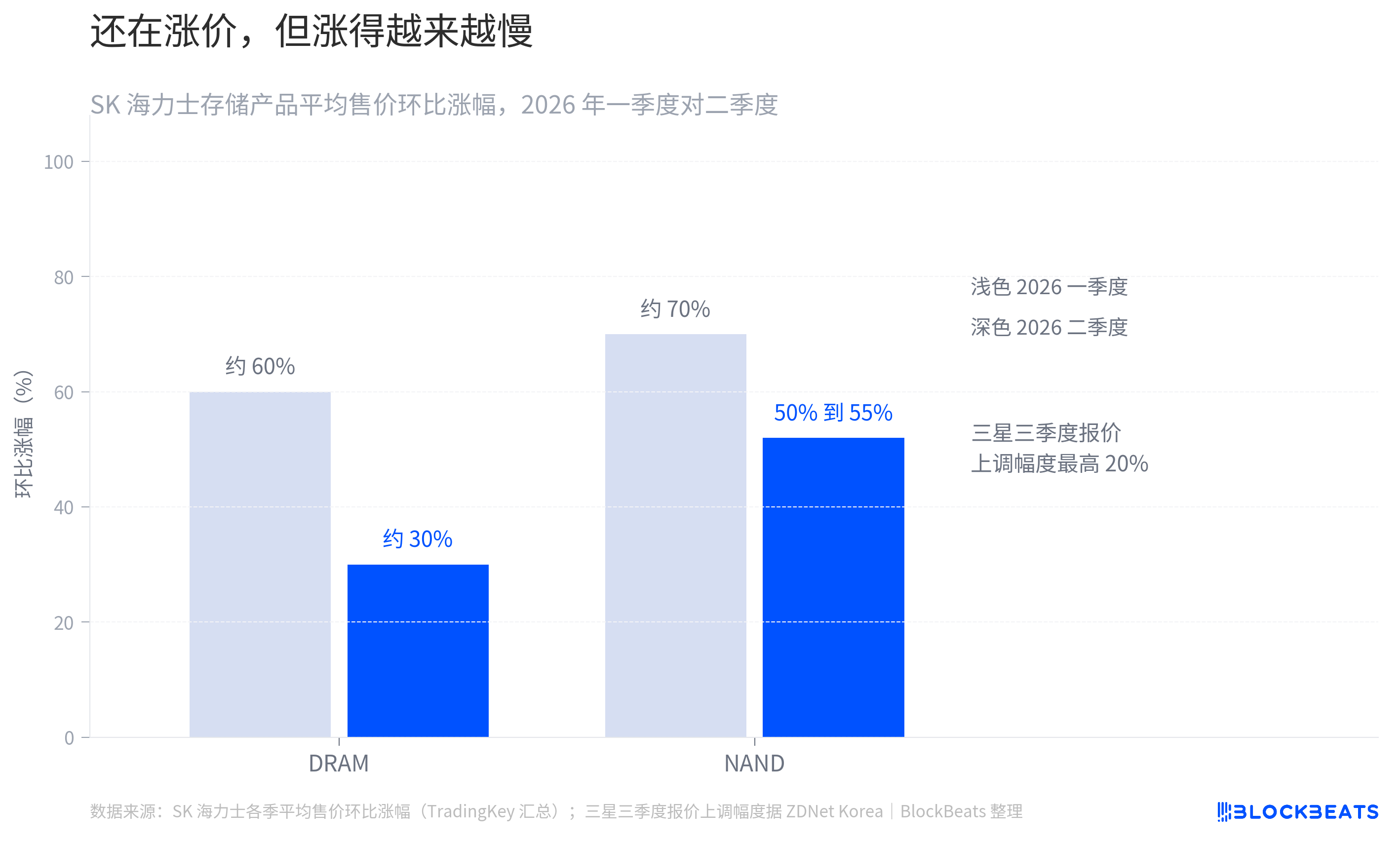
The industry perspective aligns with this trend. According to TrendForce data, the contract price increase for mainstream DRAM decreased from 93% to 98% in the first quarter of this year to 58% to 63% in the second quarter. The situation in the third quarter is that the increase is expected to be constrained. According to a July 3rd report by ZDNet Korea, Samsung raised its DRAM prices by up to 20% in the third quarter.
Prices are still rising, but the rate of increase is narrowing, which is the specific meaning of the "late cycle" terminology.
It is important to clarify that a deceleration in price hikes does not mean a decline. Samsung remains optimistic about the second half of the year in its financial report. The original text states that the storage business is expected to see "strong demand centered around AI infrastructure capital expenditures, server-centric demand," and anticipates accelerated growth in server DRAM, enterprise SSDs, and HBM demand.
Where Do These Profits Come From?
The semiconductor division's operating profit for the quarter was 8.92 trillion KRW, accounting for 99.7% of the group's total operating profit of 89.4924 trillion KRW. This percentage was 93.8% in the previous quarter.
On the same table, the Mobile and Network Equipment (MX) division reported an operating loss of 700 billion KRW, while the entire Digital Media & Appliances (DX) division, including mobile phones, televisions, and home appliances, reported an operating loss of 800 billion KRW. In the previous quarter, the MX division had a profit of 2.8 trillion KRW. The official explanation for MX's performance is that although revenue increased year-on-year, it was suppressed by "rising component costs."
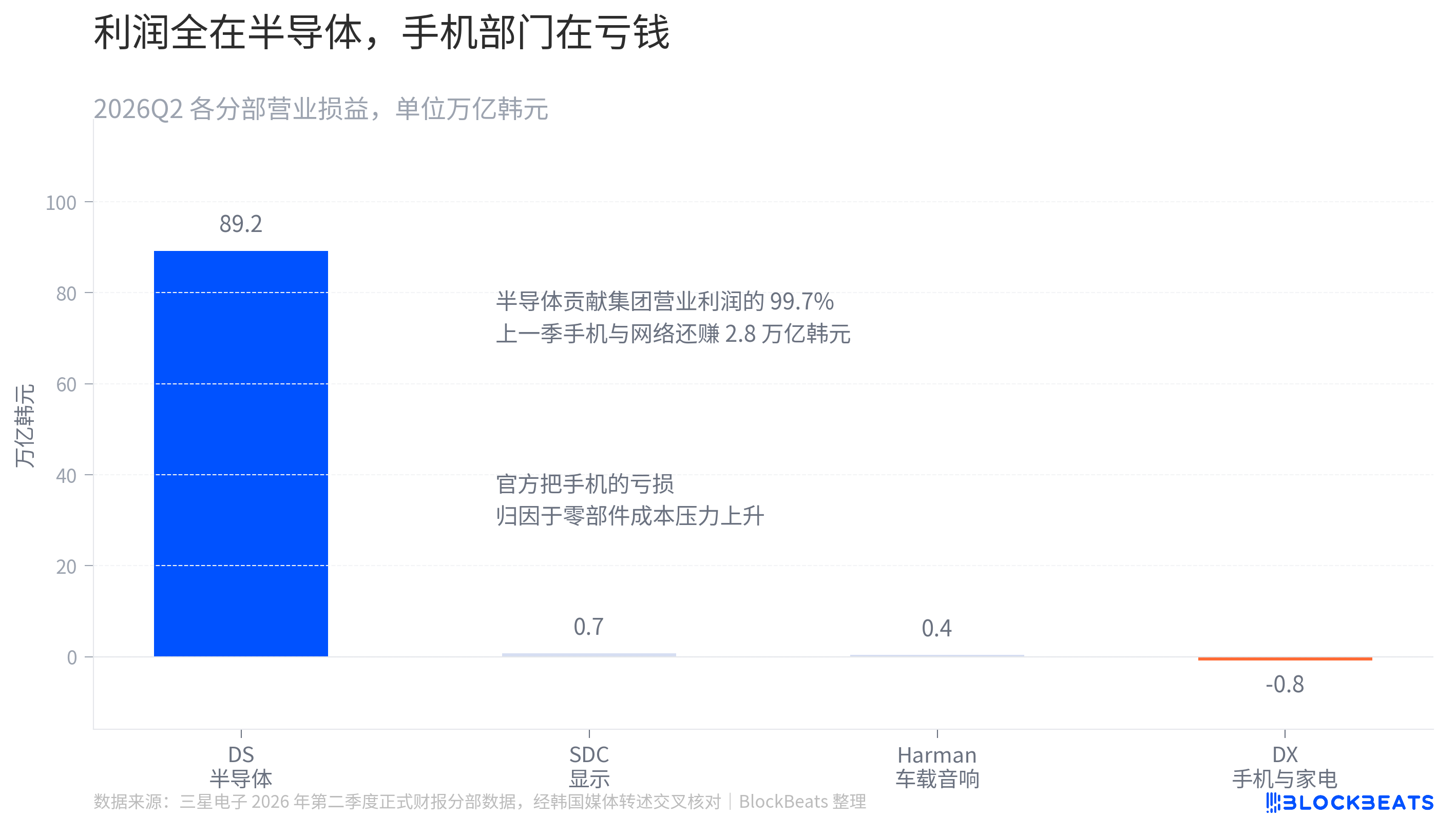
This "component" refers to the products Samsung itself sells. Samsung's mobile division has to purchase memory at the increased market price, while all the benefits of the price hike go to the semiconductor division. From a corporate perspective, this is an internal transfer, but in terms of the competitiveness of the mobile business, it is not favorable.
The official also mentioned the situation of the foundry business, stating that before deducting bonus accruals, the foundry business's profit saw a "significant improvement," driven by "HBM substrate demand and strong orders from U.S. customers." This statement means that even the recovery of the foundry business was driven by storage demand.
The Bill Arrived at Someone Else's Place
The other half of the storage price increase is someone else's cost.
Microsoft's CFO Amy Hood provided a specific breakdown during the April 29 conference call, stating that out of the approximately $190 billion in annual capital expenditures for the calendar year 2026, "around $25 billion is due to the impact of component price increases." According to Tom's Hardware, Meta, while increasing its capex by $10 billion during the same period, attributed the increase to "higher component prices this year, especially for memory chips."
In its financial report presentation on July 29, Qualcomm took a more direct approach to this calculation. It explicitly stated that due to memory price increases and supply constraints, it expects a year-on-year revenue decline of about 20% for its Android smartphone business in the 2026 fiscal year, dragging down earnings per share by more than $1.50 for the full year, and announced a price increase for products effective September 1.
This forms a closed loop. Cloud providers' capital expenditures drive up storage prices, which in turn boost the profit of Samsung's semiconductor division, while also raising costs for Samsung's smartphone division and Qualcomm. The current market concern is whether the first link of this loop, namely the capital expenditures of cloud providers, can continue to rise in this way. Morgan Stanley's post-earnings view is that the pullback in chip stocks is not over, as cloud providers are expected to tighten capital expenditures further.
The Stock Price's Timeline Needs to Be Retold
The most widely circulated claim is that "Samsung's stock price fell by 7% on the day of the earnings report," but this statement has the timing wrong. The 6.9% decline occurred on July 7, the day Samsung issued its earnings guidance, closing at 296,000 Korean won with an intraday maximum decline of 10%. On the official earnings report day, July 30, the stock price actually rose slightly.
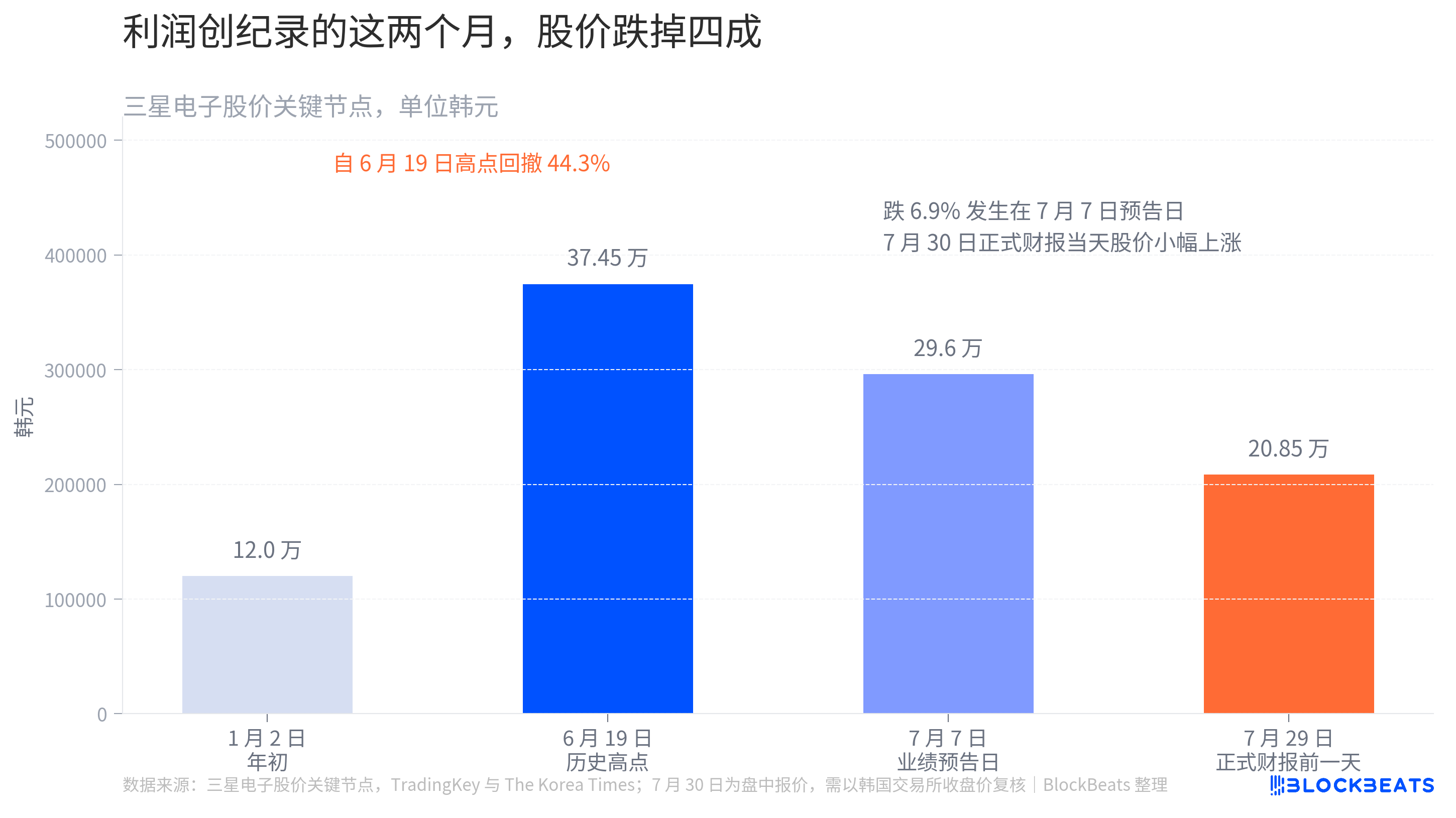
The real issue lies between these two dates. On June 19, Samsung hit an all-time high of 374,500 Korean won, closing at 208,500 Korean won on July 29, marking a cumulative pullback of 44.3%. During this period, a historic event in the South Korean stock market occurred. According to TradingKey, the KOSPI index triggered a circuit breaker on two consecutive days, July 28 and 29, for the first time in its history.
This round of pullback is partially not Samsung's fault. According to statistics, Samsung and SK Hynix together account for about 50% of the KOSPI market value, a proportion that will be 25% by the end of 2025. Josh Gilbert, eToro's Chief Market Analyst for Asia Pacific and the Middle East, pointed out that the high combined weight of the two makes it impossible for index investors to avoid synchronous declines. Leveraged funds are also amplifying the volatility. According to the Korea Times, about 30 trillion Korean won flowed into single-stock ETFs of Samsung and SK Hynix in just one week in early July, doubling the usual amount.
On the other hand, there are also dissenting voices. CLSA's strategist's assessment of this downturn is that "this is not the end of the story but a pullback in the midst of an uptrend."
Earning a record profit in one quarter while the mobile division starts losing money in the same quarter, both events are part of the same price surge.
Welcome to join the official BlockBeats community:
Telegram Subscription Group: https://t.me/theblockbeats
Telegram Discussion Group: https://t.me/BlockBeats_App
Official Twitter Account: https://twitter.com/BlockBeatsAsia
