Less than a month after its IPO, Chinese DRAM leader ChangXin Memory Technology received initial coverage from Goldman Sachs.
In its report "CHIPS IV: Accelerating China's Semiconductor Self-Sufficiency Process" released on August 23, Goldman Sachs awarded ChangXin a "Buy" rating with a 12-month price target of 129 RMB. At the time of the report, ChangXin was trading at around 10 times the 2027 estimated P/E ratio, while Goldman Sachs' target price implied approximately 24 times the 2027 estimated P/E ratio.
Behind this valuation is a growth model that extends to 2030: wafer capacity doubling, ongoing expansion of traditional DRAM shipments, rapid revenue growth from HBM, and the rising demand for local storage supported by China's AI infrastructure development and customer supply chain diversification.
However, this model is based on a series of optimistic assumptions. Apart from capacity expansion and yield improvement, Goldman Sachs also anticipates that DRAM prices will remain high in a tight supply environment, while ChangXin's gross margin will climb from 41% in 2025 to 82% by 2030. Therefore, the 129 RMB price target is a bet not only on domestic substitution but also on favorable developments in capacity, pricing, and product structure.
ChangXin Memory Technology debuted on the STAR Market on July 27 with the stock code 688825. At the time of listing, the company had approximately 66.881 billion shares of A-shares outstanding, with an initial trading of about 4.503 billion shares. The prospectus indicated that the raised funds would primarily be used for upgrading wafer manufacturing production lines, DRAM technology enhancements, and future technology research and development.
Goldman Sachs' new report then extrapolates these investments into a capacity surge lasting until 2030.
Capacity to Double in Four Years, Potentially Meeting Half of China's DRAM Demand by 2028
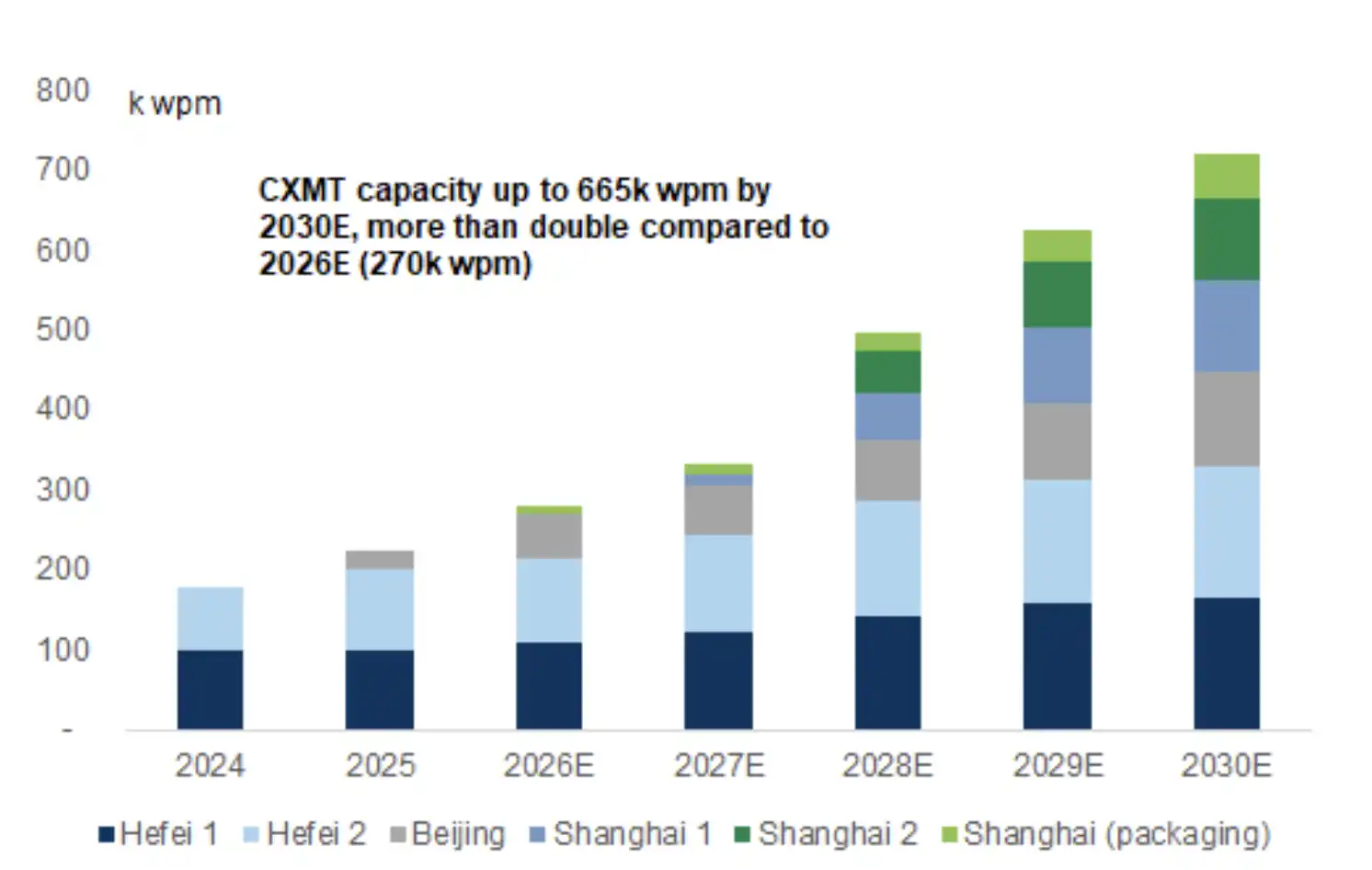
Goldman Sachs projects that ChangXin Memory's monthly production capacity will increase from 270,000 wafers in 2026 to 447,000 wafers in 2028, reaching 665,000 wafers by 2030, more than doubling from the 2026 level.
This capacity expansion is supported by continuous growth in capital expenditure. Goldman Sachs estimates that ChangXin's average annual capital expenditure from 2026 to 2030 will reach ¥84 billion, higher than the approximately ¥50 billion from 2022 to 2025. When compared to just 2024 to 2025, the previous two years saw an average annual capital expenditure of about ¥60 billion.
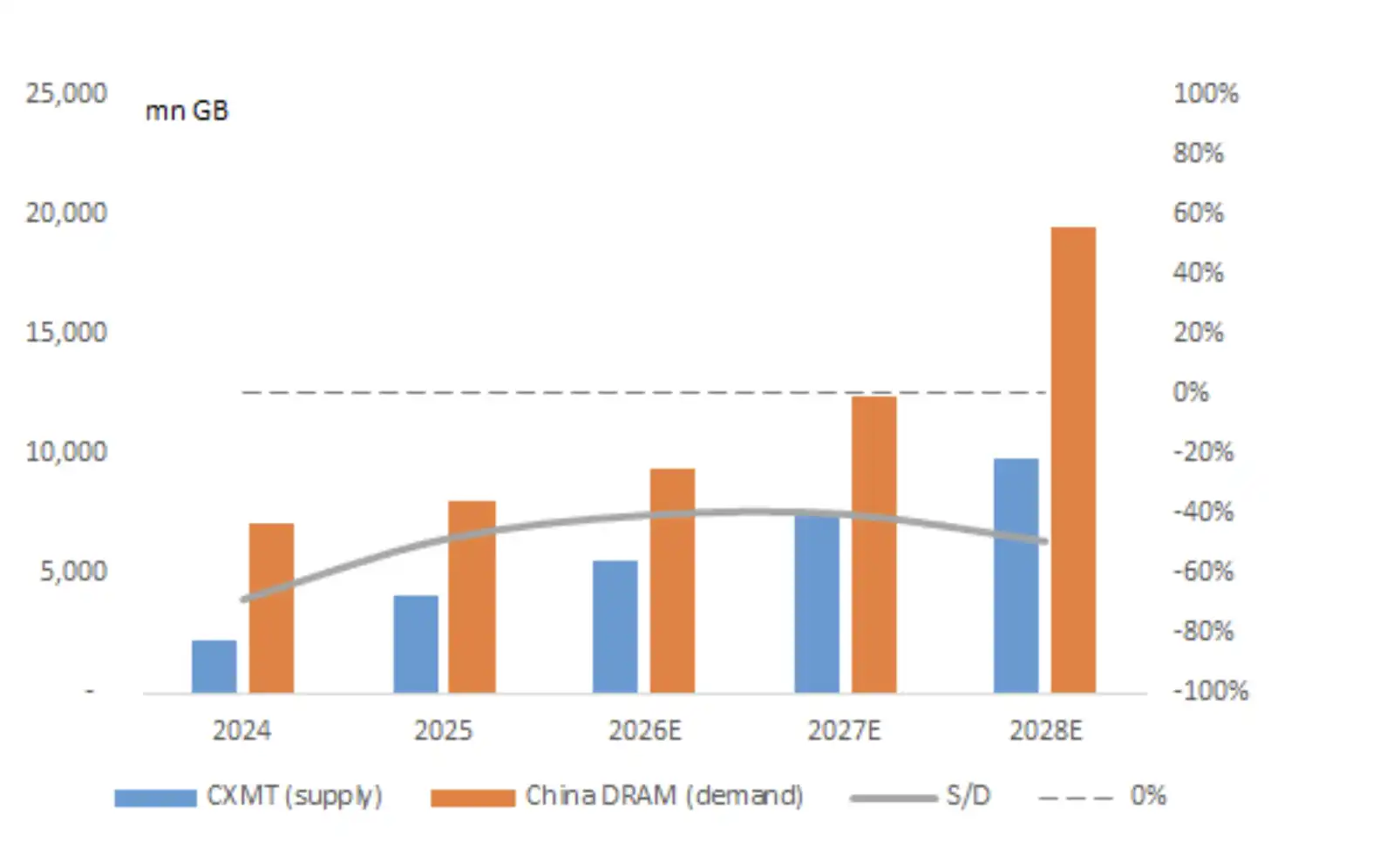
Driven by capacity expansion, yield improvement, and product specification upgrades, Goldman Sachs forecasts that ChangXin's total DRAM supply will grow at a 34% compound annual growth rate from 2026 to 2030, reaching 9.837 billion GB by 2030.
By 2028, ChangXin's supply of traditional DRAM is expected to represent 41% and 50% of Samsung's and SK Hynix's concurrent supply, respectively, higher than the 28% and 35% in 2025.
A more impactful projection is that by 2028, Goldman Sachs anticipates ChangXin's supply will meet approximately 50% of China's DRAM demand. This is a forecast of future supply capacity and does not imply that ChangXin currently holds half of China's market share.
AI Boosts Chinese Storage Demand, Providing Expansion Opportunity for ChangXin
Goldman Sachs expects the Chinese DRAM market size to grow at a 50% compound annual growth rate from 2026 to 2028, reaching $257 billion by 2028. Growth is primarily driven by AI server shipments, server DRAM, and HBM demand, with smartphones, PCs, network equipment, and cars also constituting foundational demand.
The supply side has also seen changes. As global memory manufacturers such as Samsung, SK Hynix, and Micron allocate more resources to HBM and other AI-related products, the traditional DRAM supply has been squeezed. In a scenario of rising prices and limited supply, consumer electronics manufacturers are more motivated to onboard new suppliers to mitigate single-source risks.
Goldman Sachs believes that despite ChangXin's technology nodes still lagging behind leading global manufacturers by several generations, U.S. and other overseas customers may still validate its mobile DRAM and traditional DRAM products, especially in the smartphone and PC sectors.
This sets the two main directions for ChangXin's expansion: on the one hand, meeting China's domestic DRAM demand and supporting domestic alternatives; on the other hand, filling the gap in traditional DRAM left by global manufacturers shifting capacity to HBM.
However, whether overseas customers can form large-scale purchases is still subject to geopolitical and trade restrictions. The willingness to validate products does not guarantee that orders will materialize, which is also listed as one of Goldman Sachs's key risks.
Success of HBM Will Determine Whether ChangXin Moves from Scale Expansion to Profit Enhancement
While traditional DRAM provides the scale foundation, HBM will determine whether ChangXin can truly capture the high value-add of AI storage.
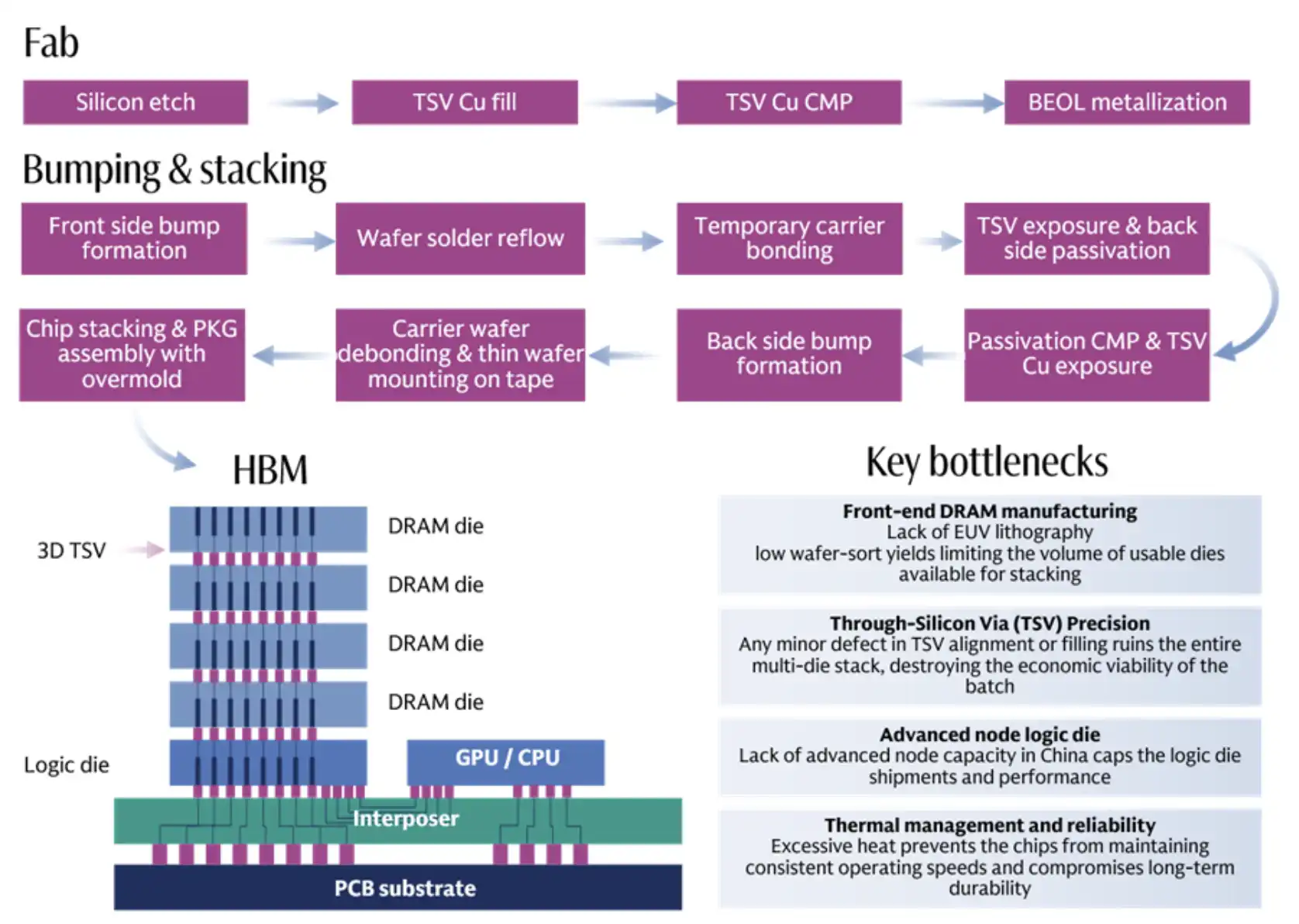
HBM, through vertically stacking multiple layers of DRAM, offers AI accelerators higher bandwidth, capacity, and energy efficiency. However, compared to regular memory, HBM manufacturing involves various processes such as front-end DRAM chip fabrication, high-precision silicon vias, advanced logic wafers, thermal management, and reliability, with significantly higher technological and supply chain barriers.
Goldman Sachs predicts that ChangXin's HBM products will start contributing revenue from Q4 2026, with HBM revenue share increasing from 2% in 2026 to 27% in 2030. The HBM supply volume is expected to grow at a compound annual growth rate of 207% between 2026 and 2028, reaching 11.79 billion GB by 2028.
However, this is also the most uncertain part of the entire model.
Goldman Sachs explicitly states that ChangXin's HBM technology maturity is still in the early stages, making it difficult to penetrate the U.S. customer supply chain in the short term. In contrast, overseas customers show a stronger willingness to validate mobile DRAM and traditional DRAM.
In other words, while ChangXin can ramp up traditional DRAM supply capacity quickly, stepping into the high-value HBM market requires addressing manufacturing processes, local packaging ecosystem, advanced logic wafers, thermal reliability, and customer certifications.
$129 Price Target, Betting Not Only on Shipment Growth
Goldman Sachs predicts that ChangXin's net profit will grow at a 47% compound annual growth rate between 2026 and 2030, with traditional DRAM revenue growing at a CAGR of 34% during the same period, while HBM revenue will achieve a CAGR of 166%.
The $129 price target is not directly derived by multiplying the 2027 earnings by a 24x price-earnings ratio. Goldman Sachs first gives ChangXin a 16.6x target P/E ratio for 2030 based on the industry's valuation and earnings growth relationship, then discounts it to 2027 at a 12.7% cost of equity, ultimately arriving at the $129 price target. This price implies approximately a 24x forecasted P/E ratio for 2027.
The factors supporting the increase in valuation are primarily threefold.
First, the expansion of China's AI infrastructure brings demand for server DRAM and HBM; second, global supply of traditional DRAM is squeezed by HBM capacity expansion, and consumer electronics customers accelerate supplier diversification; third, ChangXin's scarcity as a large-scale DRAM manufacturer in China allows it to obtain a certain valuation premium for domestic semiconductors.
However, the truly aggressive part of this valuation lies in the profit margin.
Goldman Sachs expects that as DRAM prices remain high, shipment volumes expand, and the product mix shifts to DDR5, LPDDR6, and HBM, ChangXin's gross margin will rise from 41% in 2025 to 82% in 2030, while the operating expense ratio will decrease from 27.4% to 7.9% during the same period.
This means that the $129 price target not only requires the wafer fabs to start production as planned but also demands that the additional capacity smoothly translates into shipments, the high DRAM market cycle persists, the HBM proportion continues to increase, and ultimately translates into a significant improvement in profit margins.
From Expanding Wafer Fab to Realizing Profits, There Are Still Many Hurdles
Memory is still a typical cyclical industry. When demand is strong, capacity expansion can simultaneously boost revenue and profit; however, when new capacity is released in large quantities, a shift in supply and demand balance may quickly depress prices and profit levels.
For ChangXin, the risks mainly come from three aspects.
First, global manufacturers such as Samsung, SK Hynix, and Micron are still expanding DRAM capacity and developing next-generation products. Stronger-than-expected competition may suppress Changxin's shipments and profits. Second, Goldman Sachs' profit margin model is based on strong DRAM demand and prices. If AI or consumer electronics demand falls below expectations, both shipments and gross margin could come under pressure. Finally, the geopolitical environment may restrict Changxin's access to the global customer supply chain, weakening overseas growth prospects.
Changxin has completed the leap from domestic DRAM "from zero to one" to landing on the public market. The next, more challenging part is to ramp up the expanding wafer fab to stable production levels and then extend the scale advantage of traditional DRAM to HBM in terms of performance, yield, and customer certification.
Therefore, the ¥129 target price does not reflect an already realized outcome but rather a concentrated bet on the synchronous realization of capacity expansion, a prosperous storage market, domestic substitution, and HBM upgrade.
Welcome to join the official BlockBeats community:
Telegram Subscription Group: https://t.me/theblockbeats
Telegram Discussion Group: https://t.me/BlockBeats_App
Official Twitter Account: https://twitter.com/BlockBeatsAsia
