On August 23, Alibaba launched a new stock offering in the Hong Kong market, intending to issue 7.1 billion shares at HK$112.7 per share, raising HK$80 billion, approximately $10.2 billion. If the transaction is completed, this will be the largest follow-on offering in the history of Hong Kong-listed companies and the third-largest global follow-on offering in 2026, behind only Alphabet and Intel.
Orders quickly exceeded the original size, sovereign wealth funds entered the market, and the offering amount was increased as demand surged. The funds raised will all be invested in AI, covering chips, infrastructure, model development, and deployment.
The second-quarter financial report released three days ago has already explained this fundraising. AI cloud and computing service revenue increased by 45% year-on-year to reach 48.44 billion yuan, while capital expenditure during the same period increased to 67.68 billion yuan, a 75% year-on-year increase.
During the same quarter, operating cash flow was only 22.95 billion yuan, with a net outflow of 44.67 billion yuan in free cash flow. Nearly half of the 380 billion yuan investment plan for three years has been implemented. Wu Yongming canceled the original investment cap in the previous quarter and said that the actual amount would far exceed the original plan. Based on the current gross margin level, this batch of AI infrastructure is expected to break even in about three years.
Alibaba is not short of money. As of the end of June, the company still held 474.5 billion yuan in cash and other liquid investments. This fundraising addresses capital term allocation. Operating cash flow continues to be generated, but data centers require several years to build and recoup costs. Long-term power agreements and twenty-year leases will further extend the capital utilization period. Covering such assets with short-term cash will continue to erode financial flexibility. Equity capital, with no fixed maturity date, is better suited to bear long payback periods.
AI capital expenditure is starting to change the funding structure of internet companies. The discussion used to be about whether there was enough money, but now it also involves how long this money should exist.
Alphabet's initial adjustment was in shareholder returns. In the second quarter, company revenue grew by 24%, Google Search by 17%, and Google Cloud by 82%. The group's operating profit margin is still at 34%, and there are almost no flaws in the core business.
During the same period, operating cash flow was $39.1 billion, but capital expenditure reached $44.9 billion, and free cash flow turned negative for the first time at $5.9 billion. The board still has nearly $70 billion in unused stock buyback authorization, but in the first half of 2026, not a single common stock was repurchased.
Six years ago, tech giants were still discussing how to return accumulated excess cash to shareholders. Fast forward to this year, Alphabet kept its buyback authorization on the shelf and opted for a comeback to the capital markets for funding. AI has started to reshape the distribution hierarchy of profits within companies.
Tencent is facing a different kind of pressure. In the second quarter of 2026, capital expenditures reached ¥52.7 billion, actual capital payments amounted to ¥59.3 billion, totaling ¥84.72 billion in the first half of the year, surpassing the full year of 2025. The quarterly free cash flow has decreased to negative ¥13.8 billion.
Tencent added a new perspective in its financial report, excluding the prepayment for AI computing power procurement, the free cash flow could actually reach a positive ¥37.6 billion. Just the timing of payments is enough to create a cash flow gap of over ¥50 billion. In three months alone, Tencent's net cash decreased from ¥146.86 billion to ¥58.19 billion.
Baidu faces a more direct issue. In the second quarter, its operating cash flow was only ¥3.44 billion, while capital expenditures reached ¥11.39 billion, resulting in a free cash flow outflow of ¥7.95 billion.
Online marketing revenue decreased by 19% year-on-year, the primary cash source of the past is still contracting; AI cloud infrastructure revenue grew by 50%, with GPU cloud growing by 283%, yet the capital-intensive new businesses have entered an accelerated phase.
The revenue structure has begun to shift, but the cash flow structure remains in the past. Baidu needs to use a shrinking cash flow from its old business to fund the new businesses that are just entering a capital-intensive phase.
Capital expenditures themselves are becoming more expensive. TrendForce increased its estimate of total capital expenditures for the nine global cloud companies in 2026 to approximately $830 billion in May, with a year-on-year growth rate rising from 61% to 79%.
The additional budget does not entirely translate to more equipment, as the price hikes of components have already consumed a significant portion. Of Microsoft's approximately $190 billion in capital expenditures, $25 billion is allocated solely to absorb the rise in component prices; ByteDance also raised its annual capital expenditure from ¥160 billion to over ¥200 billion due to the increase in memory prices.
The same budget now buys less computing power.
These companies still enjoy high profits and hold substantial cash reserves, but capital is no longer loose enough to ignore opportunity costs. Free cash flow is starting to feel the pressure, buybacks can be delayed, financing needs to increase, and investing in computing power means it cannot simultaneously be allocated to M&A, legacy businesses, or another growth trajectory.
Over the past decade, ample cash flow has provided internet companies with a long trial and error period. AI is now shortening this tolerance.
Capital has shifted from a default condition of internet companies to becoming a growth constraint.
Almost all major players have chosen to continue to invest. After the emergence of capital constraints, the next round of competition has shifted to capital allocation. Businesses that could previously be simultaneously pursued now need to be prioritized.
The Opportunity Cost of AI
Breaking down Alibaba's financial reports, AI itself has entered a different return cycle.
AI Cloud and computing services adjusted EBITA for the quarter reached ¥56.3 billion, a 133% year-on-year increase, and has started contributing to operating profit. Models and consumer applications are still in the investment phase, with quarterly revenue of approximately ¥33.4 billion and an adjusted EBITA loss of ¥13.86 billion, more than four times the loss compared to the same period last year. The next round of AI infrastructure development is still in the asset formation phase, and the returns have not yet entered the financial statements.
In addition to instant retail and international e-commerce, Alibaba is simultaneously driving several growth curves, all competing for the same balance sheet.
This competition will soon permeate the legacy businesses. In the past two years, Alibaba has successively exited Intime and Sun Art Retail. On August 17, it reached an agreement to sell Lizhi Xiongdi Entertainment to Trustar for a reported transaction value of over $2 billion. Lizhi Xiongdi still owns mature products such as "Three Kingdoms: Strategic Edition," and selling it is no longer a simple explanation for cleaning up loss-making assets.

ByteDance's handling of Mooton is more evident. In 2021, ByteDance acquired Mooton for approximately $4 billion; this year, when it was sold to Savvy Games, a company under Saudi PIF, the transaction valuation exceeded $6 billion. Gaming was once a new market ByteDance entered, Mooton is still appreciating, but when internal priorities within the group change, a profitable asset can also exit.
Even Microsoft has brought this reshuffling into its core business. Less than three years after the $69 billion acquisition of Activision Blizzard, Xbox has started to reassess the input-output dynamics. In July, Microsoft announced the layoff of 4,800 employees, with around 3,200 from the gaming business, and four studios are set to be sold or split off.
Internal data disclosed by Bloomberg shows that excluding Activision Blizzard, Xbox's investment over the past five years in content, platforms, and hardware subsidies has exceeded $20 billion, and the profit margin, based on internal assessment criteria, has dropped to 3%.
Corporate finance refers to this state as capital allocation.
When capital is abundant, an unproven business can be held long-term, and the strategic optionality itself is valuable. As AI drives up capital expenditure, this option starts to have a clear cost. For every additional business retained, a portion of the funds that could be allocated to computing power and a new growth curve is foregone.
The proceeds from divestments may not flow directly to AI, but the comparative standard for capital has shifted.
Strategic value alone can no longer justify continued capital allocation.
Cash is Shrinking, Assets are Appreciating
AI investment is creating a seemingly contradictory financial state. Cash is first consumed by data centers and GPUs, creating infrastructure that then enters the balance sheet; the equity investments in AI companies appreciating can boost current-period profits.
Deterioration in free cash flow, asset expansion, and profit growth can all occur simultaneously.
Amazon is the most extreme example. In the past twelve months ending June of this year, the company's operating cash flow reached $161.4 billion, a 33% year-over-year increase, while net purchases of equipment and infrastructure increased by $66.1 billion year-over-year. Free cash flow went from a positive $18.2 billion inflow a year ago to a $7.6 billion outflow.
During the same period, Amazon's net income was $62.6 billion, including $53.4 billion of non-operating pre-tax income, mainly from the appreciation of Anthropic investments. Just the price change in Anthropic's non-voting preferred shares contributed approximately $50.5 billion.
On one side, AI infrastructure is consuming cash, while on the other side, AI equity revaluations are boosting profits. Cash flow and income statements are starting to tell two different stories.
Microsoft's relationship with OpenAI is more complex. By the end of the 2026 fiscal year, Microsoft's investment commitment to OpenAI was $13 billion, of which $11.9 billion has been deployed, holding about a 25% stake on a converted basis. In the same fiscal year, Microsoft also recognized $24.1 billion in revenue from their commercial arrangements, with $6 billion in accounts receivable at year-end.
OpenAI is both a recipient of Microsoft's investment and a major customer. The equity appreciation adds asset value, while model usage, Azure services, and revenue sharing generate operating income. A strategic investment now simultaneously receives capital and operational returns.
Tencent, on the other hand, holds a thicker asset base. As of the end of June, the fair value of listed investee company shares reached ¥487.2 billion, with the book value of unlisted investee companies at ¥387.9 billion, totaling nearly ¥875.1 billion. Meanwhile, Tencent had negative free cash flow of ¥13.8 billion for the quarter, yet still allocated ¥16.9 billion for share buybacks.
The decline in free cash flow weakens the ability to invest organically in the current period, but does not simultaneously erase the accumulated assets and long-term profitability.
Cash flow determines how much money a company can put out, while the balance sheet determines how much money it can still borrow.
By 2026, these two capabilities begin to diverge significantly. As AI investments continue to expand, the capital markets are no longer just looking at profits and cash, but also at asset quality, long-term contracts, and future solvency.
As a result, the financing costs between major players begin to diverge.
Cost of Capital Begins to Determine Capacity
At this stage of AI expansion, the number of data centers a company can build is no longer solely dependent on chips and electricity, but also on the ability to obtain funds at what price and for how long a term.
In June of this year, Alphabet completed three consecutive equity financings, totaling $49.5 billion, through public and direct issuances of common stock, as well as mandatory convertible preferred stocks. At the same time, it raised a net financing of $20.3 billion through senior unsecured debt. In the second quarter alone, external financing was close to $70 billion, with funds being used to expand AI infrastructure and global computing power.
On August 19, Alphabet made its first entry into the Australian bond market, issuing $5.5 billion Australian dollars in bonds, with the longest tranche reaching 20 years and investor orders exceeding $18 billion Australian dollars.
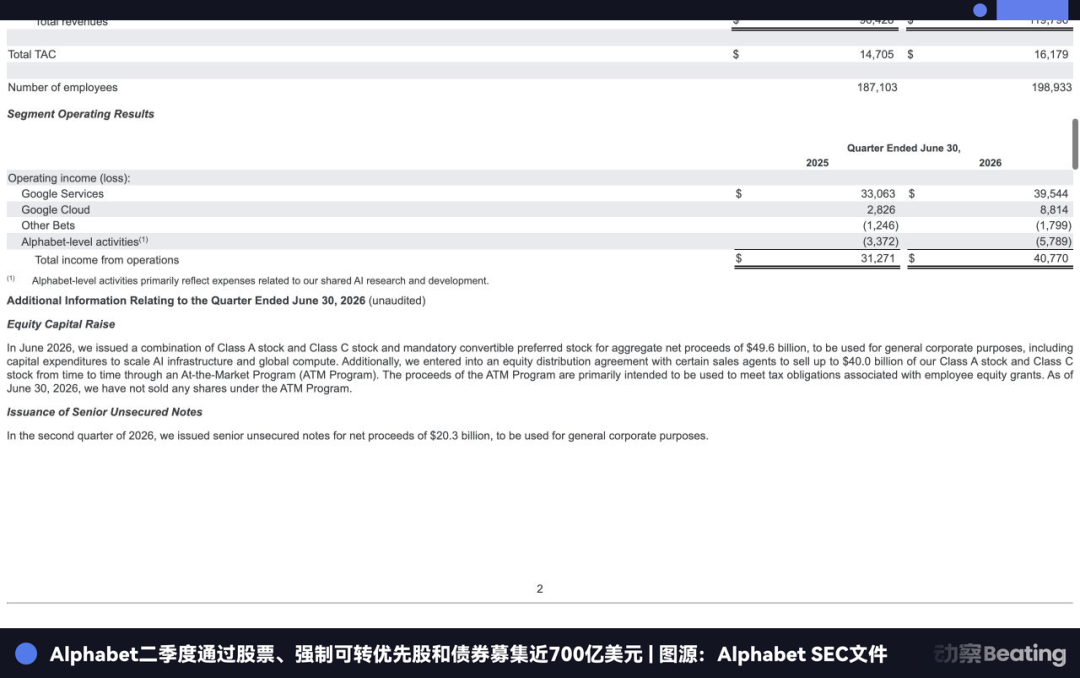
A company that has primarily relied on operating cash flow to finance investments is now using equity, long-term debt, and capital markets in various currencies. AI now needs to address not only the size of the financing, but also the stability of the funding term and source.
The entire industry is undergoing similar changes. As of July 7, Amazon, Alphabet, Meta, and Oracle have issued approximately $194 billion in bonds this year, a 79% increase over the full year of 2025. The proportion of debt added by the top five cloud providers to capital expenditure has also increased from 9% in the 2024 fiscal year to 32% in June of this year.
When close to one-third of new capital expenditures need to be funded through borrowing, credit itself begins to be a condition for expansion.
The issue is that this money is not priced the same for each company.
Oracle's 2026 fiscal year free cash flow is negative $23.7 billion, with next year's capital expenditure guidance reaching as high as $95 billion. Even after deducting the $25 billion that customers may return, there is still approximately $70 billion that needs to be self-funded.
In July, S&P downgraded Oracle's credit rating to BBB-, just one notch above junk status. Its five-year credit default swap rose to 215 basis points, reaching an eighteen-year high, and bond yields ranged from 7% to 8%. During the same period, Alphabet and Amazon had bond yields of only about 2.5% to 3.5%.
To maintain its investment-grade rating, Oracle issued $43 billion in bonds in the 2026 fiscal year and completed a $5 billion equity financing. It also plans to refinance approximately $40 billion in the next fiscal year.
For the same batch of GPUs, the equipment purchase price may not differ by much, but the long-term funding supporting them could differ by several percentage points.
Capital structure has begun to directly determine the limit of computing power expansion.
CoreWeave explained that asset pricing can also be repriced through financing structures. In 2023, when the company used GPUs as the primary credit-based financing, the spread once reached a staggering 9.62 percentage points above the benchmark interest rate. GPUs are quickly outdated, challenging to assess residual value, and not inherently the long-term collateral that financial institutions like to hold.
In March of this year, CoreWeave raised $85 billion through a project company, bundling high-performance computing infrastructure and long-term customer contracts into the credit structure. The loan obtained an investment-grade rating, with a floating rate of benchmark interest rate plus 2.25 percentage points and a fixed portion of about 5.9%.
Two months later, another $31 billion loan supported by weaker credit customer contracts was downgraded below investment grade, and the interest rate was again raised to benchmark interest rate plus 4.5 percentage points.
Within the same CoreWeave, both building AI computing power, the funding cost can differ by more than two percentage points simply due to varying customer credit, contract terms, and financing structures.
One company can build a data center with 5% long-term funding, while another company needs to pay 9%. The acceptable payback period, utilization rate, and service price naturally differ. The cheaper the funding, the more capable they are of accepting a longer ramp-up period in capacity and have room to participate in competitive pricing for inference.
Chip costs determine how cheap computing power can be sold, and capital costs determine how long this price can be sustained.
Price reduction capability is beginning to be an extension of financing capacity.
What truly locks in the budget are long-term contracts
Capital spending records the investments that have already been made, while long-term contracts lock in whether you will continue to spend less in the next decade or so.
The distance between these two figures is already evident in Meta's financial report. As of the end of June, the company had signed but not yet commenced operating and finance lease obligations amounting to $278.99 billion, mainly for data centers, colocation facilities, and network infrastructure, with the longest term reaching 30 years. In July, Meta added around $68 billion in data center leases, with contract durations generally ranging from 18 to 20 years.
In addition, the company has $349.31 billion in non-cancellable contract commitments, primarily for third-party cloud compute and technology infrastructure. Some procurement agreements even require upfront deposits as collateral, leading to $10.8 billion in money market funds being converted to restricted cash, awaiting release only after the fulfillment of related obligations between 2028 and 2030.
Even though the contracts have not yet commenced, the flexibility of funds has already decreased.
Microsoft operates on a larger scale. By the end of the 2026 fiscal year, the company disclosed contractual obligations amounting to $743.82 billion, including $329.1 billion in uninitiated data center leases, with a maximum term of 20 years. Alphabet also has $85.2 billion in uninitiated data center leases, with some extending up to 26 years, and certain long-term energy agreements surpassing twenty years as well.
Reuters calculated, based on the latest disclosures from five companies, that Microsoft, Meta, Oracle, Amazon, and Alphabet have around $1.09 trillion in uninitiated lease payments, nearly four times the on-balance sheet recognized lease liabilities.
What truly locks the big tech companies into this AI cycle is no longer just how much they spend this year, but also how much budget they have already committed for the future.
This has also altered the cost of exiting. If a consumer-facing app is underperforming, budgets can be cut, teams downsized, or even the app shut down directly. However, once a data center construction project begins, the costs of electricity, land, equipment, and lease agreements do not vanish based on quarterly business decisions. Building an additional data center today may imply payments for this decision over the next twenty years.
During Tencent's Q2 earnings call, Liu Chiping explained AI capital expenditure as centralized procurement, with significant investments mainly occurring this year and the next, suggesting it should not be straightforwardly extrapolated as a recurring fixed scale each year. While this assessment holds at the cash outlay level, long-term contracts have their own timeline. Procurement may be concentrated in the near term, but rental payments, electricity, and depreciation will continue to appear on financial statements for years to come.
Microsoft has already started to witness this impact. In the 2026 fiscal year, the company's server, network equipment, and software's carrying amount reached $215.87 billion, up from $132.84 billion in the prior fiscal year; the group's depreciation expense rose from $15.2 billion in 2024 to $22 billion in 2025, then further climbed to $34.3 billion this year.
There is yet another layer of even trickier duration mismatch here. While Microsoft's servers and network equipment typically depreciate over two to six years, some data center leases run for up to twenty years. With chip updates happening at an increasingly rapid pace, companies may accelerate depreciation or even recognize impairment if the actual economic life continues to shorten, but the facility, power, and lease contracts do not adjust accordingly.
Chips designed for a few years are now being fitted into contracts lasting twenty years.
Compute Power Emerging as an Asset
Long-term contracts lock in future demand, but construction funding needs to be in place today.
Morgan Stanley estimates that over the next four years, approximately $2.9 trillion will need to be invested in global data centers and related hardware, with large cloud providers only able to cover around $1.4 trillion out of this total using their own funds. The remaining $1.5 trillion will need to be filled by external capital. Around $800 billion is expected to come from private credit, $200 billion from investment-grade corporate bonds, $150 billion from data center securitization, with the rest being shouldered by equity and sovereign funds.
When construction scales surpass a company's cash flow, the focus of financing shifts. Capital is no longer assessing whether a company is worthy of a loan but instead evaluating how much a data center, a batch of GPUs, and the underlying long-term contracts are worth.
On August 10, Nvidia signed a partnership agreement with six financial institutions, including Apollo and BlackRock, planning to establish a compute infrastructure financing platform, mobilizing over $500 billion of third-party capital in the future. Nvidia also stated its intention to turn compute power into an asset that can be allocated by long-term funds.
This framework is already being put into practice. The VCI fund managed by Valor purchased $5.4 billion worth of compute equipment, including Nvidia's GB200, and then leased it long-term to xAI. Apollo-managed funds provided a $3.5 billion capital solution, in which Nvidia also participated. The equipment remains on the fund's asset side, xAI turns the one-time purchase into long-term rent, and the future rental income becomes the basis for today's financing.
Meta's Hyperion project is on an even larger scale. Out of an estimated $27 billion development cost, a fund managed by Blue Owl holds an 80% stake in the project, while Meta retains 20% and will lease it long-term upon completion. Meta has not entirely exited the credit relationship and has provided capped residual value guarantees for the project's first 16 years of operation.
Assets can be removed from the balance sheet of a major corporation, while the credit still remains in the transaction through leases, customer contracts, and residual value guarantees. Capital allocation is shifted from the present to the future, and construction funding is provided upfront.
Mature data centers can further enter the securitization market. The outstanding volume of data center securitization products has increased from $4 billion in 2020 to $61 billion this year, with the share in non-traditional securitization markets rising from 3% to approximately 12%. In July, the U.S. securities regulator further clarified the regulatory approach to certain data center securities, allowing qualified structures to be exempt from the 5% risk retention requirement of traditional asset securitization products.
A separate financing market is emerging. Long-term leases of major corporations, hash rate procurement contracts of mining companies, and the data centers themselves can be unbundled for pricing and then enter the investment portfolios of insurance funds, private credit, and infrastructure funds.
This also means that the capital available for hash rate development is beginning to exceed the operating cash flow of any technology company.
Risks have not disappeared; they have only been reallocated. If future demand falls below expectations or GPU residual values decline, the ultimate loss will depend on how leases, guarantees, and recourse rights are arranged.
Hash rate financialization is about turning the future cash flows of contracts over the next decade into construction funding today.
Repricing Risk
Hash rate financing has not yet seen widespread defaults, but the credit market has begun to repricing risks.
A $2.6 billion loan completed by CoreWeave this year is quite typical. The loan term is close to five years, while the underlying customer contracts have an average duration of only three years, with Anthropic-related contracts accounting for about 40%. Customer contracts expire first, while the debt has not been fully repaid, and data center leases could continue for over ten years.
Investor subscription was initially lukewarm. CoreWeave then raised the yield to nearly 9.1% and introduced a cash lockbox, requiring revenues from relevant contracts to first enter a controlled account for debt repayment. After the conditions tightened, orders quickly increased to around $9 billion.
The money can still be obtained, but lenders are starting to demand higher returns and stronger control.
What is truly expensive is the few years after the contracts expire. Whether customers renew, at what price old GPUs can be leased, will directly impact the value of the loan. What used to be technical and operational issues are now entering credit pricing.
Reuters statistics show that the subscription multiple for large tech company bonds dropped from close to 5 times in February to less than 2 times in July. The subscription multiple for Amazon's bond issuance in July was only 1.6 times, compared to 3.4 times in March.
Credit tightening usually doesn't start with “unable to borrow money.” Orders first decrease, new debt needs to offer higher returns, contract terms then become stricter, and founders put in more equity. Only when these conditions still cannot match the risk, will new projects truly lose funding.
Money becomes more expensive first, and then it may become scarce.
After credit starts to become more expensive, other companies in the supply chain are also forced to take on more risk.
On August 10, Huang Renxun stated that Nvidia can decide whether to provide credit support based on the project, with a cap of around 25% of the potential transaction size. A week later, OpenAI made a larger arrangement for its data center project in Ohio. OpenAI signed a 20-year lease, with Nvidia providing up to $105 billion in potential credit support to the project, while also investing $1.5 billion in the developer SB Energy.
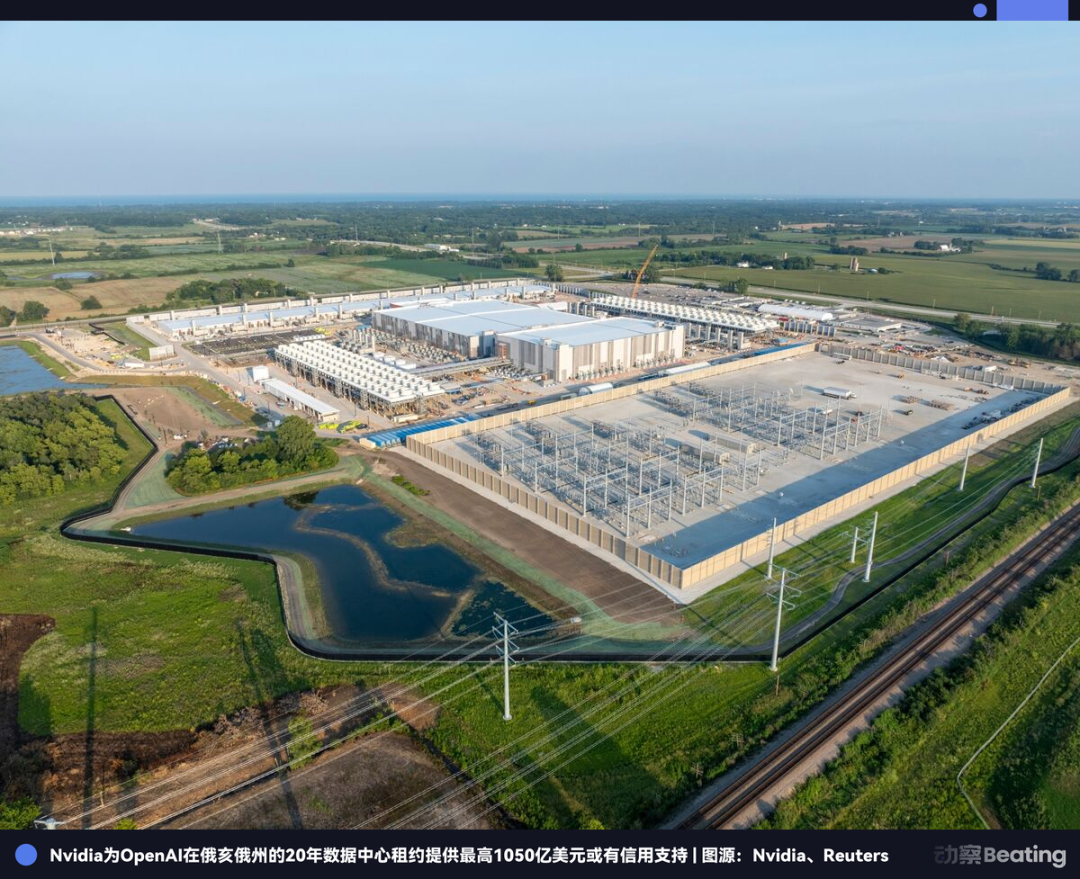
This commitment covers part of the rent, power payments, and site residual value, and does not mean Nvidia will put up cash of an equivalent amount at the current time. But it shifts the risk attribution. GPU sales revenue can be recognized today, while a portion of the future performance risk of downstream projects over the next twenty years starts to fall on Nvidia's own credit.
Assets can be transferred, but credit ultimately has to be borne by someone.
It is still too early to analogize this round of hash rate to “AI subprime”. Many core projects are ultimately used by high-credit companies such as Microsoft, Meta, Google, and the underlying credit quality is far from the 2007 mortgage market. Many data center debts also require repayment of 20% to 40% of the principal during the tenure, reducing the pressure of one-time refinancing at maturity.
What is truly sensitive is the hash rate cloud companies and project companies. They often support data center leases of a dozen years or longer with customer contracts of three to five years, while relying on continuous financing for expansion. If customers do not renew, and GPU rentals drop, the first to change are the price and terms of the next loan.
Over the past two years, long-term contracts from high-credit clients have temporarily lowered the cost of hash rate financing and even helped some projects obtain investment-grade ratings. By 2026, as the asset base continues to grow, investors are starting to reevaluate contract terms, customer credit, and GPU residual value, leading to increased protective clauses.
Systemic defaults have not yet occurred, but the credit cycle has begun.
The market is still willing to provide funds for AI, just starting to reconsider which types of contracts are worth borrowing against, and how many years a batch of GPUs can truly mortgage.
Who Will Hold Out the Longest
Both Chinese and American tech giants are seeking long-term funding for their AI assets, but the available financing tools differ between the two.
American companies have access to a deeper corporate bond market and can place large data centers into project companies to finance through leases and customer contracts, with longer-term assets held by insurance funds and infrastructure funds.
China's internet companies have not yet developed an equivalent scale in long-term private credit and project financing markets, leading to a heavier reliance on equity financing, selling non-core assets, and intra-group cash allocation.
Alibaba has chosen rights issuances, while Meta and CoreWeave rely more on project financing, all dealing with essentially a maturity matching problem. Investments that will only pay off in a decade require money that is willing to wait for ten years.
What will ultimately differentiate them is how long this type of funding can be sustained.
Aside from AI, each company also carries its own capital burdens. Alibaba is still investing in instant retail and international e-commerce, Baidu needs to complete its AI transformation amid a contraction in advertising cash flow, and Meta's Reality Labs still require long-term investment.
The more expensive computing power becomes, the more these parallel strategies need to be reordered.
Companies with stable cash flows from legacy businesses and a thick asset base can access long-term funding at lower costs, enabling them to accept slower returns and more frequent failures. Companies relying on continuous refinancing for expansion have much less room for demand fluctuations and judgment errors.
Capital resilience essentially means buying time for trial and error.
The leaderboard of models changes daily, with a single release potentially quickly narrowing the technological gap. However, credit ratings, borrowing costs, and signed twenty-year contracts are not easily reset within a quarter. Technological lag can be caught up, but the time left by the capital structure is not as easily recovered.
In her book "Technological Revolutions and Financial Capital," Carlota Perez divides technological revolutions into two stages.
In the first half, financial capital floods in, and new industries lay down infrastructure ahead of demand maturity. After bubbles, price adjustments, and redistribution of losses, the established infrastructure enters a larger-scale application phase.
Overinvestment is thus part of the technological cycle. It completes infrastructure construction prematurely, leaving valuation corrections, credit losses, and capital eliminations for the next phase. The real question has never been just about the existence of a bubble but about who has the ability to navigate through the adjustment period.
By 2026, AI is getting closer to this stage. Capital expenditures are starting to exceed what operating cash flow can easily cover, lenders are starting to price customer contracts, asset residual value, and financing terms separately, and the competition among tech companies has expanded from model capabilities to the balance sheet.
The internet industry once treated capital as an almost infinite resource. AI has brought back land, power, chips, depreciation, and twenty-year leases as core operational concerns for tech companies.
Models determine a company's technological ceiling, while capital resilience determines how much time it has to approach that ceiling.
Welcome to join the official BlockBeats community:
Telegram Subscription Group: https://t.me/theblockbeats
Telegram Discussion Group: https://t.me/BlockBeats_App
Official Twitter Account: https://twitter.com/BlockBeatsAsia
