Previously, we have been accustomed to a gradually solidifying narrative: the money for AI infrastructure is flowing from "buying chips" to power, to cooling, to cloud vendors' custom chips. As NVIDIA, the most expensive link in this chain, the growth momentum of its data center is gradually being diluted. Over the past few quarters, the bear market has repeatedly used "high base" and "peak growth rate" to assume NVIDIA's ceiling. In addition, with the accelerating advancement of self-developed ASICs by super-scale cloud vendors, as well as the ongoing market skepticism about whether the AI capital expenditure cycle has peaked, the market's expectations for NVIDIA have also been slowly converging.
On the eve of this earnings report, the forty-one analysts' consensus expectation was only 1.2% higher than the company's own guidance, indicating that Wall Street only wants to confirm that NVIDIA's data center growth has not slowed down. NVIDIA has exceeded expectations for five consecutive quarters, but each time the outperformance has been narrowing, leading the market to increasingly doubt whether this curve will eventually reach its inflection point.
After the U.S. stock market closed on August 26, NVIDIA delivered a report card that completely shattered all expectations. The data center business remains an absolute growth engine, with revenue and Q3 guidance both significantly exceeding market consensus. Jensen Huang's first sentence in the earnings statement also set the tone for this quarter to some extent: "AI has reached its inflection point. It is doing useful work. Its token is productive and profitable. Now, compute is revenue."
A Year of Transition from Supplier to Capital
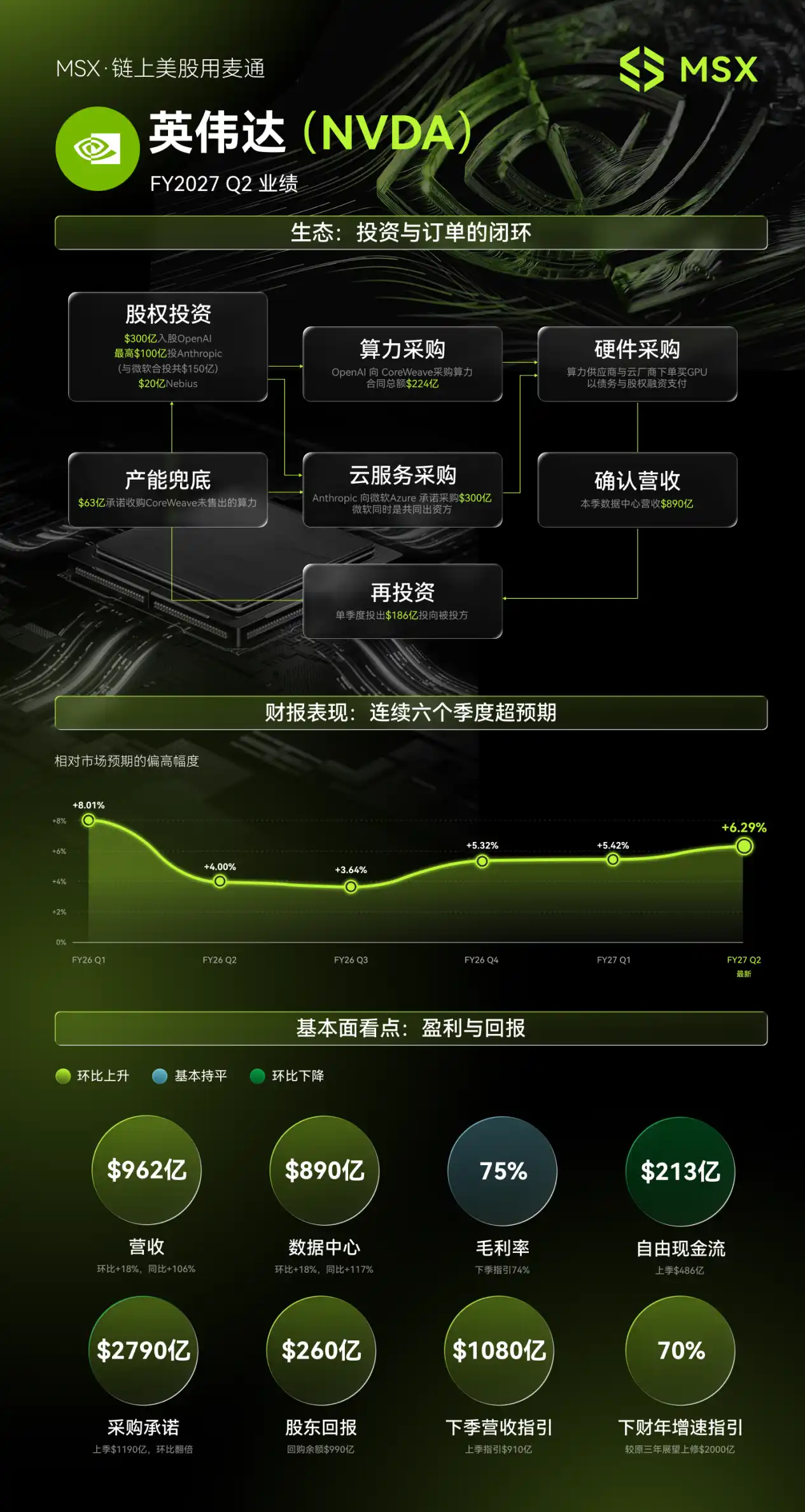
Over the past year, NVIDIA has slowly transformed into a large-scale AI infrastructure investment company. Gaming graphics cards have long been a footnote in its history, and AI industry chain data center suppliers have become one of its different identities. On September 18, 2025, NVIDIA invested $5 billion in Intel as a strategic move. This rare move investing in a competitor made the relationship between the two old rivals even more subtle, just one month after the U.S. government acquired about 10% of Intel for $8.9 billion. The government's stake, combined with NVIDIA's investment, ignited the market's imagination of the once-renowned chip giant returning to the playing field. Intel's stock price skyrocketed by 23% on that day, marking the largest single-day gain since 1987. On December 29, 2025, the transaction was officially completed as NVIDIA acquired over 214.7 million Intel shares through a private placement.
Over the following eleven months, NVIDIA embarked on an almost limitless investment spree. On September 22, 2025, NVIDIA pledged up to $100 billion to OpenAI, just four days after the Intel investment. In January 2026, NVIDIA invested $10 billion in xAI, and in July 2026, it further committed to OpenAI, increasing the total to $250 billion. Then, on August 20 of the most recent year, NVIDIA completed its most complex investment transaction yet. NVIDIA simultaneously did three things: first, it paid $6 billion to license Poolside's AI model, Model Factory; then, it made a $10 billion additional investment at a pre-money valuation of $12 billion; finally, it extended job offers to over 100 Poolside employees, who will join NVIDIA's Nemotron open-source model project.
One could say that NVIDIA once again embedded its capital influence into a cutting-edge AI model company. It is worth mentioning that in a letter to investors, Poolside explicitly stated: this is neither an acquisition nor a talent acquisition; the company will remain independently operated, with the three co-founders staying on board. And if it continues to compete independently in open-source model development, it will need more NVIDIA hardware than is realistically possible. In other words, the scarcity of computing power ultimately brought this company into NVIDIA's embrace.
The continuous flow of capital is blurring the boundaries of the entire AI industry: suppliers, shareholders, debtholders, customers—roles that were once clearly defined are now concurrently established in NVIDIA, sitting in multiple seats at the table. Therefore, this kind of capital loop makes the criticism of "recycling finance" more tangible. NVIDIA invests money in customers, who can then use that money to buy NVIDIA's GPUs, and then that money returns to NVIDIA's books as revenue. Revenue growth can boost the stock price, and a rising stock price allows NVIDIA to invest more capital in the next customer. The oft-repeated phrase "NVIDIA invests $100 billion in OpenAI, and then OpenAI gives the money back to NVIDIA" refers to this cycle. In terms of how the entire ecosystem operates more specifically, NVIDIA, Microsoft, Oracle are all investing in AI developers, who then become major buyers of their cloud computing services, causing the same capital to circulate among multiple companies and be recorded as revenue at each stop.
If the ultimate commercial return of the AI infrastructure is slow to materialize, this seemingly efficient fund cycle will first break at its most fragile link. The risk lies in the fact that every link in this chain is built on the assumption that "the next link will continue to pay": Can OpenAI make enough money with its models to cover the cost of the data center? Can cloud providers rent out computing power? Can AI startups find a profitable model before burning through their funding? And once any one link fails to meet expectations, such as a customer reducing purchases, NVIDIA's orders will decline, leading to a drop in the book value of equity investments, and the funds and guarantees previously invested to support these customers may turn into potential bad debts.
On the other hand, the defense's logic is as follows: these investments are progressive and tied to actual deployment milestones. Taking the OpenAI deal as an example, each new investment is triggered by the deployment of each gigawatt, with the initial gigawatt deployment receiving a $1 billion investment, and subsequent tranches priced based on OpenAI's valuation at the time. This means that if the deployment does not actually occur, the investment will not happen, leaving no room for "revenue out of thin air."
This has been the subject of ongoing debate in the market over the past few months regarding NVIDIA's capital strategy, with concerns about AI infrastructure leverage even rising to the bond market. From 2026 to the present, mega-scale cloud providers and related entities such as NVIDIA have issued $225 billion in bonds, a staggering 973.7% increase year-on-year! Regardless of whether these risks materialize in the end, they will all become stumbling blocks in NVIDIA's stock price ascent.
Another Quarter of Above-Expectation Performance
NVIDIA's FY2027 Q2 earnings report can be described as near perfect by any traditional standard. Revenue was $96.221 billion, a 106% year-on-year increase and an 18% increase from the previous quarter, marking the highest year-on-year growth rate since the second quarter of the 2025 fiscal year. This figure exceeded the mid-point of the company's own guidance by $5.2 billion and surpassed analysts' expectations by over 4%. Adjusted EPS was $2.22, a 120% year-on-year increase, nearly 6% above the market's expectations. Non-GAAP operating profit was $63.956 billion, up 124% year-on-year, with an operating margin of approximately 66%, higher than analysts' expectations of $61.19 billion. Operating expenses were $8.232 billion, lower than the expected $8.32 billion. While the revenue beat expectations, cost control also outperformed expectations. However, after the earnings report was released, NVIDIA's stock price rose slightly in after-hours trading, then quickly turned lower, falling by 4% at one point.
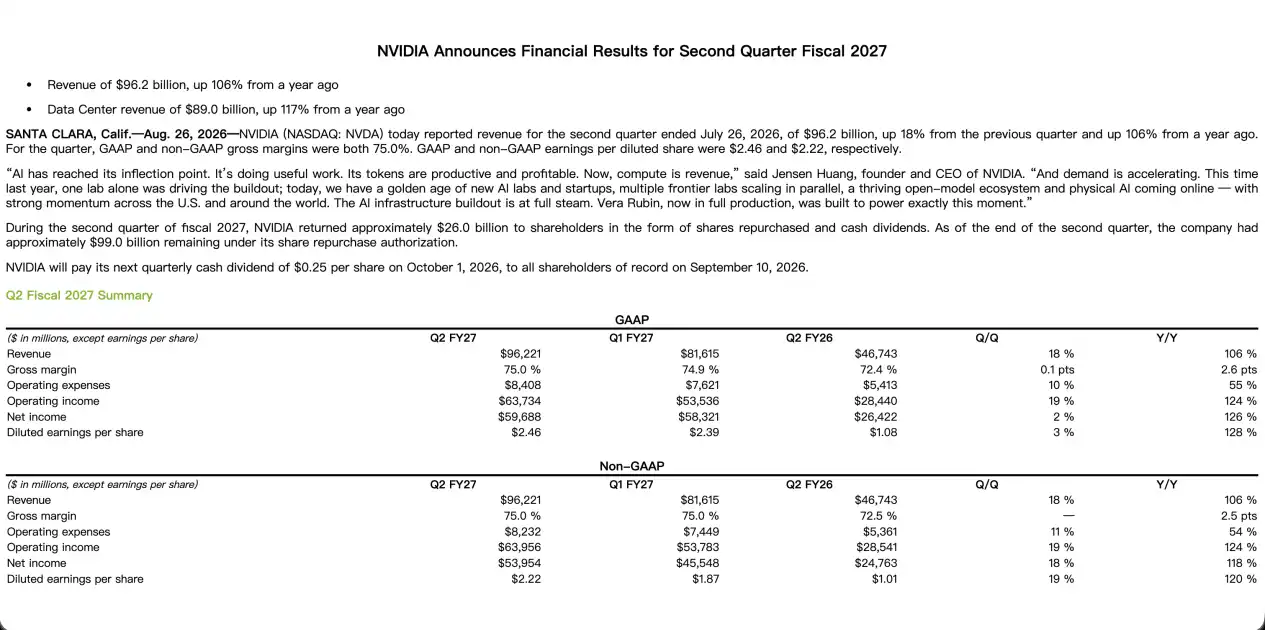
Data center revenue was $89 billion, a 117% year-on-year increase and an 18% increase from the previous quarter, surpassing analysts' expectations of $85.8 billion to $85.9 billion, accounting for approximately 92.5% of the company's total revenue. Revenue from mega-scale cloud providers reached $48.71 billion, significantly exceeding the expected $43.55 billion, with an excess of nearly $5.2 billion; revenue from AI cloud, industrial, and enterprise applications was $40.31 billion, below the market's expectation of $41.96 billion; edge computing revenue was $7.2 billion, up 27% year-on-year and 13% from the previous quarter, exceeding the expected $6.61 billion. This structure indicates that the above-expectation performance this quarter was mainly driven by mega-scale cloud providers, while the expansion pace of enterprise, industrial, and some AI cloud-related demand was slightly below the market's previous expectations.
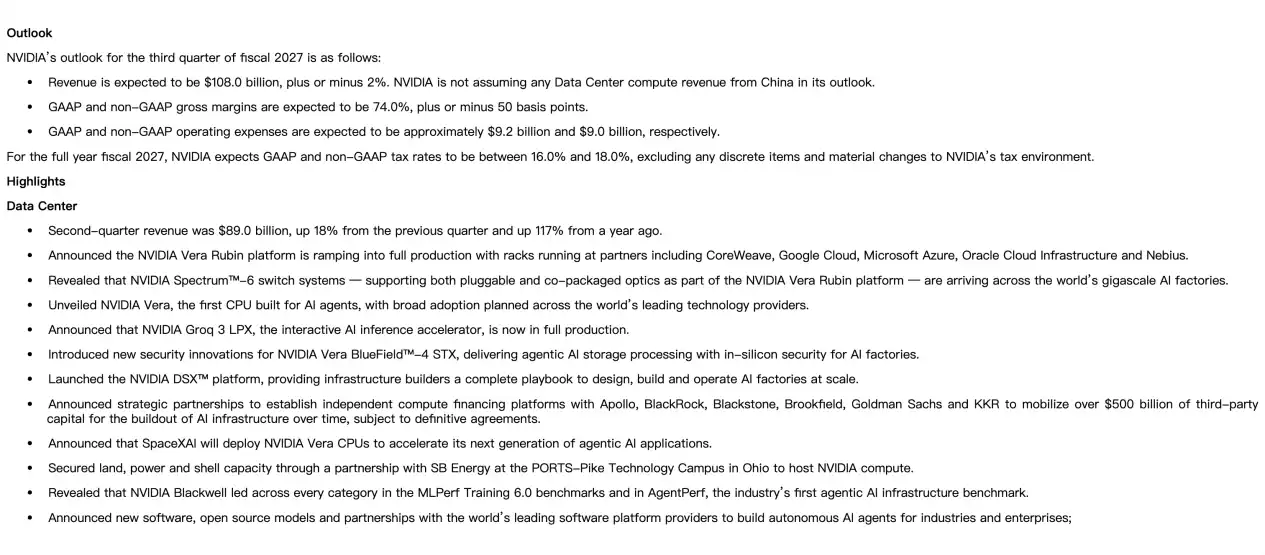
This is a signal that needs to be treated with caution. Previously, the market (including many analyses) tended to believe that NVIDIA's customer base was rapidly diversifying and enterprise demand was taking over. However, the data for this quarter shows that the four major cloud players are still the absolute growth engine, and enterprise-side adoption has not fully caught up. The Compute & Networking revenue was $88.3 billion, also higher than the expected $84.69 billion, reflecting the same logic: large-scale cluster deployment remains the core form of current demand.
As for gross margin, both GAAP and non-GAAP gross margins for Q2 were 75.0%, unchanged from the previous quarter, up about 2.5 to 2.6 percentage points from the same period last year. With revenue close to a trillion dollars and a highly tense data center supply chain, maintaining a 75% gross margin indicates that NVIDIA still holds significant pricing power in the AI acceleration computing market. However, the guidance for Q3 is 74.0%, a decrease of about 1 percentage point from Q2, below analysts' expectations of 75%. There are different driving factors behind this, including yield fluctuations and cost disturbances typically seen in the early mass production stages of new platforms, as well as cost increases in the supply chain such as HBM, advanced packaging, and key elements like substrates, similar to the memory crisis Apple faced earlier.
The changing product structure is also likely to mark the beginning of a longer-term downward trend. As the proportion of whole system rack deliveries increases, the cost structure of the product differs from when selling GPUs alone. The most important product signal in the financial report is that Vera Rubin is accelerating into full production. The current rack is already running at partners such as CoreWeave, Google Cloud, Microsoft Azure, Oracle Cloud Infrastructure, and Nebius. This detail is crucial, indicating that Rubin is already running in real customer data centers. This new system-level architecture, combining Vera CPU, Rubin GPU, Spectrum-6 network, BlueField, security, storage, software toolchain, and DSX platform, will be the core support for its growth narrative over the next several quarters. NVIDIA repeatedly uses the term "AI Factory" to emphasize that it is supplying not just chips but a complete system for building, operating, and scaling AI computing infrastructure. This is crucial for the valuation narrative, as one of the market's previous biggest concerns was whether NVIDIA could smoothly transition to the next-generation platform after the Blackwell demand peak. The smooth production of Rubin directly extends visibility into the growth cycle. However, product transitions also bring short-term uncertainties, such as typically accompanied by supply chain, delivery pace, customer acceptance, and cost structure changes in new platforms, which may be one of the reasons for the downward shift in Q3 gross margin guidance.
From this financial report, it can be seen that NVIDIA's core business growth quality is genuine, and may even be better than the surface numbers. Excluding $7.77 billion in equity investment income, non-GAAP net income was $53.954 billion, with an operating margin of 66%, indicating that the core business itself is extremely profitable and not embellished by investment income. Expense control also exceeded expectations; and ACIE falling short of expectations by $1.6 billion indicates that the process of customer diversification is slower than previously imagined by the market. This indicates that the risk of over-reliance on the four major cloud players has not been alleviated in the short term. The decline in gross margin, a sharp decrease in free cash flow, a surge in accounts receivable, and a growing investment portfolio outline a company that is using a heavier balance sheet and longer cash conversion cycle to support faster growth.
AI Narrative, Competitive Landscape, and Supply Chain: Three Parallel Tracks
Currently, NVIDIA's fundamentals remain solid, but the three pillars underpinning these fundamentals are each undergoing changes. The first is the AI narrative. We know that Wall Street's current focus on the AI investment cycle has shifted from "compute expansion" to "return validation." Huang Renxun's long-term assessment is that AI infrastructure spending could reach $3 trillion to $4 trillion annually by the end of this century, driven by the widespread adoption of intelligent AI agents. This means AI systems that can make continuous decisions, use tools, and perform multi-step tasks, rather than just simple question-answering robots.
This assessment itself is not very controversial. However, the disagreement lies in the timeline and the path to returns. Today, no one is concerned about whether investing in AI is investing in the future; cash flow and return urgency are the market's key focus. As mentioned earlier, risks are amplifying in the bond market, and the real and rapid realization of the investment-to-output ratio is the core proposition of the entire AI industry chain, which is also the terminal of its business model.
In addition, the acceleration of the custom ASIC chip track will continue to erode NVIDIA's ceiling share in the AI chip market. From a data perspective, the proportion of Custom Silicon in the entire AI chip market is expected to rise from 20.9% in 2025 to 27.8% in 2026, making it the fastest-growing competitive threat in the current AI chip market. Google's TPU, Amazon's Trainium, Meta's MTIA – the three major cloud providers are all accelerating their in-house chip development. Broadcom, as one of the biggest beneficiaries in this field, has seen AI-related revenue reach a quarterly scale of around $10.8 billion.
The unique aspect of this threat is that its driving force is not performance but bargaining power. Cloud providers are well aware that in terms of versatility and software ecosystem, in-house chips are hard to match NVIDIA. However, they are willing to sacrifice some performance proactively to reduce reliance on a single supplier, gain supply chain autonomy, and have leverage in procurement negotiations. That's why this track will not overturn NVIDIA's position in the short term, but it needs to be continuously monitored in the long term. The key is not whether TPU can beat Blackwell, but how much of the capital expenditure cloud providers are willing to divert from NVIDIA.
As for the supply chain, the current imbalance between supply and demand in data centers, including the ongoing shortage throughout its entire lifecycle, shows no signs of easing. In fact, the tight supply chain situation can be seen as the tone for the entire year in the Q1 earnings report. In Q1, NVIDIA raised its total supply target to $145 billion. Management explicitly stated they are not immune to supply challenges but are confident in supporting customer growth. They expect NVIDIA to remain supply-constrained throughout Vera Rubin's entire lifecycle.
This sentence can be interpreted in two ways, and these two interpretations carry completely different implications for investment. For long investors, if demand is indeed so strong that chip manufacturers cannot keep up with production, a supply shortage signifies pricing power stability and very high order visibility. However, a supply shortage is also a marketing narrative that can perpetuate a sense of scarcity and urgency in the market, prompting customers to place orders early and avoid waiting on the sidelines. Regardless of which interpretation holds true, the supply chain, especially TSMC's CoWoS advanced packaging capacity and HBM memory capacity, remains the most critical variable determining NVIDIA's growth ceiling.
This also explains why in this AI hardware cycle, upstream suppliers are equally in the most certain position to benefit: TSMC controls advanced processes and packaging, Micron and SK Hynix control HBM capacity, and their capacity allocation determines how much NVIDIA can ship. How much NVIDIA can ship, in turn, determines the revenue ceiling for the entire AI infrastructure chain.
When we piece together these three clues, aligning business fundamentals, earnings expectations, and these three underlying currents, a clear structure emerges: demand, capacity, capital—the three variables are the core determinants of sustaining the overall system's growth rate.
NVIDIA is still NVIDIA. After completing the leap from chip supplier to builder of the computational world, it is now laying the groundwork ahead of schedule for an era that has not yet fully arrived. The growth story continues, and it still stands in the most dazzling position of this era. However, as the spotlight shines brighter, the shadow it casts grows longer. It has left the market with unresolved questions that will be the most crucial thread in the coming quarters of the US stock market.
Welcome to join the official BlockBeats community:
Telegram Subscription Group: https://t.me/theblockbeats
Telegram Discussion Group: https://t.me/BlockBeats_App
Official Twitter Account: https://twitter.com/BlockBeatsAsia
