The South Korean government plans to set up a new strategic account under the Korea Investment Corporation (KIC), with a scale of at least 20 trillion Korean won, to invest in AI, data centers, semiconductors, robotics, national defense, and other long-term initiatives, aiming to launch by 2027, pending approval of related bills by the National Assembly.
Initially, this seemed like an industrial policy news item. South Korea is reallocating the fiscal space brought by the chip boom into the next wave of AI infrastructure. However, SemiAnalysis offers a sharper analysis. In this round of "sovereign AI" investment by South Korea, NVIDIA wins, and SK Hynix loses.
This statement goes against intuition. South Korea is one of the strongest memory nations globally, and SK Hynix is a core supplier of HBM (High Bandwidth Memory). The disagreement lies in whether South Korea will acquire stronger domestic AI capabilities or be more deeply embedded in NVIDIA's GPU and CUDA (NVIDIA software ecosystem) systems.
For investors, this will determine whether national-level AI expenditure will ultimately flow to platform companies or remain more entrenched in the local hardware supply chain.
Turning the Chip Dividend into Long-term AI Capital
The core of South Korea's current policy is not just increasing government spending but transforming the tax revenue and assets from the semiconductor boom into more patient long-term capital.
The 20 trillion Korean won strategic account is located within KIC. KIC originally carried out South Korea's overseas investment functions but is now given a role in domestic strategic investments, indicating that the government hopes it will first provide a capital base and then attract follow-up investments from companies and external funds.
AI data centers, advanced semiconductor clusters, physical AI, and local model development are all projects that are difficult to yield stable returns in a short period. If government funds only focus on short-term gains, it is challenging to support the development cycles of such projects.
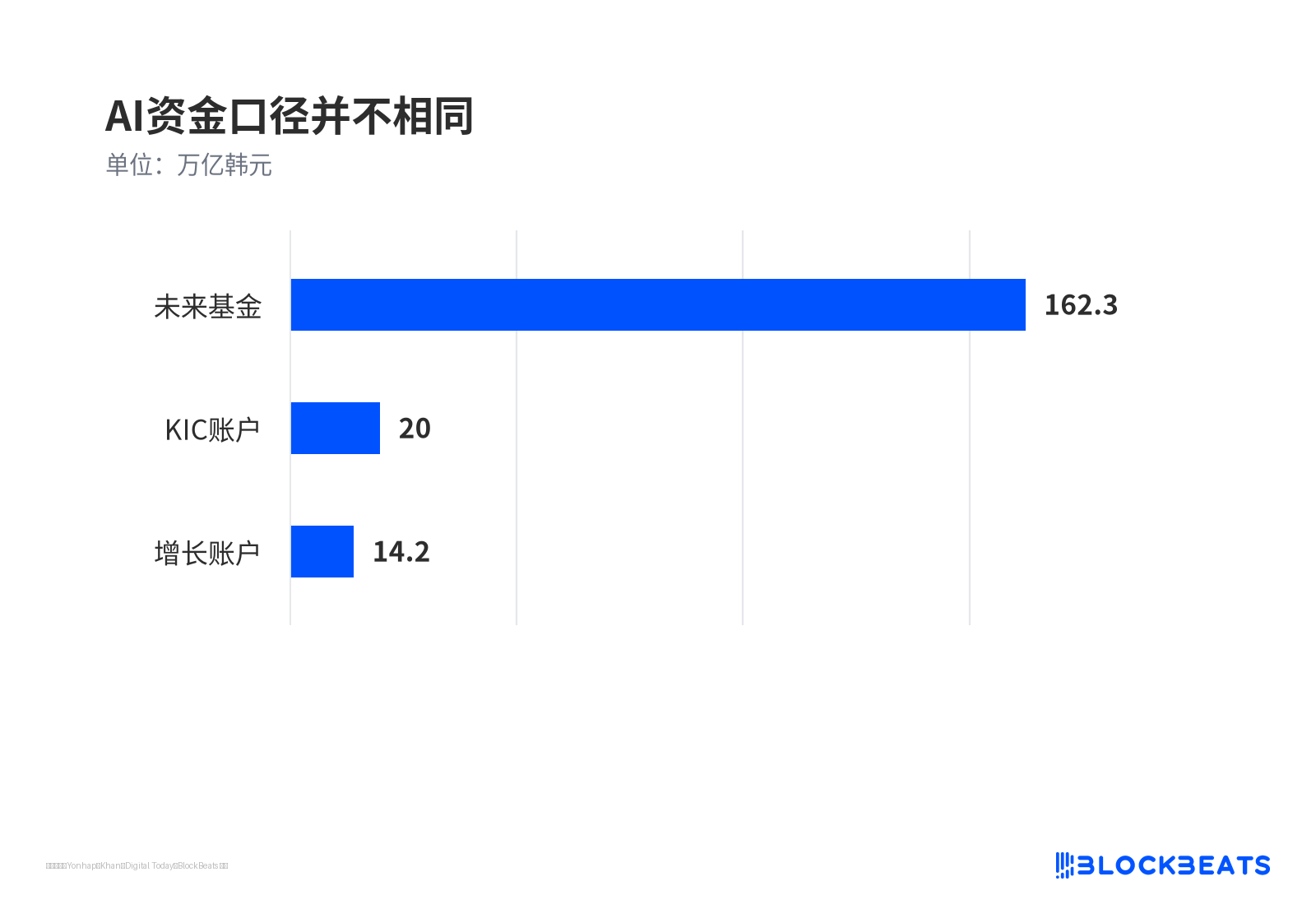
On September 1, South Korea announced the Future Response Fund related to the 2027 budget, totaling 162.3 trillion Korean won, with funds coming from trends in the semiconductor industry and other areas. Not all of this budget will be allocated to AI and semiconductors, with around 14.2 trillion Korean won designated for the Growth Engine Account to support AI, semiconductors, and related fields.
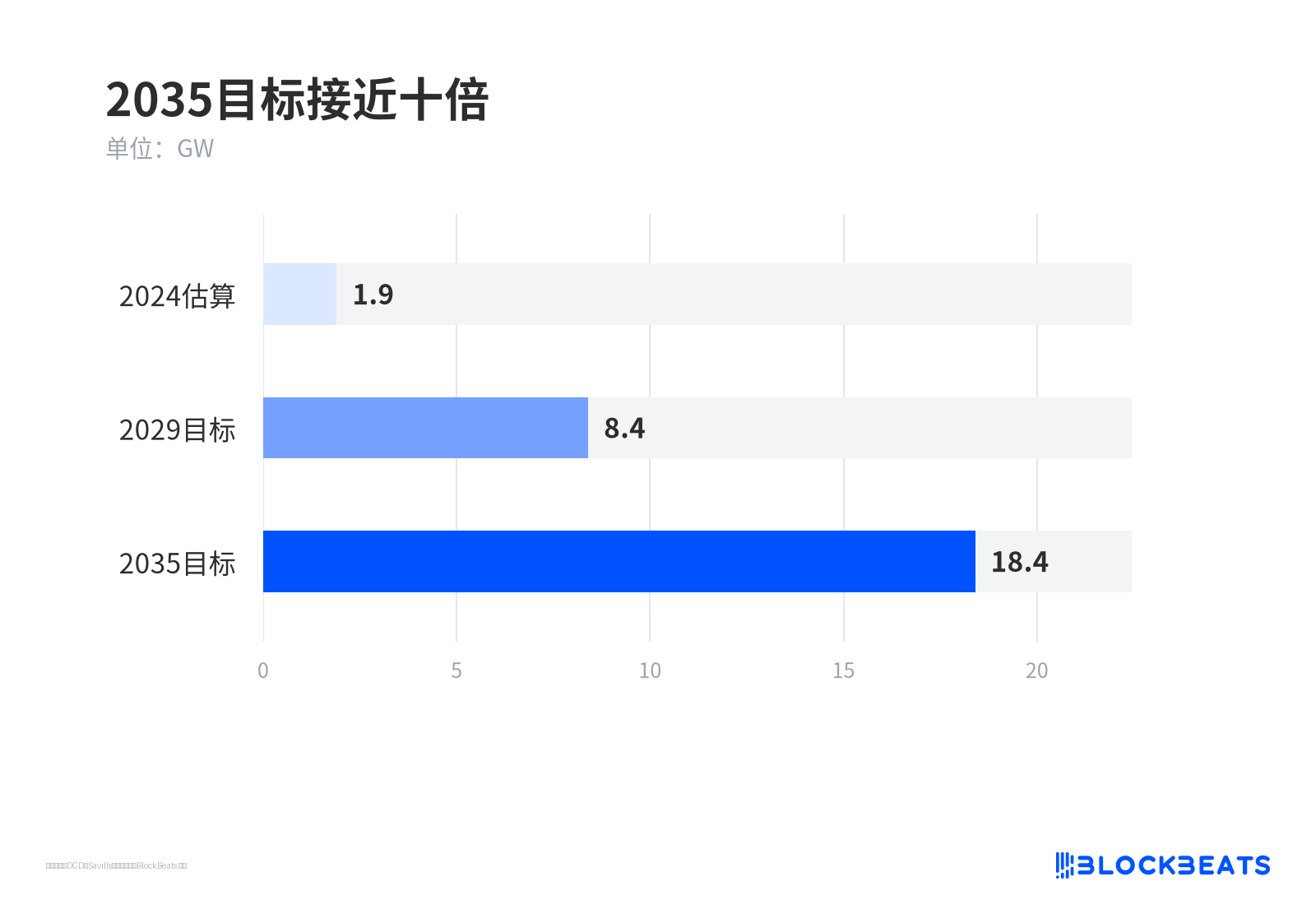
In June, the "Three Major Projects" also set the data center targets for 8.4GW by 2029 and 18.4GW by 2035. This pace is very aggressive, and whether it can be achieved still depends on electricity, land, grid connection, and equipment delivery.
Korea is not just subsidizing a single company, but is using public funds and conglomerate investments to rebuild AI infrastructure. SemiAnalysis's rebuttal is that infrastructure localization does not equate to technology stack localization. While the data center is built in Korea, the GPUs running in the servers may still be from NVIDIA.
Data Center Expansion Initially Favors NVIDIA Stack
The most expensive and irreplaceable part of AI data centers is the accelerated computing platform. Today, most large model training and inference software is optimized around NVIDIA GPUs and the CUDA ecosystem.
This is platform lock-in. The GPU is the hardware, CUDA is the software interface and development ecosystem. Developers, model frameworks, operations tools, and performance optimization experience are all entrenched in this system.
Switching to other hardware is not just about changing a chip. Models need to be recalibrated, systems need to be retested, and operations teams need to re-accumulate experience. If a national-level project wants to build usable computing power in a few years, it usually prioritizes procuring the currently most mature solution.
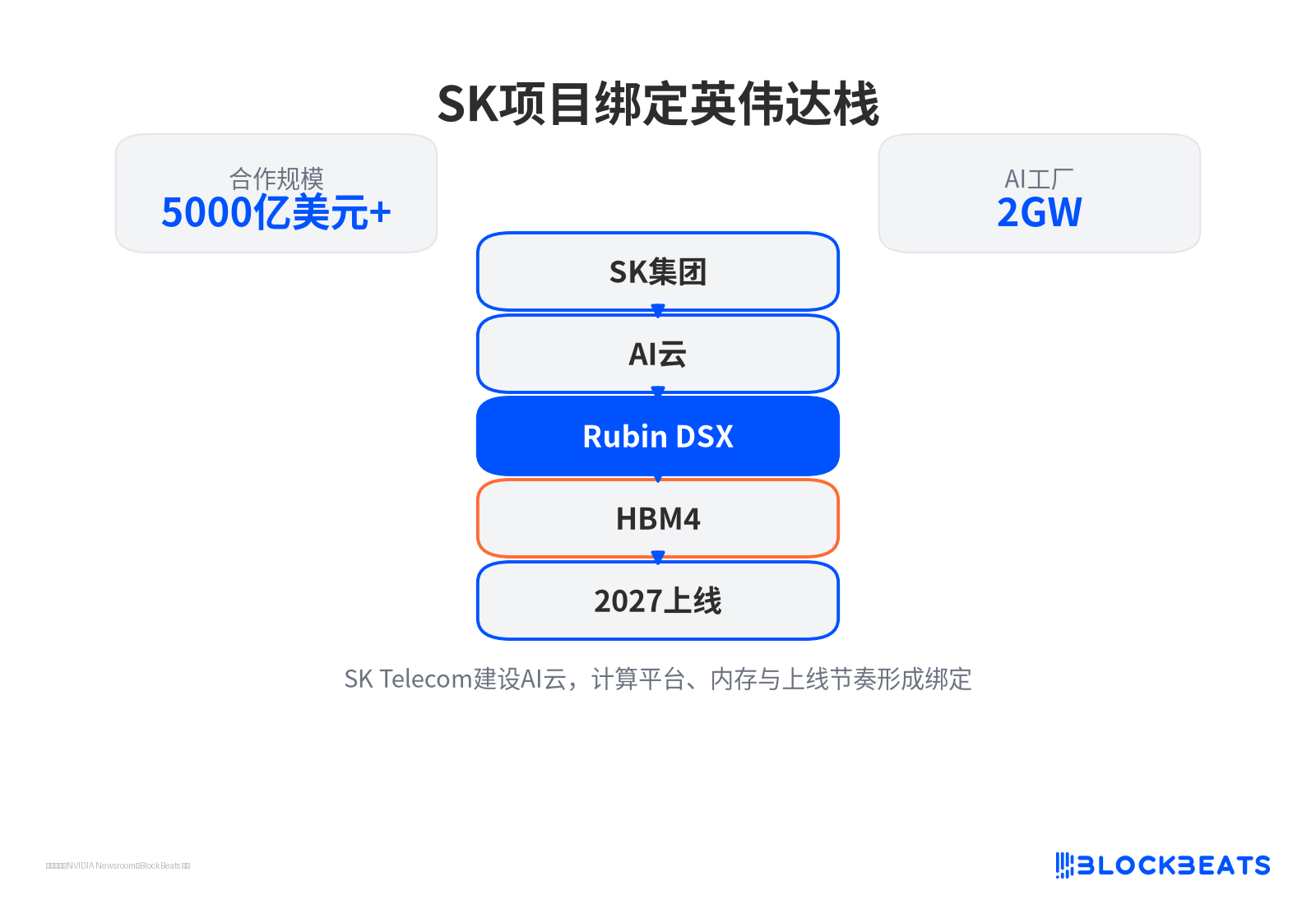
This logic already has real-world clues. In July, NVIDIA and the SK Group announced an expanded partnership, covering AI factories, AI clouds, and next-generation memory, with a total scale exceeding $500 billion. Among them, SK Telecom plans to build a 2GW NVIDIA Vera Rubin DSX AI factory and AI cloud, adopting SK Hynix's HBM4, with the first AI factory planned to go live in 2027.
This does not mean Korea has no independent path. Korea can still accumulate capabilities in packaging, memory, data center operations, local applications, and model training. However, given the current technological reality, the faster the data centers are built, the more likely it is to first strengthen NVIDIA's demand visibility.
SK Hynix Wins Demand, Pricing Power Still on the Platform Side
“SK Hynix losing” should not be understood as business damage. If the South Korean data center construction plans materialize, SK Hynix's HBM demand will receive direct support.
HBM is a key supporting memory for AI GPUs. Without sufficiently high-speed memory, the GPU's computing power cannot be fully unleashed. SK Hynix is in a leading position in HBM supply, and as NVIDIA's platform scale increases, the demand for high-end HBM also grows.
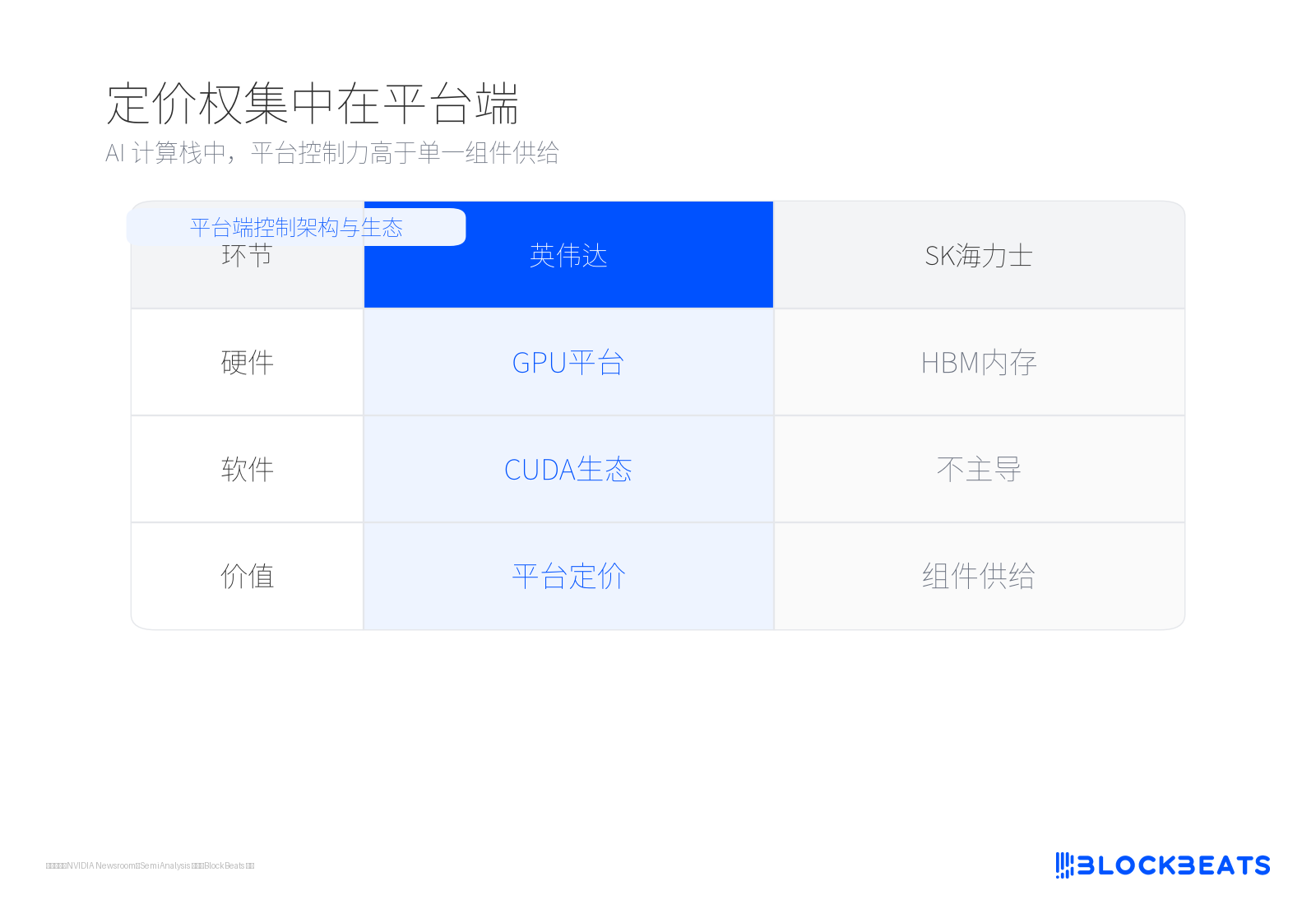
The issue lies in the different positions for value capture. The HBM supplier profits from component value, while NVIDIA profits from platform value. The former benefits from volume pricing and supply tightness, while the latter controls hardware architecture, software ecosystem, developer interfaces, and system solutions.
SemiAnalysis's assessment can be understood as follows. SK Hynix may win in terms of revenue, but in the narrative of whether South Korea holds AI sovereignty, its influence may not be as strong as NVIDIA's. The authority over computing power procurement, software migration costs, and developer ecosystem leadership is not in the hands of the HBM supplier.
Samsung Electronics is in a similar situation. It has both memory and ambitions in foundry and system semiconductors. However, to weaken NVIDIA's dominant position in the AI full stack, it will require not only capital expenditure but also alternative software ecosystems, customer validation, and long-term stability.
Order Proportion Will Bring Differences Back to Reality
This dispute has not yet reached a conclusion. A strategic account of 200 trillion Korean won does not equate to cash being immediately invested in GPU purchases. The funding will still need to go through the process of legislative approval, asset arrangement, and specific project selection.
Data center goals also face physical constraints. From 8.4GW by 2029 to 18.4GW by 2035, this poses challenges to South Korea's electricity, land, cooling, grid, and local operational capabilities. The larger the goal, the higher the execution risk.
The most direct validation variable will be the future projects' proportion of NVIDIA Rubin and other platform purchases, and whether South Korea's domestic models and open technology roadmap can reduce dependence on CUDA in practical scenarios. If orders continue to be concentrated in the NVIDIA stack, SemiAnalysis's assessment will be closer to reality.
At the current stage, what can be confirmed is that South Korea is transforming the chip boom into national-level AI infrastructure capital. Under the current technology stack, the capital that will be enhanced first is the demand visibility of the NVIDIA platform. SK Hynix remains one of the key winners, but what it wins is the high-speed memory segment, not the pricing power of the entire AI computing stack.
Welcome to join the official BlockBeats community:
Telegram Subscription Group: https://t.me/theblockbeats
Telegram Discussion Group: https://t.me/BlockBeats_App
Official Twitter Account: https://twitter.com/BlockBeatsAsia
