Editor's Note: This article is a video interview by podcast host threadguy with AJC, a Meme master ranked fourth on Fomo's current total profit leaderboard. AJC is also a researcher at Blockworks Research and has previously shared in-depth market insights on multiple occasions.
In this round of Robinhood Chain's market surge, AJC is one of the few top traders with a public track record who is willing to share real strategies with the market. In the interview below, AJC not only discussed his hands-on trading experience but also provided deep analysis on topics such as "The Rise of Robinhood Chain," "PONS vs PUMP," and "Stock & Meme Pairing."
The following is the content of the interview video, compiled and translated by Odaily Planet Daily:
The Highlight Moment of My Trading Career
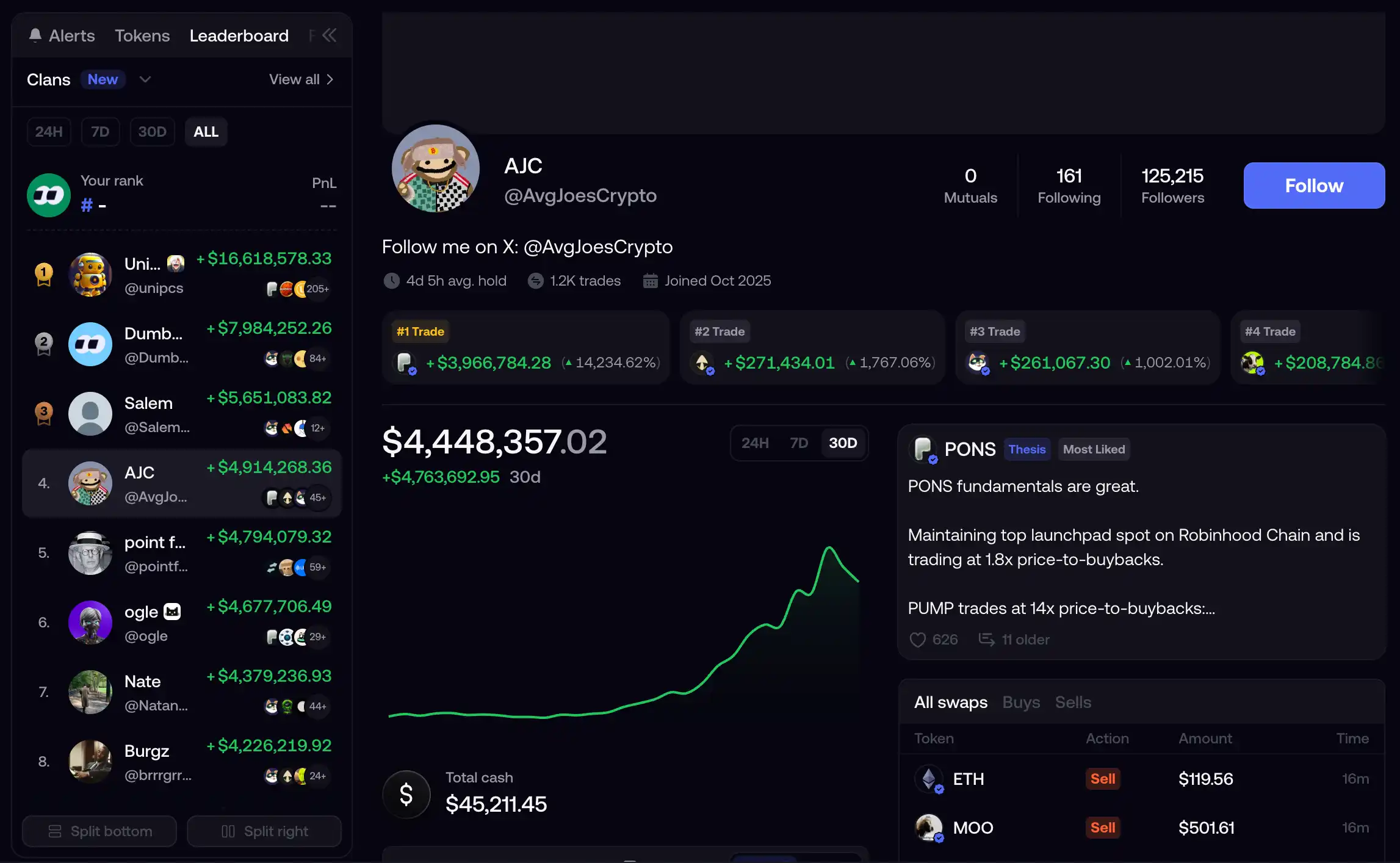
Host (threadguy): First off, congratulations—this is definitely your moment in the spotlight. We were just watching your FOMO account, and your assets have grown to nearly $3 million (approaching $5 million as of this writing), though most of it is still unrealized gains.
AJC: Haha, I'm actually taking some profits too. I sell gradually, but I'm not the type to dump my entire position at the top.
So basically, every time I open the Fomo app, I might sell $1,000 worth of PONS.
Host: Okay, I have to admit, you're better than me. You're already in the top ten on the leaderboard. Can you walk us through what you've experienced over the past month?
I've always thought of you as someone with sharp instincts, solid judgment, and strong trading skills, but this time you really seem to have caught a generational wave.
AJC: Yeah, honestly, this is all thanks to Robinhood Chain.
I have to be honest—I missed the first wave of Robinhood Chain's initial rally. At that time, I happened to be settling in after Messari was acquired by Blockworks, so I wasn't trading all that frequently.
I knew Robinhood Chain was going to take off, but in my head I thought, "There's still time—this thing won't pump that fast." Then Vlad (Robinhood co-founder and CEO) went and followed Cash Cat, and the whole dynamic shifted overnight.
Luckily, another opportunity came around—the NOXA platform shut down out of nowhere, essentially throwing away their own "cash cow." I watched that moment and thought, Robinhood genuinely cares about this chain—you can tell from Vlad's social media—this is by no means a flash in the pan.
A lot of people got tripped up here by fixed thinking, because the crypto industry has seen countless L1 projects fizzle out. But Robinhood is a beast on an entirely different scale.
So I went digging into the launchpads on the chain and found that besides NOXA, the one with the best data and momentum was Pons. At the time I was sitting in cash just watching, as it ripped all the way up to around $18 million in market cap.
Then Brian changed his profile picture to that classic Meme avatar...
Host (interjecting): Ha, I remember that—it single-handedly crashed all the Meme tokens.
AJC: Exactly! It was insane. I was watching the charts too, and PONS dropped 80% in a single day. And I thought, alright, now's the time!
I decided to take a gamble. Because by then I was already convinced that the top launchpad on Robinhood Chain should be worth a 9-figure market cap, and here it was down to $4 million while still being the absolute leader. Worst case scenario, I lose $25,000—but the risk-reward was just too good to pass up.
The ride after that was full of twists and turns. PONS ran all the way up to a $60 million market cap, then bled back down to $10 million. Through all of that, I didn't sell a single token. At the time, the launchpads on Robinhood Chain were fighting fiercely among themselves, but in the end Pons broke through. I think a key reason Pons ultimately won is that it actually had its own token—we can dive deeper into that later.
But over the past two weeks, the market has started repricing it. I basically just kept staring at it, watching the charts, and observing my expectations play out step by step.
So this period has indeed been extremely chaotic, but on the flip side, the truly hard part is already done. Right now, it's basically just sitting there, watching your own "piggy bank" keep growing.
Robinchain Chain's Path to Success
Host: I actually wrote something in the Telegram group earlier — in the crypto space, "first-mover advantage" often turns out to be a disguised punishment. Take the early NFT Launchpads, or Vector, and so many other examples — you start too early, and latecomers not only learn from your failures, but they're often more willing to go all-in and take bigger risks.
Honestly, when Robinhood Chain first launched, my reaction was totally "oh, whatever" — looking back now, that take was absolutely ridiculous. Because what Robinhood did is genuinely interesting. If other centralized exchange chains had launched a bit later, they probably would have adopted a similar strategy.
Robinhood came out of the gate with an extremely meticulous plan, fully embracing on-chain culture, understanding Meme token mechanics inside and out, and every move was executed with military precision — no missteps, no cringe-worthy over-marketing (triple shilling), no weird deployment issues... All the amateur mistakes we've seen Web2 giants make time and time again when building on-chain products, they avoided every single one. Even that "soft shill" of Cash Cat during the earnings call was calibrated to absolute perfection. Did this whole playbook surprise you? Or did you see it coming?
AJC: Half and half. First of all, Robinhood is a massive publicly traded giant. If they're determined to make their chain succeed, they have every resource and trump card necessary to get it done.
That said, how thoroughly they embraced the native on-chain "degen/speculative" culture did catch me off guard at first. But when you think about it, it makes complete sense, right? Look back at 2021 — why did DOGE and SHIB absolutely explode into the mainstream? The core catalyst was Robinhood. Their user base is naturally highly receptive to these kinds of high-volatility assets.
So I think, from that angle, them deeply activating this dynamic was a logical move. We probably do need to give Robinhood's team credit — they keenly identified a sentiment vacuum in the market. At that time, on-chain players had largely been burned by major exchanges and new L1s, feeling ignored and abandoned, like nobody genuinely cared about retail.
And then, the most influential retail trading platform for the younger generation across America charged in with its own chain, embracing these on-chain natives with open arms. In that instant, everyone's reaction was a collective "holy sh*t." So, their choice of this entry path was indeed somewhat unexpected, but the fact that Robinhood Chain managed to break through is, logically speaking, not surprising at all.
Where Is This Meme Cycle Headed?
Host: How are you currently managing the active positions in your portfolio? Where do you think the explosion of the Robinhood ecosystem over the past two weeks stands in the broader narrative evolution? What stage of the cycle are we actually at right now?
AJC: This is hard to predict with precision. My personal strength lies in keenly sensing the "inflection point when something is about to take off," but once the rally truly gets going, I usually just go with the flow and ride the roller coaster, often ending up round-tripping my profits back. That's always been my style.
So I might not be the most authoritative person to answer the "topping out" question, but I think you can absolutely draw a parallel between this wave and Solana in Q4 2023, or Base in Q1 2024— this is a brand-new ecosystem just rising from the ground, and what's likely to follow is a long and sustained bull run, not a short-lived pulse. Right now is probably just the foreplay.
Of course, I'm heavily positioned here, so I naturally hope this scenario plays out, but I genuinely can't believe that if Robinhood is serious about tokenizing all their U.S. equity assets on-chain and fully opening the door to real-world DeFi, how could this chain possibly be a flash in the pan?
I watched a podcast with Vlad, and his goal is to tokenize U.S. stocks, collectibles, and every asset class in your portfolio onto the chain. And none of these heavyweight moves have actually landed yet! Since the big guns haven't even been unleashed, I find it hard to believe Robinhood Chain has already topped out.
Granted, the Meme tokens and related stocks over the past few days have been a bit crazy. I recall that yesterday Robinhood Chain captured around $3 million in daily network revenue, directly overshadowing a host of mainstream Ethereum L2s.
So in the short term, given how overheated the rally has been, a localized interim top is entirely possible, but I firmly believe that if the broader crypto market re-enters a bull phase and liquidity stops being stagnant, then the real Alpha and the absolute main battleground will be on Robinhood Chain.
Its retail distribution moat is simply too wide. Ordinary people who know nothing about the intricate mechanics of the crypto space naturally trust Robinhood's endorsement. When they see US equity tokens on-chain, they feel reassured and willing to try them out; and the lending, trading, and Meme derivatives ecosystem built on top of these assets will naturally be something they slide into seamlessly.
So my conclusion is that a sharp short-term surge may bring about consolidation or a local top, but there is absolutely no chance of a "post-peak capital exodus where everyone scatters back to the old chains." If you firmly believe in the broader crypto market over the next 6 to 12 months, you must allocate heavily to Robinhood Chain—it's the optimal way to capture this cycle's dividends.
PONS vs PUMP
Host: Let me throw in a completely irrelevant tangent here, and then we'll continue. I noticed that Ethereum mainnet's daily revenue sourced through Robinhood Chain is only around $4,000 right now. That really shows how disastrous the whole L2 narrative has been. But that's beside the point.
Back to positioning—you're sitting on a massive PONS position. Just a few months ago, I also reignited a strong interest in on-chain ecosystems, especially Pump.fun. When Anon and Cash, two platform tokens, successively ran to nine-figure market caps in explosive moves, my first reaction was "the on-chain space is about to go absolutely wild, Pump's money-absorbing power is insane." Solana was the obvious beneficiary, but I don't really like holding SOL spot, so I bought Pump and Anon instead.
As Bitcoin broke out, the entire ecosystem erupted rapidly. But the crypto world shifts direction faster than any traditional market—within just over ten days, the entire narrative landscape has been completely dominated by Robinhood Chain. Now even mentioning Solana on a livestream feels out of place, almost taboo. The speed of this shift is unbelievable.
So from a current trading perspective, how do you view the relative battle between PONS and PUMP, and the Solana ecosystem versus the Robinhood ecosystem?
AJC: If I had to choose, I'd want to go long both. I don't see them as mutually exclusive in a zero-sum game.
Host: Are you currently holding PUMP?
AJC: I don't hold PUMP right now, but I'm absolutely a bull in spirit. I genuinely hope it keeps climbing—I'm definitely not a PUMP hater.
From a pessimistic PvP perspective, yes, PONS and PUMP are indeed fighting over the same batch of on-chain users and the same speculative liquidity. But I lean toward an optimistic "growing the pie" view — Robinhood Chain will bring a wave of brand-new incremental users from outside the crypto circle onto the chain, and that overflow of capital and attention will ultimately feed back into other chains like Solana. Everyone can absolutely coexist and thrive together.
Think back to Q4 2024 — while Pump.fun's revenue was exploding parabolically, Virtuals was also on a tear. Both surged simultaneously in the same macro environment. So I would never view them as mortal rivals, nor do I think investors are forced to make an either-or choice. If PUMP were to 5x from its current level and reclaim its all-time high, that would be a massive tailwind for PONS, because it directly raises the valuation ceiling for the entire crypto launchpad sector.
As for the L1 token you mentioned, I completely agree. I don't hold any SOL myself either. If I had to bet on one dog between PUMP and SOL, I'd pick PUMP without hesitation. Because launchpad products are extremely unique — they're among the few killer apps in the entire crypto industry with the most rock-solid product-market fit (PMF). As you've emphasized multiple times before, even during the deepest bear market, they can still rake in millions of dollars in real revenue on a single day.
You can mock this user base as a bunch of gamblers, but these people show up day in and day out to place their bets on the platform. You can have moral scruples, but that's just the reality.
However, the entire crypto capital ecosystem has been obsessively pivoting toward the so-called "institutional narrative" over the past few years — what do institutions like? How do we pitch a story to institutions? This has led to launchpad protocols being chronically and severely undervalued. People always assume "serious institutions won't touch this kind of thing," but look at Pump.fun's actual captured revenue — how many so-called star projects backed by top-tier institutions does it obliterate into dust?
Host: Indeed, the data is absolutely brutal.
AJC: So for me, this is the perfect opportunity you can only dream of in a bear market: it has battle-tested, formidable PMF; because of mainstream capital's bias and indifference, it enjoys extremely low historical valuation multiples; and the protocol's cash flow is more than ample.
PUMP is an excellent expression of this thesis, and PONS is an equally outstanding vehicle. My earlier relentless shilling of PONS was based on a very simple and crude logic — just compare Pump.fun's revenue against Pons' revenue, and calculate the ratio of their fully diluted valuations (FDV) to buyback size.
At the time, PUMP's FDV/buyback multiple was around 10 to 15x; when I built my position in PONS, that multiple was only about 2x, and it even lingered between 1 and 2x afterward.
If you believe the on-chain market as a whole is heading into a bull run, the logic follows naturally—both PUMP and PONS are severely undervalued. There's absolutely no need to set up any long-short pair trade; if you were to pair them, the strategy should be "going long on both simultaneously."
Host: But have you ever considered this: when you're calculating Pons' platform revenue, the hottest and top-tier tokens on Robinhood Chain right now weren't actually launched from Pons—isn't that a hidden risk?
AJC: I don't see that as a problem at all.
Host: What if other competitors (like Long) suddenly issue a token?
AJC: I'm not sure they will. I'm increasingly leaning toward a "horseshoe theory" of token launches—either you launch your token on day one alongside your product, or you never launch one at all.
I believe this is precisely the core reason PONS managed to break through. The industry used to hold this outdated belief that "a launchpad platform shouldn't issue its platform token too early, otherwise the token price would put an invisible ceiling on the platform's ecosystem." But after enduring so many junk tokens and being effectively rugged by teams time and again, on-chain retail investors have wised up completely—if they can't see a clear, tamper-proof token binding mechanism from day one, if they can't feel the team's interests aligned with holders, users have no incentive to stay on your platform long-term.
This is the key to PONS' massive success. When PONS first came out, it wasn't even officially launched by the team—it was spontaneously launched by the community, and then the team stepped in for a community takeover (CTO), explicitly declaring: "This is our official platform token, and 80% of the platform's revenue will be used to buy back this token."
Retail investors immediately got the message: "Alright, now I feel safe using your platform, because you have a token that's genuinely tied to value—you won't just pocket all the trading fees you earn."
This is an extremely profound market paradigm shift—a complete 180-degree reversal from last year's logic. So for me now: if you're launching a new product, either put out a token that empowers users on day one, or don't issue one at all.
The Magic of the "Stocks & Meme" Pairing
Host: Bro, I honestly think this might be one of the most important shifts to ever happen on-chain. It feels like we've finally reached a social consensus: "What actually makes a good coin?"
The answer is: generate revenue, then use those profits to buy back the token. Because tokens have always been the most terrifying cold-start tool for aggregating attention and initial capital. The crypto industry is playing on a completely different level here. The biggest pain point in the market has always been—after raising money and grabbing eyeballs, what exactly does the project team plan to do with it? Nobody knew.
Until Hyperliquid stepped in and set the example: "We figured it out—the money we earn should be used to aggressively buy back our own tokens on the open market via TWAP." Of course, Hyperliquid is a special case. Their revenue is on a completely different scale, and the team had no external VC pressure—they were already wealthy on their own, so they didn't need to pocket the profits. At the time, the market was saying: "Don't expect every project to be Hyperliquid. That's an outlier."
But then Pump.fun did the same thing, followed by more tokens... The entire market has been extrapolating along this logic: as long as a protocol has real revenue, it's fully capable of—and should—allocate a certain percentage to buybacks. Different projects may have different buyback ratios and varying revenue-generating power, but this signal of real money standing in the same trench as token holders has been completely absent for far too many years. In the past, it was all a bunch of intangible vaporware, with founders dumping massive amounts of tokens behind the scenes via OTC to cash out, leaving retail investors battered and bruised.
Sticking with the on-chain topic—before you earned your latest few million dollars, your social media feed was already a must-read for me, because your radar for cutting-edge on-chain plays is incredibly sharp. From the early SocialFi days, Cards pack-opening mechanics, to the Railgun privacy narrative, you've always been the first to catch the new wave.
I mentioned this in a previous livestream too—the current on-chain gaming cycle might have the highest "grand narrative ceiling" in history. In the past few years, crypto loved creating value out of thin air—from early DeFi yield farming to junk-asset lending, constantly getting drained by hackers. Now, the world's most liquid, most trusted, and most stable high-quality real-world assets (like US equities) are being brought on-chain. The crypto market's ability to "play with assets in creative ways" has finally found solid ground.
So I'm really curious—for the recently exploding Meme stocks, what's your core investment thesis right now? How high can it actually go? Are you genuinely super bullish on the stock-and-Meme-token paired liquidity pool mechanism (Gigapump)?
AJC: Yeah, extremely bullish.
This is interesting—last time I was here, we talked about Zora, and honestly, my fundamental understanding of Zora is 100% interchangeable with this. The reason I was so bullish on Zora back then is that they recognized very early on the core magic of AMM liquidity pools: you can forcibly bind the value of any two assets together through a decentralized pool.
That's what drew me into Zora in the first place. Let me give you a vivid example—remember that influencer guy who filmed his "aesthetic morning routine" holding a bottle of Saratoga spring water?
Host: Yeah, that video went viral and became a top-tier meme.
AJC: At the time, someone on-chain immediately launched a meme coin around him, and its market cap briefly hit $20 million. Meanwhile, Saratoga's stock in the U.S. equity market got hyped up too, surging 100%.
But in the traditional environment back then, these two surging assets were completely disconnected at the fundamental level—there was no channel for their capital flows to transmit between each other.
Imagine this: what if that influencer's meme coin had been paired directly with Saratoga's tokenized U.S. stock as an AMM liquidity pair? These two assets would instantly form a direct value link. Every time someone buys that memecoin, the buy pressure would mechanically transmit through the underlying mechanism to the underlying U.S. stock.
So, I'm extremely bullish on the paradigm of "pairing meme coins at the base level with their true value drivers." To give a counterexample, if you launch an AI-themed meme coin, what's the point of pairing it with ETH? Nvidia surges, OpenAI hits a tech breakthrough—what does that have to do with Ethereum? Ethereum isn't going to pump because of the AI revolution.
The rational move is to anchor that AI meme coin directly to Nvidia, or pair it via platforms like Stock.fun with equity tokens of pre-IPO unicorns like Anthropic or OpenAI in a pool.
From this perspective, I'm very confident that we finally have the ability to fundamentally hard-bind the frenzy of real-world cultural assets to their true value carriers. I can't guarantee whether it'll eventually reach hundreds of billions, but I firmly believe this will become the standard paradigm for future on-chain asset issuance—no longer mindlessly pairing with SOL or ETH, but pairing with the underlying benchmark asset that best matches its logical attributes.
Look at how many people are aping into random shitcoins on Solana every day? If this massive flow of capital pivots into the stock meme arena, the valuation ceiling for tokens will be completely blown through. If you want to go long on U.S. listed company Hims, you can just buy BONER directly—the underlying logic is interconnected: if Hims stock rises 500% in the future, BONER will also see an explosive correlated surge driven by the liquidity pool dynamics.
So, from the underlying mechanics, I'm extremely bullish on this sector.
Host: Let's dig into the technical details. I know many people might be hesitant to break through this barrier, but you clearly know your stuff—when we use a U.S. stock token (like HIMS stock) to purchase an on-chain paired token (like BONER), what exactly happens at the underlying smart contract and liquidity pool level?
AJC: Here's the simple breakdown.
First, Robinhood Chain has a batch of officially recognized U.S. stock tokens. For these tokens to be minted and brought on-chain, they must be executed by whitelisted market makers. For example, Rialto is one of the proprietary AMM market-making institutions on the Robinhood Chain.
The specific purchase flow is: suppose a regular user wants to buy $100 worth of BONER, which essentially equates to indirectly purchasing $100 of Hims U.S. stock spot.
1. The user holds a universal stablecoin (like USDG);
2. The system uses that $100 to buy an equivalent amount of on-chain HIMS stock tokens through the market-making channel;
3. Those HIMS stock tokens are injected into the BONER/HIMS AMM liquidity pool;
4. The user ultimately swaps out $100 worth of BONER tokens.
Host: Got it! So on the surface, you're selling Hims to get BONER, but in reality, the capital flow injects the U.S. stock tokens into the underlying liquidity pool, thereby locking in the stock spot.
AJC: Exactly, spot on! You can think of it as depositing HIMS in there.
This also conveniently explains another core phenomenon: for instance, the recent unusual moves in AMC stock and its on-chain token CINEMA. At the time, on-chain AMC spot liquidity was extremely thin, sitting at just around $40,000, which caused the on-chain price to severely depeg.
The only force driving traditional institutions to bring real-world US stock spot assets onto the chain is "risk-free arbitrage." As long as the frenzied buying of Meme tokens on-chain pushes the price of stock tokens in the pool up by even 0.5%, traditional arbitrage market makers will immediately buy spot shares in the US equity market, cross-chain mint them into tokens, and dump them on-chain to capture the premium.
This is the underlying flywheel that forcibly drags real liquidity from traditional US stocks onto the chain. Just yesterday, the total value locked (TVL) of real-world assets (RWA) on Robinhood's chain surged by more than 30%. This mechanism is indeed taking effect at scale, but lurking beneath it is a deadly risk: US stock tokens can only be minted and redeemed during regular US trading hours (or extended pre-market and post-market sessions).
Once the weekend hits and US markets close, all Mint and Redeem channels are completely locked down. This means that when certain tokens experience parabolic pumps over the weekend, the on-chain liquidity pool cannot perform arbitrage to smooth prices—for instance, the on-chain AMC token was once driven to a high of $400, while the actual off-chain stock price was nowhere near that! Market makers are completely unable to step in and arbitrage before Monday's market open.
So everyone must remain highly vigilant when trading—never blindly chase these paired stock tokens during weekend market closures or when on-chain pool liquidity is extremely scarce, or you'll be handing market makers a windfall of arbitrage exposure for nothing.
Host: So if HIMS stock suddenly hits a black swan event during US trading hours and plunges 50% within 15 minutes, would the BONER token crash along with it? Why?
AJC: It would definitely crash.
Because AMM automated market makers follow the most classic constant product formula (x * y = k). The pricing logic of the two assets in the pool is tightly bound. Under the pure vacuum assumption with no additional retail buying or selling, if the external fair fiat value of one asset (HIMS stock) is cut in half by 50%, then to maintain the relative balance of the pool, the book value of the other asset (BONER) denominated in fiat would also instantly lose 50%.
Host: So they are truly deeply bound at a 1:1 ratio at the mechanical level!
AJC: Yes. Of course, in actual trading, retail buying and selling behavior will disturb the ratio. For example, even if the stock is cut in half, if retail traders develop conviction in BONER at that level and frantically buy the dip, part of the decline could be hedged off; but if external buying and selling variables are completely stripped away, the two are mirror-linked at a 1:1 ratio in underlying value.
Host: This design is pure genius! It perfectly validates the Saratoga case you mentioned earlier.
I was also deeply obsessed with AMC a few months back. AMC is a company that's extremely skilled at playing games with its stock price. In 2022, in order to raise capital and dilute shares indirectly without issuing more common stock, they created a preferred stock called APE, airdropped 1:1 to all AMC shareholders. That thing ultimately failed miserably and went to zero, but they successfully used it to harvest and walk away with several hundred million dollars.
If we fast-forward to today, why couldn't AMC simply issue an official APE token directly on Robinhood Chain? AMC's current actual market cap is only around $2 billion — and right now, an AI Meme that pops off on-chain can touch $300 million in market cap, GOAT once surged to $1.5 billion, not to mention other top-tier Memes. If AMC management wanted to inject endless buy-side liquidity into the common stock, this would absolutely be the better channel!
Vlad would never specifically talk about an ordinary AMC in public, but if it were an APE token on Robinhood Chain pulling in billions of dollars in daily trading volume, that would be a super-narrative capable of rewriting industry perceptions.
So I fully agree with what you said — the marginal expectations for stock Memes have been completely elevated to an unimaginable level. The ceiling for an AI token on Solana might just be some random low-ranking programmer at OpenAI casually posting a tweet, but the narrative ceiling for a top-tier stock Meme could be the listed company's CEO himself, or even the entire Wall Street retail army!
AJC: In theory, yes, but what I personally remain cautious about is that listed companies directly issuing Meme tokens in an official capacity still face massive regulatory and legal hurdles under the current framework. Even as the regulatory landscape gradually becomes clearer, listed companies venturing into security-like tokens remains a high-voltage line.
However, I'm confident that in the future, there will definitely be some small-cap listed companies brave enough to be the first to embrace Meme token communities. The playbook might lean toward "community rewards and cultural building" — for example, holding the Meme token could unlock exclusive merchandise discounts or grant certain shareholder-level perks, reviving the 2021 NFT community playbook.
But that won't be what arrives first. I believe what comes even sooner will definitely be the WallStreetBets (Reddit's retail army) crowd. They'll quickly realize with sharp instincts: using the liquidity leverage of on-chain stock Memes is the perfect new financial weapon to trigger short squeezes in U.S. equities!
Of course, I want to make it clear personally that I never encourage or participate in any market manipulation activities.
We've actually already seen early signs of this on-chain. Certain heavily shorted small-cap stocks, once tokenized, are seeing retail investors use highly aggressive on-chain ponzinomics to push prices higher, attempting to force traditional market shorts into liquidation.
Of course, all of this could just be crypto-native circles hyping themselves up—maybe outside the crypto bubble, no one really cares about this underlying mapping, and once the hype fades, everyone bails. But having been through the trenches in crypto, staying long-term optimistic is often what delivers outsized odds.
Traditional US-listed companies could use this to reach a whole new cohort of Gen Z buyers who would never have touched their stocks in their lifetime. I might never step into an AMC theater, but if your token can get me discounts on movies and let me make money on-chain, I'd be willing to indirectly hold AMC.
This sector just fully ignited last week, and the ceiling simply can't be measured with old-school thinking. You know how it goes—a new animal-themed memecoin on Solana can pump to tens of millions of dollars at most, but how high can the leader go when top US equities meet on-chain frenzy? No one knows.
Facing a brand-new set of rules, being in the thick of it is what makes it thrilling.
What About the Majors?
Host: One last question for you—today's conversation has been incredibly insightful and exciting—what's your take on the current trajectory of the majors, and where we stand in the crypto cycle? Especially Bitcoin, how do you see the broader market moving next?
AJC: I'm a Perma Bull on Bitcoin—I'm forever bullish on it.
In my view, the worst-case extreme scenario has already played out. For instance, when Bitcoin dipped to around $60,000 earlier, the market was flooded with panic and short-selling pressure, but the price simply couldn't break lower. If even that situation couldn't push it down further, aside from a force-majeure "total global macro liquidity collapse," I can hardly imagine what could drive Bitcoin to significantly new lows. Of course, macro black swans fall outside my circle of competence—I don't have any unique insights there, so I simply don't use it as a baseline variable to over-project.
As of now, I believe the broader market is in a healthy "bullish consolidation" phase. After a massive upward impulse earlier, Bitcoin and the entire crypto market have been severely suppressed and washed out over the past year-plus, with the shakeout brutal enough. I see some people casually saying, "Oh, this bear market didn't really drop that much," and in terms of absolute drawdown measured in USD, the numbers on paper do look less dramatic.
But when measured against gold as a benchmark, the drawdown in crypto assets is nothing short of catastrophic.
Host: Right, compared to gold, it's absolutely brutal.
AJC: As a veteran who has fully lived through three crypto bear markets, I personally think this cycle's bear market is the most psychologically torturous one yet.
The last bear market was actually clear-cut in terms of how it died: everyone knew exactly why it collapsed—a bunch of blatant Ponzi schemes blew up, Three Arrows Capital went under, and FTX completely imploded. The reasons were highly specific and transparent; everyone knew where the cancer was. As long as you cleared out those liquidation pressures and leftover landmines, the market could bottom out and rebound.
But this time, the decline feels inexplicable—the market is extremely gloomy and fragile. Nobody can figure out where the core downward pressure is really coming from. The unknown is what terrifies people most—if you can't even diagnose the cause of the illness, you have no idea when this pall of gloom will finally lift.
Host: Totally agree, 100% that's the feeling.
AJC: But precisely because of that, my core view right now is this: The crypto market has been suppressed for far too long. The moment there's even the slightest trigger, it's desperate to explode upward. Almost everyone on the sidelines is sitting in cash, watching from the shore.
You can tell from how violently the market reacted recently to any hints of macro liquidity easing expectations or policy commentary—the moment sentiment shifts even slightly, capital rushes in like crazy to grab positions.
I can't precisely predict what specific bullish catalyst will ignite the next super bull leg, but the strongest signal from this pulse rebound is this—the current crypto market is actively searching for any reason to rally, and sooner or later, it will find enough reasons.
At this current level, the reasons for further deep declines are running thin; but the potential bullish catalysts that could ignite a rally are countless. That's my underlying assessment.
Host: Well said, man. Once again, heartfelt congratulations on this dreamlike "winning streak." I truly enjoy following every step of your trading—you're absolutely at the forefront when it comes to sensing the market's pulse.
Chatting with you is always an unparalleled pleasure. Thanks again for joining the livestream!
Welcome to join the official BlockBeats community:
Telegram Subscription Group: https://t.me/theblockbeats
Telegram Discussion Group: https://t.me/BlockBeats_App
Official Twitter Account: https://twitter.com/BlockBeatsAsia
