Summary
In January 2021, retail investors were able to squeeze GameStop's shorts because the float was locked up—shorts couldn't conjure up more shares to cover. It ultimately took Robinhood turning off the buy button to end it.
Five years later, a batch of meme coins has emerged on Robinhood's own chain, priced not in dollars but in tokenized shares of real listed companies. $BONER is denominated in Hims & Hers, $MEME in AMC, and $AI in Nvidia. The accompanying narrative is still a short squeeze: pump the coin, drive up the tokenized stock price, and force the institution maintaining the peg to buy real shares in the secondary market.
We fully reconstructed the mint and burn records of all tokenized stocks on this chain. In one sentence:
On-chain prices can indeed be pushed—and fast. But the issuer then repairs it, usually within less than a morning.
Here are four specific findings.
The money did reach New York. Over that AMC weekend, Robinhood's issuance agent bought and custodied roughly $7.6 million in real AMC shares in the secondary market, at its peak accounting for 7.6% of pre-market volume. So anyone claiming this system can't touch the real market is wrong.
But the float is now alive, and that's where the market-manipulation logic breaks down. The same agent expanded the tokenized AMC supply 19-fold within three days, from 152,106 shares to 2,895,758 shares. In the Hims round, it went from 468 shares to 130,876 shares. The issuer keeps printing beneath your feet—you can't lock up any float. In 2021, Robinhood stopped retail from buying; in 2026, it sells freely and pockets the spread on the side. This latter defense is far more effective.
So what you get is a needle, not a squeeze. And the needle isn't small: AMC spiked as high as +22% pre-market, and Farmmi hit +321% intraday—both largely given back within a week. A short squeeze sustains because covering forces more covering. These two faded because the mechanism responsible for transmitting capital is inherently self-closing.
There's also a scale issue almost no one has bothered to calculate. Even targeting the cheapest asset, pulling off a real short squeeze would require a $3.4 billion meme coin—thirteen times larger than the biggest project this chain has ever seen—for roughly a 9% gain.
It's also worth clarifying what buying these coins actually gets you. It's not exposure to the company. What these coins truly price is whether the company will notice you. The biggest price move in this entire saga came from a CEO's post on Thursday evening, and Adam Aron was not friendly about it: he called the tokens disgusting and said he'd hired securities lawyers. The token still hit seven times the stock price overnight. The real return here is corporate attention, and it pays out whether that attention is friendly or hostile. The short squeeze is the advertised return, and that one doesn't work out arithmetically.
The genuinely valuable asset on the tokenized stock side isn't the meme coins, and it isn't the issuance platform—it's the subscription and redemption channel. That's a whitelist.
The Weekend AMC Came Back
Thursday, September 3, 5:18 PM New York time, 78 minutes after the close. AMC CEO Adam Aron posted that Robinhood's tokenized AMC was "despicable, outrageous, and disgusting," adding that he'd retained outside securities counsel.
Crypto Twitter saw something else. Within six hours, two meme coins named after the tweet—$CINEMA and $MEME—were trading in pools priced against tokenized AMC. The New York Stock Exchange was already closed. And the token, which theoretically should equal exactly one share of AMC, hit $18.04.
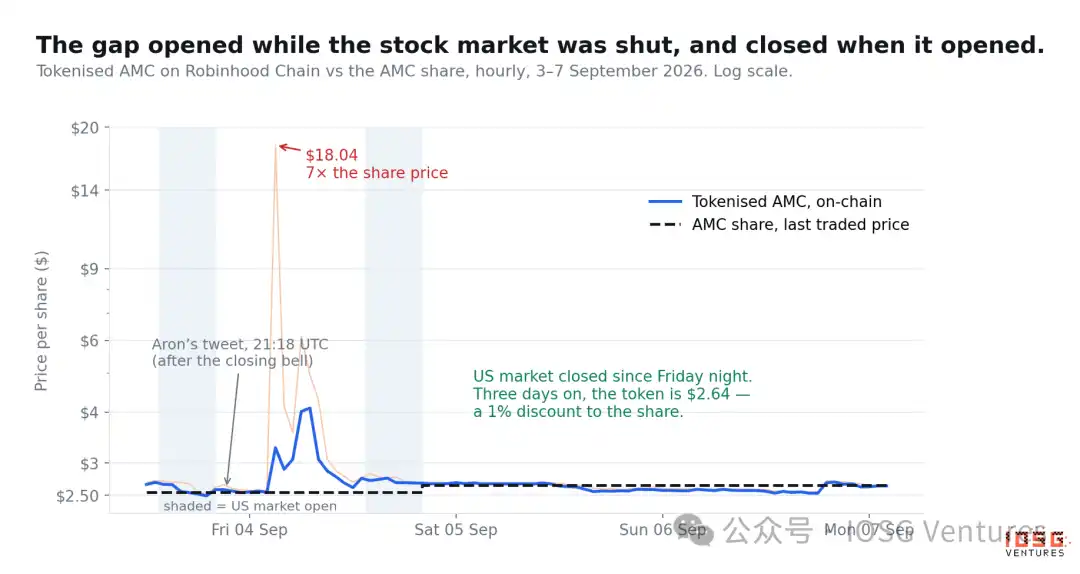
The real stock closed that day at $2.54. Seven times, overnight. And this was a company whose entire investment thesis was "survived the last mania."
The next morning, the gap vanished, but not the way most people think. The stock spiked to $3.11 in the first fifteen minutes of pre-market trading, up 22%, then slid all the way back to close at $2.65. Section 6 will break down that stretch. The most misread hour in this entire episode is that one.
That's exactly why the AMC case is so useful. Everything the short squeeze theory says should appear, did: a real meme stock ticker, a real CEO, a real crowd, real de-pegging, and real buy orders hitting the tape. The stock still ended up back where it was a week earlier.
Stock Tokens on Robinhood
There are three things that need to be introduced first, because none of them existed eighteen months ago.
Robinhood Chain is a public blockchain operated by Robinhood itself. The hundred most active pools turn over roughly $1.65 billion a day, the vast majority of which is ordinary crypto assets.
Stock tokens are issued by Robinhood Assets (Jersey) Limited and track individual US stocks. Legally, they are not stocks but debt instruments that pay you the economic return of a share, backed by real stock held at a broker custodian. In practice, one token equals exposure to one share, and licensed intermediaries (Authorized Participants, or APs) can subscribe and redeem at fair value. It's the same machinery as an ETF.
The token launch platform refers to sites like long.xyz, where anyone can deploy a meme coin and a trading pool with one click. What changed in August was the quote asset: previously meme coins were priced in dollars, now they're priced in tokenized stocks. You're not buying $BONER with dollars—you're buying it with tokenized Hims & Hers.
That single substitution is the whole story, because it means buying a meme coin is buying a stock. Your $ETH and $USDG get swapped into stock tokens on the way in, the pool accumulates stock as a result, and fees accrue in stock rather than cash. A crowd of meme coin buyers becomes, mechanically, a bid for a listed company's shares.
There are now seven of these stock-quoted venues in the top hundred most active pools across the entire chain, with combined daily volume of roughly $73 million. That's no longer a niche play.
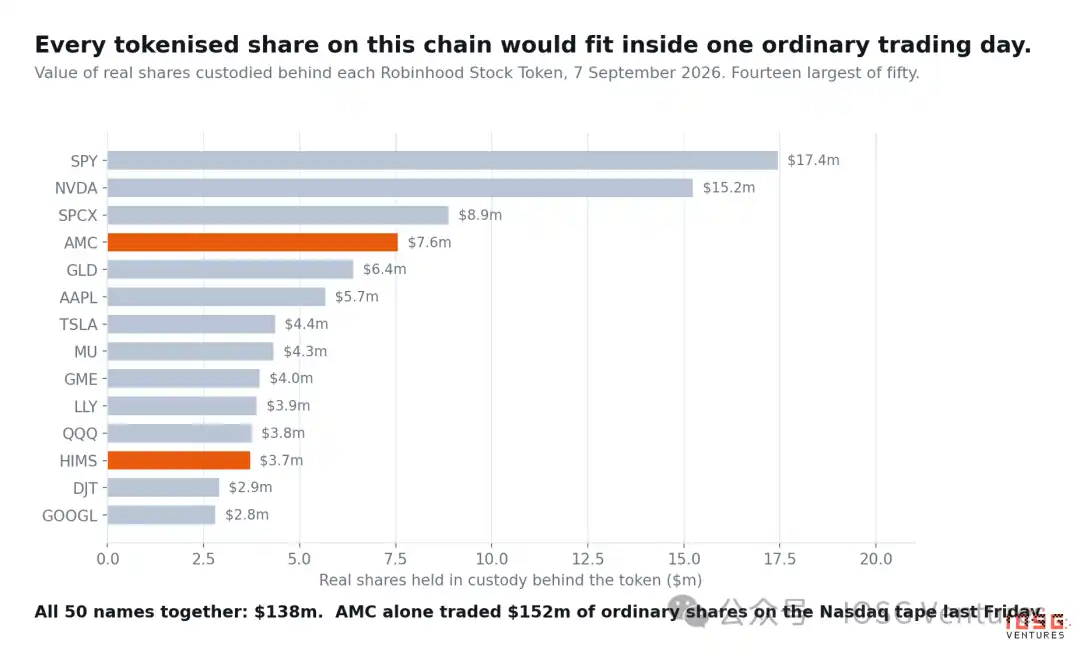
There's one number worth remembering, because it explains most of what follows: all the tokenized stocks on this chain, across fifty underlying names, represent about $138 million in real stock behind them. AMC alone traded roughly $150 million on Nasdaq last Friday. The entire on-chain stock market doesn't match one mid-cap stock on a busy afternoon.
The GameStop Analogy, and Where It Breaks Down
The short squeeze narrative was built around GameStop, so let's get 2021 right first.
GameStop worked because of a hard constraint: short sellers had sold shares equal to roughly 138% of the float—more shares borrowed and sold than actually existed. Retail bought and held, shorts had nowhere to cover, and the stock ran from $17 to $483 intraday on January 28. What ended it was brokers restricting buying, with Robinhood the most famous among them, triggered by a $3 billion clearinghouse margin call. The float is fixed, and the only leverage anyone had was shutting the door.
The same scene, now on Robinhood Chain.
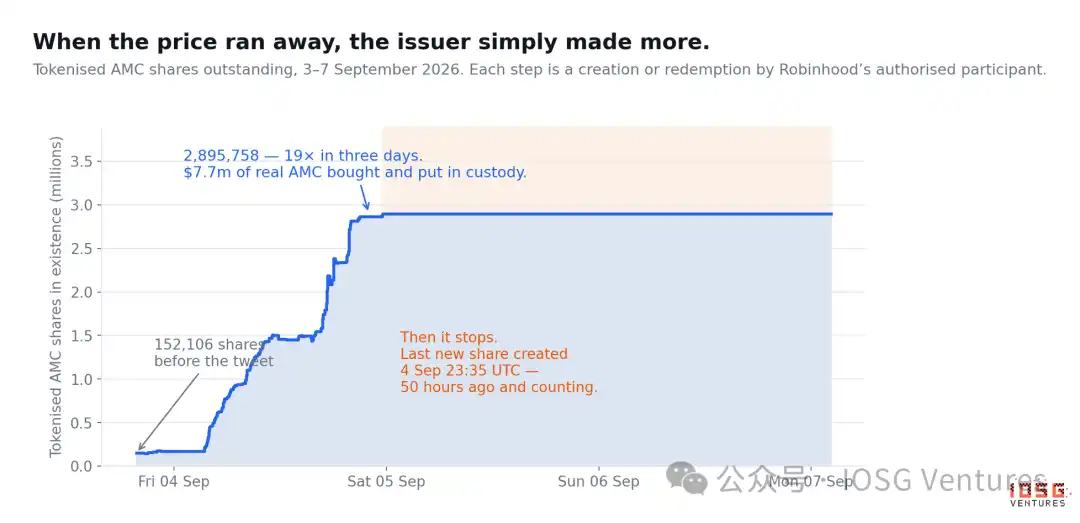
When tokenized AMC ran up to seven times the share price, Robinhood's issuance agent didn't shut the door. It went out, bought real AMC shares, placed them in custody, and minted tokens against them accordingly. In three days, it created 3.05 million shares, redeemed and burned 310,000, and the tokenized float went from 152,106 shares to 2,895,758. Seventy-two hours, nineteen-fold.
Hims is the same story, just slower. When $BONER launched on August 20, Robinhood Chain's tokenized Hims had only 468 shares. Now it's 130,876, a 280x expansion, backed by roughly $3.6 million in real Hims & Hers shares bought and held in custody. We tested this once on September 3: over four days, $BONER's share of the tokenized supply dropped from 81% to 47%, while the actual token count it held increased. It didn't dump the bag—the bag got diluted around it.
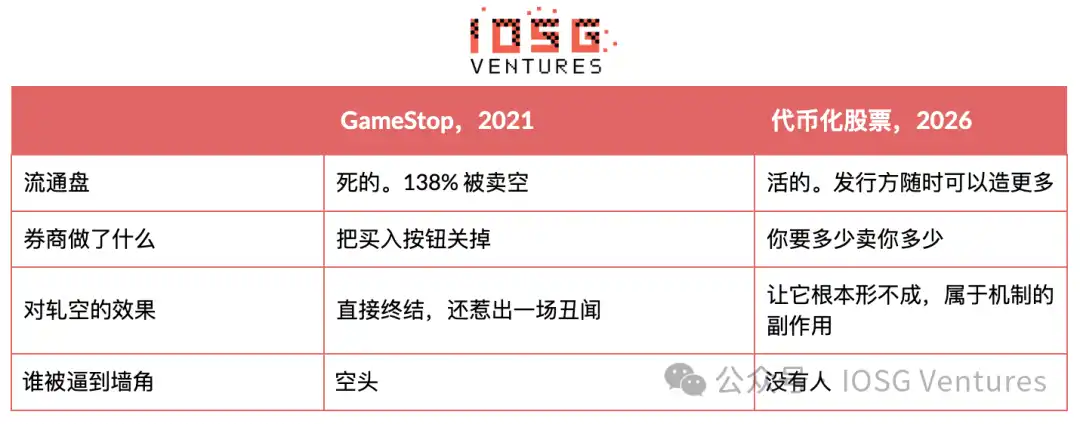
But let's be clear about one thing. The creation-redemption channel wasn't built to prevent short squeezes. Its purpose is to keep the token tethered to the stock—and that's the entire reason to hold a tokenized stock instead of a Meme coin. It's the same machinery every ETF runs on. The inability to corner the market is just a side effect of a mechanism doing its job. And this outcome is far better than the 2021 shutdown, because no one was locked out of selling.
What Meme coin buyers are actually betting on
Walk the chain from the retail side. The first half holds up—skipping past it would be dishonest.
You buy $MEME with dollars. The router swaps dollars into stablecoins, then into tokenized AMC, and finally into the Meme coin. Your money, on its way in, is physically a buy order for tokenized stock. When enough buyers pile in, the token price rises above the real share price, a premium appears, and the AP sees profit: it buys real AMC on the NYSE, hands it to the custodian, receives newly minted tokens, and sells them into the pool at the premium price.
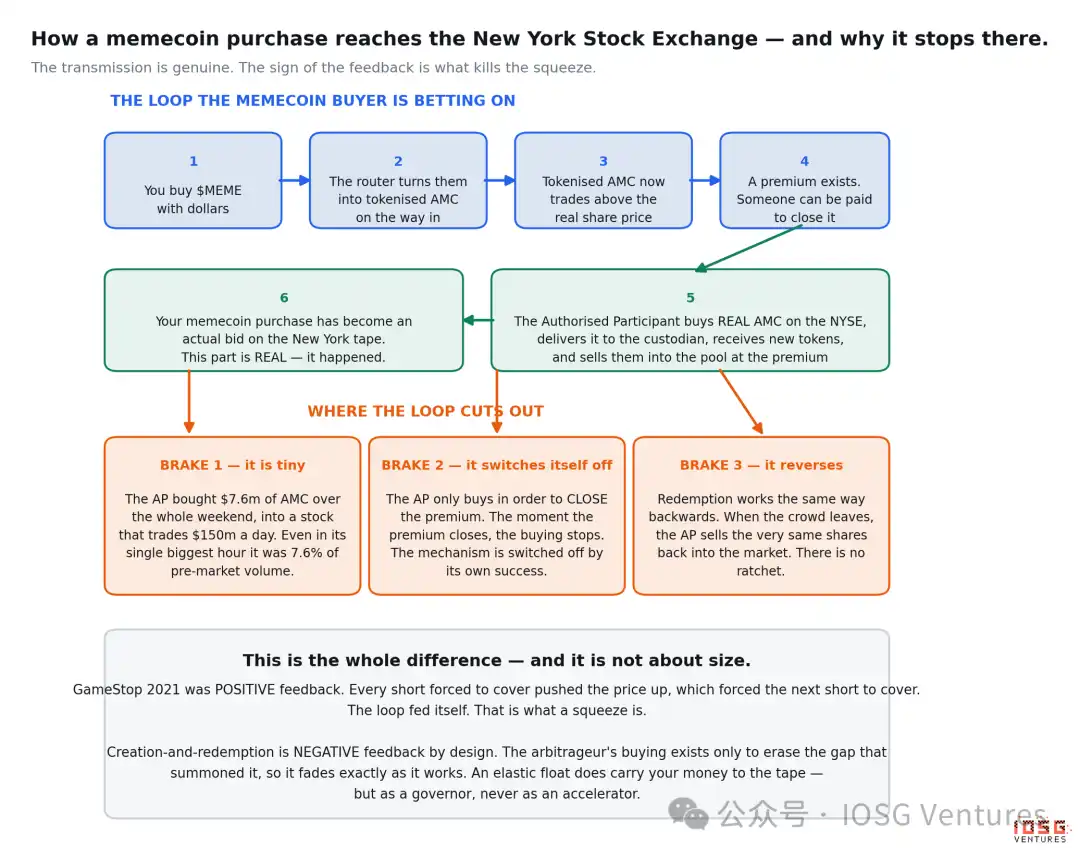
The retail trader's core thesis is correct. The crowd's money does land on the NYSE tape as real buy orders. This isn't speculation—it's $7.6 million of AMC in a single weekend, and 7.6% of pre-market volume during the most intense stretch.
Next, the "flywheel" narrative adds another loop: forced buying pushes the price higher, the price rise validates the narrative, more people pile in to buy the token, and the AP has to buy even more. That's the ideal script—and it breaks in three places.
First, the size is too small. $7.6 million against a stock that trades $150 million a day. In steady state, the AP's footprint is roughly one-tenth of one percent of volume.
The second point is the killer: the mechanism switches itself off. The AP buys for one reason—to eliminate the premium. Once the premium is gone, the reason to buy is gone. It's shut down by its own success.
Third, it's reversible. Redemption is creation in reverse. When the crowd disperses, the AP sells the same shares back into the market.
Put those three together, and the answer to what's actually changed from 2021 to now becomes clear. And it has nothing to do with size.
GameStop was positive feedback: every forced short covering pushed the price a little higher, forcing the next short to cover. The loop fed itself. That's the definition of a short squeeze.
The creation-redemption mechanism is, by design, negative feedback: the arbitrageur's buying exists only to erase the spread that summoned it, so it disappears even as it works. Live float does deliver your money to the tape, but it's a governor, never an accelerator.
Dead float turns buying pressure into a spiral; live float turns the same buying pressure into a one-time decaying impact cost. Both can move the price, but only one keeps pushing.
Put more bluntly—this is the line to remember from the whole piece: a crowd can indeed push the on-chain price up, and fast. What they can't do is hold it there, because the moment the stock market opens, the AP plugs the gap right back. The ceiling isn't set by how big the crowd is—it's set by how many hours until the channel reopens.
The one thing the issuer can't print is time. See Section 7 on that.
Who's at the Table
Don't look at it as a machine. First ask who's at the table and what each seat gets paid—judgment gets much easier that way.
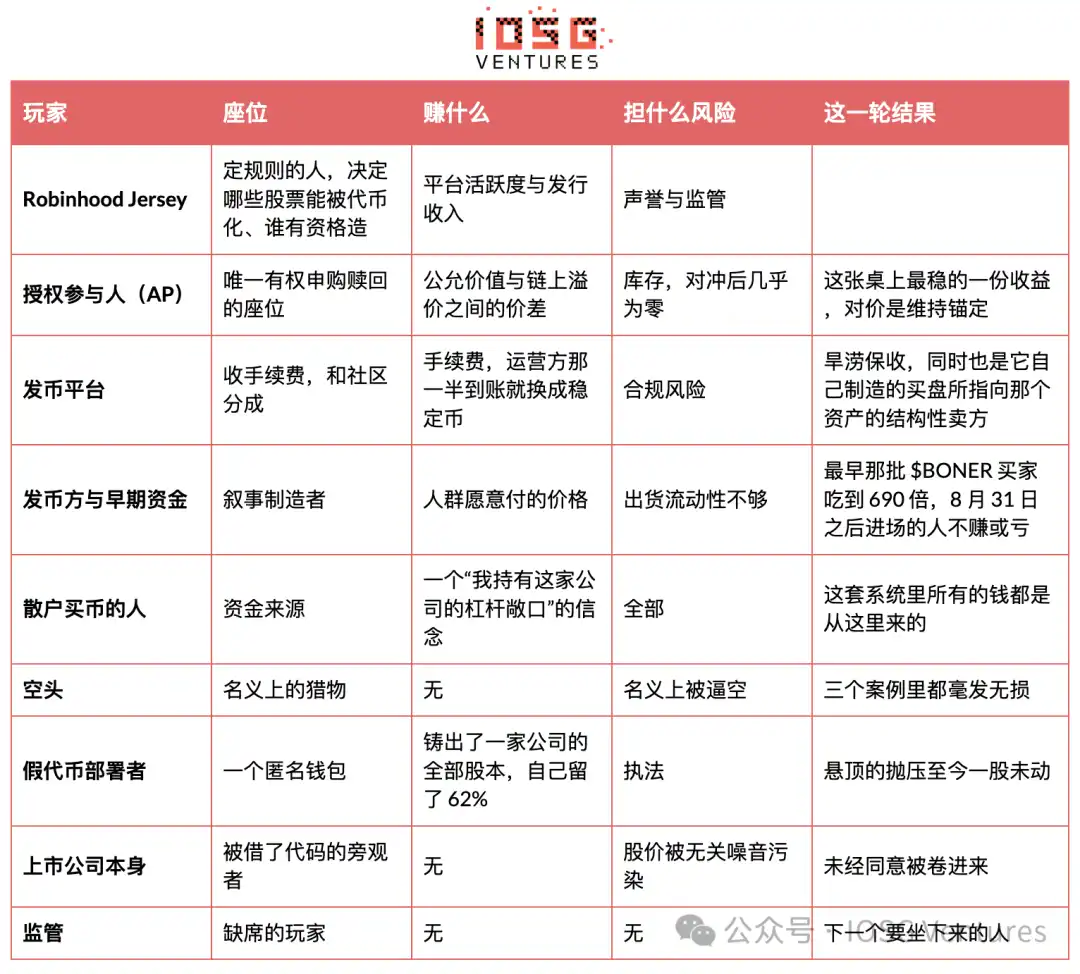
One thing is worth stating directly: the authorized participant is the steadiest earner at this table. It mints tokens at fair value, sells into the premium the crowd creates, then buys back after the crowd disperses. That AMC weekend, it bought and custodied roughly $7.6 million of real stock at a price of its choosing, facing a market willing to pay up to seven times fair value. There's nothing improper here. It's a role with compensation—and that compensation is exactly why someone will do this at 4 a.m. The peg holds because this trade pays. The only thing that matters to us is one question: where does sustainable yield live? It lives here—not on the issuance platform, and not on the token.
The GameStop Analogy, and Where It Breaks Down
It's not "is this a short squeeze," but rather: can the priced asset be subscribed and redeemed.
Everything else follows from that, because it determines whether the premium is a depeg that will eventually be arbitraged away, or simply the price of a different asset altogether.
The real Robinhood stock token sits behind a Jersey prospectus, has a custodian holding actual shares, each underlying has its own series and ISIN code, and there's a whitelist of intermediaries allowed to subscribe. On the block explorer, its name ends with • Robinhood Token, and the exchange rate field has a value.
The fake one only needs 63 lines of Solidity and roughly $400 in gas. Fixed supply, no issuer, no oracle—the so-called backing is described as "an operational obligation of the issuer," meaning nothing on-chain verifies it, nor could it ever.
Both look identical on the block explorer, are quoted by the same platforms, and display in the same wallets. The entire difference comes down to one field that can be left empty.
So did it actually move the real stock price?
This section needs to be written carefully, because looking only at closing prices makes the skeptic's case look too easy. On a closing-price basis, AMC rose 4.3% that day, which looks like nothing happened. But if you measure from the last pre-event price to the high, including pre-market and after-hours, that's a different story.
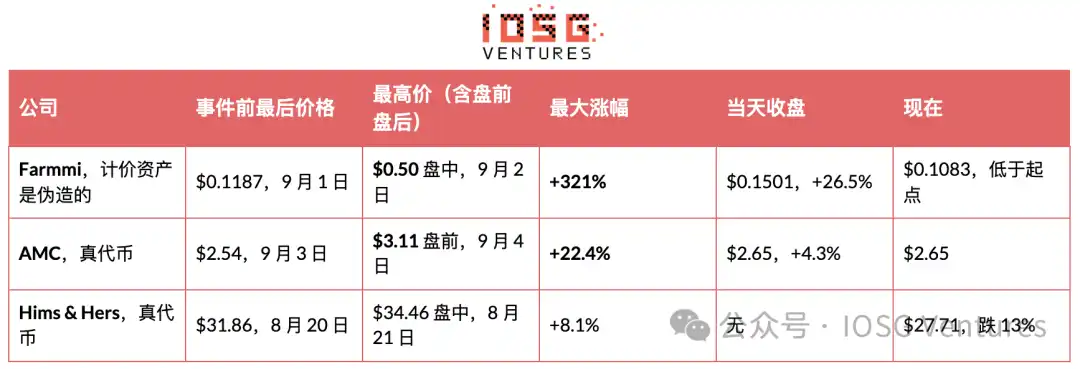
So the honest framing isn't "meme coins failed to move the stock," but rather: they pushed hard, and never once held the move.
The pre-market session on September 4 shows the mechanism most clearly, and it's worth going through minute by minute. Compare on-chain prices to the Nasdaq pre-market order book, not to the prior day's close: when pre-market opened at 4:00 AM ET, the token was at $4.09, while the last real stock price was $2.54—a 61% gap. Fifteen minutes later, the stock had printed $3.11 on 8.35 million shares of pre-market volume, while the token was already drifting lower. Roughly half of that convergence came from the stock moving up toward the token, not the token falling back to the stock. That's exactly the transmission the positive-feedback thesis predicts.
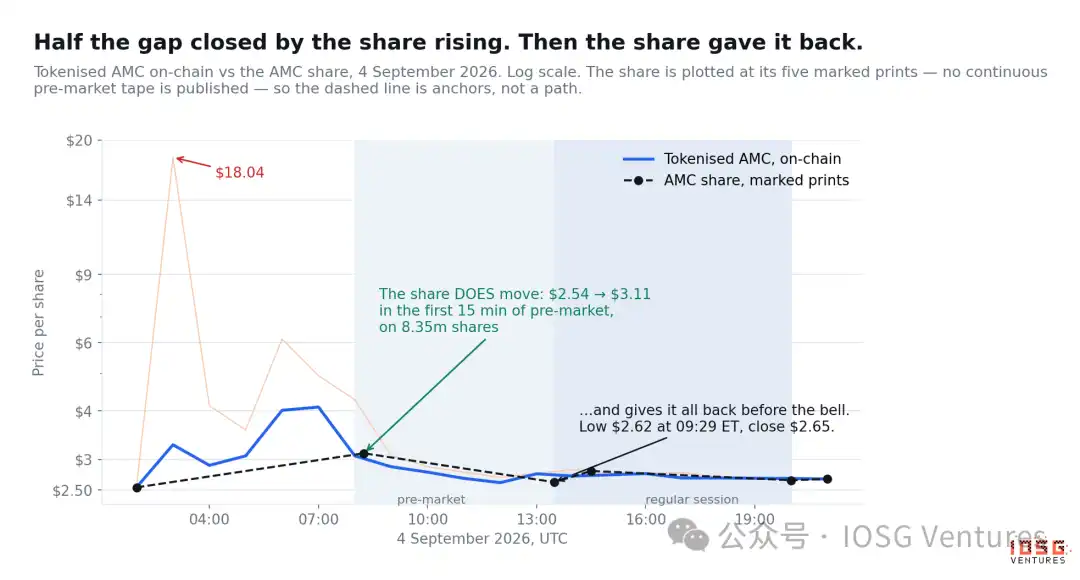
Then it stopped. By 9:29 AM ET, the stock had fallen back to $2.62, and the token was at $2.61. The bid that appeared at 4:15 AM never got a second lap, because the premium it was chasing was already gone. The stock ultimately closed at $2.65.
Placing the three events back in their own historical context: AMC traded 57.2 million shares that Friday, 1.9 times its daily average, ranking only fifteenth over the past six months; on July 20, AMC traded 186.8 million shares, with no connection to meme coins whatsoever. Hims' trading volume never left its normal range. Farmmi, however, traded 872.6 million shares on September 2, versus its daily average of just 45,000 shares—roughly a 19,000-fold increase.
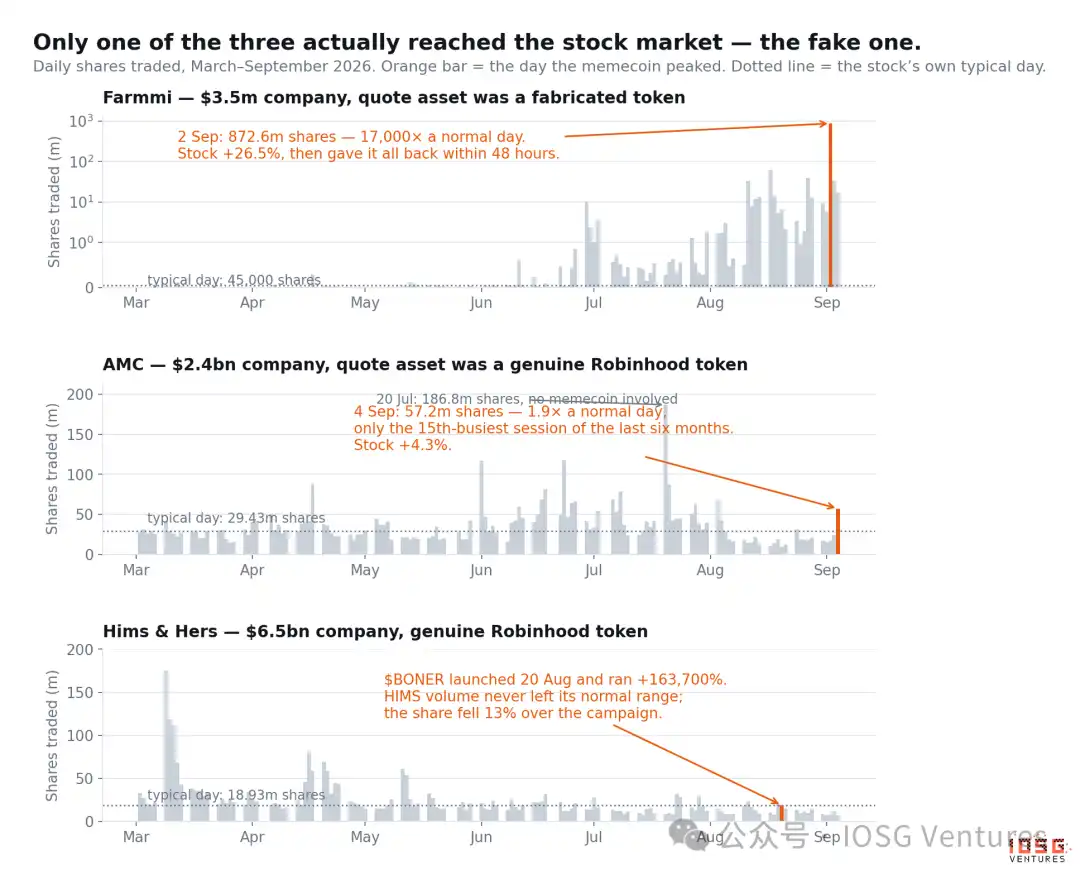
This pattern runs counter to intuition. The on-chain venue's biggest impact on the tape occurred precisely when the company was so small that the on-chain crowd essentially constituted its entire market—and that only happened when the underlying asset was counterfeit, because Robinhood doesn't tokenize companies with market caps below $1 billion. The two real tokens corresponded to companies that were simply too large; a $3.6 million or $7.6 million buy order couldn't hold up the price.
As for the fate of these meme coins themselves, it has nothing to do with any of the above: $CINEMA ignited the AMC fire and is now down 93%. $MEME arrived late, took over the crowd, and is still worth $102 million. $JINQIAN is attached to the only stock that was genuinely moved, and is down 98%. They are attention assets; the company printed on the label is mere decoration.
The real vulnerability is the weekend, and that's exactly where an on-chain short squeeze could occur
The true structural weakness here isn't on the stock side—it's that the subscription channel operates on New York hours while the tokens trade 24/7.
This is visible in real time right now. As of this writing, the most recent supply increase for any Robinhood stock token (AMC, Hims, GameStop, Nvidia, SPY) occurred on Friday, September 4 at 23:35 UTC—50 hours ago. Monday is Labor Day, and the channel won't reopen until Tuesday's pre-market, leaving an 80-hour window: tokens trade as usual, but no one can mint a single new one.
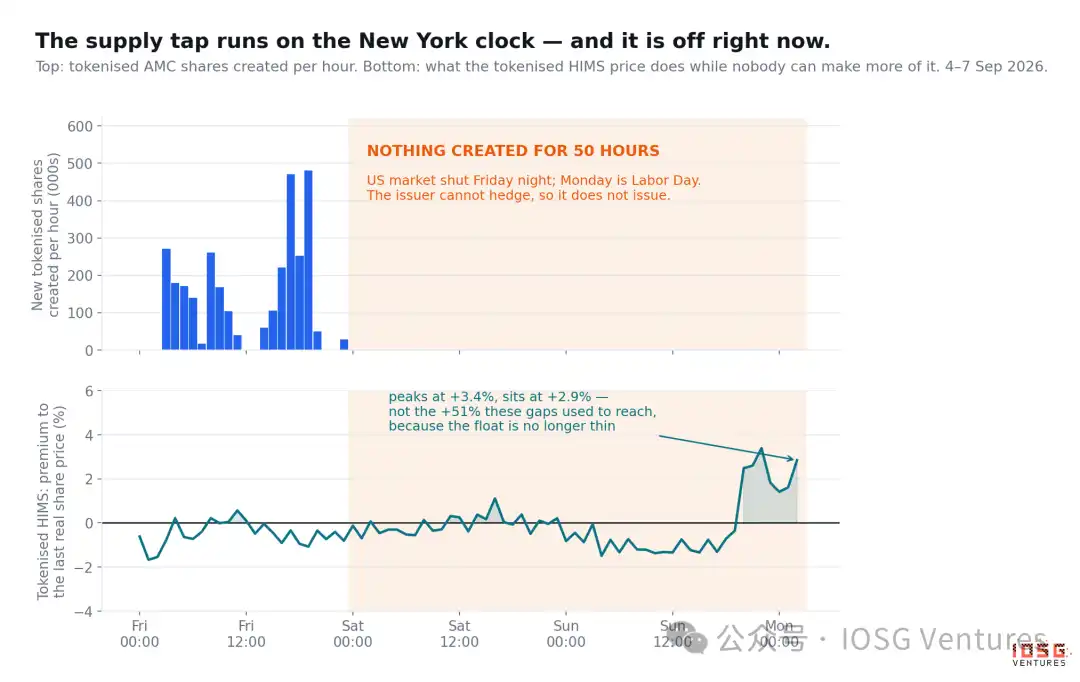
Reading this against Section 3 narrows the earlier conclusion. All prior arguments said a squeeze was impossible because the float was alive. But within this window, the float isn't alive—it's dead. For three full days, the supply of tokenized AMC is as locked as GameStop's share count in 2021, and no amount of money from any arbitrageur can unlock it.
So the honest conclusion is narrower than "nothing can be squeezed here." Listed stocks can't be squeezed through this channel, for reasons laid out in Section 3. But the tokens themselves can be squeezed, and only within the closed-market window. This isn't hypothetical: that's how $18.04 vs. $2.54 happened, and how the tokenized Hims single-hour close of +51% we measured in August happened. Token-level short squeezes are a real, recurring, calendar-driven phenomenon on this chain.
That raises an obvious question: why isn't it happening now.
It isn't, and the reason is critical. All weekend, tokenized Hims oscillated between -2% and +4%, now sitting at +2.9%. Tokenized AMC spent most of the time at a discount, dipping as low as -7%. Combined volume was roughly $40 million, and the peg hasn't loosened.
It's back to that 19x from the start. After the panic, issuers didn't pull supply back, so the float now frozen is a deep one: 2,895,758 shares, not 152,106. A thin float was always the necessary condition; the closed market was just the amplifier. APs used three days of excess supply to defuse the fuse three days ahead. For something unintentional, that's rather elegant.
For holders of these tokens, the practical read is: the risk factor is the calendar, not the company. When you stack a long weekend, a public holiday, and a cold name that hasn't seen much new issuance recently, that's when the on-chain price has the weakest relationship to the real stock price.
Stress test: how big would this need to get to actually work
This isn't a plan; it's a yardstick to measure how far this mechanism is from "being able to work." Two terms first, because the whole argument rests on them.
Short interest is the number of shares borrowed and sold, with the seller betting the price will fall. Those shares must eventually be bought back. That's the fuel.
Days to cover is short interest divided by average daily volume: if shorts were the only buyers in the market, how many normal trading days it would take to buy everything back. That's the fuse. A high number means shorts are trapped—normal volume isn't enough for them to exit without pushing the price up; a low number means they can walk out the front door slowly.
GameStop's shorts sold more shares than exist, so no normal volume could let everyone cover—that's why the price went vertical. These tokenized names have days to cover between 3 and 9. Everyone can get out.
That caps the ceiling: even if all shorts in these names covered simultaneously, the upside would be only 7% to 14%. None of them could double.
Two more metrics to add. The channel's conversion rate: at its peak, $BONER had a market cap of roughly $85 million, which forced out about $3.6 million in real Hims stock purchases held in custody—meaning every $1 of Meme coin market cap corresponded to roughly 4 cents of forced buying. The cost: to push the stock price into a full short squeeze, the channel would need to buy up nearly the entire short position.
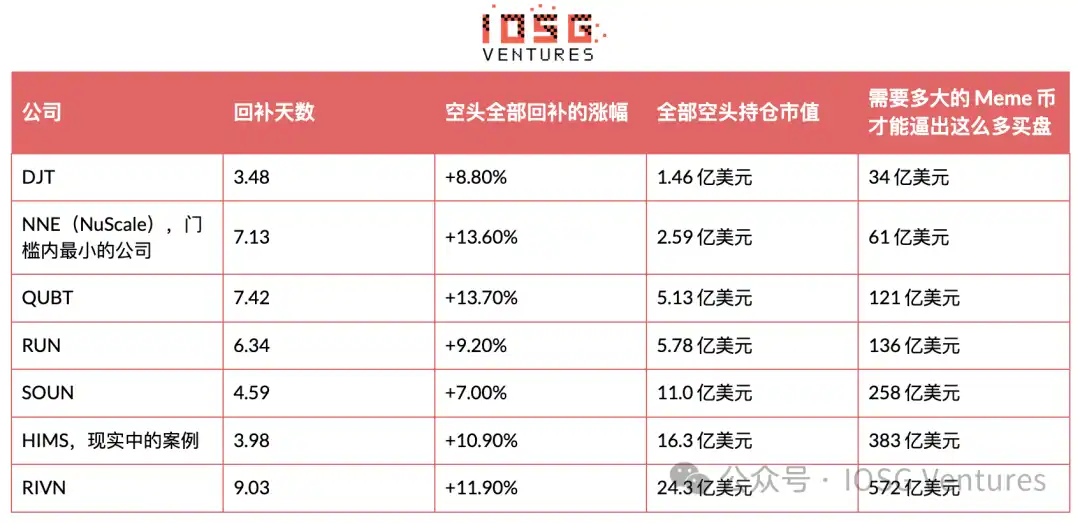
For scale: the largest Meme coin in this chain's history is $AI, at $270 million. The lowest threshold row in the table would require thirteen times that, yielding roughly a 9% gain.
There are no cheap small-caps to pick either. Among companies Robinhood has tokenized, the smallest is NuScale at $951 million—three orders of magnitude above Farmmi. This threshold isn't a coincidence: fake tokens exist because of it, and real tokens are safe because of it.
What Would Change Our Assessment
Robinhood lowers its market cap threshold, or issues series for genuinely small companies. All the safety margin here rests on the fact that not a single shortable target has been tokenized.
A second authorized participant emerges, or the existing one gets faster. Today's premium ceiling is determined by how long the channel stays closed. A 7×24 subscription channel would erase the last real point of de-pegging, while a slower or narrower channel would amplify it.
U.S. equities shift to 24-hour trading, which would directly eliminate the non-trading-hours price gap.
An obscure ticker collides with a long weekend. The vulnerability in Section 7 is currently dormant because supply has increased, not because someone fixed it. A newly listed token or one with minimal recent issuance hitting a public holiday closure would bring back that 2021 characteristic.
Fake pricing assets go from exception to norm. Two clone contracts within a week, both matching cap tables to five significant digits, plus a counterfeit code that has already squeezed into the chain's most active venues. This spread requires no one's approval.
What We Take Away From This
The throat of tokenized stocks is the subscription-redemption channel, not the trading venue. Downstream components—token launchpads, Meme coins, liquidity pools—are all replaceable and will eventually be competed down to zero margin. The seat that cannot be replicated is the one holding the issuance license, custody relationship, and AP whitelist simultaneously. If we want exposure to tokenized stocks, that's where it lives.
The discipline of a premium comes from a primary market that actually works—an old ETF lesson replayed on-chain within a single week. The median premium on tokenized Hims was under 1%, because anyone could mint more at any time. The counterfeit FAMI token had no such backstop, so its premium didn't converge—it blew straight through parity into a 10% discount, and it's still falling. Same curve shape, opposite mechanics, entirely different risk.
Counterfeit priced assets are the next regulatory flashpoint, and the real investor protection issue here. A token that mimics a company's entire equity with nothing behind it, no issuer disclosed, sold to retail side-by-side with the genuine security—that's not an edge case. It's already happened twice and it's spreading. $400 to create one, and indistinguishable from the real thing on any consumer-grade interface.
That also changes what these coins actually are. It's not leveraged exposure to a public company. During trading hours, the underlying explains maybe 1% of the coin's price movement—there's almost no company in it. It's closer to a bet on corporate attention: Will the CEO notice, will the company respond, will this ticker get swept into a story big enough that headquarters has to say something. That bet has paid off before. Aron's post was the starting point of this article's biggest price move, and the CEO of Hims & Hers has followed the $BONER account. Neither was an endorsement—attention still got paid.
The short squeeze is the other leg. It's the one being sold, and it's the one that doesn't hold up. People buying these coins should at least know which one they're actually long.
Finally, the framework worth keeping. A short squeeze isn't "went up a lot"—it's "the rally feeds itself." Tokenization makes the float live, so the spiral that should have formed gets converted into a one-time decaying impact cost—real, measurable, and over by noon. The very feature that makes tokenized stocks good infrastructure is precisely what makes them unsqueezable. A good outcome for Robinhood, an expensive tuition payment for everyone who bought the narrative, and a reminder: watch the issuance layer, not the trading layer built on top of it.
Welcome to join the official BlockBeats community:
Telegram Subscription Group: https://t.me/theblockbeats
Telegram Discussion Group: https://t.me/BlockBeats_App
Official Twitter Account: https://twitter.com/BlockBeatsAsia
